Ryse Health’s 11-slide pitch deck is a masterclass in establishing founder-market fit within the highly regulated healthcare sector. Eschewing the typical 'growth at all costs' narrative, the deck focuses on the massive economic burden of chronic disease ($3.7T annually in the US) and the specific failures of current primary care and virtual-only models. The team, featuring veterans from McKinsey, Evolent Health, and Johns Hopkins, leverages early clinical data—specifically a 2.0 point reduction in A1c for high-risk patients—to validate their hybrid office-based and virtual care model. While…
Key takeaways
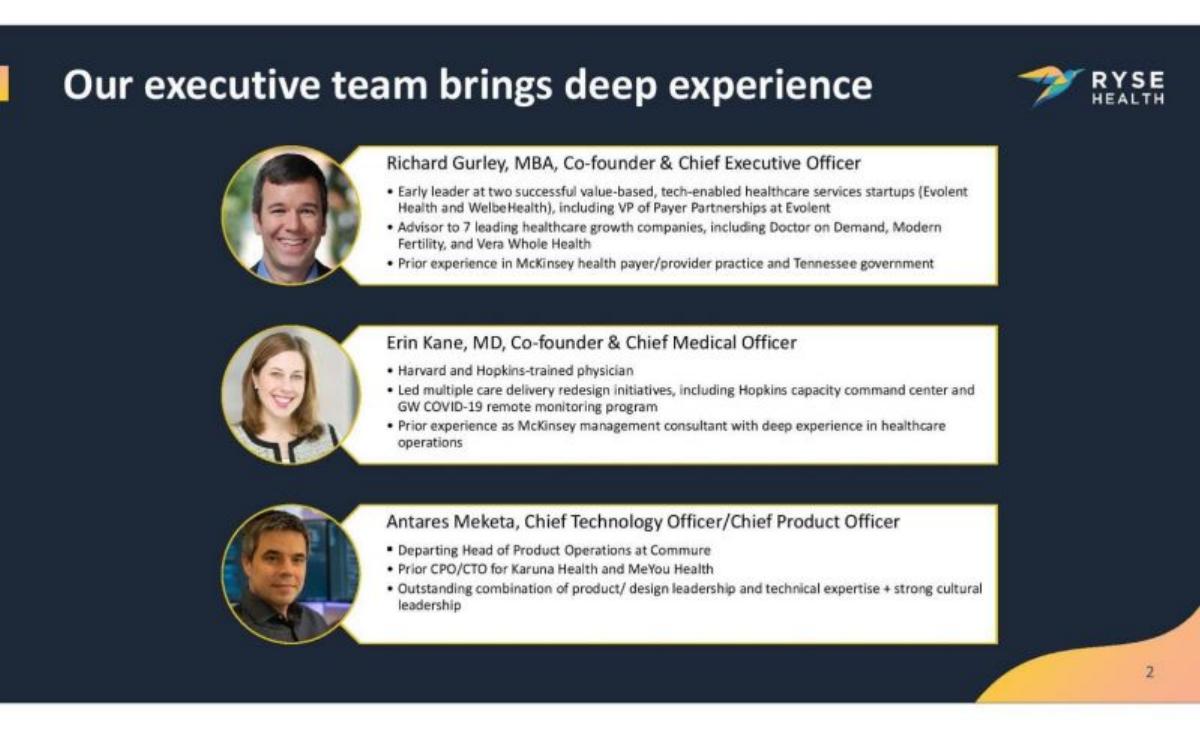
- The executive team features deep institutional pedigree, including experience at McKinsey, Johns Hopkins, and Evolent Health (Slide 2).
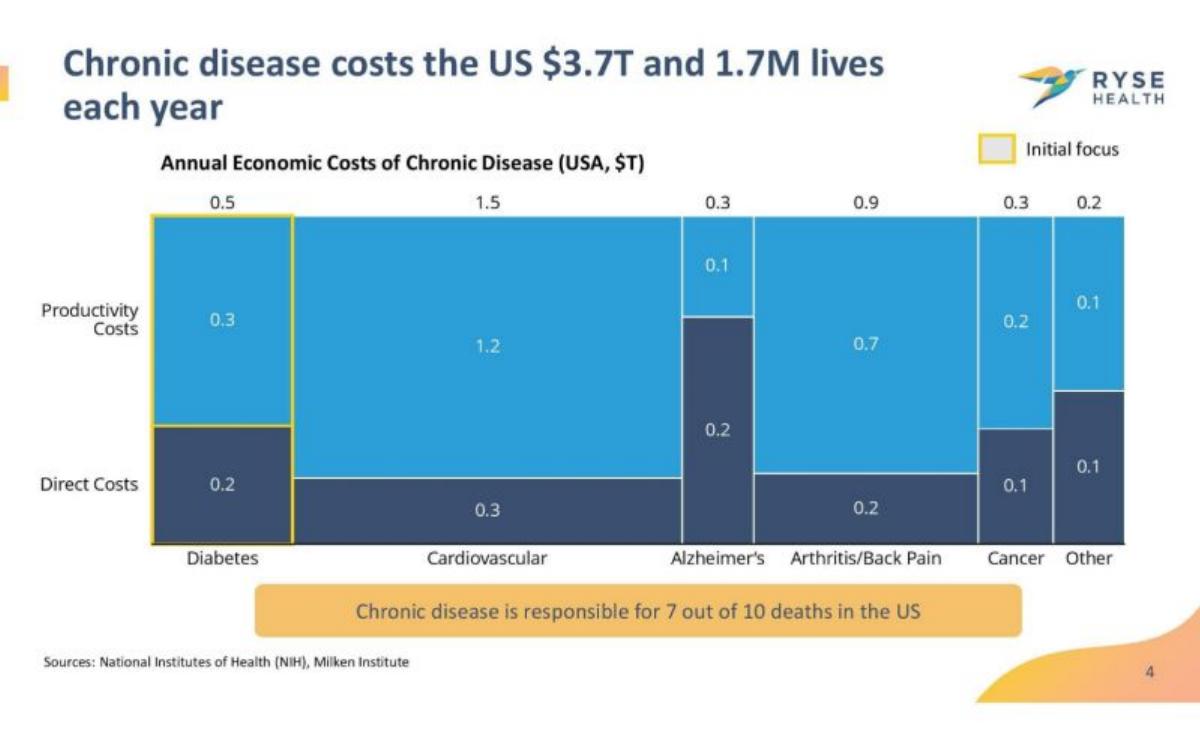
- Chronic disease is framed as a $3.7T annual economic cost in the US, with diabetes identified as the initial focus area (Slide 4).
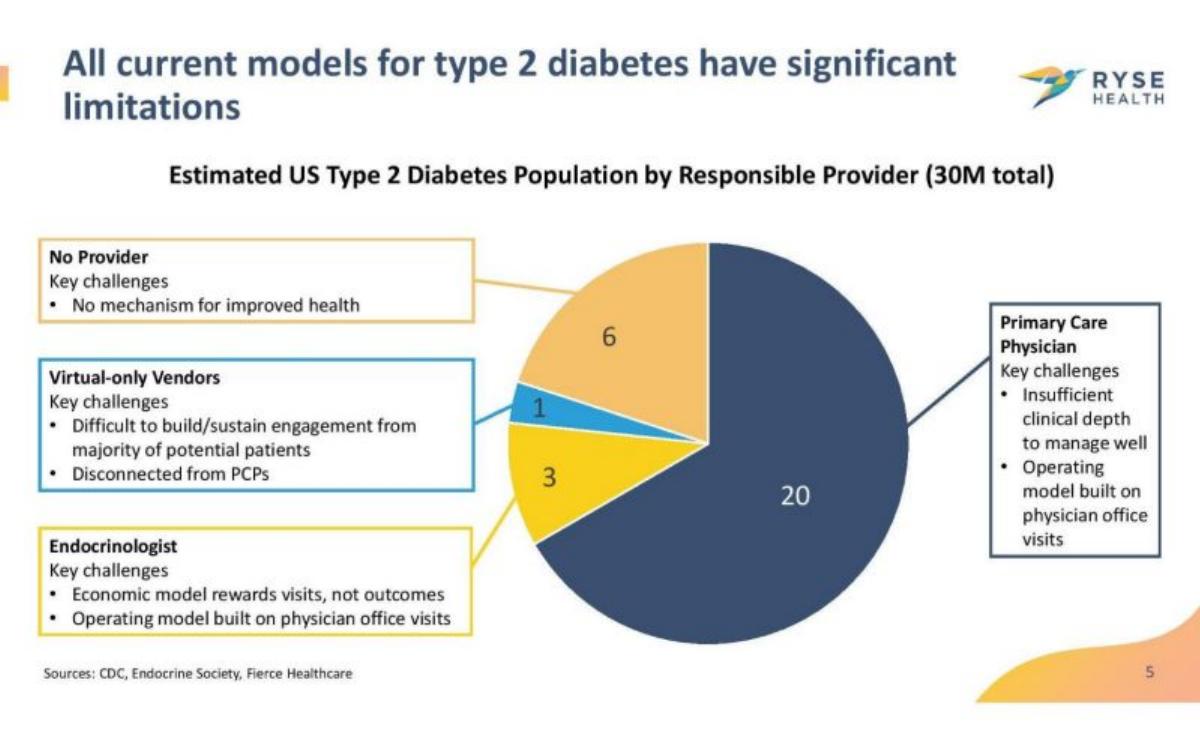
- The company identifies a gap in the market where 20 million Type 2 diabetes patients are managed by primary care physicians who lack clinical depth (Slide 5).
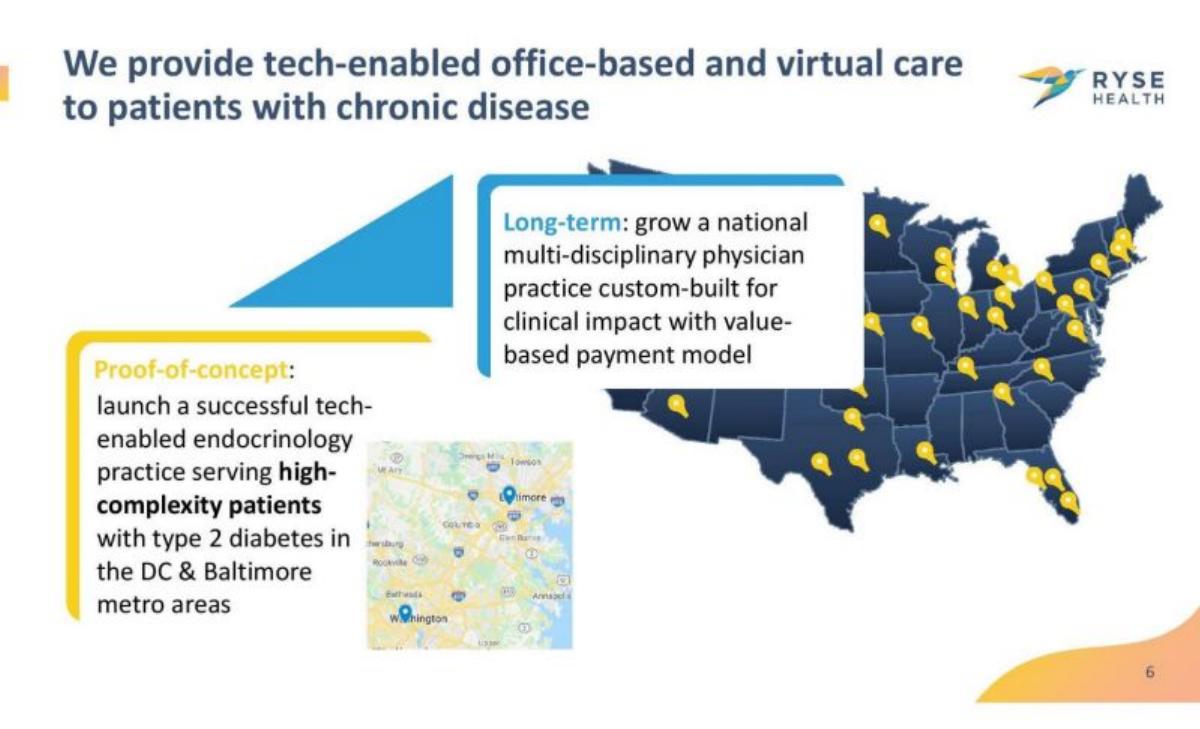
- Ryse utilizes a hybrid 'office-based and virtual care' model rather than being a virtual-only vendor (Slide 6).
- The care team is multidisciplinary, including endocrinologists, health coaches, RDs, CDCESs, and LCSWs (Slide 7).
- Patient onboarding is structured into four distinct phases: Set up, Launch (60 days), Maintenance, and Tune up (Slide 8).
- Early clinical outcomes show a 36% reduction in 'time out of range' and a 2.0 point drop in average A1c for patients starting above 8.0 (Slide 9).
- The business model is built on a value-based payment structure rather than traditional CPT code-based billing (Slide 7).
The Clinical Credibility Playbook
Ryse Health’s Seed deck is a focused, 11-slide presentation that prioritizes clinical authority and market gap analysis over the flashy growth metrics often seen in consumer tech. In the healthcare space, particularly in chronic disease management, the 'who' is often as important as the 'what.' Ryse leans heavily into this, leading with a team slide that establishes immediate trust with institutional investors. The deck follows a classic problem-solution-traction narrative but adapts it for the complex world of value-based care.
Slide 1: Title and Branding
The cover slide is minimalist, featuring the Ryse Health logo—a stylized, multi-colored bird—and the date, April 2022. The subtitle 'Company overview' suggests this version of the deck was intended as a high-level introduction for initial partner or investor conversations. The imagery of a smiling patient reinforces the human-centric nature of the business.
Slide 2: The Executive Team
Ryse places its team slide second, a strategic move for a healthcare startup. In a field where regulatory knowledge and clinical expertise are barriers to entry, showing a 'deeply experienced' team is essential. Richard Gurley (CEO) is highlighted for his role at Evolent Health and McKinsey. Dr. Erin Kane (CMO) brings Harvard and Hopkins credentials, while Antares Meketa (CTO/CPO) provides the necessary tech pedigree from Commure and Karuna Health. This slide effectively signals that the founders understand both the 'care' and the 'business' of healthcare.
Slide 3: The Vision
Slide 3 is a transition slide. It states: 'Our vision is a world free of the burden of chronic disease.' It is a broad, aspirational statement that sets the stage for the specific problem analysis that follows. The use of lifestyle photography (people running) emphasizes the goal of wellness over mere treatment.
Slide 4: Market Opportunity and Economic Burden
This slide quantifies the problem. It cites a $3.7T annual cost for chronic disease in the US and 1.7M lives lost. A treemap breaks down these costs by disease type, with Cardiovascular ($1.5T) and Diabetes ($0.5T) leading. Ryse explicitly boxes 'Diabetes' as their 'Initial focus,' showing investors they have a massive TAM (Total Addressable Market) but a disciplined, staged entry point. The note that chronic disease is responsible for 7 out of 10 US deaths adds a sense of urgency.
Slide 5: Competitive Gap Analysis
Slide 5 is perhaps the most critical for positioning. It uses a pie chart to segment the 30M Type 2 diabetes patients in the US by their 'Responsible Provider.' It identifies that 20M patients are managed by PCPs who have 'insufficient clinical depth.' It also dismisses 'Virtual-only Vendors' (1M patients) as being 'disconnected from PCPs' and 'Endocrinologists' (3M patients) as being trapped in an economic model that 'rewards visits, not outcomes.' This creates a 'Goldilocks' zone for Ryse: more clinical than a virtual app, but more modern and outcome-focused than a traditional specialist.
Slide 6: The Hybrid Care Model
Ryse defines its solution as 'tech-enabled office-based and virtual care.' This hybrid approach is a direct response to the limitations cited on the previous slide. The slide outlines a two-step roadmap: a proof-of-concept in the DC & Baltimore metro areas , followed by a long-term national expansion. The mention of a 'value-based payment model' is a key signal to healthcare investors that Ryse is aiming for high-margin, outcome-linked contracts rather than low-reimbursement fee-for-service billing.
Slide 7: The Multidisciplinary Care Team
This slide details the 'how.' Ryse differentiates itself from a 'Typical specialist practice' (the dark blue slice) by adding 'Ryse enhancements' (the light blue slices). These enhancements include Health Coaches , Registered Dieticians (RDs) , Certified Diabetes Care & Education Specialists (CDCESs) , and Licensed Clinical Social Workers (LCSWs) . At the base of this human stack is a 'Technology platform' including Continuous Glucose Monitoring (CGM) and a custom app. This slide successfully argues that Ryse is a comprehensive platform, not just a clinic.
Slide 8: The Patient Journey
Slide 8 visualizes the user experience. It breaks the treatment into four phases: Set up (2-hour initial visit), Launch (60-day intensive virtual contact), Maintenance (quarterly reviews), and Tune up (as needed). This structured approach suggests a scalable operational playbook. The inclusion of mobile app mockups showing glucose profiles and meal tracking provides a glimpse into the product's UI/UX.
Slide 9: Clinical Outcomes and Traction
For a Seed stage company, Slide 9 provides impressive 'outstanding patient outcomes.' It shows a 36% reduction in time out of range and a 2.0 point reduction in A1c for high-risk patients. These are the metrics that matter to payers (insurance companies). The slide also includes a 4.96/5 star patient satisfaction rating and qualitative testimonials, proving that patients actually enjoy a service that is traditionally viewed as a chore.
Slide 10 & 11: Closing and Appendix
The deck concludes with a 'Thank You' slide featuring diverse patients, reinforcing the mission. Slide 11 is a placeholder for the source of the deck (bestpitchdeck.com). Notably, the deck ends without a 'The Ask' slide, which is common in 'sanitized' or 'overview' versions of decks shared publicly. However, in a live pitch, the absence of a clear funding requirement and use-of-funds breakdown would be a significant omission.
What Ryse Health Does Well
The deck excels at Problem Framing . By breaking down the $3.7T cost and then immediately showing why current providers (PCPs, specialists, and virtual apps) are failing, Ryse makes their hybrid, value-based model feel like an inevitability. They also do an excellent job of Establishing Authority . The combination of the founders' McKinsey/Hopkins backgrounds with hard clinical data (the 2.0 A1c drop) makes the business feel 'de-risked' compared to a typical tech-first startup entering healthcare.
What is Missing from the Deck
While the deck is strong on clinical vision, it is light on Unit Economics . There is no mention of the Customer Acquisition Cost (CAC) for patients, the cost to serve (given the heavy multidisciplinary staffing), or the specific structure of their value-based contracts. Furthermore, the Competitive Landscape is only addressed categorically (e.g., 'Virtual-only vendors'). Investors would likely want to see how Ryse specifically stacks up against incumbents like Livongo or Omada Health, especially regarding their 'office-based' overhead costs. Finally, the Financial Ask is missing; we know from external data they raised $34M, but the deck doesn't specify how that capital will be allocated between tech development, clinic leases, and clinical staffing.
What Founders Should Copy
Founders in complex, regulated industries should emulate Ryse’s 'Gap Analysis' (Slide 5) . Instead of a standard 2x2 matrix, Ryse uses a population-based pie chart to show exactly where the current healthcare system is leaving patients behind. This makes the market opportunity feel tangible and underserved. Additionally, the 'Enhancement' visualization (Slide 7) is a clever way to show how a startup adds value to a traditional service model without having to reinvent the entire wheel. By showing the 'Typical specialist practice' as a subset of their own model, they position themselves as an evolution rather than a risky, unproven radicalization.
Frequently asked questions
- What is Ryse Health's primary business model?
- Based on Slide 6 and Slide 7, Ryse Health operates a tech-enabled endocrinology practice. Unlike traditional fee-for-service models that reward the volume of visits (CPT codes), Ryse utilizes a value-based payment model. This aligns their revenue with clinical impact and patient outcomes, focusing on long-term management of high-complexity Type 2 diabetes patients through a mix of in-person and virtual care.
- How does Ryse Health differentiate itself from virtual-only diabetes startups?
- Slide 5 explicitly critiques virtual-only vendors, noting they struggle to sustain engagement and remain disconnected from a patient's primary care physician (PCP). Ryse differentiates itself by maintaining physical office-based care alongside its virtual platform and by employing a 'deeply experienced' clinical team of prescribers (endocrinologists, NPs, and PAs) rather than just coaches.
- What clinical evidence does the deck provide?
- Slide 9 presents early proof-of-concept data. For patients with an initial A1c greater than 8, Ryse saw an average reduction of 2.0 points post-launch. Additionally, they reported a 36% improvement in glycemic control (time out of range) and a high patient satisfaction score of 4.96/5 stars based on 31 published reviews.
- What is the geographic strategy for the company?
- According to Slide 6, Ryse Health began with a proof-of-concept launch in the Washington DC and Baltimore metro areas. Their long-term strategy is to scale this into a national multi-disciplinary physician practice. The slide includes a US map with approximately 25 pins indicating target expansion markets across the East Coast, Midwest, and South.
- Who are the key members of the leadership team?
- The team (Slide 2) is led by CEO Richard Gurley (formerly of Evolent Health and McKinsey), CMO Dr. Erin Kane (Harvard/Hopkins trained physician and former McKinsey consultant), and CTO/CPO Antares Meketa (formerly Head of Product Operations at Commure and CPO/CTO at Karuna Health).