SafeGuard Privacy raised $7M in 2024 for its SaaS privacy compliance platform. The deck succeeds by quantifying the 'pain' of compliance through massive fine figures—citing €1.6B for GDPR and $888M for Amazon—and contrasting it with a streamlined, automated solution. The narrative focuses heavily on the 'Vendor Compliance Hub,' a strategic move that expands their Total Addressable Market (TAM) beyond internal audits to the management of thousands of third-party relationships. While the deck is light on specific unit economics or a detailed breakdown of the $7M ask, it relies on the deep domai…
Key takeaways
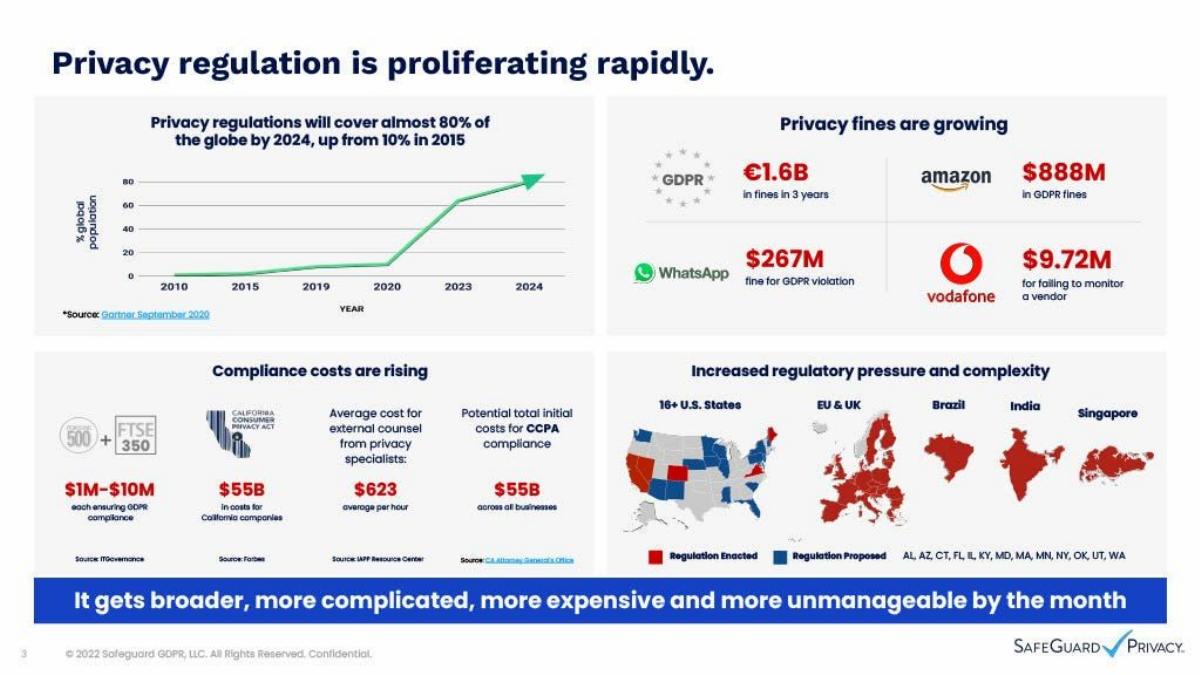
- The deck uses massive regulatory fines, such as Amazon's $888M GDPR penalty, to establish immediate urgency on slide 3.
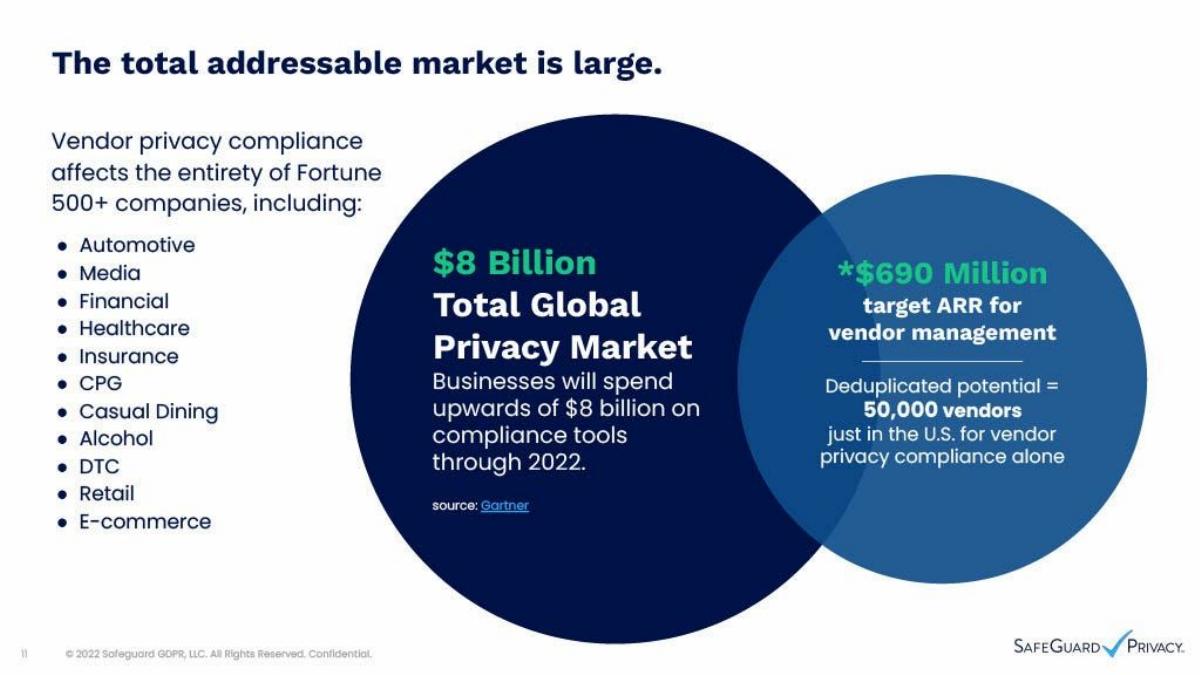
- SafeGuard Privacy identifies a specific target ARR of $690M for vendor management alone, citing a potential of 50,000 vendors in the U.S. on slide 11.
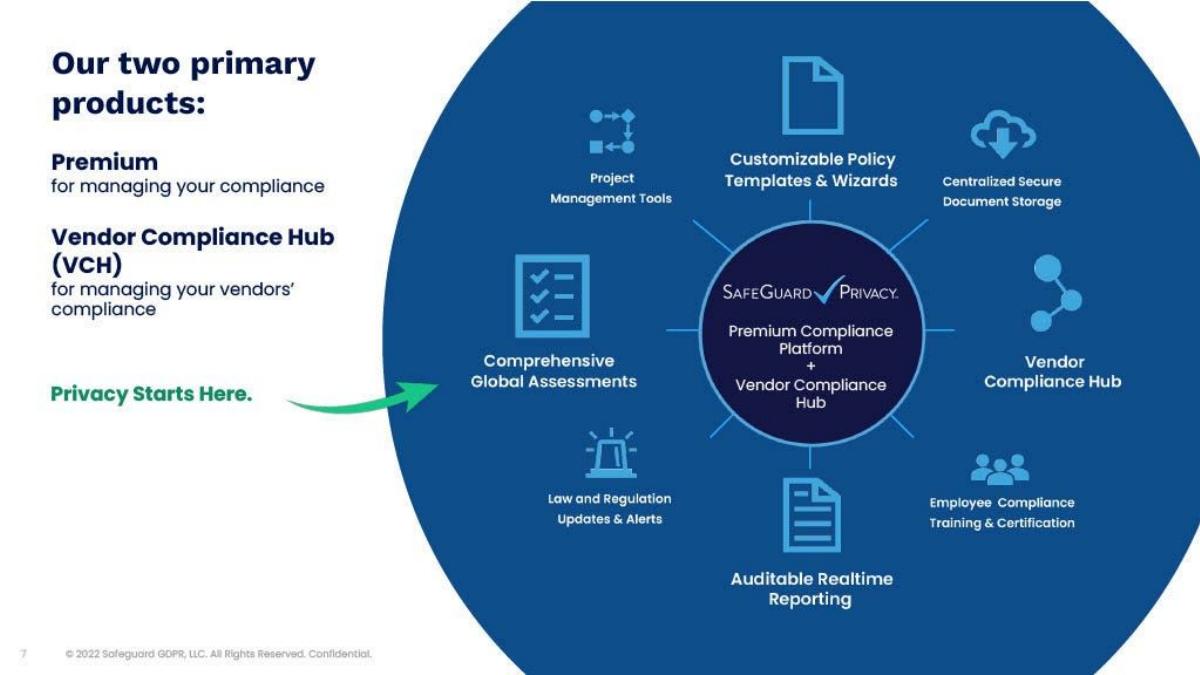
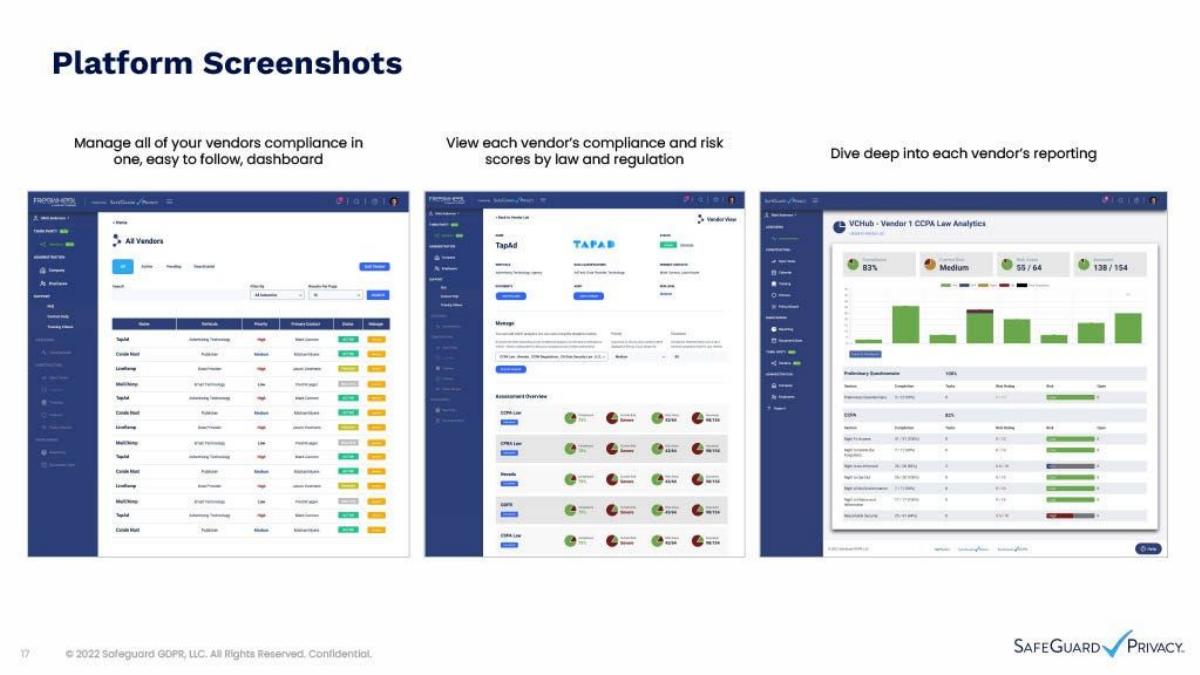
- The product architecture is split into two primary offerings: 'Premium' for internal compliance and the 'Vendor Compliance Hub' (VCH) for third-party risk on slide 7.
- Founder pedigree is a central pillar, highlighting Co-Founder Wayne Matus's background as Managing Director at UBS AG and a first-tier legal specialist on slide 14.
- The deck utilizes a 'before and after' timeline visual (slides 20 and 22) to demonstrate how they replace manual research with pre-written assessments.
- Market expansion is clearly mapped out in a two-phase roadmap, moving from privacy into InfoSec and HIPAA, targeting a $1Bn+ TAM on slide 18.
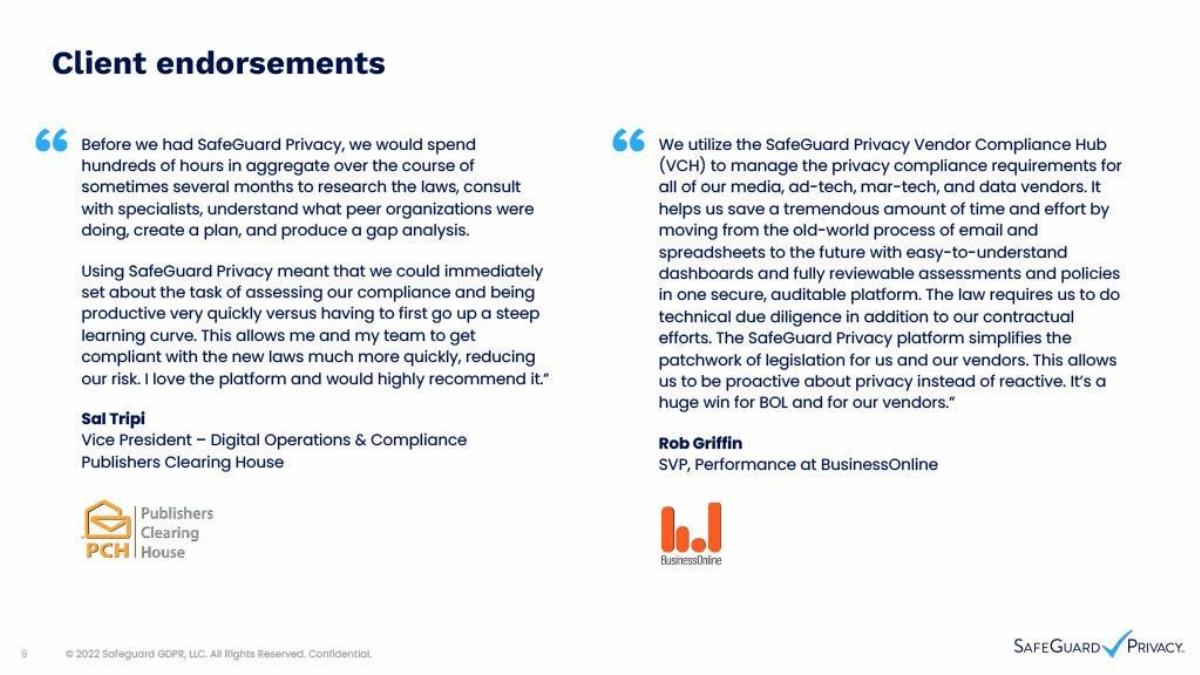
- Client endorsements from Publishers Clearing House and BusinessOnline provide social proof for the platform's ability to save 'hundreds of hours' on slide 9.
- The deck omits a specific 'Ask' slide detailing the $7M round terms or a breakdown of how the capital will be deployed.
SafeGuard Privacy: Turning Regulatory Chaos into a $7M Seed Round
SafeGuard Privacy entered the legal tech market at a time of unprecedented regulatory volatility. With the proliferation of GDPR, CCPA, and various state-level privacy laws, the 'cost of doing nothing' for enterprises skyrocketed. Their pitch deck, which helped secure a $7M Seed round in 2024, is a textbook example of how to sell a 'must-have' utility in a high-stakes environment. By focusing on the logistical nightmare of vendor management, they moved the conversation from a simple checklist to a scalable enterprise infrastructure.
Slide 1-2: The Identity and Positioning
The deck opens with a clean, corporate blue aesthetic. Slide 1 introduces the logo and the core descriptor: 'SaaS Privacy Compliance Platform.' This is a straightforward, no-nonsense opening that immediately categorizes the company for the investor. There are no vague mission statements here; the focus is entirely on the category they intend to lead.
Slide 3: The 'Wall of Pain'
Slide 3 is arguably the most important slide in the deck for establishing urgency. Titled 'Privacy regulation is proliferating rapidly,' it uses a four-quadrant layout to overwhelm the reader with data. It notes that privacy regulations will cover 80% of the globe by 2024 (up from 10% in 2015). More importantly, it lists specific, high-profile fines: €1.6B in GDPR fines over three years, $888M for Amazon, $267M for WhatsApp, and $9.72M for Vodafone specifically for 'failing to monitor a vendor.' This last point is a subtle setup for their Vendor Compliance Hub product. The slide also highlights that compliance costs for California companies alone reach $55B.
Slide 5: The Business Limitations
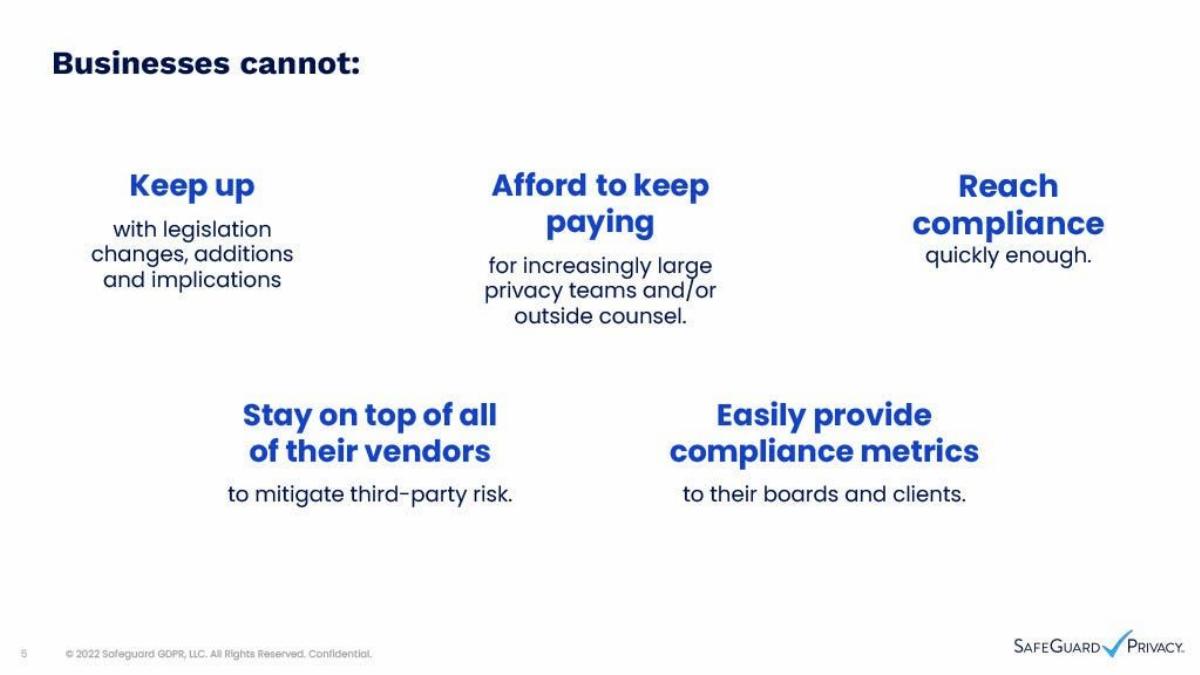
Slide 5 pivots from the macro regulatory environment to the micro business impact. It lists five things businesses 'cannot' do: keep up with legislation, afford increasingly large privacy teams, reach compliance quickly, stay on top of vendors, and provide metrics to boards. This slide effectively bridges the gap between 'there are big fines' and 'your current workflow is broken.'
Slide 7: The Product Architecture
SafeGuard Privacy presents its solution as a dual-pronged platform. The 'Premium' product is for internal compliance management, while the 'Vendor Compliance Hub' (VCH) handles third-party risk. The visual uses a hub-and-spoke model to show how global assessments, policy templates, document storage, and employee training all feed into a central auditable reporting engine. This slide demonstrates that the platform is a comprehensive 'system of record' rather than a point solution.
Slide 9: Social Proof via Client Endorsements
Social proof is critical in legal tech, where trust is the primary currency. Slide 9 features two detailed testimonials. Sal Tripi from Publishers Clearing House emphasizes that the platform allowed his team to bypass a 'steep learning curve' and move immediately to productivity. Rob Griffin from BusinessOnline highlights the shift from 'the old-world process of email and spreadsheets' to a secure, auditable platform. These quotes specifically validate the time-saving claims made earlier in the deck.
Slide 11: The TAM and the Target
Slide 11 breaks down the market opportunity. While it cites an $8 Billion total global privacy market (via Gartner), it smartly narrows its focus to a '$690 Million target ARR for vendor management.' By identifying 50,000 potential vendors in the U.S. alone, they provide a bottom-up justification for their valuation. The slide lists 11 industries, from Automotive to E-commerce, showing the horizontal nature of the privacy problem.
Slide 14: The Pedigree Slide
For a Seed round, the team is often more important than the product. SafeGuard Privacy boasts a heavy-hitting leadership team. Richy Glassberg (CEO) brings the 'startup grit' with 7 previous startups and experience launching CNN.com’s advertising business. Wayne Matus (General Counsel) provides the 'legal authority,' having served as Managing Director at UBS AG and a first-tier specialist in the Legal 500. This combination of tech-scaling experience and deep-domain legal expertise is a significant de-risking factor for investors.
Slide 18: The Multi-Billion Dollar Roadmap
Slide 18 shows the company's ambition beyond privacy. Phase 1 is privacy vendor compliance ($690M+ TAM). Phase 2 is the 'land and expand' strategy, moving into InfoSec ($1.5B+ TAM), HR Regulations ($1.2B+ TAM), and HIPAA ($450M+ TAM). This roadmap suggests that SafeGuard Privacy isn't just a privacy tool, but a foundational platform for all corporate regulatory compliance.
Slide 20 & 22: The Workflow Transformation
The deck concludes (in the provided sequence) with a 'before and after' comparison. Slide 20 illustrates the 'problem'—a fragmented, manual timeline of researching laws and managing tasks through spreadsheets. Slide 22 shows how SafeGuard Privacy 'fixed it' by overlaying their automated tools (pre-written assessments, policy wizards, real-time reporting) over that same timeline. It’s a visual representation of the 'hundreds of hours' saved, mentioned in the testimonials.
What SafeGuard Privacy Does Well
The deck is exceptionally strong at establishing regulatory fear . By leading with billion-dollar fines and the rapid expansion of global laws, they make the problem feel unavoidable. They also do a great job of niche targeting . While 'privacy' is a broad category, their emphasis on the 'Vendor Compliance Hub' identifies a specific, painful friction point—managing third parties—that is often more difficult than managing internal processes.
The team slide is another highlight. In the legal tech space, having a General Counsel from a major global bank (UBS) on the founding team provides instant credibility that a standard engineering-heavy team might lack. Finally, the market sizing is grounded. Instead of just claiming a multi-billion dollar TAM, they break it down by the number of vendors and specific target ARR, which feels more achievable and calculated.
What is Missing from the Deck
Despite the successful raise, the deck has several notable omissions. First, there is no mention of unit economics . There is no data on Customer Acquisition Cost (CAC), Lifetime Value (LTV), or even average contract value (ACV). While this is a Seed round, providing some early signal on the efficiency of their sales motion would have strengthened the case.
Second, the competitive landscape is absent . The privacy tech space is crowded with players like OneTrust and BigID. The deck does not explicitly state how SafeGuard Privacy differentiates itself from these incumbents, other than the implication of a more streamlined workflow. Third, the specific 'Ask' is missing . The deck does not state how much they are raising (though we know from reports it was $7M) or how they plan to spend the capital (e.g., 50% engineering, 30% sales, 20% marketing). Investors generally want to see a clear plan for the 'use of proceeds.'
Founder Takeaways: What to Copy
Use the 'Cost of Inaction': If you are in a regulated industry, don't just sell your features; sell the avoidance of the alternative. SafeGuard’s use of specific fine amounts (Slide 3) is a powerful motivator.
Visualize the Workflow Shift: The 'before and after' timeline (Slides 20 and 22) is a brilliant way to show exactly where your software removes friction. It turns an abstract 'efficiency' claim into a concrete visual map.
Segment Your TAM: Don't just give a giant, top-down number. Follow SafeGuard’s lead on Slide 11 by breaking the market into specific, targetable segments (like vendor management) and explaining the math behind the ARR potential.
Leverage Social Proof Early: Even at the Seed stage, having a name like Publishers Clearing House (Slide 9) vouch for your product is worth more than ten slides of feature descriptions. If you have early pilots, get their specific time-saving metrics into the deck.
Frequently asked questions
- What is the primary problem SafeGuard Privacy solves?
- According to slide 20, the company solves the 'time consuming, inefficient and expensive' nature of manual privacy compliance. They specifically target the endless cycle of researching new laws, manually identifying gaps, and managing hundreds of vendors through spreadsheets and email, which must be restarted every time a new regulation is enacted.
- How does the company define its market opportunity?
- On slide 11, the company cites Gartner data stating businesses will spend upwards of $8 billion on compliance tools through 2022. They narrow this down to a $690 million target ARR specifically for vendor management, based on a deduplicated potential of 50,000 vendors in the United States.
- What are the core features of the SafeGuard Privacy platform?
- Slide 7 outlines the platform's features, which include comprehensive global assessments, project management tools, customizable policy templates, centralized secure document storage, a Vendor Compliance Hub, employee training/certification, and auditable real-time reporting.
- Who are the key members of the leadership team?
- As shown on slide 14, the team is led by Co-Founder & CEO Richy Glassberg (7 startups, former CEO of Medialets) and Co-Founder Wayne Matus (General Counsel & EVP, formerly of UBS AG and Pillsbury Winthrop Shaw Pittman). They are supported by Rachel Walkden (COO) and Daniel Cox (VP, Engineering).
- What is the company's long-term growth strategy?
- Slide 18 details a two-phase roadmap. Phase 1 focuses on privacy vendor compliance ($690M+ TAM). Phase 2 involves automating all vendor compliance tasks across InfoSec ($1.5B+ TAM), HR Regulations ($1.2B+ TAM), and HIPAA ($450M+ TAM), aiming for a total addressable market exceeding $1 billion.