Dalan Animal Health’s 16-slide deck is a masterclass in establishing a 'must-solve' problem by linking a niche biological issue (American Foulbrood in bees) to a massive economic pillar (the California almond industry). By highlighting that growers spend $500M annually on hive leasing and face a 40% annual hive loss rate in the U.S., the company positions its oral vaccine not just as a biotech innovation, but as a supply chain necessity. The deck successfully transitions from a specific proof-of-concept—showing a 60% reduction in larval mortality—to a multi-billion dollar global roadmap. Whil…
Key takeaways
- The deck anchors its value proposition in the $5B California almond industry, where 2.4M hives are required annually for maximum yield (Slide 3).
- Annual leasing costs for hives have reached $500M, representing a 50% increase since 2012, creating a clear financial incentive for better bee health (Slide 3).
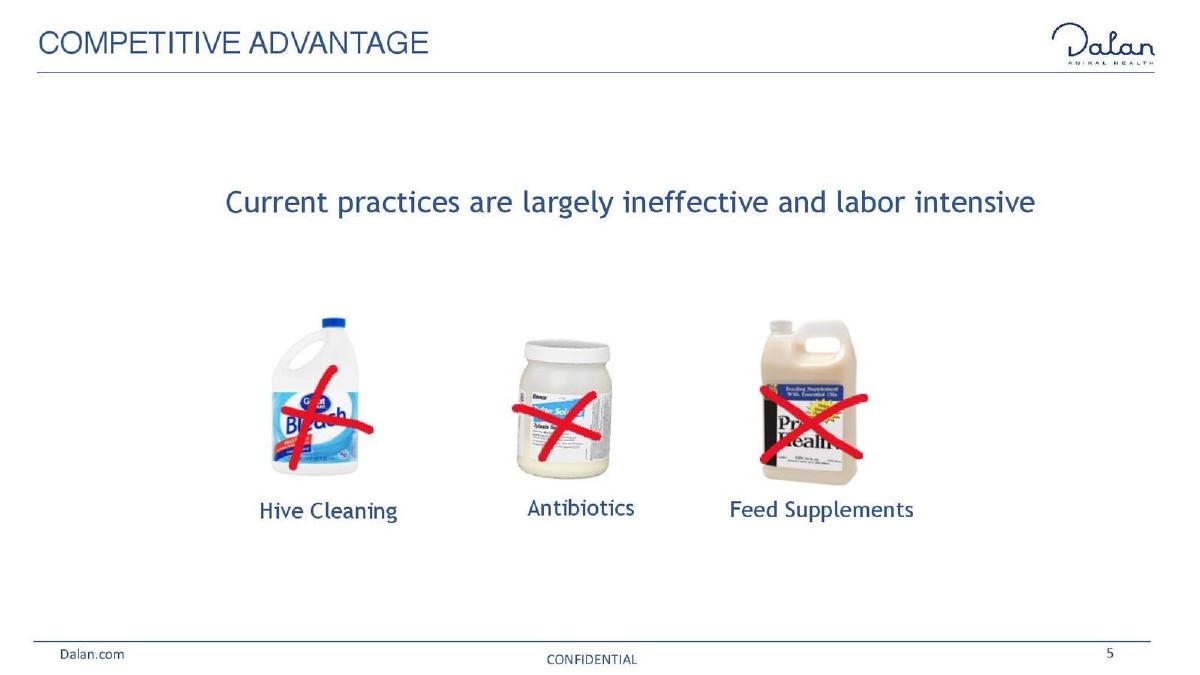
- Current industry practices like hive cleaning, antibiotics, and feed supplements are dismissed as 'largely ineffective and labor intensive' (Slide 5).
- Proof-of-concept data shows that the AFB vaccine reduces larval mortality by 60% in challenged models (Slide 7).
- The U.S. entry market is valued at $300M in annual revenue loss, with a broader global 'Rest of World' market estimated at $3B (Slide 11).
- The roadmap outlines a transition from bacterial vaccines (AFB) to viral bee vaccines by 2025 and shrimp vaccines by 2027 (Slide 13).
- The deck lacks a dedicated slide for the internal management team, instead focusing on external advisors and directors (Slide 15).
- The company reports a highly consolidated U.S. market with few large commercial producers, simplifying the initial go-to-market strategy (Slide 11).
Dalan Animal Health: Bridging Biotech and Global Food Security
Dalan Animal Health’s pitch deck is a focused narrative on a specific biological solution for a massive agricultural bottleneck. According to publisher-reported facts from Business Insider, the company raised a $3.5M Seed round in 2024. The deck, dated July 2nd, 2022, serves as the foundational argument for why honeybee health is a venture-scale opportunity. By framing the honeybee not just as an environmental concern but as a critical industrial input for the $5B California almond market, Dalan moves the conversation from 'sustainability' to 'supply chain resilience.'
Slide 1-2: The Identity and Vision
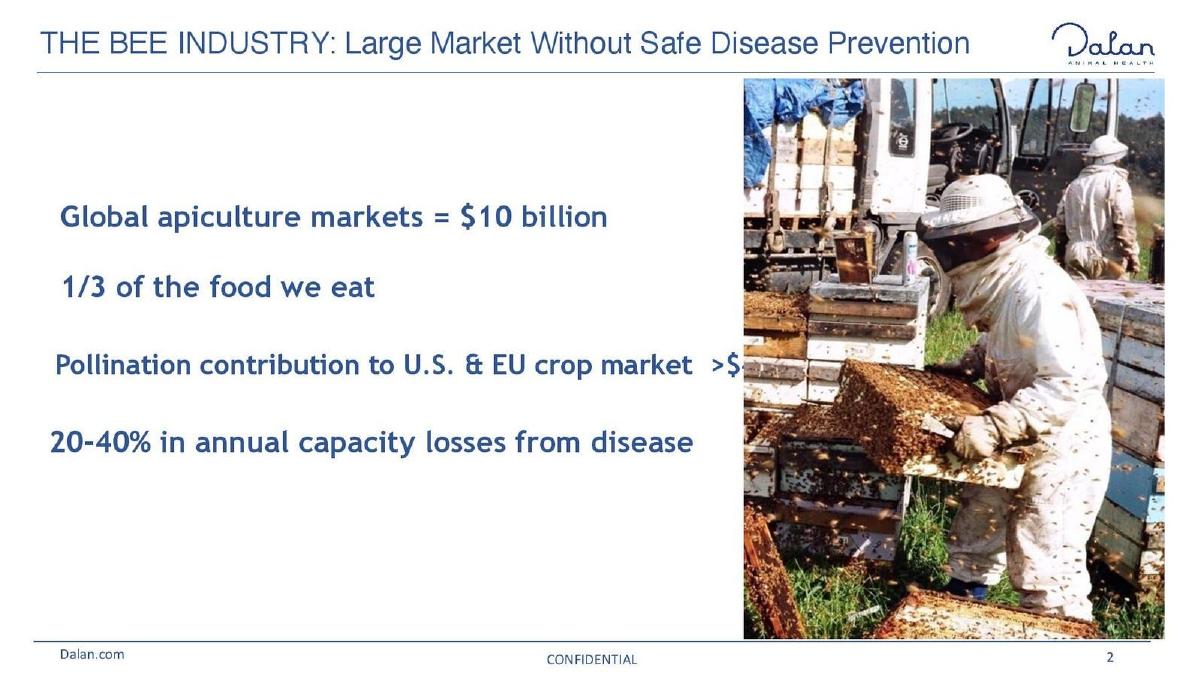
The deck opens with a clean, professional title slide (Slide 1) that immediately identifies Dalan as 'A Biotech Company' with a mission of 'Revolutionizing Agriculture & Animal Health.' The use of high-quality macro photography of bees on flowers and in hives sets a thematic tone that is both scientific and grounded in nature. Slide 2 is a transition or placeholder slide, maintaining the brand's minimalist aesthetic.
Slide 3: The Economic Anchor
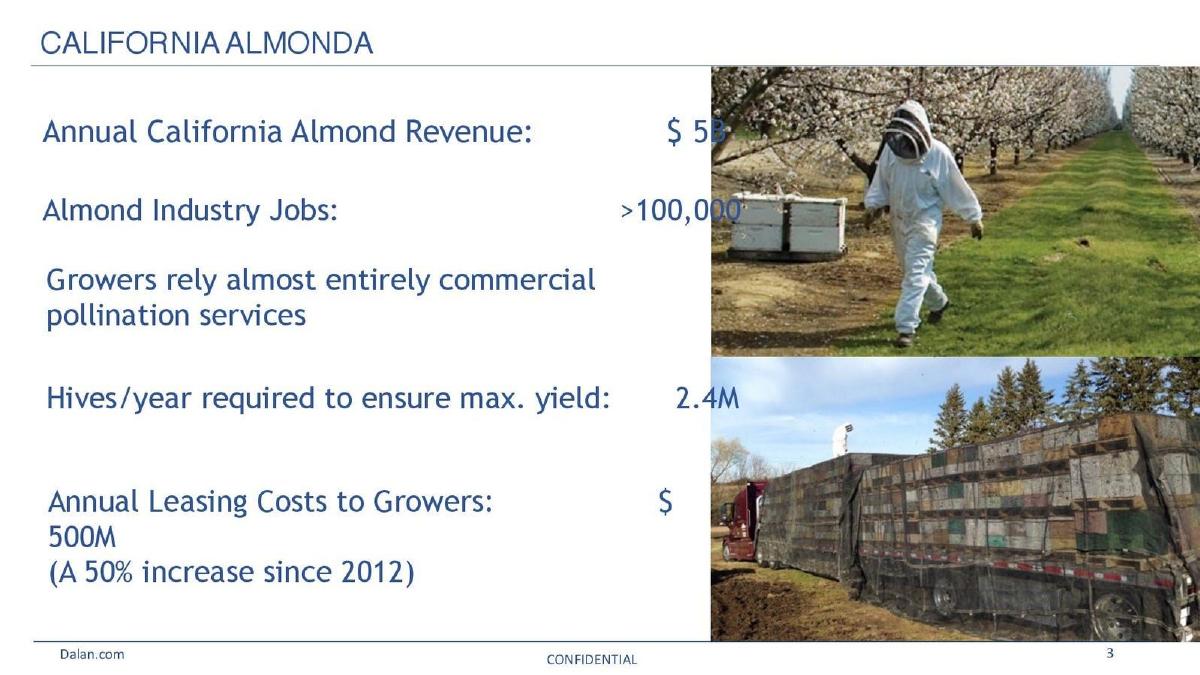
Slide 3 is arguably the most important slide for a Seed-stage investor. It establishes the 'California Almonds' market as the primary economic driver for the business. It lists Annual California Almond Revenue at $5B and notes that the industry supports >100,000 jobs . The critical metric here is the 2.4M hives required annually to ensure maximum yield. By stating that Annual Leasing Costs to Growers are $500M (a 50% increase since 2012), Dalan proves that their customers (beekeepers and growers) are already spending massive amounts of money to mitigate the risks Dalan intends to solve.
Slide 5: The Competitive Landscape
Under the heading 'Competitive Advantage,' Slide 5 uses a 'Stop' visual (red X's) to dismiss current industry practices. It lists Hive Cleaning (Bleach), Antibiotics, and Feed Supplements as 'largely ineffective and labor intensive.' This is a classic 'Old Way vs. New Way' setup. By positioning current solutions as manual and failing, Dalan clears the path for a high-tech, scalable biological intervention (a vaccine) that doesn't rely on the diminishing returns of antibiotics.
Slide 7: Scientific Proof of Concept
Slide 7 provides the hard data required for a biotech pitch. The headline states: 'AFB Vaccine Reduces Mortality by 60%.' The slide features a bar chart showing 'Lab Efficacy Challenge Model Results.' The 'AFB Challenged' group shows a dramatic spike in larval mortality (near 50%), while the vaccinated larvae group remains significantly lower. This slide serves to de-risk the technology in the eyes of the investor, showing that the product actually works in a controlled environment before moving to market size discussions.
Slide 9: Stakeholder Validation
Biotech often suffers from a 'lab-to-market' gap. Slide 9 addresses this with a testimonial from Brett Adee of Adee Honey Farms . The quote is urgent: 'We are on borrowed time if we do not have a prophylactic... we are at the critical edge.' Including a quote from a major industry player (Adee Honey Farms is one of the largest beekeeping operations in the U.S.) provides 'social proof' that the market is not just ready, but desperate for this solution.
Slide 11: Market Sizing and Segmentation
Slide 11, 'Unlocking Multi-Billion Dollar Markets,' breaks down the revenue loss due to diseases. It segments the market into three tiers:
U.S. (Entry Market): $300M revenue loss, 2.8M hives, >40% annual hive losses. · EU (Target Market): $1B revenue loss, 17.5M hives, >25% hive losses. · ROW (Growth Markets): $3B revenue loss, 70M hives.
This slide is effective because it shows a clear path to scale. It starts with a 'highly consolidated' U.S. market where a small sales team could theoretically capture significant share, then moves to larger, more fragmented global markets.
Slide 13: The Strategic Roadmap
Slide 13 outlines the company's trajectory from 2022 to 2028. Key milestones include:
2022: Conditionally Licensed AFB Vaccine (USDA). · 2023: 1st Commercial Sale (US & Canada). · 2024: US Full License and First EU Sale. · 2025-2026: 1st Viral bee vaccine and EMA licensing. · 2027-2028: Expansion 'Beyond Bees' with the 1st Shrimp vaccine .
This roadmap is vital because it transforms Dalan from a 'bee company' into a 'platform biotech company.' The move into shrimp (aquaculture) suggests that their underlying technology for delivering vaccines to invertebrates is transferable, significantly raising the potential valuation ceiling.
Slide 15: The Governance and Advisory Team
Interestingly, the deck omits a traditional 'Founders' slide in this 16-slide sequence. Instead, Slide 15 focuses on Advisors and the Board of Directors . The pedigree is high: Susan Hershenson (Deputy Director, Bill & Melinda Gates Foundation), Peter Brons-Poulsen (Retired President, Colgate-Palmolive Europe), and Neal Carter (President, Okanagan Specialty Fruits). For a Seed round, this level of institutional oversight suggests that while the internal team might be lean, they are backed by significant industry and regulatory expertise.
What Dalan Animal Health Does Well
The deck excels at economic translation . Many biotech decks get bogged down in the proteomics or the delivery mechanism of the vaccine. Dalan keeps the science simple (Slide 7) and spends more time explaining why a dead bee costs an almond grower money (Slide 3). This makes the deck accessible to generalist VCs, not just specialized life-science funds.
The market segmentation on Slide 11 is also a highlight. By identifying the U.S. as a 'highly consolidated market with few large commercial producers,' they signal to investors that their Customer Acquisition Cost (CAC) will likely be low. They don't need to reach 100,000 hobbyists; they need to reach a handful of industrial beekeepers who control the majority of the 2.8M hives.
What is Missing from the Deck
The most glaring omission is the Internal Management Team . While the advisors are impressive, investors generally want to see the CEO, CTO, and Lead Scientists who will be doing the day-to-day work. The deck also lacks Unit Economics . While we see the 'market loss,' we don't see the 'product gain'—specifically, how much a dose costs to produce versus the price point for a beekeeper.
There is also no Financial Ask or Use of Funds slide in this version. While we know from external reporting that they raised $3.5M, the deck doesn't specify how that money will be allocated between R&D, regulatory filings, and commercial sales. Finally, the Competitive Landscape is a bit thin; it mentions 'Old Way' solutions but doesn't address other biotech startups or academic labs that might be working on RNAi or other genetic interventions for bee health.
Lessons for Founders
1. Anchor in a 'Must-Have' Industry: If you are solving a niche problem, tie it to a massive, well-known industry. Dalan didn't just pitch 'bee health'; they pitched 'the survival of the $5B almond industry.' This makes the problem feel urgent and the market feel tangible.
2. Use Social Proof Early: The testimonial on Slide 9 from a major stakeholder is a powerful way to validate market demand before you have significant revenue. It proves that the 'pain' you are describing is felt by the people who will actually write the checks.
3. Show a Platform, Not a Product: By including the 'Beyond Bees' shrimp vaccine on the roadmap (Slide 13), Dalan tells a story of a platform technology. Investors are rarely excited by a single-product company in biotech; they want to see a repeatable process that can be applied to multiple high-value markets.
4. Visualize the Data Simply: Slide 7 is a great example of how to present efficacy data. It doesn't use complex tables or p-values that require a PhD to interpret. It uses a simple bar chart that shows 'Vaccine = Fewer Dead Larvae.' In a pitch deck, clarity beats comprehensiveness every time.
Frequently asked questions
- What is the primary problem Dalan Animal Health is solving?
- Dalan is addressing the high mortality rates in honeybee colonies caused by diseases like American Foulbrood (AFB). Slide 11 notes that the U.S. faces >40% annual hive losses due to disease. This impacts the agricultural supply chain, specifically the $5B California almond industry which relies on 2.4M hives for pollination as shown on Slide 3.
- How effective is the Dalan vaccine according to the deck?
- According to Slide 7, the AFB vaccine reduces larval mortality by 60%. The slide displays a Lab Efficacy Challenge Model where vaccinated larvae showed significantly lower mortality rates compared to the 'AFB Challenged' control group, providing the core scientific proof-of-concept for the investment.
- What is the total addressable market for bee vaccines?
- Slide 11 breaks down the market by annual revenue loss due to diseases. The U.S. entry market is $300M, the EU is $1B, and the Rest of World (ROW) is $3B. The slide also notes a global growth market of 70M hives, positioning the total opportunity in the multi-billion dollar range.
- Does the deck include a financial ask or valuation?
- No. The provided 16-slide deck does not include a specific 'Ask' slide, use of funds, or valuation. While publisher facts state the company raised $3.5M in a Seed round in 2024, these details are omitted from the visual presentation materials.
- What is the long-term product roadmap beyond honeybees?
- Slide 13 illustrates a 'Beyond Bees' strategy. After securing EMA licensing and multi-disease vaccines for bees between 2025 and 2026, the company plans to launch its first shrimp vaccine in 2027-2028, signaling an expansion into broader aquaculture and animal health.