Dandelion Energy’s 16-slide Series B deck is a masterclass in framing a complex hardware and infrastructure business as a scalable, technology-driven platform. The company addresses the massive environmental and financial costs of traditional home heating, positioning geothermal as a superior alternative that has historically suffered from high friction. By internalizing the entire value chain—from virtual site assessments and proprietary drilling data to in-house financing—Dandelion lowers the barrier to entry for homeowners. The deck effectively uses a 'Tesla for heating' analogy to signal…
Key takeaways
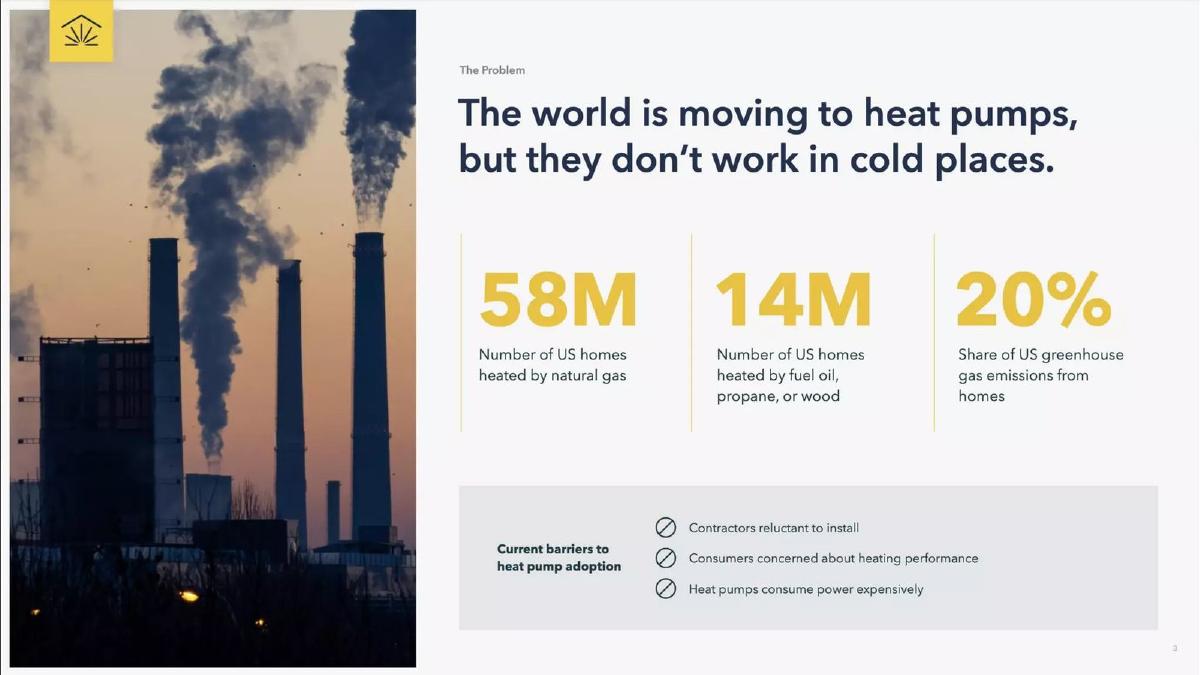
- The deck identifies 58M US homes heated by natural gas and 14M by fuel oil, propane, or wood as the primary target market (Slide 3).
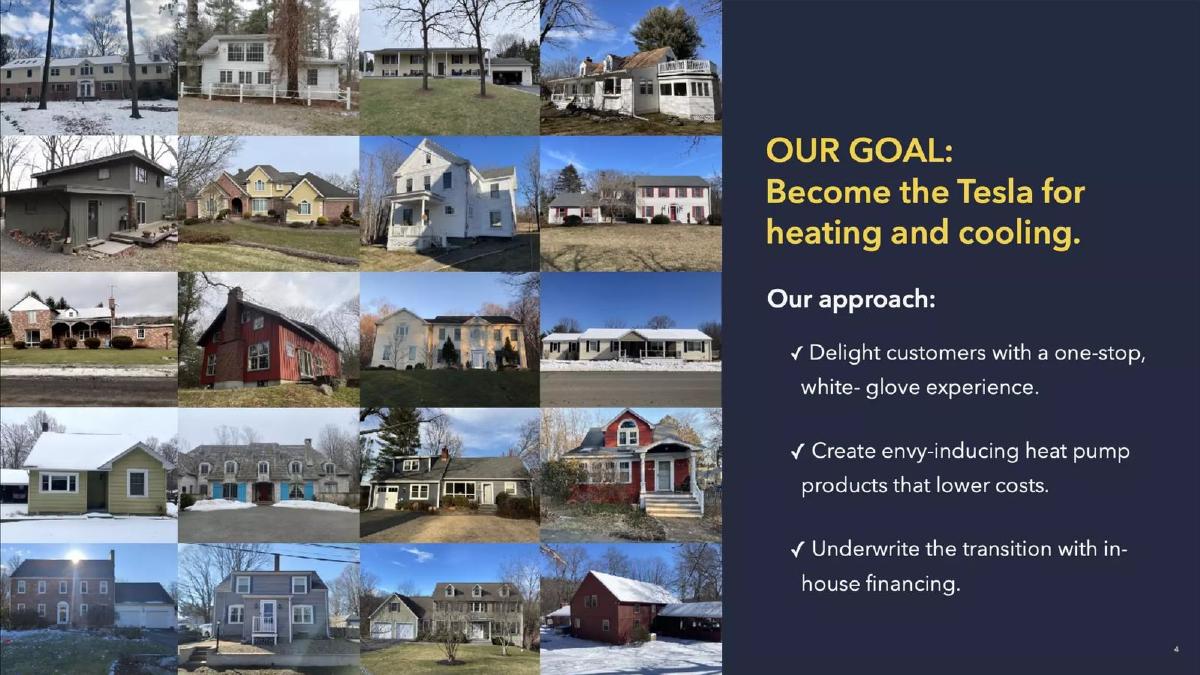
- Dandelion positions itself as the 'Tesla for heating and cooling,' emphasizing a white-glove, one-stop-shop experience (Slide 4).
- The company utilizes proprietary algorithms and virtual sales to estimate costs, aiming to be the 'Kleenex/Bandaid' of the geothermal space (Slide 7).
- Financing is a core product, allowing customers to save money on 'Day 1' rather than waiting for a 7-year cash payback (Slide 9).
- Unit economics show a $0 upfront cost for financed customers compared to a $10,000 status quo for traditional HVAC (Slide 10).
- The company boasts a 63 NPS and a 4.8-star rating on Home Advisor, claiming the #1 rated contractor spot in NY (Slide 11).
- Market sizing identifies a $978B opportunity in retrofit homes and a $129B opportunity in new construction (Slide 13).
- The growth strategy relies on three pillars: hardware innovation, financial products, and a B2B channel partnering with large home builders (Slide 14).
Executive Summary: The Full-Stack Decarbonization Play
Dandelion Energy’s Series B pitch deck is a strategic document designed to convince investors that home geothermal is no longer a niche luxury, but a scalable infrastructure play. Raised in 2022, the $70M round was predicated on the company’s ability to vertically integrate a notoriously fragmented and difficult installation process. By controlling the technology, the data, and the financing, Dandelion positions itself as the definitive brand in a market worth over $1 trillion. The deck follows a logical progression from the macro problem of home emissions to the micro-level unit economics that make their solution a 'no-brainer' for the modern homeowner.
Slides 1-2: Branding and Roadmap
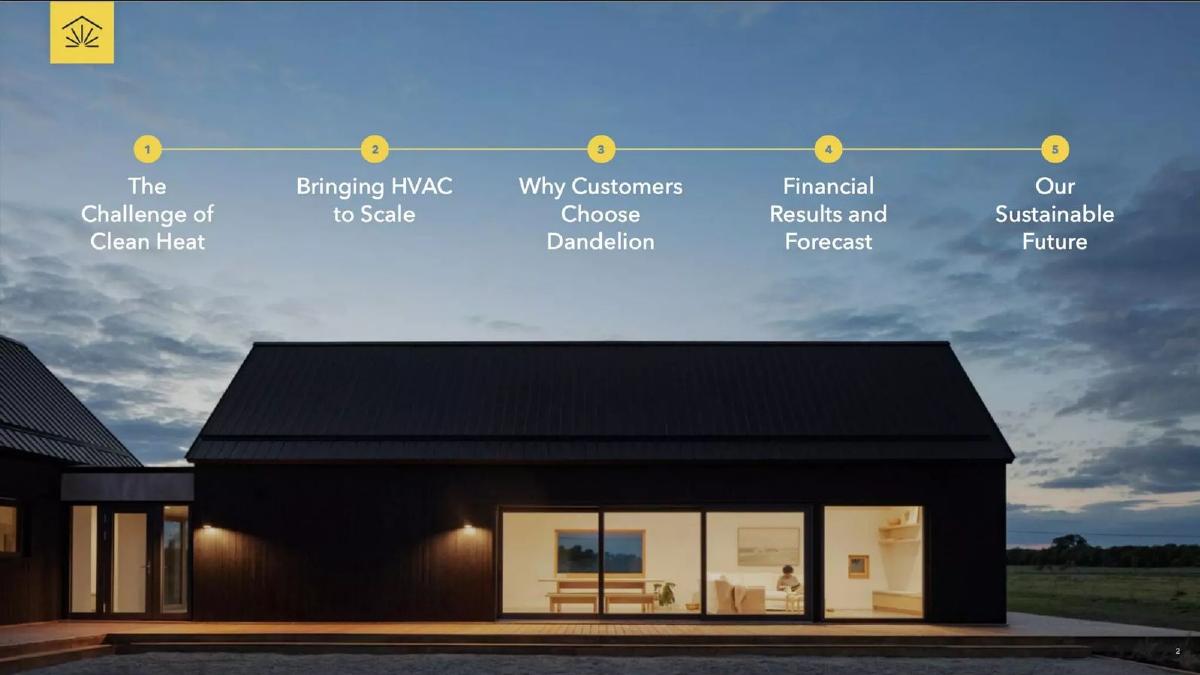
The deck opens with a minimalist title slide featuring the Dandelion logo and the tagline "Heat Without Fire." This immediately establishes the core mission: electrification and the elimination of combustion-based heating. Slide 2 provides a clear five-part agenda: The Challenge of Clean Heat, Bringing HVAC to Scale, Why Customers Choose Dandelion, Financial Results and Forecast, and Our Sustainable Future. This roadmap signals to investors that the presentation will cover both the high-level vision and the hard financial data required for a Series B investment.
Slides 3-4: The Problem and the 'Tesla' Ambition
Slide 3 frames the problem with staggering figures: 58M US homes are heated by natural gas, 14M by fuel oil, propane, or wood, and residential emissions account for 20% of US greenhouse gas emissions . The slide also identifies three specific barriers to heat pump adoption: contractor reluctance, consumer performance concerns, and high power consumption costs. Slide 4 introduces the solution by setting a bold North Star: "Become the Tesla for heating and cooling." This slide outlines a three-pronged approach: a white-glove one-stop-shop experience, 'envy-inducing' products, and in-house financing to underwrite the transition. The use of a grid of real customer homes reinforces that this is a proven, existing service, not a theoretical concept.
Slides 5-7: Technology and the Full-Stack Advantage
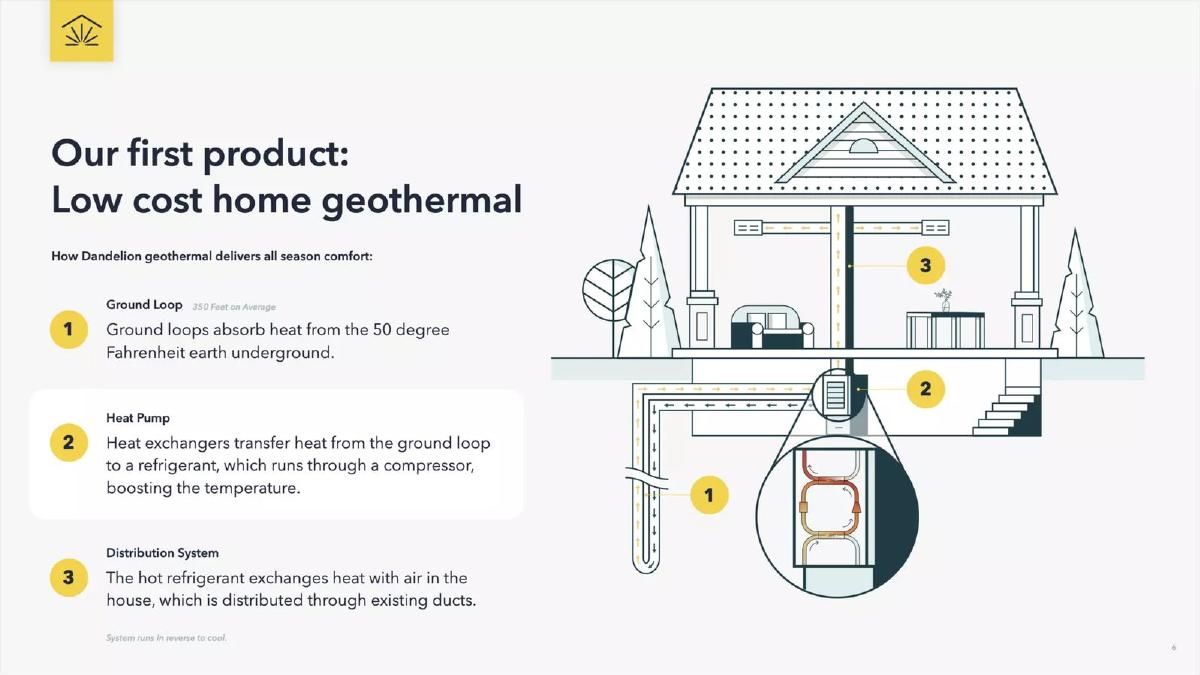
After a transition slide, Slide 6 explains the mechanics of their first product: Low cost home geothermal. It breaks the system down into three components: 1) Ground loops (averaging 350 feet) that absorb heat from the 50-degree earth, 2) a heat pump that transfers and boosts that heat, and 3) a distribution system using existing ducts. Slide 7 is perhaps the most important for a VC audience; it argues that their "full stack, technology driven approach makes buying easy and competition unlikely." It highlights a virtual sales process that uses photos and proprietary algorithms to estimate costs, and the use of proprietary soil conductivity data to improve installation efficiency. This positioning moves Dandelion away from being a mere 'contractor' and toward being a 'tech-enabled platform.'
Slides 8-11: The Consumer Value Proposition
Slide 9 shifts the focus to the homeowner, stating that this is both an "econ purchase and an eco purchase." It claims geothermal lowers heating costs by 80% and AC costs by 30% , while ground loops last 50+ years . A quote from a customer in the Wall Street Journal adds social proof: "I couldn't afford not to do this." Slide 10 provides a side-by-side comparison of the 'Status Quo' versus Dandelion. While the status quo has a $10,000 upfront cost and no payback, Dandelion's financing option offers $0 upfront and immediate savings. Slide 11 focuses on brand dominance, citing a 63 NPS , a 4.8-star rating on Home Advisor, and the title of #1 rated contractor in the State of NY. These metrics are intended to prove that Dandelion has solved the customer satisfaction issues that plague the traditional HVAC industry.
Slides 12-14: Market Sizing and Future Growth
Slide 13 tackles the Total Addressable Market (TAM) with 'Our Math.' It identifies a $978B opportunity in retrofit homes heated by natural gas across 32 states where geothermal is cost-competitive. It also breaks down the heating fuel market in the Northeast (NY, CT, MA, etc.) as a $143B and $85B opportunity. New construction adds another $129B . Slide 14 outlines the future roadmap through three horizontal bars: Hardware Innovation, Financial Products (aiming to become the 'utility of the future'), and a B2B Channel for partnering with large home builders. This indicates that the company plans to move beyond direct-to-consumer sales into large-scale developer partnerships.
Slides 15-16: Conclusion
Slide 15 repeats the title branding, and Slide 16 is a promotional slide for the pitch deck library from which this deck was sourced. Notably, the deck ends without a 'The Ask' slide or a 'Team' slide in this version, though these may have been removed for public distribution or handled in a separate document.
What Dandelion Energy Does Well
Economic Framing: By emphasizing the 'Day 1' savings of their financing model, Dandelion transforms a complex environmental upgrade into a simple financial decision. · Vertical Integration Narrative: The deck successfully argues that controlling the entire process—from soil data to financing—is a competitive moat that traditional HVAC companies cannot easily replicate. · Market Specificity: Instead of claiming a vague global TAM, Slide 13 uses specific state-level data and fuel-type breakdowns to build a credible, bottom-up market size. · Brand Aspiration: The 'Tesla' comparison is a powerful shorthand for investors, suggesting a path from a high-end early adopter product to a mass-market necessity.
What is Missing from the Deck
Team Slide: There is no mention of the founders, their backgrounds (e.g., the Google X spin-out origin), or the executive leadership team. For a Series B, team depth is usually a critical component. · Use of Funds: The deck does not specify how the $70M will be allocated. Investors typically want to see a breakdown between R&D, geographic expansion, and sales/marketing. · Competitive Landscape: While the deck mentions that competition is 'unlikely' due to their full-stack approach, it does not explicitly name or analyze other heat pump manufacturers or geothermal startups. · Financial History: While it mentions 'Financial Results' in the agenda, the actual slides provided focus more on unit economics and market math than on historical revenue growth or burn rate.
Lessons for Founders
Use Shorthand Carefully: Comparing yourself to a giant like Tesla or Amazon can be risky, but Dandelion backs it up by showing they are following the same vertical integration and brand-building playbook. · Solve the Upfront Cost: If your product has a high 'green premium,' your business model must include a financial product that turns a CAPEX hurdle into an OPEX benefit. · Data as a Moat: Dandelion highlights their 'proprietary soil conductivity data.' Founders should always look for 'exhaust data' from their operations that can be turned into a proprietary asset. · Visualizing the Invisible: Geothermal is literally underground. Slide 6 does an excellent job of using a simple, clean diagram to make a complex mechanical system understandable in seconds.
Frequently asked questions
- What is Dandelion Energy's core value proposition?
- Dandelion Energy provides a 'full-stack' geothermal heating and cooling solution. According to Slide 7, they handle everything from virtual design and sales using proprietary algorithms to installation and performance monitoring. Their primary value prop is reducing heating costs by 80% and AC costs by 30% while eliminating the need for fossil fuels in the home, as stated on Slide 9.
- How does Dandelion address the high upfront cost of geothermal?
- The company uses in-house financing to eliminate the 'green premium' barrier. Slide 10 shows that while a cash purchase costs $22,200, their financing product allows for $0 upfront cost. This shifts the customer experience from a 7-year payback period to 'saving money day 1,' making the transition economically viable for a broader range of homeowners.
- What is the 'Tesla' analogy used in the deck?
- On Slide 4, Dandelion explicitly states their goal is to 'Become the Tesla for heating and cooling.' This implies a focus on high-end brand appeal ('envy-inducing products'), a vertically integrated customer experience, and a mission-driven approach to transitioning an entire industry away from fossil fuels toward cleaner, more efficient technology.
- How does Dandelion use technology to scale a hardware-heavy business?
- Slide 7 highlights their 'technology driven approach,' which includes a frictionless virtual sales process and the ability to capture energy characteristics via photos. They also leverage proprietary soil conductivity data and algorithms to estimate costs predictably, which reduces the traditional manual labor and uncertainty involved in geothermal site assessments.
- What are the primary growth channels identified in the Series B deck?
- As shown on Slide 14, Dandelion is focusing on three main pillars: continued hardware innovation to increase efficiency, expanding financial products to turn Dandelion into the 'utility of the future,' and developing a B2B channel by partnering with the country's largest home builders to integrate geothermal into new construction at scale.