Dartrays WHUD II is an aftermarket automotive head-up display (HUD) designed to project virtual images onto a vehicle's windshield. The pitch deck positions the product as a safer, more affordable alternative to expensive OEM solutions, which the company claims cost between $1,500 and $3,000 (Slide 4). With a heavy emphasis on technical differentiation, the deck outlines an optical path involving LCD projection and curved mirrors to correct aberrations (Slide 5). While the deck successfully communicates the technical 'how' and the market opportunity—projected to reach $4.3 billion by 2025 (Sl…
Key takeaways
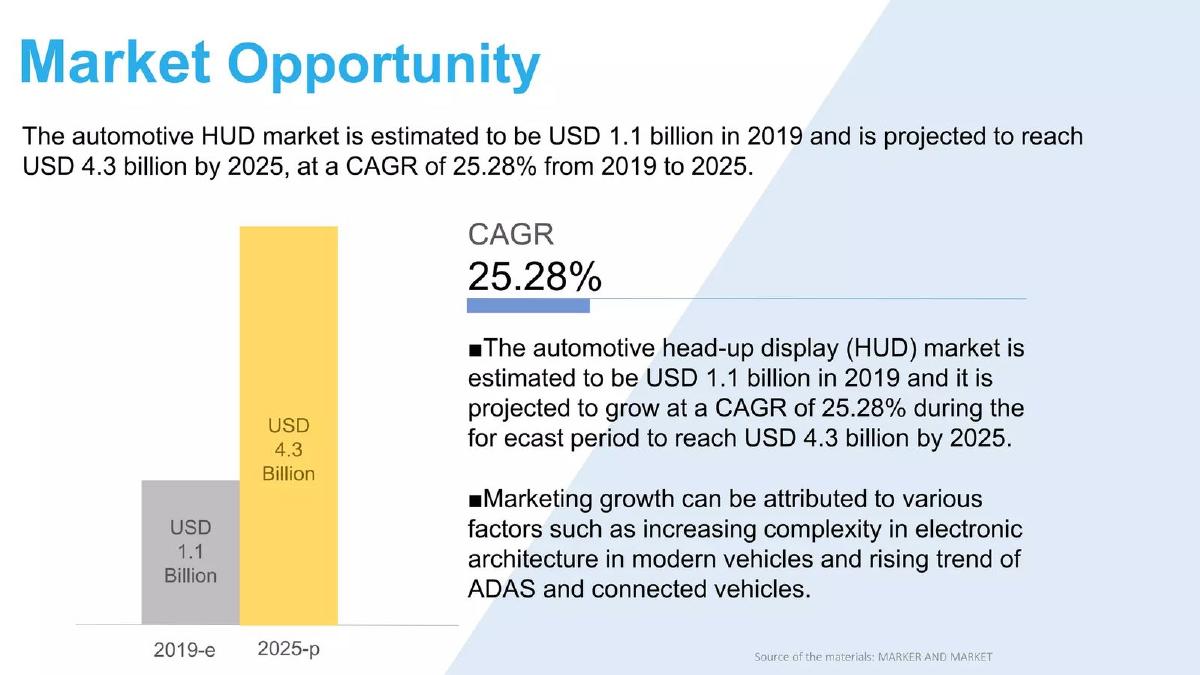
- The automotive HUD market is projected to grow from $1.1 billion in 2019 to $4.3 billion by 2025 at a 25.28% CAGR (Slide 3).
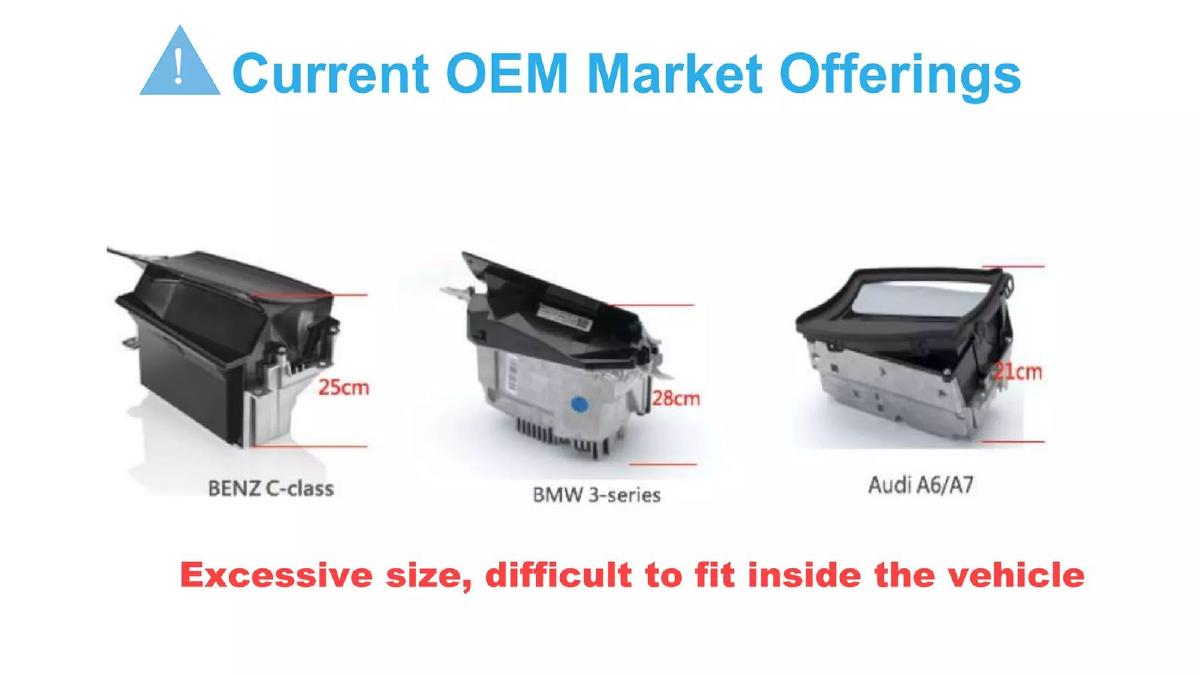
- Dartrays identifies high costs ($1,500-$3,000) and bulky form factors (25cm+ height) as the primary weaknesses of existing OEM HUD solutions (Slide 4).
- The technical solution relies on a specific optical path: LCD to Fold Mirror to Curved Mirror to Windshield (Slide 5).
- The company claims intellectual property protection through invention patents in the US, Japan, and Taiwan, plus a utility model patent in China (Slide 6).
- Real-world testing is demonstrated across multiple vehicle models, including the Luxgen U5, Mitsubishi Motors Colt Plus, and Toyota Corolla Altis (Slide 7).
- The product features automatic brightness adjustment based on ambient light to ensure visibility during both day and night (Slide 7).
- The deck lacks a team slide, financial projections, and a clear investment ask, which are standard requirements for a professional fundraising round.
- The market data provided is dated, referencing 2019 estimates and 2025 projections, suggesting the deck was likely produced around 2019-2020 (Slide 3).
Slide-by-Slide Teardown
Slide 1: Title Slide
The deck opens with the Dartrays logo and the tagline "Eyes on the Road." The branding is minimal, using a blue and white color palette. The logo incorporates a location-pin-style icon, which subtly suggests navigation, a primary use case for head-up displays. There is no mention of the specific funding round or the year on this slide.
Slide 2: The Solution
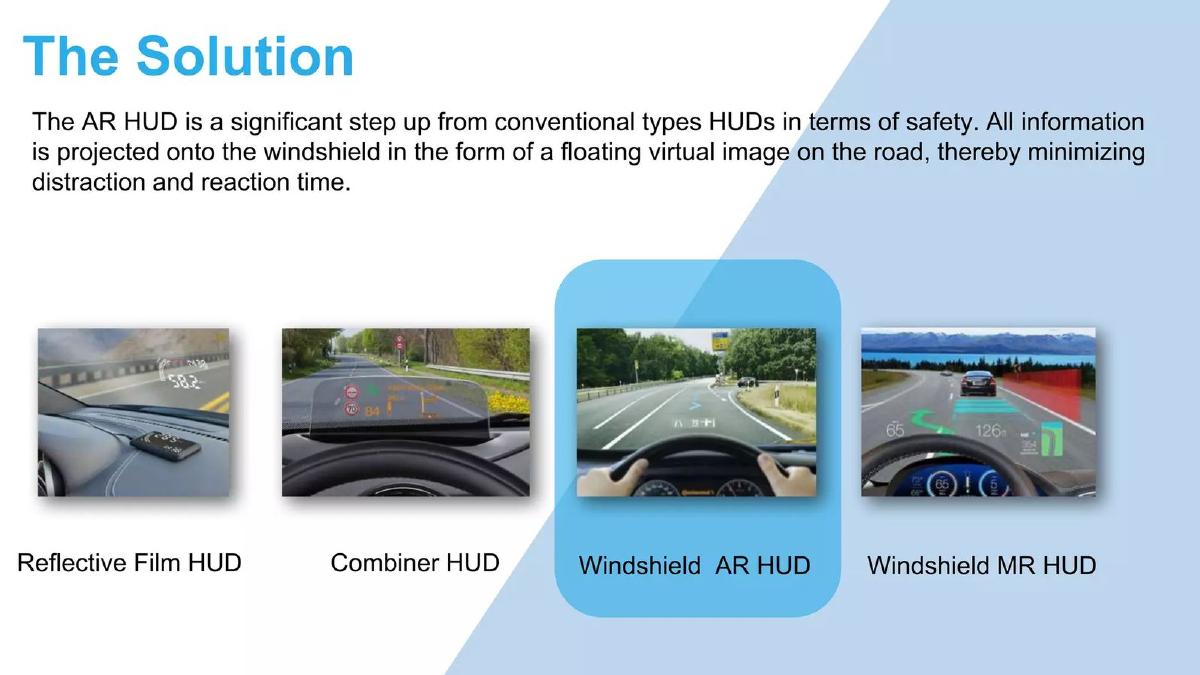
This slide defines the product category. It categorizes HUD technology into four types: Reflective Film HUD, Combiner HUD, Windshield AR HUD, and Windshield MR HUD. Dartrays highlights the "Windshield AR HUD" as their focus. The text claims this technology is a "significant step up" in terms of safety because it projects a floating virtual image onto the road, which minimizes distraction and reaction time. The visual comparison helps the viewer understand where Dartrays sits in the technological landscape.
Slide 3: Market Opportunity
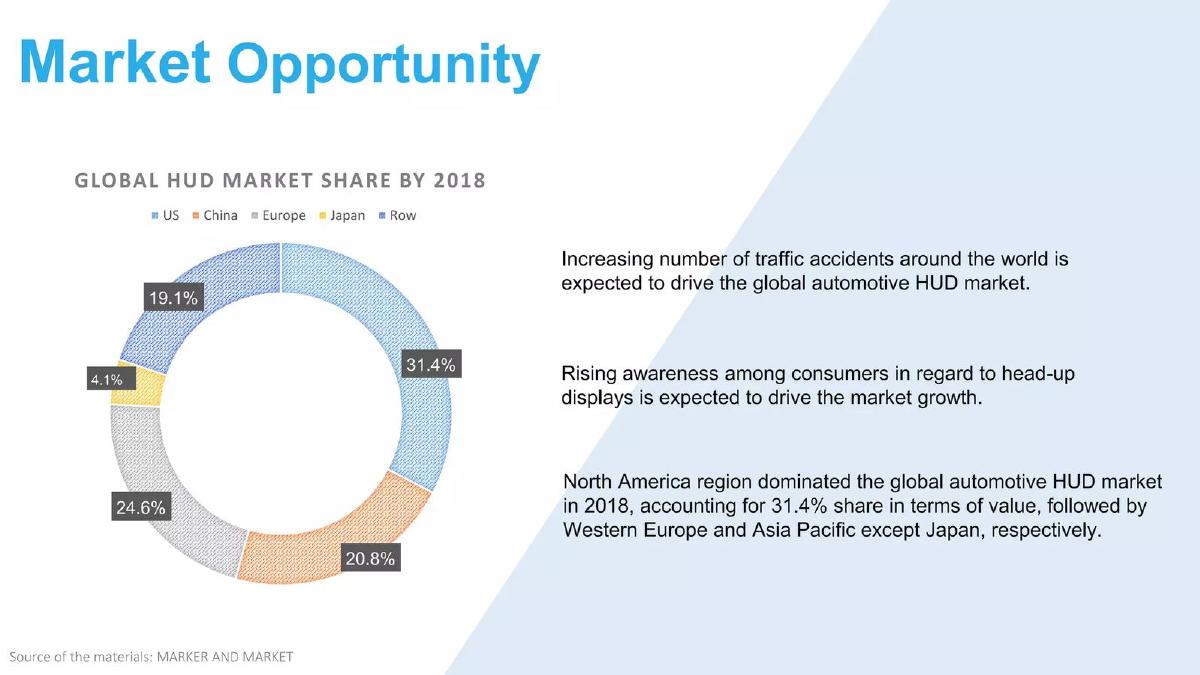
Dartrays uses third-party data from "MARKER AND MARKET" to establish the market size. The slide notes a 2019 market value of $1.1 billion, growing to $4.3 billion by 2025. A CAGR of 25.28% is prominently displayed. The slide attributes this growth to the "increasing complexity in electronic architecture" and the "rising trend of ADAS and connected vehicles." While the numbers are substantial, the data is now several years old, which is a common issue with archived decks.
Slide 4: Product Comparison
This is a classic "competitor pain point" slide. It splits the competition into OEM (Original Equipment Manufacturer) and AM (Aftermarket). For OEMs, the deck cites high costs ($1,500 to $3,000) and bulkiness (25cm+ height) as barriers. For aftermarket competitors, it cites short projection distances (up to 25cm), the need for eyes to constantly refocus on reflective screens, and poor heat dissipation. By identifying these specific technical failings, Dartrays sets the stage for why their specific hardware design is necessary.
Slide 5: Optical Path
This slide is the technical heart of the deck. It uses a flow chart and a cross-section diagram to explain the "Technology Revolution." The path is described as: LCD (Projection) -> Fold Mirror (Reflection/Correction) -> Curved Mirror (Enlargement/Correction) -> Windshield (Reflection) -> Imaging (Virtual Image). This level of detail is intended to satisfy technical due diligence, showing that the company has solved the optical challenges of projecting a clear image onto a non-flat surface like a windshield.
Slide 6: Patented Innovation
To defend its technical claims, Dartrays presents its patent portfolio. It lists four specific patents: US010337882B2 (USA), 6698120 (Japan), I638190 (Taiwan), and ZL 2017 2 1439925.1 (China). Showing the actual certificates adds a layer of credibility, suggesting the company has a "moat" around its optical path technology. This is particularly important for hardware startups where copycat products are a significant risk.
Slide 7: Real-World Application
This slide provides proof of concept. It shows the WHUD II installed in three different car models: a Luxgen U5, a Mitsubishi Motors Colt Plus, and a Toyota Corolla Altis. The photos demonstrate the display's visibility in daylight. The text at the bottom notes that the device is "all-purpose" and "automatically adjusts brightness to ambient light," ensuring clarity regardless of the time of day. This addresses the practical concern of whether an aftermarket device can actually function across different vehicle makes and lighting conditions.
Slide 8: Closing Slide
The deck ends abruptly with a "Thank You" slide featuring the logo. There is no contact information, no call to action, and no summary of the investment opportunity. This reinforces the feeling that this deck may have been used as a supporting document for a presentation rather than a standalone pitch deck intended to be read by an investor in isolation.
What Works
Technical Clarity: The deck does an excellent job of explaining a complex optical process in simple terms. Slide 5, in particular, makes the "Optical Path" easy to visualize, which is vital for a hardware play.
Problem Identification: Slide 4 clearly articulates the trade-offs between current OEM and aftermarket solutions. By citing specific figures like the $1,500 OEM cost and the 25cm projection limit of competitors, the founders show they understand the market's current limitations.
IP Transparency: Listing specific patent numbers across multiple jurisdictions (Slide 6) provides immediate proof of the company's intellectual property claims, which is a major green flag for hardware investors.
What is Missing
The Team: There is no mention of who is building this. In early-stage hardware, the engineering pedigree of the founders is often more important than the product itself. The absence of a team slide is a critical failure.
Business Model and Unit Economics: The deck explains what the product is, but not how the company makes money. There is no information on the Bill of Materials (BOM), the target retail price, or the distribution strategy (e.g., direct-to-consumer vs. B2B partnerships with auto retailers).
The Ask: A pitch deck is a fundraising tool. This deck fails to mention how much money is being raised, the valuation, or the milestones the company intends to hit with the new capital.
Traction: While Slide 7 shows the product in cars, it doesn't mention if these are prototypes, beta tests, or if the company has sold any units. There are no mentions of pre-orders, revenue, or manufacturing partnerships.
Founder Takeaways
Use specific numbers for competitor weaknesses: Dartrays didn't just say competitors are "expensive"; they said they cost "$1500 to $3000." They didn't just say competitors are "bulky"; they said they are "25cm+ height." These specific metrics make the problem feel real and solvable.
Visualize the 'How': If your startup relies on a physical process (like optics, chemistry, or mechanics), use a simplified diagram like Slide 5. It bridges the gap between a high-level pitch and a technical white paper.
Don't forget the 'Who' and the 'How Much': A great product description is not a business pitch. Always include a team slide to build trust and an 'Ask' slide to initiate the negotiation. Without these, you are just showing off a gadget, not pitching a venture.
Frequently asked questions
- What is the primary problem Dartrays is trying to solve?
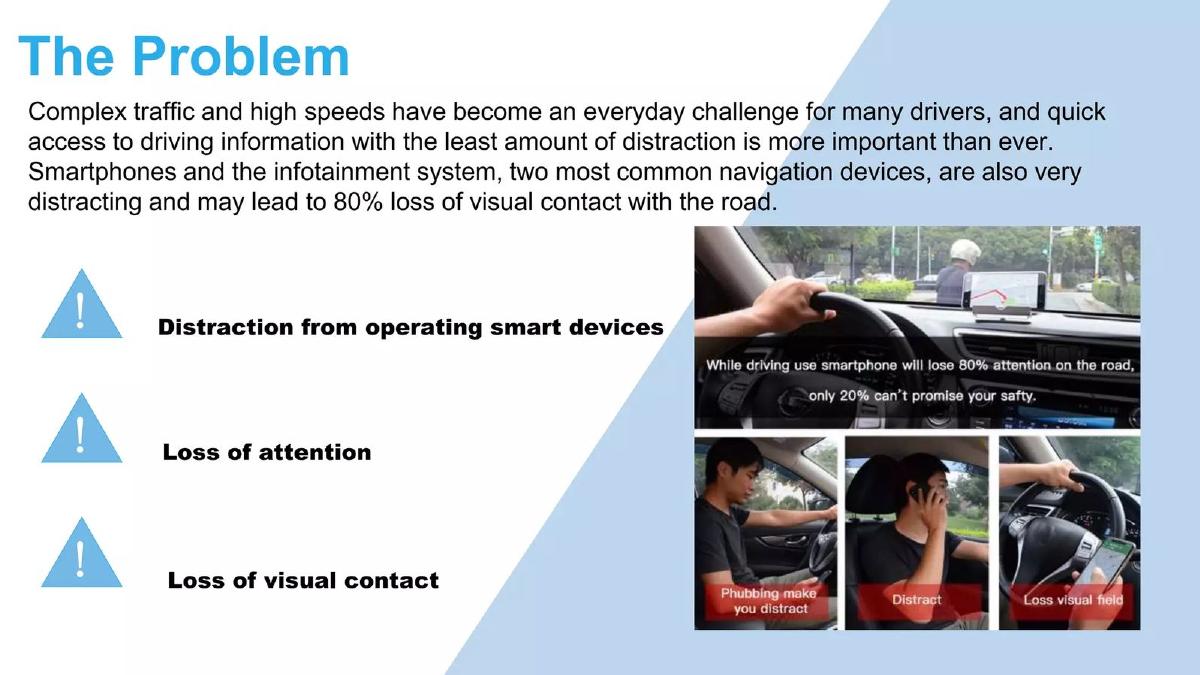
- Dartrays addresses the limitations of current automotive Head-Up Displays (HUDs). According to Slide 4, existing OEM options are too expensive ($1,500-$3,000) and bulky (over 25cm in height), making them difficult to install or upgrade. Aftermarket alternatives often suffer from short projection distances (up to 25cm) and poor heat dissipation. Dartrays aims to provide a windshield AR HUD that minimizes driver distraction and reaction time by projecting a virtual image directly onto the road view.
- How does the Dartrays technology work?
- The technology uses a multi-step optical path to create a virtual image. As detailed on Slide 5, the process begins with an LCD projection of a real image. This light travels through a fold mirror for reflection and aberration correction, then hits a curved mirror for further correction and image enlargement. Finally, the image reflects off the windshield to create a floating virtual image that the driver sees 'on the road'.
- What is the market size for this technology?
- Slide 3 cites data from 'MARKER AND MARKET' stating that the automotive HUD market was estimated at $1.1 billion in 2019. It is projected to grow to $4.3 billion by 2025. This growth represents a Compound Annual Growth Rate (CAGR) of 25.28%. The deck attributes this growth to the increasing complexity of modern vehicle electronics and the rising trend of Advanced Driver Assistance Systems (ADAS).
- Does Dartrays have intellectual property protection?
- Yes, Slide 6 highlights 'Patented Innovation' as a core asset. The company displays four patent documents: a US Invention Patent (US010337882B2), a Japan Invention Patent (6698120), a Taiwan Invention Patent (I638190), and a China Utility Model Patent (ZL 2017 2 1439925.1). This suggests a global strategy for protecting their specific optical and hardware design.
- What information is missing from the Dartrays pitch deck?
- The deck is missing several critical components for a fundraising round. There is no 'Team' slide to verify the founders' expertise. There are no financial slides covering revenue, unit costs, or margins. Most importantly, there is no 'Ask' slide detailing how much capital the company is seeking or how that capital will be deployed. It functions more as a product technical brief than a comprehensive investment pitch.