How mobility and automotive startups present the solution in a pitch deck: answer each problem, show how the service works for the driver.
Mobility Startup Solution Slide: Real Pitch Deck Examples
Eight solution slides from startups in parking, car care, car sharing, EV charging and driver safety, shown in full, compare whether each slide answers the problem it set up, shows how the service works for the user, and says where the cars, spaces or stations come from.
TL;DR
A mobility solution slide should answer the problem slide point by point, show how the service works for the driver, and say who supplies the physical side: the cars, parking spaces, stations or mechanics. Orto does all three in three columns: "Four unrelated customers co-lease a single new car worth between £40k and £100k", each gets "85 days per year" booked through a calendar, and "Orto takes care of all the details for an upfront and monthly fee". Kilapin draws an arrow from each of its three problems to a feature (waiting time to reservation). Parkhound shows the real booking screen with prices. GetPark's slide is a phone with a logo and three words ("Comfortable & easy", "Assured security", "Manageable"), which is the weaker pattern.
Mobility solution slides from real pitch decks
Each example shows the exact stored slide above its analysis and links to the full teardown. Claims are as shown on the slides; we have not verified them.
Orto solution slide — slide 6
Shared long-term car leasing. Three columns with icons and a paragraph each.
Orto deck, slide 6. Exact stored slide matched to this analysis.
Our analysis: The strongest slide here: who shares, how they book, and what the fee covers, each in one column.
Evidence and limitation: Specific terms (four customers, 85 days, £40k–£100k cars); no customer numbers.
What a founder can adapt: Three columns: how a customer joins, how they use it, what you handle.
Supporting analysis
What the deck claims: "Co-leasing service overview." "Four unrelated customers co-lease a single new car worth between £40k and £100k." "The customers book time with their car through their Orto calendar": "Each customer has 85 days per year which they book via the web and an app." "Orto takes care of all the details for an upfront and monthly fee": "collection and delivery, valet, insurance, maintenance, storage... road tax."
Presentation choice: An investor can picture joining, booking and handing over the car.
When it does not fit: The paragraphs are small; the bold lines alone tell the story. Cut the rest.
Marketplace for private parking. A screenshot of the search page with a map and prices.
Parkhound deck, slide 3. Exact stored slide matched to this analysis.
Our analysis: The screen answers all three problem lines (hard to find, expensive, frustrating) without words: a map, prices, a booking.
Evidence and limitation: A real product screen with prices; result count shown on screen.
What a founder can adapt: Show your product in use with real data; label the supply types above it.
Supporting analysis
What the deck claims: "Solution." "Residential." "Commercial." "On-street." Screenshot: Melbourne search, "1,234 Results for Parking in Melbourne", listings such as "$10.00 /HOUR", "$17.00 /DAY", "$70.00 /WEEK", and a "Lease my space" button.
Presentation choice: A real screen with real prices is more convincing than a mock-up.
When it does not fit: Point to the one thing to look at (the price, the number of spaces), or investors will read the whole screen.
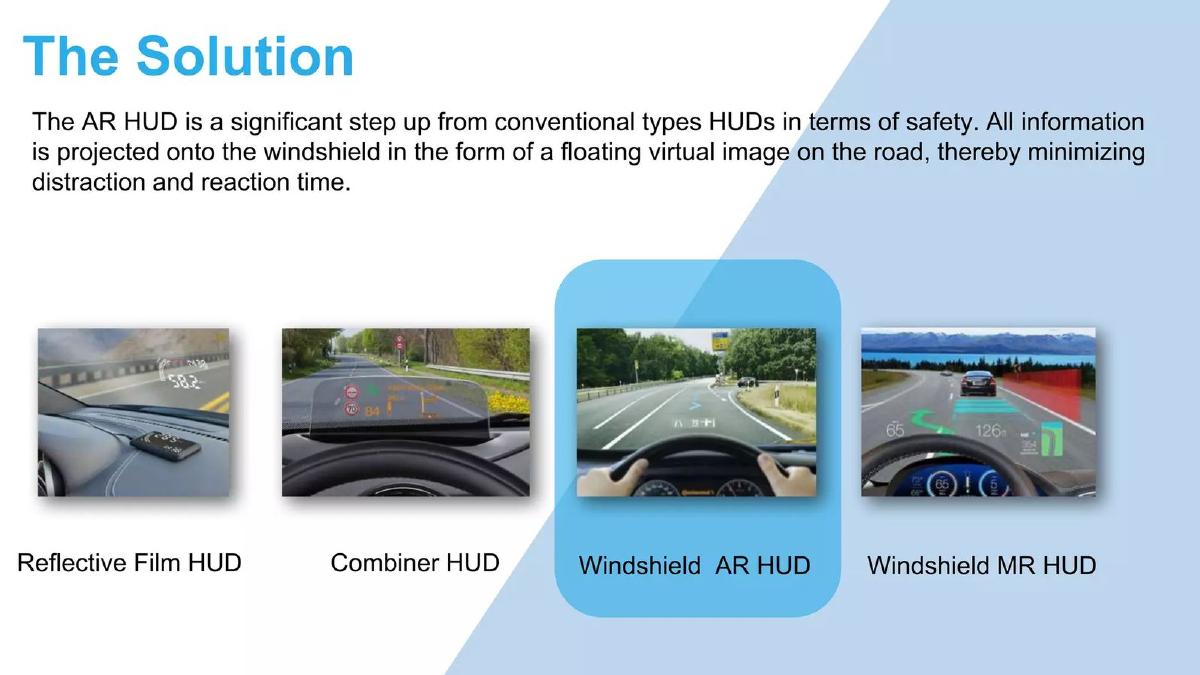
Head-up display for cars. A sentence and four photos of display types, one highlighted.
Dartrays deck, slide 3. Exact stored slide matched to this analysis.
Our analysis: It answers the problem slide directly (eyes off the road) and shows where the product sits among existing displays.
Evidence and limitation: No figures.
What a founder can adapt: Show the alternatives and highlight yours.
Supporting analysis
What the deck claims: "The Solution." "The AR HUD is a significant step up from conventional types HUDs in terms of safety. All information is projected onto the windshield in the form of a floating virtual image on the road, thereby minimizing distraction and reaction time." Photos: "Reflective Film HUD", "Combiner HUD", "Windshield AR HUD" (highlighted), "Windshield MR HUD".
Presentation choice: Highlighting one option among four makes the choice clear.
When it does not fit: Say how much reaction time improves; the problem slide set up an 80% figure to answer.
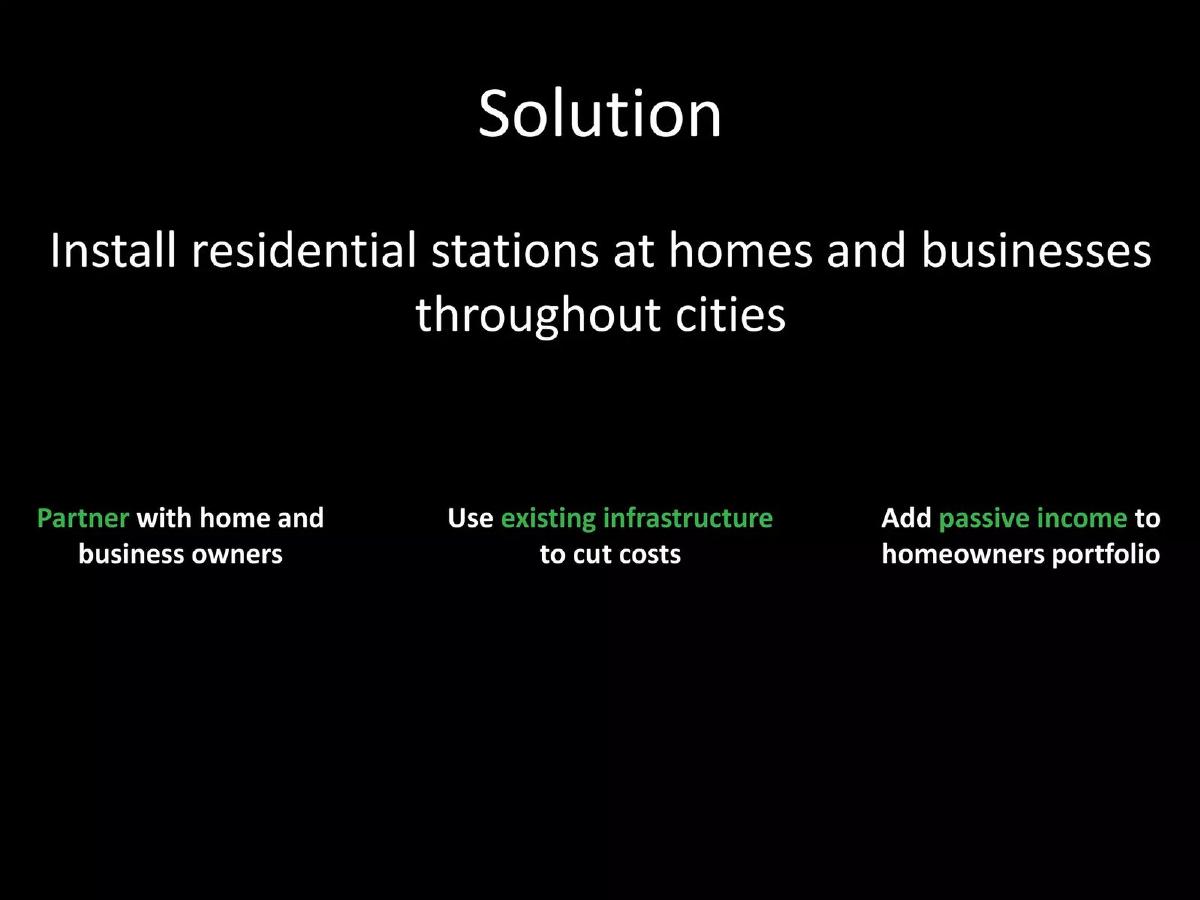
EV charging. One headline and three short lines on black.
Cyclectric deck, slide 3. Exact stored slide matched to this analysis.
Our analysis: It answers the cost problem ("~$20K" per station) with existing infrastructure and explains why hosts join.
Evidence and limitation: No figures.
What a founder can adapt: Say who hosts or supplies, and what they get.
Supporting analysis
What the deck claims: "Solution." "Install residential stations at homes and businesses throughout cities." "Partner with home and business owners." "Use existing infrastructure to cut costs." "Add passive income to homeowners portfolio."
Presentation choice: Naming the supply partner and their reason to join is what most two-sided slides miss.
When it does not fit: Give the new cost per station so the answer to "~$20K" is a number.
Peer-to-peer car sharing in India. A bold line and two paragraphs.
Get A Drive deck, slide 6. Exact stored slide matched to this analysis.
Our analysis: It explains both sides: owners earn, renters avoid a loan. The idle-car point is a strong supply argument.
Evidence and limitation: "less than 90%" (the wording appears to mean cars sit idle about 90% of the time); no source.
What a founder can adapt: Lead with the idle asset and who earns from it.
Supporting analysis
What the deck claims: "Solution." "Unlock the inventory available all around us. Cars that are standing idle in car parks, offices, on the road sides etc. and are used less than 90% of their entire lifetime." Owners "get compensated for the time it is being shared"; people who need cars briefly "can stay EMI free".
Presentation choice: Unused supply that already exists is a clear reason the model can scale.
When it does not fit: The figure is worded backwards; check numbers read correctly. Much of the text repeats the earlier overview slide.
Mobile car repair staffed by veterans. Three bullets and a mission paragraph. Partial.
GH Mobil deck, slide 5. Exact stored slide matched to this analysis.
Our analysis: The first bullet answers the problem (no towing, no lost day), but the slide doesn't say how "using technology" works or what a repair costs.
Evidence and limitation: No figures.
What a founder can adapt: Describe the service in steps: book, mechanic arrives, repair done.
Supporting analysis
What the deck claims: "Unique VALUE PROPOSITION." "We efficiently shift the point of service to our customer's home or office using technology." "We pay higher than normal wages to employees." "And we provide affordable automotive repair services." "GH Mobil is a means to an end": "entrepreneurship opportunity to veterans."
Presentation choice: It shows that a mission can sit next to the solution without replacing it.
When it does not fit: "Higher wages" and "affordable" pull against each other without an explanation of how both work.
Whether each slide answers its problem, shows how it works for the user, and explains supply.
Example
Answers the problem
How it works
Supply side
Orto
Yes (cost of ownership)
Yes (85 days, calendar)
Yes (Orto buys and runs the car)
Kilapin
Yes (problem → feature)
Partly (features only)
Partly (verified database)
Parkhound
Yes (map and prices)
Yes (real screen)
Yes (residential, commercial, on-street)
Dartrays
Yes (eyes on the road)
Partly (photos)
Not applicable (hardware)
Cyclectric
Yes (existing infrastructure)
No
Yes (home and business owners)
Get A Drive
Partly
Partly
Yes (idle cars, owners paid)
GH Mobil
Partly (service at home)
No
Partly (veteran mechanics)
GetPark
No
No
No
Key Takeaways
Answer each problem from the previous slide; Kilapin's arrows make the link visible.
Show how it works for the user in steps or a real screen (Orto, Parkhound).
Say who supplies the cars, spaces or stations and why they join (Cyclectric: "passive income" for homeowners).
A comparison with existing products helps if you highlight where you fit (Dartrays).
Adjectives ("comfortable", "secure") and mission statements don't explain a service.
Build your mobility solution slide
Answer the problem, show the user's steps, name the supply.
Problem → answer. For each point on your problem slide, what does the product do?
User steps. Three steps from opening the app to arriving, parking or driving away.
Supply. Who provides the cars, spaces, stations or mechanics, and what do they earn?
Proof. One number: minutes saved, cost per trip, stations live.
Copyable framework: [User] [step 1], [step 2] and [step 3]. [Supplier] provides [asset] and earns [amount]. Result: [measured improvement].
Illustrative example 1 — written by us
Before: A smart, secure and easy parking app for everyone.
After: Drivers pick a space on the map, pay €2 an hour in the app, and the gate opens on arrival. Office buildings list their empty evening spaces and keep 80% of each booking. Average search time in our pilot: 2 minutes, down from 18.
What improved: Our illustrative rewrite; the figures are invented for the example. It shows the user's steps, the supplier, what they earn and a result.
What this guide adds
This guide pairs with the mobility problem guide: seven of the eight companies have their problem slide there, so you can compare both slides for each company.
Most mobility businesses have two sides: users who need a ride, a space or a repair, and the owners of the cars, spaces or stations. Strong solution slides explain both.
Three things a mobility solution slide proves
It answers the problem: Kilapin maps queues to reservations; Dartrays answers distraction by putting information "on the road".
It shows the user's experience: Orto's booking calendar, Parkhound's search screen with hourly, daily and weekly prices.
It explains supply: Cyclectric partners with home and business owners; Get A Drive uses cars "standing idle"; Parkhound lists residential, commercial and on-street spaces.
Common mistakes
Adjectives instead of steps. "Easy" and "secure" don't show how it works.
Only one side of the market. Say who supplies the cars, spaces or stations and why.
Not answering the problem slide. Each problem point should have an answer.
Logo on a phone. Show a real screen in use.
Mission instead of product. A mission can support the solution, not replace it.
Diagnostic checklist
Each problem point has an answer.
The user's steps are shown.
It says who supplies the physical side and what they earn.
A real screen or photo shows the product.
There is at least one number.
Frequently asked questions
How we chose these examples
Corpus: published pitch deck teardowns on StartupFundraising.com. Founder-uploaded private decks are excluded.
Selection (2026-09-25): we started from the decks in the mobility problem guide and inspected their solution slides in slides 2–6, plus iCycle. Ten stored images were inspected. HumanForest p6 was left out because it describes pricing, not the service; iCycle p4 was left out because it is a list of services with no matching problem slide in the guide. GH Mobil is marked partial; GetPark is kept as a weaker contrast.
Overlap check: none of these eight slides appears in another guide. Seven of the eight companies have their problem slide in the mobility problem guide.
Review: all eight stored slide images were inspected on 2026-09-25 and matched to company, deck and slide number (editorial model review). No person has yet completed an editorial review of this page.
Claims are as shown on the slides; we have not verified them. We make no claim that any slide caused a fundraising outcome.