How travel, tourism and hospitality startups present the solution in a pitch deck: show who supplies the trip, who books it, what each side gets.
Travel and Hospitality Startup Solution Slide: Real Pitch Deck Examples
Eight solution slides from travel, tourism and hospitality startups, shown in full, compare whether each slide shows who supplies the trip, how the traveller books it, what each side gains, and any proof that it already works.
TL;DR
A travel solution slide should show the path from the people who supply the trip (tour operators, hotels, airlines, guides) to the traveller who books it, say what each side gains, and add one proof. OutTrippin draws the chain in three boxes — "Tour operators: guide & provide", "Travel bloggers: find & share", "Travel lovers: browse & book" — with a gain under each ("Access new markets", "Monetize experiences", "Save time searching"). point.me shows its booking screen and promises "6-12x the value for your rewards points". Entrepreneur Resorts adds the proof most slides lack: both models "are operating with 20%+ profitability in Bali". Tripongo's "Give the customers what they want!" names no supplier, no booking step and no result, which is the weaker pattern.
Travel startup solution slides from real pitch decks
Each example shows the exact stored slide above its analysis and links to the full teardown. Claims are as shown on the slides; we have not verified them.
OutTrippin solution slide — slide 6
Bookable trips recommended by travel bloggers. Three coloured boxes joined by arrows.
OutTrippin deck, slide 6. Exact stored slide matched to this analysis.
Our analysis: It shows every party in the chain in order and what each gains, which answers "why would they join" for all three at once.
Evidence and limitation: No figures; a clear three-party diagram.
What a founder can adapt: Draw your chain left to right and write one gain under each party.
Supporting analysis
What the deck claims: "Solution." "Extraordinary bookable trips, recommended by 'real' experts (Like travel bloggers and travel writers)." "Tour operators — Guide & provide" → "Travel bloggers — Find & share" → "Travel lovers — Browse & book", each "extraordinary experiences". Under the boxes: "+ Access new markets", "+ Monetize experiences", "+ Save time searching". "OutTrippin is the platform to connect the 'new' travel chain."
Presentation choice: Three sides are hard to explain; one row of boxes with one gain each makes it readable in seconds.
When it does not fit: Add one proof point, such as operators signed or bookings made through bloggers.
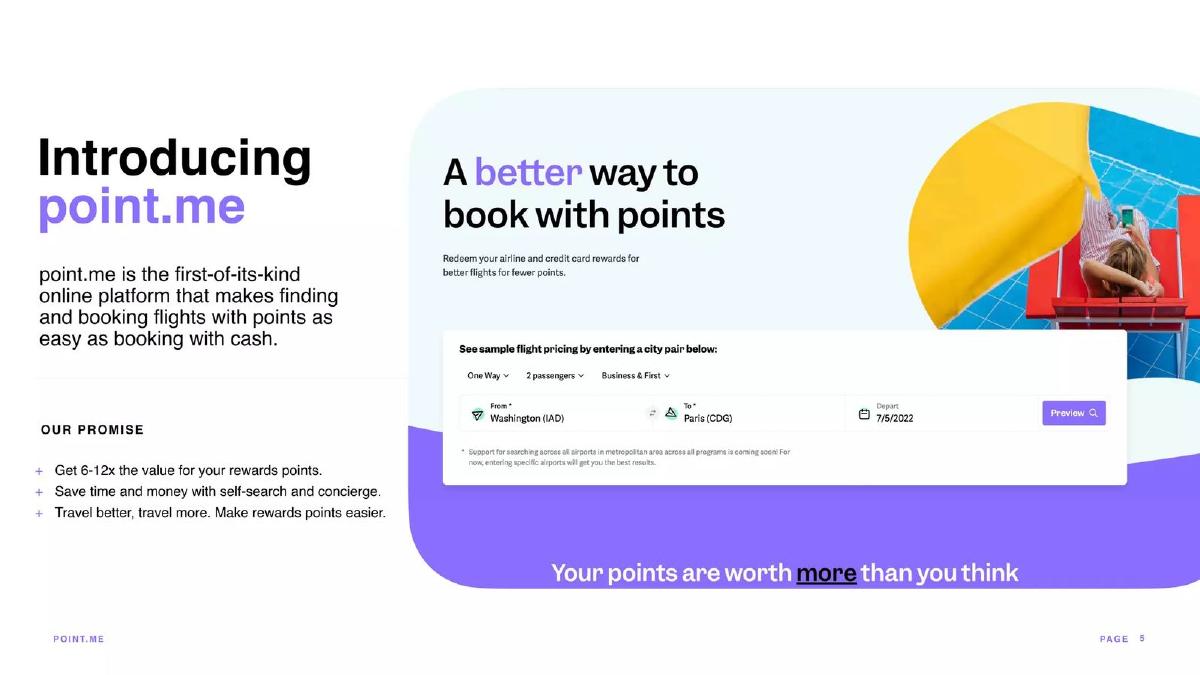
Search and booking for flights paid with loyalty points. Text on the left, product screen on the right.
point.me deck, slide 5. Exact stored slide matched to this analysis.
Our analysis: It shows the exact booking moment (a real route search) and gives the traveller a measured gain.
Evidence and limitation: "6-12x the value" claimed; not explained on the slide.
What a founder can adapt: Show your booking screen with a real example trip, and state the traveller's gain as a number.
Supporting analysis
What the deck claims: "Introducing point.me." "point.me is the first-of-its-kind online platform that makes finding and booking flights with points as easy as booking with cash." "Our promise: Get 6-12x the value for your rewards points. Save time and money with self-search and concierge. Travel better, travel more." Screen: "A better way to book with points", a Washington (IAD) to Paris (CDG) search. "Your points are worth more than you think."
Presentation choice: A familiar search box tells investors instantly what the product is; the multiple says why travellers switch.
When it does not fit: Explain the multiple (compared with what?) in a footnote; "first-of-its-kind" adds nothing.
Tour and activity distribution. Four numbered cards over a photo.
TourMega deck, slide 6. Exact stored slide matched to this analysis.
Our analysis: It shows two routes to the traveller (through partners and direct) from one pool of tours, labelled B2B2C.
Evidence and limitation: No figures.
What a founder can adapt: If you sell through partners and directly, show both routes from the same supply.
Supporting analysis
What the deck claims: "How it works (B2B2C)." "1 Tours aggregated from our supply partners." "2 TourMega provides our inventory to distribution partners." "2 Travelers search & plan activities on our platform." "3 Tours booked!"
Presentation choice: Naming both routes tells investors where bookings come from before the business model slide.
When it does not fit: Fix the numbering (two cards are "2"), and say who the distribution partners are.
iSmartAfrica deck, slide 5. Exact stored slide matched to this analysis.
Our analysis: It answers its own problem slide (businesses that can't be found) with a verified directory and cross-border payments, but in dense paragraphs.
Evidence and limitation: No figures.
What a founder can adapt: Show the Lagos-to-Nairobi booking from the problem slide passing through the product in three steps.
Supporting analysis
What the deck claims: "How it works." "The ATX works by combining intelligent discovery, seamless integrations, and trusted transactions. Through an AI-powered directory, it verifies and showcases Africa's tourism and hospitality businesses." "API integrations connect the ATX with booking platforms, airlines, payments, and government registries..." "A data and insights dashboard... and a secure payment and trust layer ensures safe cross-border transactions." "Together, these features create a connected, intelligent ecosystem for African travel."
Presentation choice: Linking back to the problem (unfound operators, cross-border trust) makes the solution feel necessary.
When it does not fit: Three paragraphs of features read as a system diagram; cut to one sentence per card.
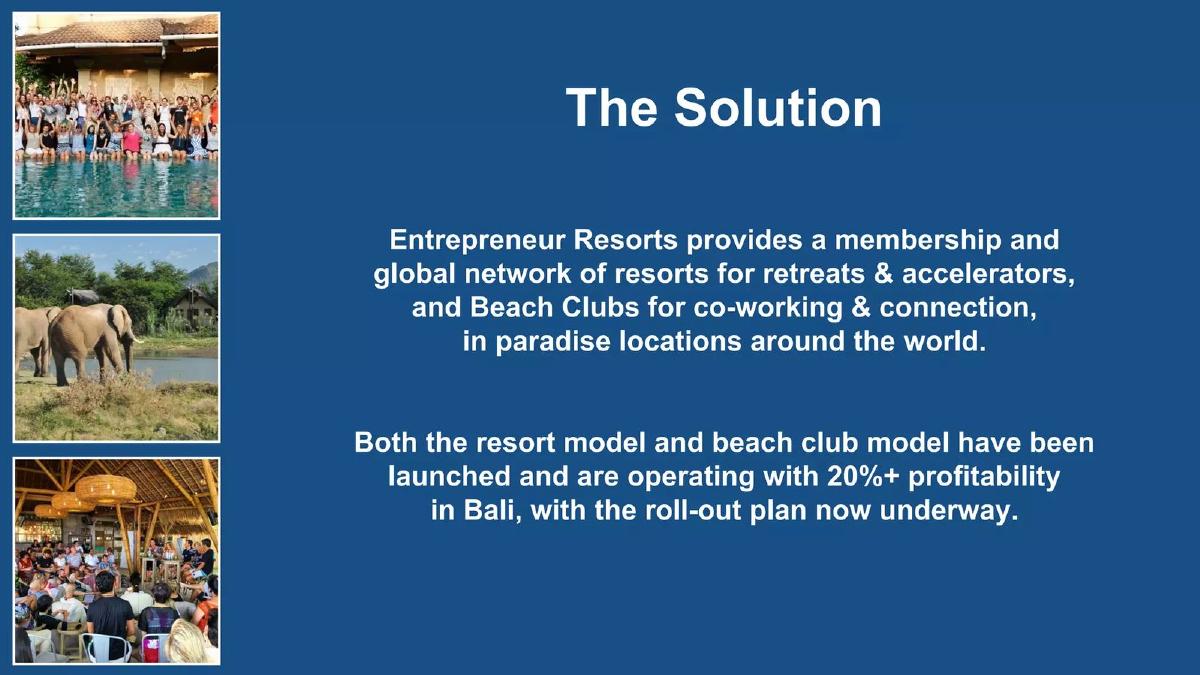
Resorts and beach clubs for travelling entrepreneurs. Three photos and two sentences.
Entrepreneur Resorts deck, slide 3. Exact stored slide matched to this analysis.
Our analysis: It names two products and proves both run somewhere today, the only slide here with an operating result.
Evidence and limitation: "20%+ profitability" in Bali; not defined or sourced.
What a founder can adapt: If you operate, name the live location and one result from it.
Supporting analysis
What the deck claims: "The Solution." "Entrepreneur Resorts provides a membership and global network of resorts for retreats & accelerators, and Beach Clubs for co-working & connection, in paradise locations around the world." "Both the resort model and beach club model have been launched and are operating with 20%+ profitability in Bali, with the roll-out plan now underway."
Presentation choice: For physical travel businesses, one live site with a margin is the strongest proof a solution slide can hold.
When it does not fit: Say which profit measure "20%+" is; its problem slide (weak in our problem guide) should set this up.
Traveller-to-local-advisor matching. Text over a map with a profile card.
Tip and Trip deck, slide 5. Exact stored slide matched to this analysis.
Our analysis: It explains how matching works but not the result; its problem slide measured 40 hours of planning, and this slide doesn't say how many it saves.
Evidence and limitation: No figures.
What a founder can adapt: Close the loop with your problem number: "40 hours of planning becomes one call".
Supporting analysis
What the deck claims: "The Solution." "Creating a platform matching the Traveler with an expert/local Advisor." "The match will be based on several parameters: 1. Geographical region 2. The Traveler desires 3. Fields of interest 4. Constraints (physical limitations, business, diet, children etc.)"
Presentation choice: Matching criteria show the mechanism is thought through; the traveller's gain is missing.
When it does not fit: Say what the advisor gets, since the problem slide promised to reward their knowledge.
Adventure travel discovery and booking (pre-revenue deck). One sentence and three icons. Partial example.
JourneyPalette deck, slide 3. Exact stored slide matched to this analysis.
Our analysis: It covers both sides (travellers filter and book; providers get visibility and inventory tools) but only as feature labels.
Evidence and limitation: No figures.
What a founder can adapt: Turn the three icons into one traveller booking one local provider, with what each gets.
Supporting analysis
What the deck claims: "Solution." "A unified platform for seamless adventure discovery and booking, featuring personalized recommendations and a strong focus on sustainable tourism and cultural preservation." Icons: "Centralized platform for discovery, booking and well-organized filters for different adventure styles"; "Global visibility, direct connections and inventory management for local providers"; "Curation of sustainable and culturally immersive travel experiences".
Presentation choice: Naming both sides is right; without a booking path or a gain, it reads as a feature list.
When it does not fit: "Seamless" and "unified" are claims; show the step that becomes easier.
Curated local tours. A slogan and three short phrases. Weak on purpose.
Tripongo deck, slide 4. Exact stored slide matched to this analysis.
Our analysis: The headline is a slogan with a question mark; the three phrases hint at operators and experts but show no product, booking step or result.
Evidence and limitation: No figures.
What a founder can adapt: Replace the slogan with one sentence naming who supplies, who books and what changes, then show the product.
Supporting analysis
What the deck claims: "The Solution?" "Give the customers what they want!" "Booked with pre verified local tour operators." "Give travellers access to trusted recommendations that they seek, make it easily bookable, save time." "Trips curated by trusted travel experts."
Presentation choice: It shows the minimum a travel solution slide needs: the parties, the booking step and one proof.
When it does not fit: A question-mark headline signals uncertainty on the slide that should be most concrete.
Whether each slide shows the supply-to-traveller chain, a gain for each side, and proof it works.
Example
Chain shown
Gain for each side
Proof
OutTrippin
Yes (operators → bloggers → travellers)
Yes (one per party)
No
point.me
Partly (traveller booking screen)
Traveller only (6-12x value)
No
TourMega
Yes (supply → partners or direct → booked)
No
No
iSmartAfrica
Partly (in paragraphs)
Partly
No
Entrepreneur Resorts
No (operator of resorts)
No
Yes (20%+ profitability in Bali)
Tip and Trip
Yes (traveller ↔ advisor)
No
No
JourneyPalette
Partly (feature labels)
Partly
No
Tripongo
No
No
No
Key Takeaways
Draw the trip's chain: who supplies it, who books it, and anyone in between.
Put one gain under each side, in their terms: new markets for operators, time or money for travellers.
Show the booking moment itself, such as a search screen, if the product is software.
Add one proof: a live location, a margin, bookings made. Few travel slides do.
A slogan is not a solution; name the parties and the step you change.
Build your travel solution slide
One chain, one gain per side, one proof.
Supply. Who supplies the trip: operators, hotels, airlines, guides, you?
Booking. How does the traveller find and book it? Show the screen or the step.
Gains. What does each side get, in their own units (bookings, hours, money)?
Proof. What already works: a live location, bookings made, a margin, a pilot?
Copyable framework: [Supplier] lists [trip] on [product]; [traveller] books it in [step]. Suppliers get [gain]; travellers get [gain]. So far: [proof].
Illustrative example 1 — written by us
Before: An all-in-one platform that revolutionises travel.
After: Small dive operators in Bali list trips; divers book in two taps. Operators keep 90% instead of paying 25% to agents; divers save 3 hours of searching. Pilot: 12 operators, 340 bookings.
What improved: Our illustrative rewrite; the figures are invented for the example. It names both sides, the booking step, a gain for each and a proof.
What this guide adds
The travel problem slide guide shows how these startups describe what goes wrong. This guide covers the next slide: how they show the fix. The general and marketplace solution guides cover any business or any two-sided platform; travel adds a longer chain (operators, hotels, airlines, guides, bloggers, distribution partners) and a buyer who books rarely, so investors look for who is on each end and why both will use it.
Most slides here are platforms connecting suppliers and travellers (OutTrippin, TourMega, iSmartAfrica, JourneyPalette, Tip and Trip, Tripongo). Two are different: point.me is a booking tool for one kind of payment (points), and Entrepreneur Resorts operates physical resorts.
Three things a travel solution slide proves
The chain: who supplies the trip and who books it (OutTrippin's three boxes; TourMega's four steps from supply partners to "Tours booked!").
The gain for each side: OutTrippin puts one under every party; point.me gives the traveller a multiple ("6-12x").
Proof: something already working. Only Entrepreneur Resorts gives one ("20%+ profitability in Bali").
Common mistakes
Slogan headline. "Give the customers what they want" says nothing about what you built.
Features, not a path. Show the booking from supplier to traveller, not a list of modules.
One side's gain only. Travel platforms need suppliers too; say what they get.
Not answering your problem slide. If your problem was 40 hours of planning, say how many you save.
No proof. Add one thing already working, even a small pilot.
Diagnostic checklist
It shows who supplies the trip and who books it.
It shows the booking step or screen.
It gives each side one gain.
It answers the number on the problem slide.
It includes one proof that it works.
Frequently asked questions
How we chose these examples
Corpus: published pitch deck teardowns on StartupFundraising.com. Founder-uploaded private decks are excluded.
Selection (2026-09-25): we searched slides 3–6 of travel, tourism and hospitality decks for solution slides. Eight stored images were inspected and all eight used. The Airbnb solution slide was excluded because Airbnb already appears in the general guides. Pilota was excluded because it appears in the AI solution guide. Alodmd's product slide was excluded because it describes a resort's amenities rather than a solution. JourneyPalette is marked partial; Tripongo is kept as a weaker contrast.
Overlap check: none of these eight slides appears in another guide. iSmartAfrica, Tip and Trip and Entrepreneur Resorts appear in the travel problem guide with different slides; JourneyPalette's problem slide there comes from a different deck.
Review: all eight stored slide images were inspected on 2026-09-25 and matched to company, deck and slide number (editorial model review). No person has yet completed an editorial review of this page.
Claims are as shown on the slides; we have not verified them. We make no claim that any slide caused a fundraising outcome.