How travel, tourism and hospitality startups present the problem in a pitch deck: name the traveller or travel business that suffers.
Travel and Hospitality Startup Problem Slide: Real Pitch Deck Examples
Eight problem slides from travel, tourism and hospitality startups, shown in full, compare whether each slide names who suffers (the traveller or the travel business), where in the trip it goes wrong, and whether it measures the problem.
TL;DR
A travel problem slide should say who suffers — the traveller, or the hotel, tour operator or host selling to them — at which point in the trip (planning, booking, the stay itself), and give one number. iSmartAfrica does all three: "a Lagos tour operator can't be found by a traveller in Nairobi" and "70% of Africa's 500,000+ tourism businesses have no digital presence", with a source ("UNWTO Africa Report 2023"). Tip and Trip measures the planning step: "The average Traveler is bound to waste 40 hours while planning an 8 day trip." Entrepreneur Resorts states a wish ("entrepreneurs want to be working... in paradise locations") and "No one organization has focused on meeting this need", with no one hurt and no number, which is the weaker pattern.
Travel startup problem slides from real pitch decks
Each example shows the exact stored slide above its analysis and links to the full teardown. Claims are as shown on the slides; we have not verified them.
iSmartAfrica problem slide — slide 4
Pan-African travel booking exchange. Problem and solution share one text slide.
iSmartAfrica deck, slide 4. Exact stored slide matched to this analysis.
Our analysis: Two concrete cases (Lagos operator, Kenya hotel) show both sides of the trip failing to find each other, and the sourced figure sizes it.
Evidence and limitation: 70% of 500,000+ businesses without digital presence, attributed to a UNWTO report.
What a founder can adapt: Give one concrete case of the failure between two named places or parties, then one sourced figure.
Supporting analysis
What the deck claims: "The problem." "Most times in Africa a Lagos tour operator can't be found by a traveller in Nairobi. A Kenya hotel can't access buyers in Lagos. 70% of Africa's 500,000+ tourism businesses have no digital presence." "(UNWTO Africa Report 2023)." "Our solution — The iSmartAfrica Africa Travel Exchange (ATX) would be a pan-African digital platform..."
Presentation choice: Specific city-to-city examples plus a cited number make the problem easy to picture and to trust.
When it does not fit: Move the solution to its own slide so the problem gets the full space.
Trip planning community. Two numbered problems with icons.
Tip and Trip deck, slide 4. Exact stored slide matched to this analysis.
Our analysis: Problem 1 is measured and belongs to the traveller; problem 2 is a missing product, not a pain.
Evidence and limitation: 40 hours of planning per 8-day trip; not sourced.
What a founder can adapt: Measure the painful step in time or money per trip.
Supporting analysis
What the deck claims: "The Problems." 1: "There is an overabundance of information available on the web. The average Traveler is bound to waste 40 hours while planning an 8 day trip." 2: "Lack of a platform that rewards people for their widespread knowledge regarding various destinations." Graphic: "40hr = 8days".
Presentation choice: Hours spent planning is a unit every traveller and investor understands.
When it does not fit: Drop "lack of a platform"; it describes your solution, not the problem. Source the 40 hours.
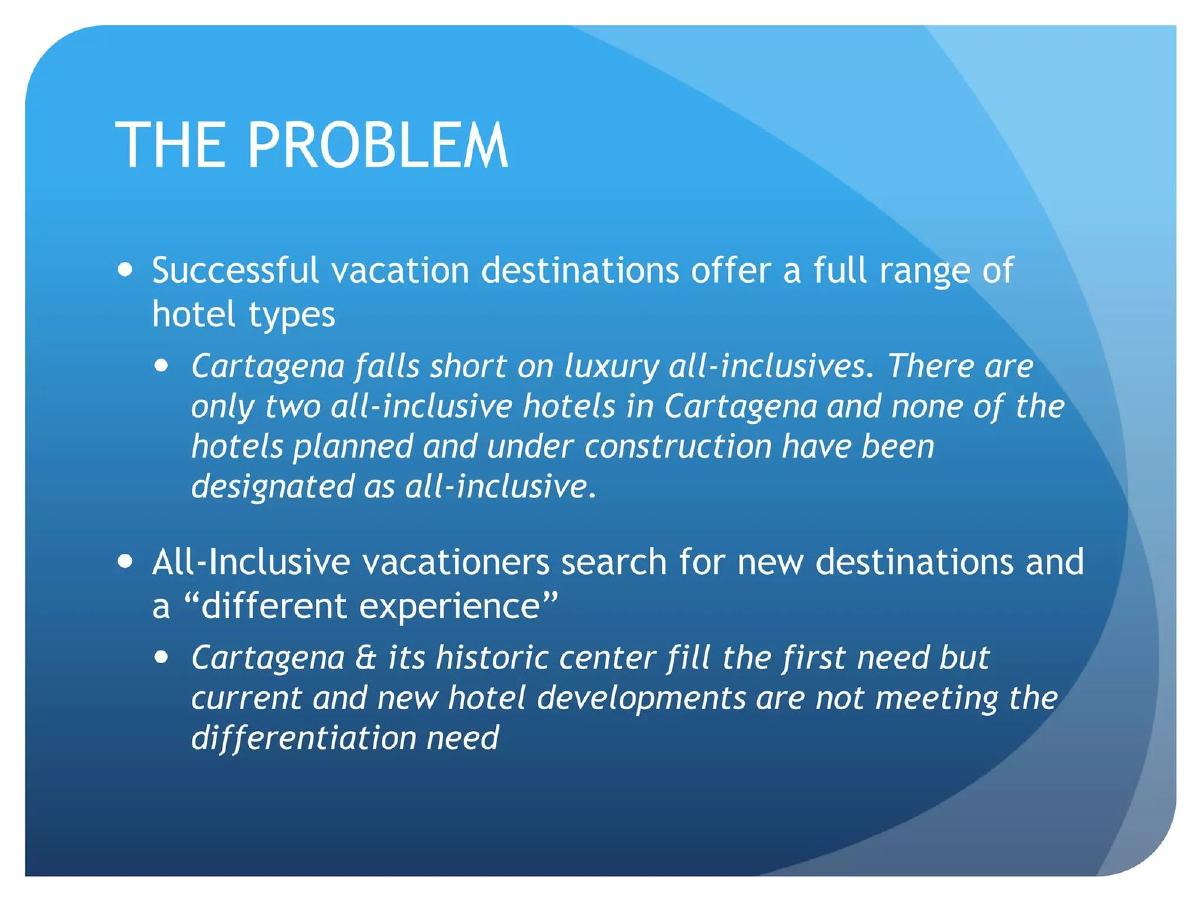
All-inclusive resort development in Cartagena, Colombia. Two bullets with sub-points.
Alodmd deck, slide 5. Exact stored slide matched to this analysis.
Our analysis: It frames the problem as a gap in a destination's supply, counted in hotels, which suits a property investment.
Evidence and limitation: Two all-inclusive hotels today; none in the pipeline. Not sourced.
What a founder can adapt: If you build or operate travel supply, count what exists and what is planned at your destination.
Supporting analysis
What the deck claims: "The problem." "Successful vacation destinations offer a full range of hotel types." "Cartagena falls short on luxury all-inclusives. There are only two all-inclusive hotels in Cartagena and none of the hotels planned and under construction have been designated as all-inclusive." "All-Inclusive vacationers search for new destinations and a 'different experience'."
Presentation choice: Counting existing and planned supply is exactly what a hotel investor checks first.
When it does not fit: Add demand: visitors per year or all-inclusive occupancy in comparable destinations.
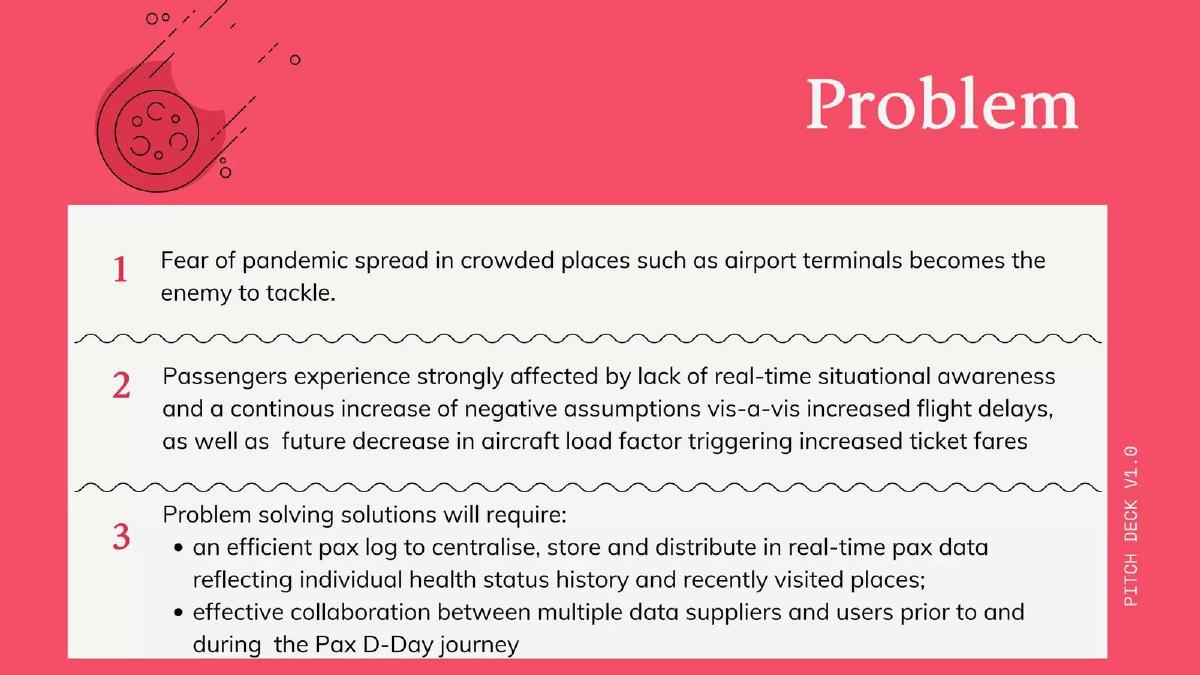
Passenger health-data platform for airports. Three numbered points.
Airport Continuity deck, slide 2. Exact stored slide matched to this analysis.
Our analysis: It names the place (the terminal) and a chain of effects (delays, lower load factor, higher fares), but point 3 describes the solution.
Evidence and limitation: No figures.
What a founder can adapt: Follow the chain to the party who pays and put a number on one link, such as delay minutes per flight.
Supporting analysis
What the deck claims: "Problem." 1: "Fear of pandemic spread in crowded places such as airport terminals becomes the enemy to tackle." 2: "Passengers experience strongly affected by lack of real-time situational awareness... increased flight delays, as well as future decrease in aircraft load factor triggering increased ticket fares." 3: "Problem solving solutions will require: an efficient pax log..."
Presentation choice: Tracing the problem to load factor and fares connects a passenger worry to airline economics.
When it does not fit: Keep requirements for the solution slide.
Adventure travel discovery and booking. A cycle of three linked problems.
JourneyPalette deck, slide 3. Exact stored slide matched to this analysis.
Our analysis: It points to the right step (discovery and booking) from the business side, but three abstract problems compete.
Evidence and limitation: No figures.
What a founder can adapt: Pick one: for example, share of an adventure operator's bookings that come from walk-ins versus online.
Supporting analysis
What the deck claims: "Problem." "Fragmented discovery and booking process & limited visibility for businesses." "The current fragmented discovery of adventures is a limitation to businesses visibility, reach and sustainable tourism practices." "Operational inefficiencies and lack of data-driven insights." "Lack of sustainable tourism practices and culture erosion."
Presentation choice: Choosing the operator's side is clear; the slide needs one operator and one number.
When it does not fit: "Culture erosion" is a separate, larger claim; leave it out or support it.
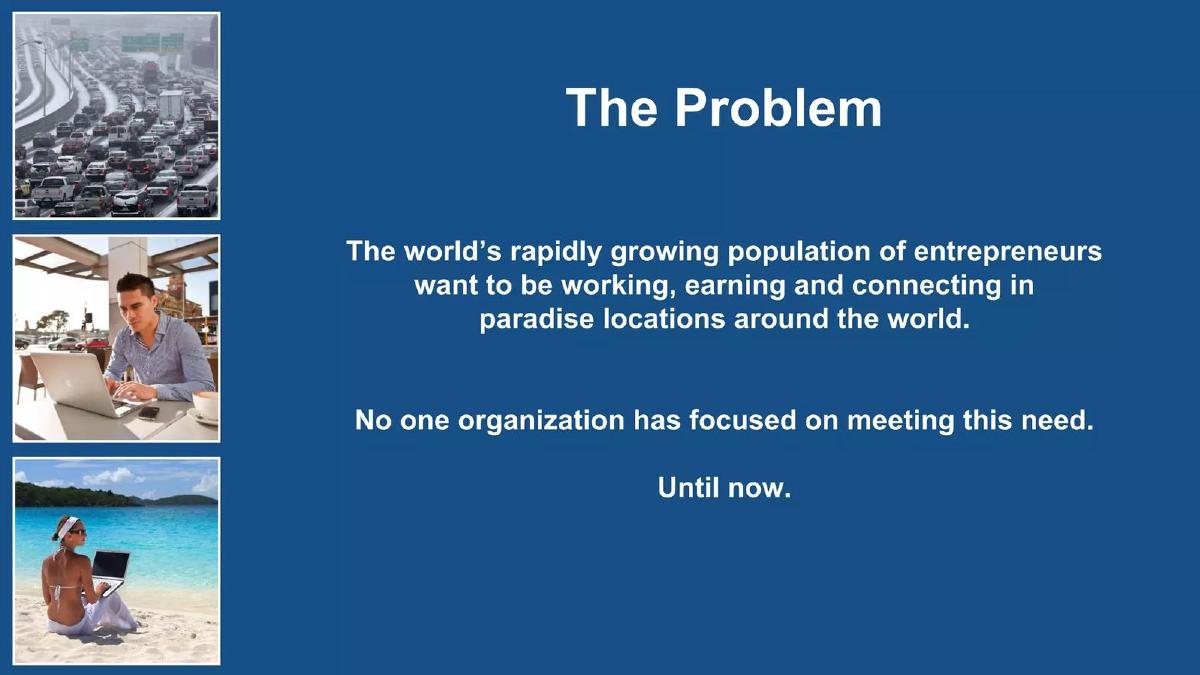
Resorts and co-working for travelling entrepreneurs. Three photos and two sentences. Weak on purpose.
Entrepreneur Resorts deck, slide 2. Exact stored slide matched to this analysis.
Our analysis: It states a desire and the absence of a company, not a pain for anyone.
Evidence and limitation: No figures; "rapidly growing" is unmeasured.
What a founder can adapt: Describe what a working traveller struggles with today (unreliable internet, no desk, visa limits) and how often.
Supporting analysis
What the deck claims: "The Problem." "The world's rapidly growing population of entrepreneurs want to be working, earning and connecting in paradise locations around the world." "No one organization has focused on meeting this need." "Until now."
Presentation choice: It shows the minimum a travel problem slide needs: who suffers, where in the trip, and a number.
When it does not fit: "No one has done this" is not a problem and invites the question of why.
Whether each slide names who suffers, where in the trip it goes wrong, and gives a number.
Example
Who suffers
Where in the trip
Number
iSmartAfrica
Yes (operators, hotels, travellers)
Yes (finding and booking)
Yes (70%, sourced)
Tip and Trip
Yes (the average traveller)
Yes (planning)
Yes (40 hours per 8-day trip)
Alodmd
Partly (all-inclusive vacationers)
Yes (destination hotel supply)
Yes (2 hotels, none planned)
Airport Continuity
Yes (passengers)
Yes (the terminal)
No
JourneyPalette
Yes (adventure businesses)
Yes (discovery and booking)
No
Love My Guide
No
Partly (guides at the destination)
Unclear ("€200 market")
Casai
No
Partly (the stay)
No
Entrepreneur Resorts
No
No
No
Key Takeaways
Decide which side of the trip you serve: the traveller or the business selling to them. Say it in the first line.
Name the point in the trip where it goes wrong: planning, booking, arrival, the stay.
Measure it in the sufferer's units: hours of planning, bookings lost, hotels missing, fares rising.
Source any industry figure; iSmartAfrica's cited 70% is more credible than an unsourced one.
"No one has focused on this" is not a problem; show who pays the price today.
Build your travel problem slide
One sufferer, one moment in the trip, one number.
Who. Is it the traveller or the business selling to them? Name one.
Where. At which point in the trip does it go wrong: planning, booking, getting there, the stay, the destination?
How much. What does it cost them: hours, money, lost bookings, empty rooms?
Source. Where does the number come from?
Copyable framework: [Traveller or business] loses [number and unit] at [point in the trip] because [cause]. (Source: [source].)
Illustrative example 1 — written by us
Before: Travel is broken and nobody is fixing it.
After: Small dive operators in Bali fill 40% of seats because 7 in 10 bookings go through agents who take 25% commission. (Source: our survey of 60 operators.)
What improved: Our illustrative rewrite; the figures are invented for the example. It names who suffers, where in the trip, a number and a source.
What this guide adds
The general problem slide guide covers any business, and the marketplace and real estate problem guides cover booking platforms and property. This guide covers travel itself: trip planning, destinations, tours, airports and short stays. Travel investors want to know which side of a two-sided trip is hurt, because travellers and travel businesses pay in very different ways.
Half of these slides are written from the traveller's side (Tip and Trip, Airport Continuity, Love My Guide, Casai) and half from the business or destination side (iSmartAfrica, Alodmd, JourneyPalette). Seeing both helps you choose.
Three things a travel problem slide proves
Who suffers: a named traveller or business (iSmartAfrica's Lagos operator and Kenya hotel; Tip and Trip's "average Traveler").
Where in the trip: planning (Tip and Trip), discovery and booking (JourneyPalette), the airport (Airport Continuity), the destination's hotel supply (Alodmd).
How much: a measured size (iSmartAfrica's 70%, Tip and Trip's 40 hours, Alodmd's "only two all-inclusive hotels"). Most slides skip this.
Common mistakes
No side chosen. Say whether the traveller or the travel business is hurt.
"No one has done this". Absence of a company is not a problem; show who pays today.
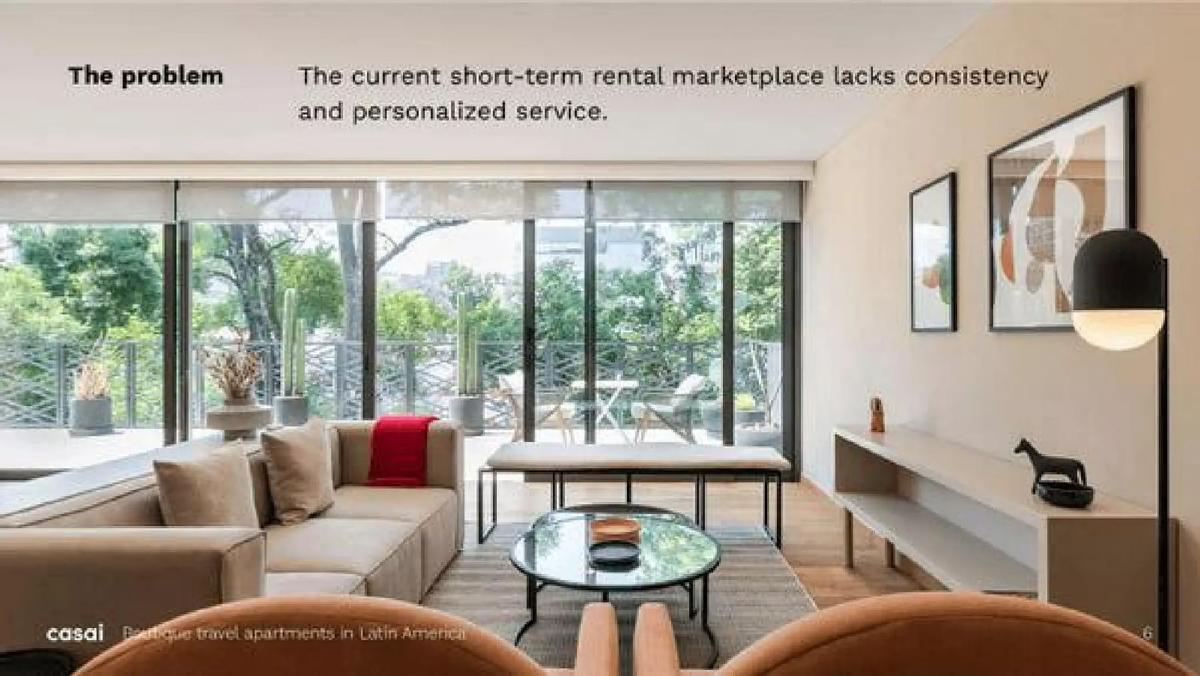
Your product in the picture. A photo of your apartment or app makes the problem look solved.
Solution on the problem slide. Requirements and platform descriptions belong on the next slide.
Unreadable numbers. Write figures in full with a unit and a source.
Diagnostic checklist
It names who suffers: traveller or business.
It says where in the trip it goes wrong.
It gives one number in their units.
The number has a source.
The solution is left for the next slide.
Frequently asked questions
How we chose these examples
Corpus: published pitch deck teardowns on StartupFundraising.com. Founder-uploaded private decks are excluded.
Selection (2026-09-25): we searched slides 2–6 of travel, tourism and hospitality decks for problem slides. Ten stored images were inspected. The Airbnb problem slide was excluded because it already appears in the general problem slide guide. Smart Host and Stay Ulo were excluded because they appear in the real estate problem guide. Casai and Love My Guide are marked partial; Entrepreneur Resorts is kept as a weaker contrast.
Overlap check: none of these eight slides appears in another guide.
Review: all eight stored slide images were inspected on 2026-09-25 and matched to company, deck and slide number (editorial model review). No person has yet completed an editorial review of this page.
Claims are as shown on the slides; we have not verified them. We make no claim that any slide caused a fundraising outcome.