Alodmd (A La Orilla Del Mar Development LLC) presents a traditional real estate and hospitality investment deck for a luxury resort in Cartagena, Colombia. The project, titled Atolones Beach Resort & Spa, seeks to capitalize on Cartagena's growth as a mass-market tourist destination. The deck is heavily focused on capital expenditure and long-term financial modeling, projecting a total capital cost of $100 million. Key components include land acquisition at $16 million and construction at $44 million. The revenue model is granular, breaking down rates by channel (Tour Operators, OTAs, Direct)…
Key takeaways
- The project requires a total capital cost of US$100 million, with construction accounting for $44 million and land for $16 million (Slide 5).
- The resort concept is modeled after Maldives-style water villas and man-made blue water lagoons (Slide 3).
- Revenue is diversified across three product types: Hotel Rooms, Villas, and Villa Suites, with specific ADR targets for each (Slide 8).
- Financial projections extend to Year 10, forecasting a rise in net margin from 5% in Year 1 to 18% in Year 10 (Slide 9).
- Occupancy is expected to scale from 65% in Year 1 to 80% by Year 10 (Slide 9).
- The development relies on Karisma Hotels & Resorts for operational management, marketing, and sales (Slide 6).
- Competition is identified both locally in Cartagena (Decameron Baru) and regionally in Mexico and the Dominican Republic (Slide 7).
- The master plan for Atolones Beach Resort & Spa was designed by architect Carlos Ott (Slide 4).
Executive Summary: A High-Stakes Hospitality Play
The Alodmd pitch deck for the Atolones Beach Resort & Spa is a classic real estate development proposal. Unlike a software startup deck that focuses on user growth and viral loops, this deck is centered on physical assets, capital expenditure (CapEx), and long-term yield. The project aims to bring a Maldives-inspired luxury experience to Cartagena, Colombia, a market the founders describe as an emerging mass-market destination similar to the early days of the Mayan Riviera.
Slide 1: Title and Branding
The cover slide introduces "A La Orilla Del Mar Development LLC" (Alodmd) with a wave-inspired logo. The subtitle is a generic "Investment Opportunity." While functional, it does not immediately communicate the scale or the specific location of the project, requiring the viewer to move to the next slide to understand the geographic focus.
Slide 2: Market Opportunity
Slide 2 identifies Cartagena as the primary market. The core thesis is that Cartagena is currently in an "emerging" phase, reminiscent of high-growth periods in the Mayan Riviera and Punta Cana. This is a standard real estate pitch tactic: identifying a location that is undervalued but poised for a massive influx of tourism infrastructure.
Slide 3: The Concept
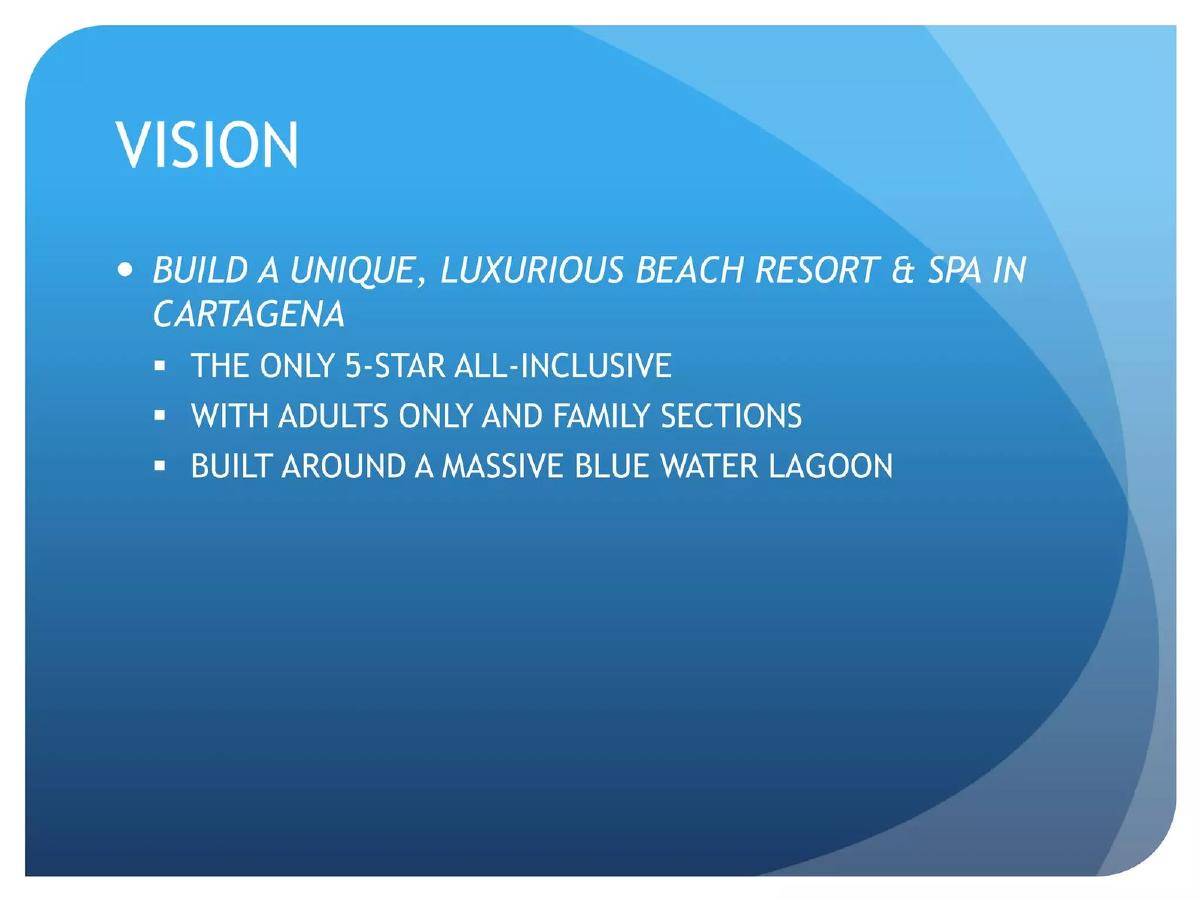
The "Concept" slide defines the product. The resort will feature two distinct architectural elements: villas built over the water (referencing the Maldives) and a man-made blue water lagoon. This slide serves as the "Solution" in a traditional pitch deck, offering a differentiated product to a market that may currently lack this specific type of luxury offering.
Slide 4: The Master Plan
This slide provides a high-resolution architectural rendering of the Atolones Beach Resort & Spa. The plan is credited to Carlos Ott, a well-known architect. The visual shows a dense but organized layout of villas, central amenities, and the lagoon mentioned in the previous slide. Including a professional master plan is critical for real estate decks to prove the project has moved past the ideation phase.
Slide 5: Hotel Cost (The CapEx Breakdown)
Slide 5 is the most critical slide for an investor interested in the "Ask." It lists a total Capital Cost of US$100 million. The breakdown is specific: Land ($16,000,000) , Construction Costs ($44,000,000) , Furniture & Fixtures ($11,000,000) , Professional Fees & Services ($7,000,000) , Working Capital ($15,000,000) , and Capitalized Interest ($7,000,000) . The inclusion of capitalized interest and working capital suggests a realistic understanding of the financial carry required for a project of this magnitude.
Slide 6: Operational Partnership
To mitigate the risk of being "just a developer," Alodmd highlights its partnership with Karisma Hotels & Resorts. The slide lists Karisma's brands (El Dorado, Azul) and their "Gourmet Inclusive" experience. By mentioning Karisma’s existing operations in Colombia and their centralized marketing and sales infrastructure, Alodmd is attempting to de-risk the operational side of the investment.
Slide 7: Competition
The competition slide is split into local and regional categories. Locally, it names Decameron Baru and Occidental Grand Cartagena. Regionally, it acknowledges the heavy hitters in Mexico and the Dominican Republic. This shows a macro-level understanding of where their potential guests might otherwise spend their money, though it lacks a direct comparison of features or price points.
Slide 8: Revenue Model
Slide 8 provides a granular look at how the resort will generate cash. It breaks down the "Base Room Rates AIPPPN" (All-Inclusive Per Person Per Night) across three tiers: Hotel Rooms, Villas, and Villa Suites. It also forecasts the channel mix, showing a heavy reliance on Online Travel Agencies (OTAs) for Villas (40%) and Villa Suites (45%), while Hotel Rooms are split evenly between Tour Operators and OTAs (35% each). The weighted average rates are calculated in both USD and COP (Colombian Pesos).
Slide 9: Ten-Year Financial Projections
The financial slide provides a P&L forecast for Years 1, 2, 3, 4, 5, and 10. Key metrics include:
Sales: Starting at $44.6M (Year 1) and reaching $71.4M (Year 10). · EBITDA: Growing from $12.0M to $20.7M. · Net Margin: Scaling from 5% to 18%. · Occupancy: Starting at 65% and reaching 80%. · ADR per Person: Increasing from $165 to $215.
The inclusion of "Asset Replacement" and "Management Fees" as line items indicates a sophisticated financial model that accounts for the long-term maintenance of a luxury property.
Slide 10: Keys to Success
The final slide in the sample summarizes the value proposition: product differentiation, Karisma’s management, service ethics, and the growth of Cartagena. It acts as a summary of the preceding slides but does not offer new data.
What Works in This Deck
The deck is exceptionally strong on financial transparency. Slide 5 (Costs) and Slide 9 (Financials) provide the level of detail a private equity firm or a high-net-worth real estate investor would expect. The revenue model (Slide 8) is also highly professional, showing a clear understanding of hospitality distribution channels (Tour Operators vs. OTAs vs. Direct). The inclusion of a master plan by a named architect (Carlos Ott) adds significant credibility to the project's feasibility.
What Is Missing
The most glaring omission in this 10-slide sample is a specific "Ask" slide. While the total cost is $100 million, the deck does not specify how much equity is being raised, what the debt-to-equity ratio is, or what the expected IRR (Internal Rate of Return) for the investor will be. Additionally, there is no "Team" slide for Alodmd itself; while Karisma is mentioned as an operator, the background of the developers (A La Orilla Del Mar Development LLC) is not provided. Finally, there is no timeline or roadmap showing the current status of permits, land acquisition, or construction start dates.
Founder's Takeaway
Founders in the real estate or hospitality space should study Slide 8 and Slide 9. Many decks fail because they provide "top-down" market numbers without showing the "bottom-up" mechanics of how money is actually made. Alodmd shows exactly how room rates, channel mix, and occupancy flow into the bottom line. However, founders should ensure they include a clear timeline. In development, time is the greatest risk; investors need to know if this is a two-year build or a five-year build before they can evaluate the projected Year 1 revenues.
Frequently asked questions
- What is the total investment required for the Alodmd project?
- According to Slide 5, the total capital cost is US$100 million. This is broken down into land ($16M), construction ($44M), furniture and fixtures ($11M), professional fees ($7M), working capital ($15M), and capitalized interest ($7M).
- Who will manage the day-to-day operations of the resort?
- The deck identifies Karisma Hotels & Resorts as the partner for hotel operations. Slide 6 notes that Karisma provides centralized marketing, sales, a call center, and social networking, and has experience operating in Colombia, Mexico, Jamaica, and Europe.
- What are the projected room rates for the different accommodations?
- Slide 8 details the 'Base Room Rates AIPPPN' (All-Inclusive Per Person Per Night). Hotel rooms range from $100 to $160, Villas from $140 to $220, and Villa Suites from $175 to $280, depending on the sales channel.
- How does the company view its competitive landscape?
- Slide 7 categorizes competition into two tiers: local all-inclusive hotels in Cartagena like Decameron Baru and Occidental Grand, and regional 4-5 star all-inclusive destinations in Mexico (Cancun/Riviera Maya), the Dominican Republic (Punta Cana), and Cuba.
- What are the long-term profitability goals for the resort?
- Slide 9 projects that the resort will achieve $44.6 million in sales in Year 1, growing to $71.4 million by Year 10. During this period, EBITDA is projected to grow from $12 million to $20.7 million, with net margins improving from 5% to 18%.