The Allana Potash pitch deck, presented in June 2014, outlines the company's vision to develop a low-cost potash mine in Africa, targeting new markets. The presentation emphasizes a 'World Class Potash Resource' with 'Robust Economics & Low Cost Proven Mining Method', detailing a US$1.32 billion after-tax NPV and a 33% IRR. Key highlights include a clear path to full debt plus equity financing, strategic partnerships with ICL, Liberty Metals & Mining, and IFC, and a fast track to production with project commencement expected late 2016. The deck provides detailed resource estimates, financial…
Key takeaways
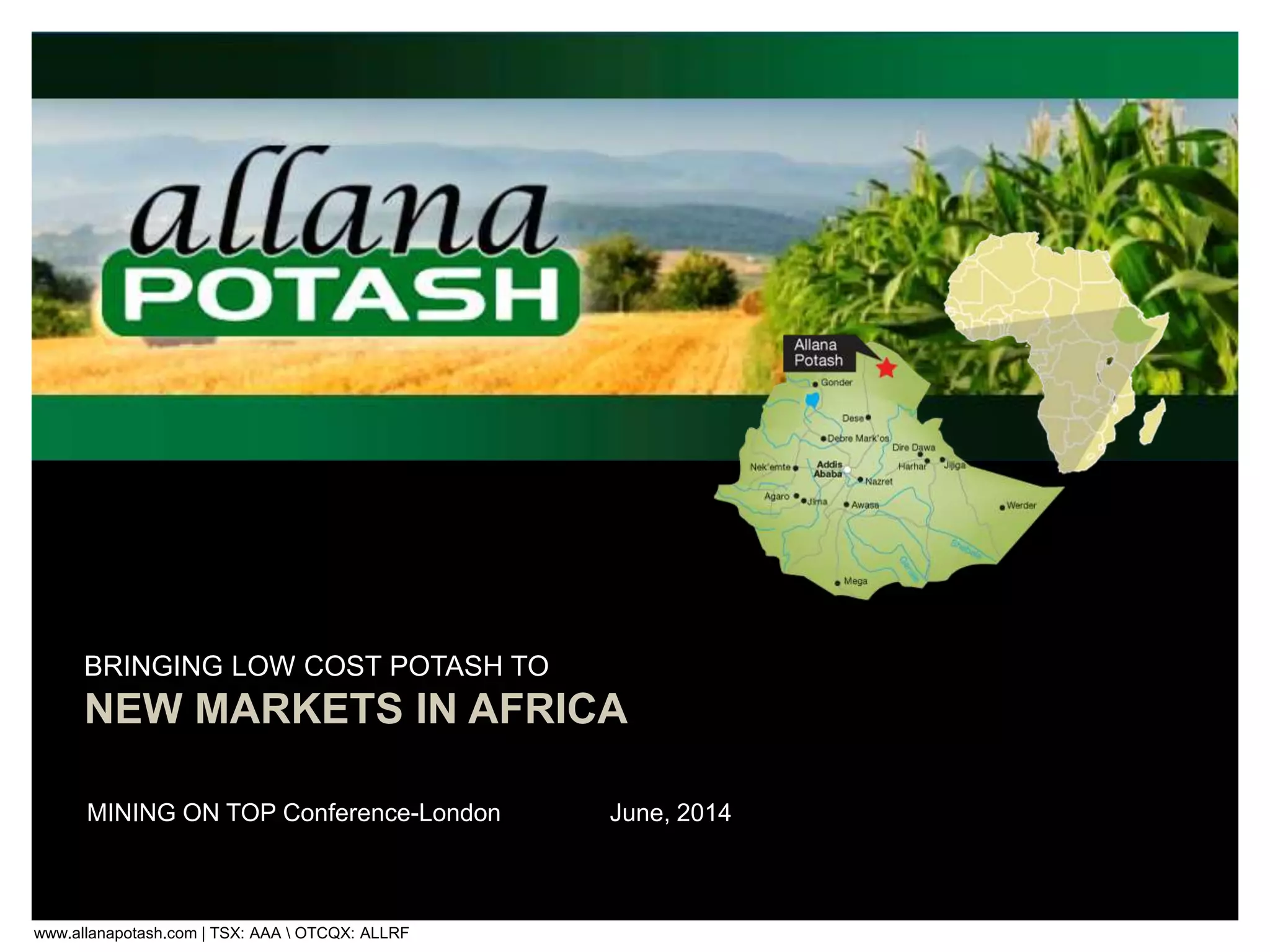
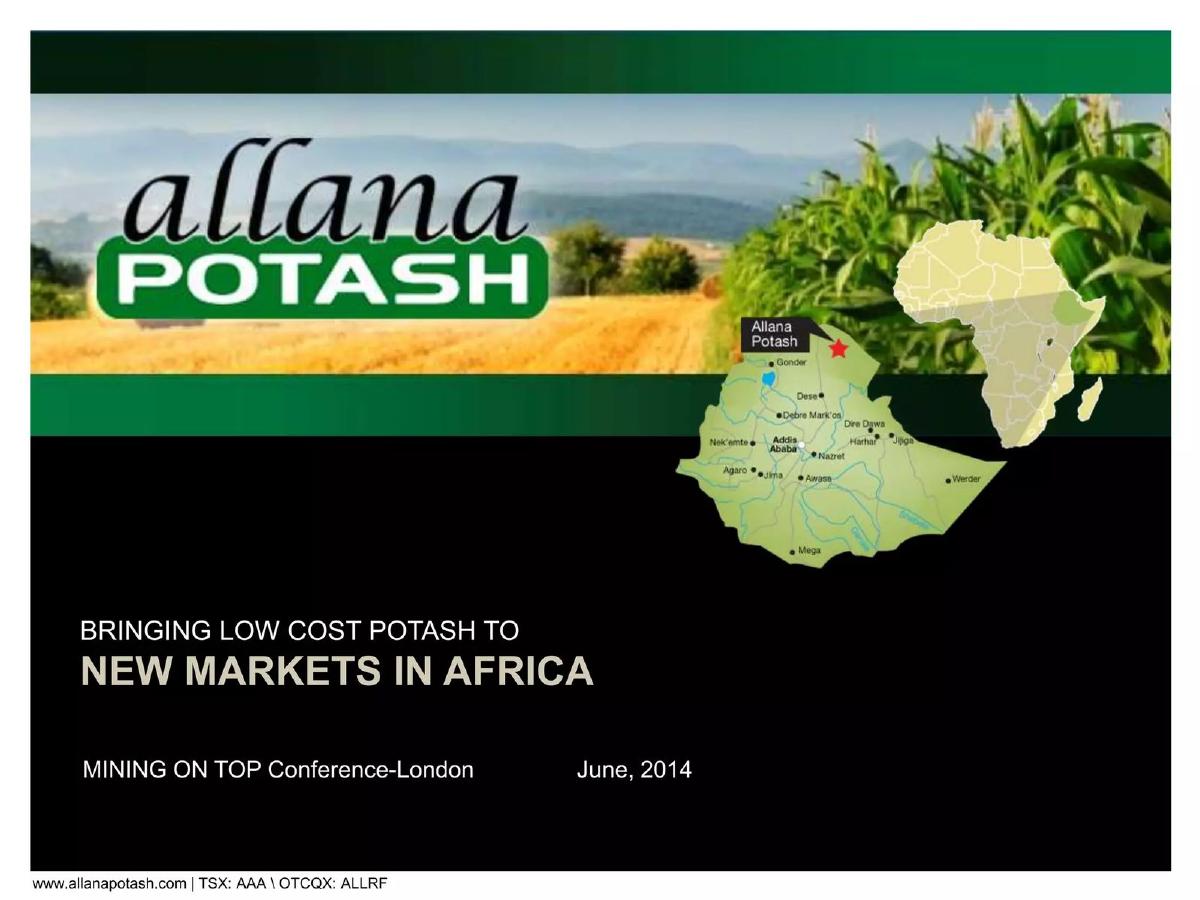
- The deck's title slide (Slide 1) clearly states the company's mission: 'BRINGING LOW COST POTASH TO NEW MARKETS IN AFRICA'.
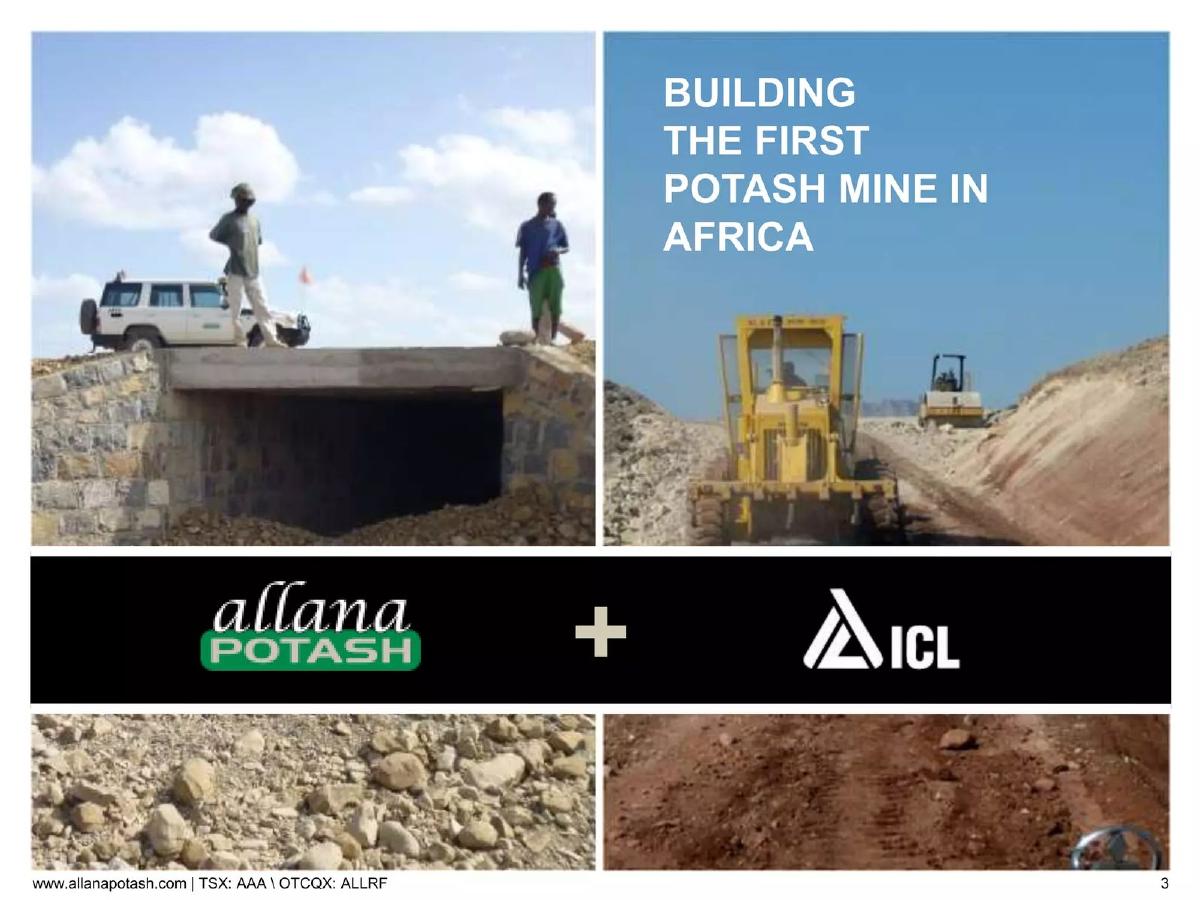
- Slide 3 highlights the company's primary objective: 'BUILDING THE FIRST POTASH MINE IN AFRICA' and showcases a partnership with ICL.
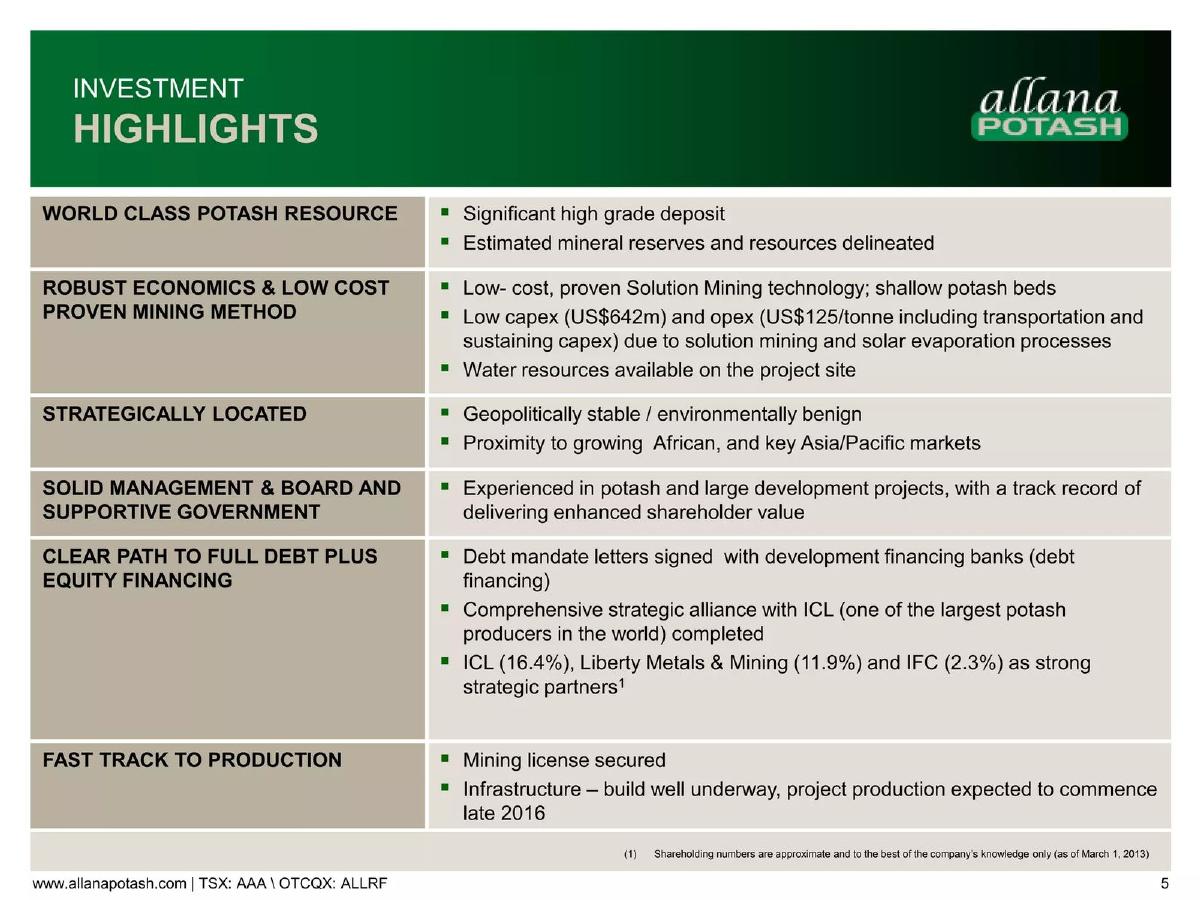
- Investment Highlights on Slide 5 detail a 'World Class Potash Resource', 'Robust Economics & Low Cost Proven Mining Method' with low capex (US$642M) and opex (US$125/tonne).
- Slide 5 also mentions a 'Clear Path To Full Debt Plus Equity Financing' and strategic partners including ICL (16.4%), Liberty Metals & Mining (11.9%), and IFC (2.3%).
- The market opportunity is presented on Slide 7, noting that 'potash demands to grow by 5-6% CAGR through to 2025' in African nations like Ethiopia.
- Feasibility Study results on Slide 11 project a 10% after-tax NPV of US$1.32 billion, an IRR of 33%, and a payback period of 3.1 years from COD.
- Slide 11 provides detailed CAPEX (US$M) of US$642 and OPEX (US$/tonne) of US$125, with key assumptions including a Potash Price of US$430 / tonne.
- A 'Track Record' on Slide 13 outlines milestones from 2009 to 2013, including resource estimate increases and strategic investments.
Allana Potash Pitch Deck Teardown
This teardown analyzes the investor presentation for Allana Potash, a company focused on developing potash resources in Africa. The deck, titled "Investor Presentation - Allana Potash" according to its SlideShare source listing, was presented in June 2014. It comprises 15 slides in total, with 8 slides provided for this analysis. The presentation aims to outline the investment opportunity in building the first potash mine in Africa, emphasizing the project's economic viability, strategic location, and market potential.
The analysis will proceed slide-by-slide, detailing the content presented, quoting exact figures, and highlighting any notable omissions in line with the specified guidelines. The deck primarily targets potential investors, providing a comprehensive overview of the project's technical, financial, and market aspects.
Slide 1: Title Slide
The first slide serves as the title page for the presentation. It features the company logo, "allana POTASH," prominently displayed against a backdrop of what appears to be an agricultural landscape, possibly indicating the end-use of potash. A map of Africa, with a specific focus on Ethiopia, highlights the location of "Allana Potash" with a red star. Several cities and regions within Ethiopia are marked, including Gondar, Dessie, Debre Markos, Addis Ababa, Nekemte, Agaro, Jimma, Awassa, Dire Dawa, Harar, Nazret, Werder, and Mega. The main title of the presentation is "BRINGING LOW COST POTASH TO NEW MARKETS IN AFRICA." Below this, it states "MINING ON TOP Conference-London" and "June, 2014." At the bottom of the slide, a footer reads "www.allanapotash.com | TSX: AAA | OTCQX: ALLRF."
Omissions: While providing a clear title and context for the presentation, this slide does not offer any specific financial figures, team information, or a direct call to action. It sets the stage but leaves the details for subsequent slides.
Slide 3: Building the First Potash Mine in Africa
Slide 3 is visually driven, featuring four distinct images. The top left image shows two individuals standing on a structure, possibly part of an access road or bridge, with a white vehicle nearby. The top right image depicts heavy machinery, specifically a grader, working on a dirt road or site preparation. The bottom two images show close-ups of rocky terrain, likely indicating the project site. Centrally, the logos "allana POTASH" and "ICL" are displayed with a plus sign between them, suggesting a partnership. The main text on the slide, in large blue font, declares: "BUILDING THE FIRST POTASH MINE IN AFRICA." The footer remains consistent: "www.allanapotash.com | TSX: AAA | OTCQX: ALLRF."
Omissions: This slide effectively communicates the company's ambition and a key partnership but provides no specific details about the nature of the partnership with ICL, the timeline for building the mine, or any financial aspects related to this construction. It serves as a high-level statement of intent.
Slide 5: Investment Highlights
This slide is structured as a bulleted list of "INVESTMENT HIGHLIGHTS." The main categories are: "WORLD CLASS POTASH RESOURCE," "ROBUST ECONOMICS & LOW COST PROVEN MINING METHOD," "STRATEGICALLY LOCATED," "SOLID MANAGEMENT & BOARD AND SUPPORTIVE GOVERNMENT," "CLEAR PATH TO FULL DEBT PLUS EQUITY FINANCING," and "FAST TRACK TO PRODUCTION."
Under "WORLD CLASS POTASH RESOURCE," points include: "Significant high grade deposit" and "Estimated mineral reserves and resources delineated." · "ROBUST ECONOMICS & LOW COST PROVEN MINING METHOD" details: "Low- cost, proven Solution Mining technology; shallow potash beds," "Low capex (US$642M) and opex (US$125/tonne including transportation and sustaining capex)," and "Water resources available on the project site." · "STRATEGICALLY LOCATED" highlights: "Geopolitically stable / environmentally benign" and "Proximity to growing African, and key Asia/Pacific markets." · "SOLID MANAGEMENT & BOARD AND SUPPORTIVE GOVERNMENT" states: "Experienced in potash and large development projects, with a track record of delivering enhanced shareholder value." · "CLEAR PATH TO FULL DEBT PLUS EQUITY FINANCING" includes: "Debt mandate letters signed with development financing banks (debt financing)," "Comprehensive strategic alliance with ICL (one of the largest potash producers in the world) completed," and "ICL (16.4%), Liberty Metals & Mining (11.9%) and IFC (2.3%) as strong strategic partners¹." A footnote states: "(1) Shareholding numbers are approximate and to the best of the company’s knowledge only (as of March 1, 2013)." · "FAST TRACK TO PRODUCTION" notes: "Mining license secured" and "Infrastructure – build well underway, project production expected to commence late 2016."
The footer is consistent: "www.allanapotash.com | TSX: AAA | OTCQX: ALLRF."
Omissions: While comprehensive in its highlights, this slide does not provide specific names for the "Solid Management & Board," nor does it detail the nature of the "supportive government." The "Estimated mineral reserves and resources delineated" is mentioned without specific figures, which are likely detailed elsewhere. The debt mandate letters are mentioned but not the specific banks or amounts.
Slide 7: African Potash Consumption
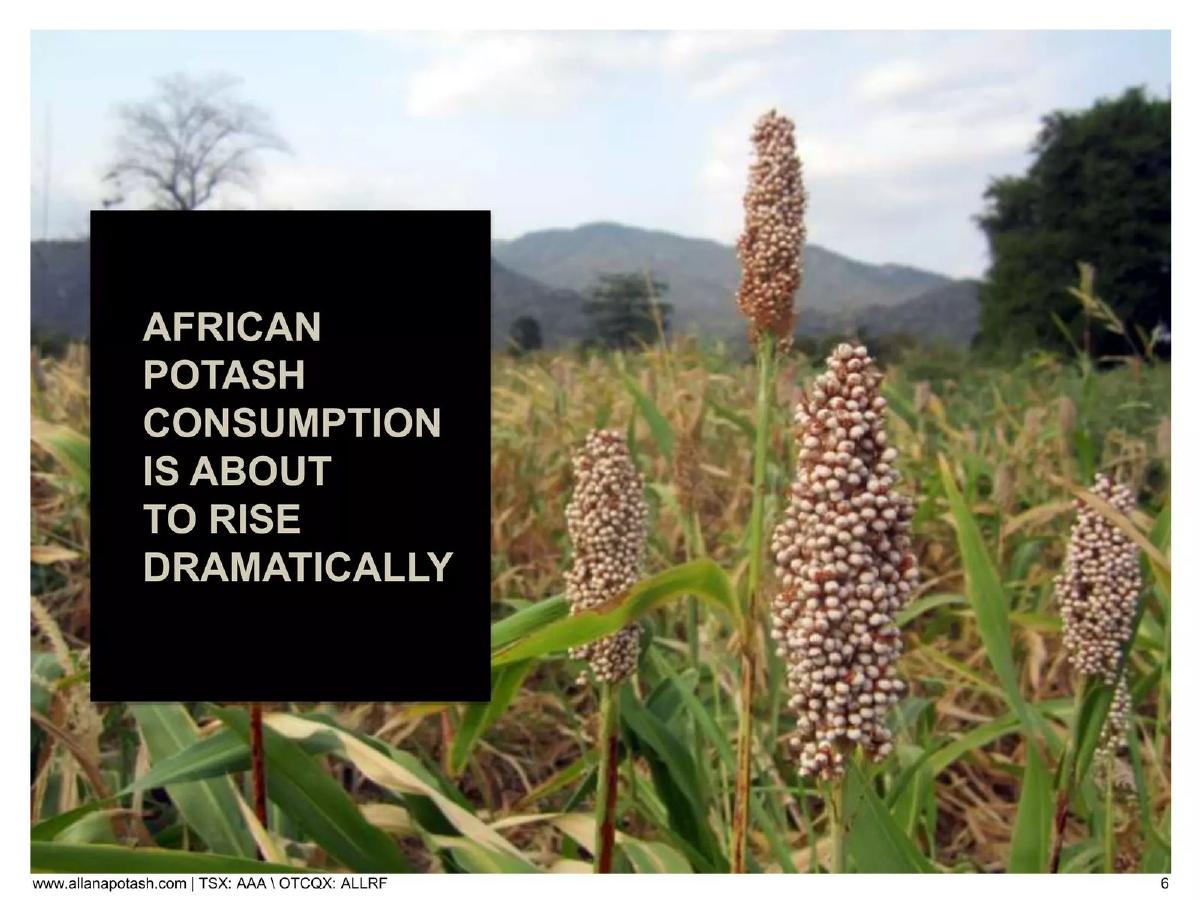
This slide focuses on the market opportunity, titled "AFRICAN POTASH CONSUMPTION¹ IS ABOUT TO RISE DRAMATICALLY." The main content is a bulleted list on the left, with a large image of a combine harvester in a field on the right.
The first bullet point states: "Dramatic structural changes in the agricultural sectors in African nations including Ethiopia:" followed by a sub-bullet: "Significant FDI into the agribusiness sector, better funding, export orientation, need for more fertilizers (potash demands to grow by 5-6% CAGR through to 2025)." · The second bullet point: "Governments along with NGOs and private companies building rural infrastructure and educating farmers on the use of fertilizers including potash" with a sub-bullet: "(Ethiopia – 15% of public spending goes to agribusiness sector; length of rural roads quadrupled, rail network under construction, extreme poverty reduced by 49% 1995-2011)." · The third bullet point: "African nations including Ethiopia announced plans to build NPK blending facilities which will increase the amount of potash used." · The fourth bullet point: "Ethiopia and other countries are becoming significant exporters of various agricultural products."
A source is cited at the bottom: "Source: IFIA + Argus Consulting Inc. – 2013, New African Magazine, March 2014." The footer remains consistent: "www.allanapotash.com | TSX: AAA | OTCQX: ALLRF."
Omissions: The slide presents compelling market trends but does not provide specific data on current potash consumption volumes in Africa or Ethiopia, nor does it detail the competitive landscape within this growing market. The exact impact of the NPK blending facilities on potash demand is not quantified.
Slide 9: Geology and Resource Delineation
Slide 9 is dedicated to the technical aspects of the resource, titled "STRATEGY EXECUTION GEOLOGY AND RESOURCE DELINEATION." It features two main sections: "RESOURCE ESTIMATE SUMMARY (FEASIBILITY STUDY)" on the left and "DELINEATION OF SIGNIFICANT RESOURCE" on the right, which includes a map.
SYLVINITE RESERVES (1) · Proven: In Situ Resource (MT) 32.97, KCl (%) 28.0, Contained KCl (MT) 8.2 · Probable: In Situ Resource (MT) 60.81, KCl (%) 28.8, Contained KCl (MT) 15.5 · Total reserves: Contained KCl (MT) 23.7
Measured: In Situ Resource (MT) 115.31, KCl (%) 27.8, Contained KCl (MT) 32.0 · Indicated: In Situ Resource (MT) 212.11, KCl (%) 28.6, Contained KCl (MT) 60.7 · Inferred: In Situ Resource (MT) 90.76, KCl (%) 27.8, Contained KCl (MT) 25.2
Measured: In Situ Resource (MT) 552.3, KCl (%) 19.2, Contained KCl (MT) 105.9 · Indicated: In Situ Resource (MT) 598.2, KCl (%) 19.5, Contained KCl (MT) 116.8 · Inferred: In Situ Resource (MT) 481.8, KCl (%) 19.8, Contained KCl (MT) 95.3
Measured: In Situ Resource (MT) 121.5, KCl (%) 17.5, Contained KCl (MT) 21.3 · Indicated: In Situ Resource (MT) 289.8, KCl (%) 17.2, Contained KCl (MT) 49.9 · Inferred: In Situ Resource (MT) 175.5, KCl (%) 16.5, Contained KCl (MT) 29.0
The right section displays a map titled "Allana Drill Hole Allana Property" with a scale bar in kilometers and a date of "March 17, 2014." Various drill hole locations are marked on the map, along with geological delineations. A source note at the bottom states: "Source: ERCOSPLAN Feasibility Study Feb 2013 & Resource Estimate Jun 2013 – Please refer to page 2 for full source of FS and resource estimate." The footer is consistent: "www.allanapotash.com | TSX: AAA | OTCQX: ALLRF."
Omissions: While providing extensive resource data, the slide does not explain the implications of these different resource types (Sylvinite, Kainitite, Upper Carnallitite) for mining methods or processing, nor does it detail the specific geological challenges or advantages beyond the raw numbers. The map lacks a legend for all its symbols, making full interpretation difficult without prior knowledge.
Slide 11: Feasibility Study Completed
This slide, titled "STRATEGY EXECUTION FEASIBILITY STUDY COMPLETED," presents the financial outcomes of the feasibility study. It is divided into two main sections: "PROJECT COSTS" on the left and "FINANCIALS" and "KEY ASSUMPTIONS" on the right.
CAPEX (US$M): Brine Field $ 85, Evaporation Pond $ 93, Plant & Storage $ 148, Utilities $ 102, Truck Loading $ 5, Transportation Capex $ 18, Port Capex $ 24. Total Direct $ 475. EPCM $ 47, Owners Cost, Contingency & Other $ 120. Total Capex $642. · OPEX (US$/tonne): Production Opex $ 65, Transportation & Port Opex $ 28, G&A, Contingency $ 6. Total Opex (loaded on ship) $ 99. Total Opex (includes sustaining Capex) $125.
10% After-tax NPV: US$1.32 billion · IRR (after tax): 33% · Payback Period: 3.1 years from COD
Potash Price (US$2013): US$430 / tonne · Proven and Probable Reserves (Sylvinite): 24 million tonnes MOP · Annual Production: 1 million tonnes MOP · Mine Life: 25 years · Accuracy of Study: +/-15%
A " NOTE" at the bottom explains: "In 2013 US$ terms. MOP denotes muriate of potash. The Feasibility Study was prepared by ERCOSPLAN IngenieurgesellschaftGeotechnik und Bergbau ('ERCOSPLAN') under the supervision of EuroGeol. Dr. Henry Rauche and EuroGeol. Dr. Sebastian van derKnaap, who are 'qualified persons' as such term is defined in National Instrument 43-101. Dr. Peter MacLean, P. Eng. is the author of the Pre-Feasibility Study/Option to Re-Conveyance & Geological Qualified Person for the purposes of the Feasibility Study. For more information regarding the Feasibility Study, including parameters used to generate the estimates, please see Company’s press release dated February 4, 2013, and supporting technical report filed on SEDAR on March 19, 2013." The footer is consistent: "www.allanapotash.com | TSX: AAA | OTCQX: ALLRF."
Omissions: While detailed, this slide does not break down the "Owners Cost, Contingency & Other" component of CAPEX. It also doesn't provide a sensitivity analysis for the key financial metrics (NPV, IRR, Payback Period) against variations in potash price or operating costs, which are crucial for assessing risk. The specific breakdown of G&A and Contingency within OPEX is also not provided.
Slide 13: Allana's Track Record
This slide, titled "ALLANA'S TRACK RECORD DELIVERING ON SIGNIFICANT MILESTONES," presents a timeline of achievements from "2009 & PRIOR" to "2013."
2009 & PRIOR: "Entered option agreements for three Danakhil licenses in 2008." · 2010: "Commenced drilling," "Acquired adjacent Haro license," "Initial investment by Liberty Metals & Mining." · 2011: "Strategic investment by IFC," "Completed acquisition of three Danakhil options," "Mineral resource estimate increase to M&I of 1.3Bt @ 19% KCl& 588Mt Inferred @ 18.6% KCl," "PEA completed; ESIA & feasibility study initiated." · 2012: "Mineral resource estimate increase to M&I of 1.3Bt @ 19.3% KCl& 588Mt Inferred @ 18.6% KCl," "Acquired adjacent Nova license." · 2013: · "Feb 2013: Major hydrogeological study completed." · "Feb 2013: Feasibility Study completed." · "May 2013: Environmental & Social Impact Assessment approved." · "June 2013: Resource estimate increase announced, with measured & indicated resources bolstered by 85% to 2.4Bt @ 17.9% KCl; Debt LOIs received for over 65% of total capex." · "July 2013: Debt due diligence process underway." · "August 2013: Discussions continuing with off-take and strategic partners; Debt mandate letters signed." · "October 2013: Mining license issued consolidating all licenses and acquisitions into single property."
A final line at the bottom states: "2014 – AAA & ICL FORM MAJOR STRATEGIC ALLIANCE (FEBRUARY 12)." The footer is consistent: "www.allanapotash.com | TSX: AAA | OTCQX: ALLRF."
Omissions: While providing a clear historical progression, this slide does not detail the specific outcomes or impacts of each milestone beyond the immediate action (e.g., what was the result of the PEA, or the specific terms of the debt LOIs). It also doesn't project future milestones beyond the 2014 alliance, which could provide a forward-looking perspective for investors.
Slide 15: Contact Us
The final slide provided is a contact slide. The top half features an image of heavy machinery, possibly an excavator, on a coastal or lakeside landscape, with water in the background. The bottom half is divided into two sections. On the left, it reads "CONTACT US." On the right, it provides contact information: "Allana Potash Corp., Richard A. Kelertas, Senior Vice President – Corporate Development, rkelertas@allanapotash.com." The footer is consistent: "www.allanapotash.com | TSX: AAA | OTCQX: ALLRF."
Omissions: This slide provides essential contact information but does not include a phone number or a physical address for the company. It also lacks a clear call to action or a summary of the investment opportunity, which is common for a closing slide in a pitch deck.
What Works Well
The Allana Potash pitch deck effectively communicates the core investment opportunity and the project's robust financial viability. The "Investment Highlights" on Slide 5 are particularly strong, providing a concise summary of key selling points, including the "World Class Potash Resource," "Robust Economics & Low Cost Proven Mining Method" with specific CAPEX (US$642M) and OPEX (US$125/tonne) figures, and a "Clear Path To Full Debt Plus Equity Financing." This slide quickly establishes the project's credibility and attractiveness. The inclusion of strategic partners like ICL, Liberty Metals & Mining, and IFC on Slide 5 further bolsters confidence by demonstrating institutional backing and industry expertise. The "Feasibility Study Completed" slide (Slide 11) is another highlight, presenting critical financial metrics such as a 10% after-tax NPV of US$1.32 billion, an IRR of 33%, and a payback period of 3.1 years. These figures, combined with key assumptions like the Potash Price of US$430/tonne and Annual Production of 1 million tonnes MOP, provide a clear and compelling financial case. The "African Potash Consumption" slide (Slide 7) effectively outlines the significant market opportunity, citing a projected "5-6% CAGR through to 2025" for potash demand in Africa, driven by agricultural growth and government initiatives. The "Track Record" on Slide 13 demonstrates a history of achieving significant milestones, from initial license acquisition to resource delineation and securing financing, which builds trust and shows execution capability. The visual elements, such as the map on the title slide (Slide 1) highlighting the project's location in Ethiopia and the images of mining activities on Slide 3, help to ground the abstract concepts in tangible reality.
What Is Missing
Despite its strengths, the Allana Potash deck has several notable omissions that could strengthen its appeal to investors. Most significantly, there is no dedicated "Team" slide. While Slide 5 mentions "SOLID MANAGEMENT & BOARD," it does not introduce the key individuals, their experience, or their specific roles. For a large-scale mining project, the expertise and track record of the leadership team are crucial for investor confidence. Another major omission is a clear "Ask" slide. The deck presents a compelling investment case but does not explicitly state the amount of funding being sought, what it will be used for, or what valuation is being proposed. This leaves investors guessing about the immediate opportunity. While CAPEX and OPEX figures are provided on Slide 11, a more detailed breakdown of unit economics, including specific cost drivers and how they compare to industry benchmarks, would be beneficial. The "Owners Cost, Contingency & Other" within CAPEX (US$120M) is a substantial figure that lacks granular explanation. Furthermore, a sensitivity analysis for the financial projections (NPV, IRR) against varying potash prices or operational costs would provide investors with a better understanding of the project's risk profile. The competitive landscape is also not explicitly addressed; while the market opportunity is highlighted, the deck does not discuss other players in the African potash market or how Allana Potash differentiates itself beyond being the "first." Finally, while a track record is provided, a forward-looking roadmap with specific upcoming milestones beyond the 2014 alliance would offer a clearer vision for future growth and de-risking.
What a Founder Should Copy
Founders can learn several valuable lessons from the Allana Potash pitch deck. Firstly, the clear and concise "Investment Highlights" on Slide 5 are an excellent model for summarizing the most compelling aspects of a business. Grouping key strengths under clear headings (e.g., "World Class Potash Resource," "Robust Economics") allows investors to quickly grasp the value proposition. Secondly, the detailed "Feasibility Study Completed" slide (Slide 11) with specific financial projections (NPV, IRR, payback period, CAPEX, OPEX) is crucial for capital-intensive projects. Presenting these figures transparently, along with key assumptions, builds credibility and demonstrates a thorough understanding of the project's economics. Thirdly, dedicating a slide to the market opportunity, as seen on Slide 7, is essential. Quantifying market growth (e.g., "5-6% CAGR through to 2025") and explaining the drivers behind it (e.g., FDI, government initiatives) helps investors understand the potential scale and timing of returns. Fourthly, a "Track Record" slide (Slide 13) that outlines past achievements and milestones is highly effective in demonstrating execution capability and building trust. This chronological overview of progress can reassure investors about the team's ability to deliver. Lastly, the consistent use of a footer with the company website and stock tickers (Slide 1, 3, 5, 7, 9, 11, 13, 15) reinforces the company's identity and provides easy access to more information, which is a simple yet effective branding and transparency practice.
Frequently asked questions
- What is the primary objective of Allana Potash as stated in the deck?
- The primary objective of Allana Potash is to build the first potash mine in Africa, as stated on Slide 3. This initiative aims to bring low-cost potash to new markets across the continent, leveraging significant resource deposits and strategic positioning.
- What are the key financial projections presented in the feasibility study?
- According to the Feasibility Study Completed slide (Slide 11), the key financial projections include a 10% after-tax NPV of US$1.32 billion, an Internal Rate of Return (IRR) of 33%, and a payback period of 3.1 years from the Commercial Operation Date (COD).
- Which strategic partners are mentioned in the deck?
- Slide 5 lists several strategic partners: ICL (16.4%), Liberty Metals & Mining (11.9%), and IFC (2.3%). The deck also mentions a 'Comprehensive strategic alliance with ICL' completed, describing them as 'one of the largest potash producers in the world'.
- What is the projected market growth for potash in Africa?
- Slide 7 indicates that 'potash demands to grow by 5-6% CAGR through to 2025' in African nations, specifically mentioning Ethiopia. This growth is driven by significant FDI in agribusiness and government initiatives to increase fertilizer use.
- What information is notably missing from this pitch deck?
- The pitch deck notably omits a dedicated 'Team' slide, which would typically introduce the leadership and their expertise. It also lacks a clear 'Ask' slide, which would specify the funding amount sought and its intended use. Detailed unit economics beyond high-level CAPEX and OPEX figures are also not provided.