Algolia’s 20-slide deck serves as a post-momentum narrative for a company that has already achieved significant scale. The deck focuses heavily on social proof, developer adoption, and market positioning rather than basic problem-solution mechanics. With 10,000+ customers and 400,000+ developers (Slide 3), Algolia uses this deck to transition from a 'search tool' to a foundational 'API-first platform' for the modern enterprise. The presentation is notable for its aggressive use of analogies, comparing its role in search to Stripe’s role in payments and Twilio’s role in communications (Slide 7…
Key takeaways
- Algolia successfully raised $150 million at a $2.25 billion valuation using this Series D narrative (Slide 2).
- The company positions itself as a 'must-have' utility by drawing direct parallels to Stripe and Twilio (Slide 7).
- Developer adoption is a primary growth signal, with the deck reporting over 400,000 developers on the platform (Slide 6).
- The deck highlights a dual-track Go-To-Market strategy: Product-Led Growth (PLG) for self-service and Sales-Led Growth (SLG) for enterprise (Slide 19).
- Market size projections are aggressive, targeting a $30 billion Serviceable Addressable Market (SAM) by 2026 (Slide 3).
- Real-world ROI is quantified through diverse case studies, including a 35% higher conversion rate for Under Armour (Slide 16).
- The leadership slide emphasizes a massive hiring spree, noting that 7 of the 11 featured executives were hired after May 2020 (Slide 14).
- The product vision shifts from a single search API to a multi-product suite including 'Recommend' and 'Predict' (Slide 18).
The Infrastructure Play: Algolia's Series D Narrative
Algolia’s pitch deck is a definitive example of how to pitch a 'Later' stage round. At the Series D level, investors are no longer looking for proof of concept; they are looking for proof of dominance. This deck delivers that by focusing on three pillars: developer ubiquity, enterprise ROI, and the 'API-first' macro trend. The deck is polished, uses a consistent dark-blue aesthetic, and relies heavily on social proof from some of the world's largest brands.
Slides 1-2: The Headline and the Valuation
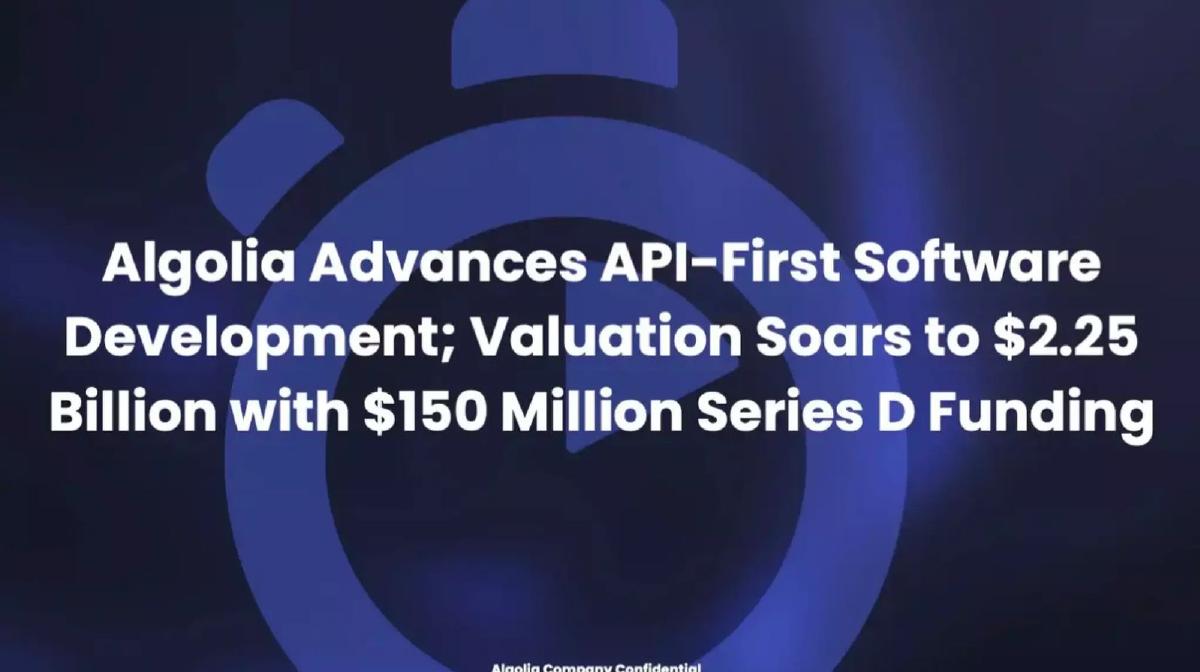
The deck opens with a simple, bold statement: "Search is everywhere" (Slide 1). This sets the stage for the scale of the opportunity. Slide 2 immediately hits the investor with the 'why now' and the 'how much,' stating that Algolia has raised "$150 Million Series D Funding" at a "$2.25 Billion" valuation. By putting the valuation and round size upfront, Algolia establishes itself as a winner before the presentation even begins.
Slides 3-5: The Opportunity and Macro Trends
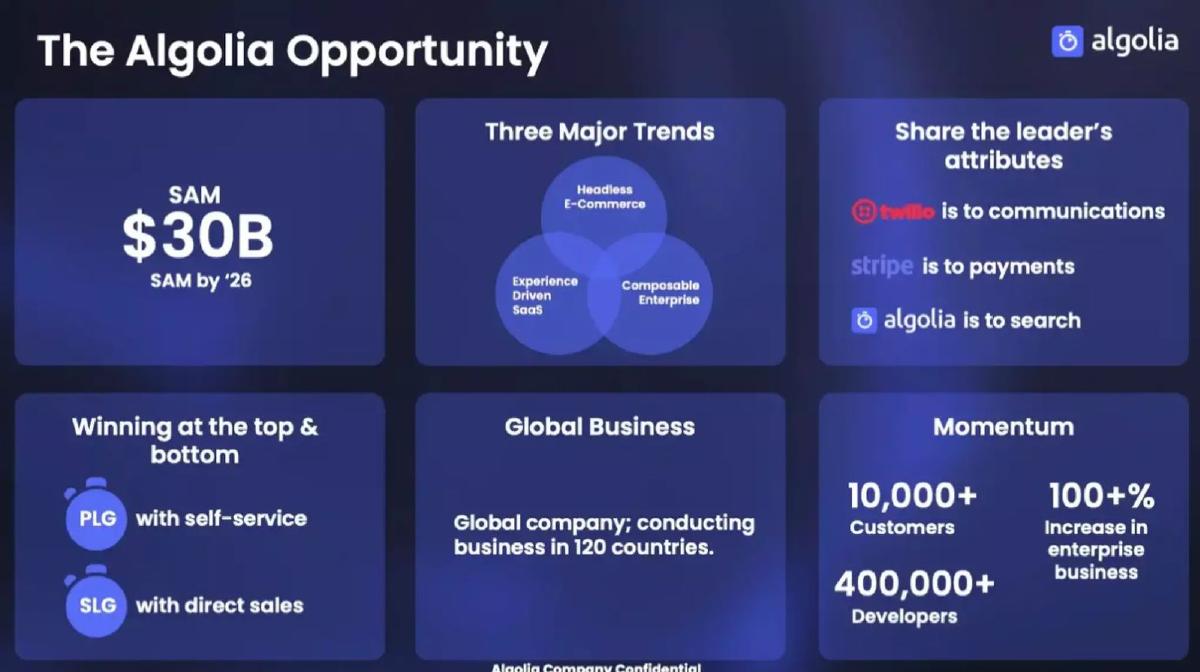
Slide 3, titled "The Algolia Opportunity," is a summary slide that could almost stand alone. It lists a "$30B SAM by '26," "10,000+ Customers," and "400,000+ Developers." It also introduces the core analogy that Algolia is to search what Stripe is to payments. Slide 4 and 5 reinforce the "API-First approach" and note that the company is being fueled by the growth in E-Commerce and Digital Transformation. This aligns the company with the broader 'Headless' movement in tech.
Slides 6-8: Winning the Developer Heart
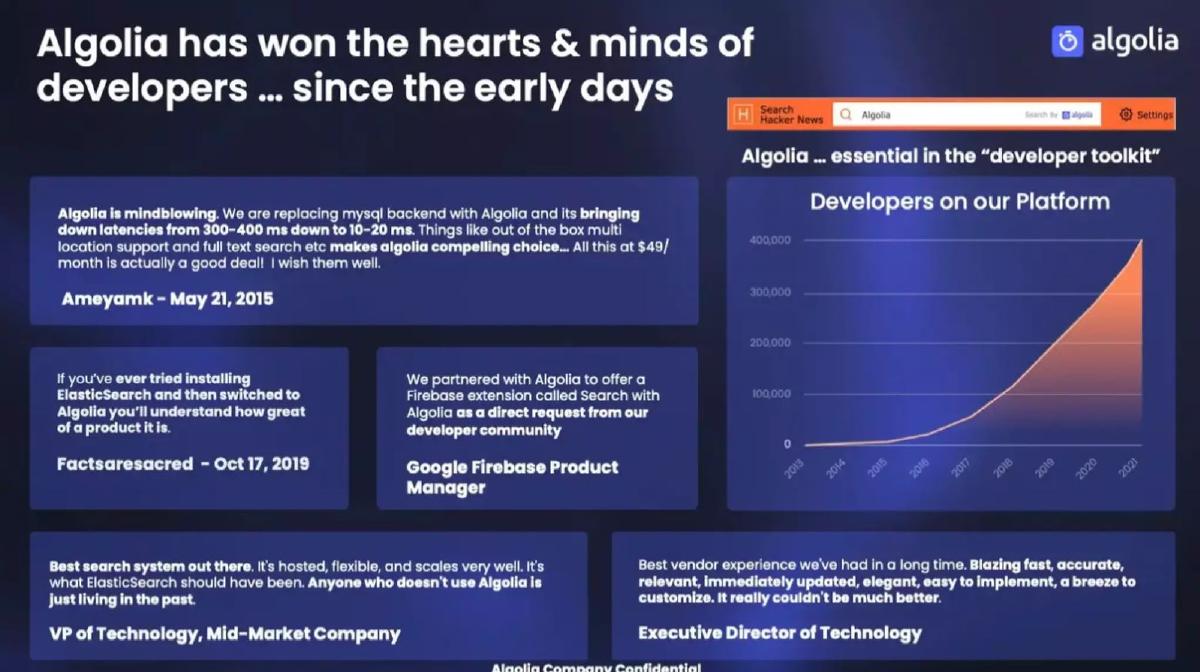
For a technical product, developer sentiment is a leading indicator of future enterprise success. Slide 6 features testimonials from Hacker News and various VPs of Technology. One quote calls the product "mindblowing," noting latencies dropping from 300-400ms to "10-20 ms." The chart on this slide shows an exponential growth curve of developers on the platform from 2013 to 2021. Slide 7 and 8 double down on the API economy, listing four 'must-have' attributes: Must have (not nice to have), Revenue driver, Sustaining differentiation, and Broad applicability.
Slides 9-13: Real-World Application and Case Studies
Slide 9 uses a screenshot of the retailer Boots to show that Algolia isn't just a search bar; it powers navigation, CTA banners, facets, filtering, and merchandising. This is a crucial pivot from 'tool' to 'platform.' Slides 10, 11, and 12 provide specific case studies:
Mercari: 350,000+ new listings indexed daily and sub-30ms discovery across 90M products. · The Trade Desk: Powering in-app navigation for the world's largest advertiser (P&G). · ManoMano: Increased conversion rate by 20% in multiple markets in just 2 weeks.
These slides provide the 'hard' evidence that the technical speed mentioned earlier translates directly into business revenue.
Slides 14-15: The Team and Recent Milestones
Slide 14 introduces the "Algolia Leadership Team." A key detail here is the asterisk denoting "New hires since May 2020." Out of 11 executives shown, 7 are new, including the CEO, CMO, and CFO. This signals to investors that the company has successfully 'up-leveled' its leadership to handle the next phase of growth. Slide 15 lists milestones from the last 12 months, including the acquisition of an AI/ML company and the move to "pure usage based pricing."
Slides 16-17: Quantifiable Profit and Market Size
Slide 16 is a 'wall of logos' with specific metrics. It’s a high-density proof slide showing "196% increase in registered users" for AllTrails and "4H of productivity saved per person" for The Times. Slide 17 visualizes the Target Addressable Market (TAM) , projecting it to grow from $14 Billion in 2021 to $86.6 Billion by 2031 . This long-term projection suggests that even at a $2.25B valuation, there is still significant upside for Series D investors.
Slides 18-20: Product Vision and GTM
Slide 18 outlines the "Multi-year product vision," showing a layered architecture from infrastructure to core APIs (Search, Recommend, Predict) to frontend components. This illustrates how Algolia plans to capture more of the 'experience' stack. Slide 19 explains the "GTM & Business model," highlighting a "Land & Expand" strategy across three vectors: Usage, Search API, and New Product APIs. The deck concludes on Slide 20 by repeating the 'Opportunity' summary from Slide 3, a classic rhetorical technique to ensure the key numbers stick.
What Works in this Deck
The Power of Analogy: By repeatedly stating "Algolia is to search what Stripe is to payments," the founders bypass the need to explain the complexities of API infrastructure. They anchor their value to companies that investors already understand and value highly.
Developer-First Evidence: The inclusion of raw Hacker News comments and a developer growth chart (Slide 6) proves that the product has organic pull. In SaaS, developer love is often a moat that competitors cannot easily buy.
Specific ROI: The deck doesn't just say they improve search; they cite a "20% conversion rate increase" (Slide 12). These are the numbers that justify enterprise contracts and high valuations.
What is Missing from this Deck
Unit Economics: There is no mention of Customer Acquisition Cost (CAC), Lifetime Value (LTV), or Net Revenue Retention (NRR). While these were likely in the data room, their absence in the deck makes the 'Momentum' slide feel a bit superficial.
Competitive Landscape: The deck assumes Algolia has already won. While this is a strong positioning tactic, it ignores the threat of cloud providers (AWS/Azure/Google) building their own native search services or the rise of open-source alternatives.
Financial Transparency: For a Series D, the lack of a historical revenue chart is notable. The deck focuses on 'customers' and 'developers' rather than 'dollars,' which may be a choice to keep the narrative focused on scale rather than margins.
What a Founder Should Copy
The 'Summary' Slide: Slide 3 is a masterpiece of information density. If an investor only looks at one slide, they get the market size, the trends, the competitive positioning, the GTM strategy, and the current momentum. Every deck should have a 'North Star' slide like this.
The 'New Hires' Callout: If you have recently hired heavy hitters from established companies (like Algolia did with execs from Dropbox, Twilio, and Adobe), highlight it. It proves that the company is attractive to top-tier talent, which is a massive de-risking signal for investors.
Visualizing the Stack: Slide 18 does a great job of showing how a technical product fits into a customer's existing workflow. Using logos of languages (JS, React, Go, Ruby) and platforms (Shopify, Zendesk) makes the 'integration' story visual and easy to grasp.
Final Verdict: Algolia’s deck is less of a 'pitch' and more of a 'victory lap.' It is designed to attract capital by showing that the company is an inevitable part of the future internet stack. For founders, the lesson here is to stop selling features and start selling your place in the ecosystem.
Frequently asked questions
- What was the primary goal of this Algolia deck?
- The deck was designed to secure Series D funding by proving that Algolia had evolved from a developer tool into a critical piece of global internet infrastructure. It emphasizes scale (120 countries), market dominance ($2.25B valuation), and a clear path to a $30B SAM. It aims to convince late-stage investors that Algolia is the 'Stripe of Search,' making it an inevitable winner in the API economy.
- How does Algolia handle the 'Competition' slide?
- Interestingly, the deck does not have a traditional grid-style competitor slide. Instead, it uses developer testimonials on Slide 6 to indirectly address competitors like Elasticsearch, claiming Algolia is 'what Elasticsearch should have been.' By using customer quotes to frame the competition as 'living in the past,' Algolia avoids a defensive stance and reinforces its superior user experience.
- What are the key financial metrics shared in the deck?
- As a later-stage deck, it is surprisingly light on specific revenue dollars, likely due to confidentiality. However, it highlights '100%+' increase in enterprise business (Slide 3) and a move to 'pure usage-based pricing' (Slide 15). It defines its business model through MRR for self-service and ARR for direct sales, focusing on 'units' as the primary pricing lever (Slide 19).
- How does the deck justify its $2.25 billion valuation?
- The valuation is justified through a combination of massive developer reach (400k+ users), high-velocity growth in the enterprise sector, and a 'land and expand' model. By showing that search is 'everywhere'—from navigation to merchandising (Slide 9)—Algolia demonstrates that its potential for expansion within a single customer is vast, moving from one API to a suite of dynamic experience tools.
- What is missing from this pitch deck?
- The deck lacks a detailed breakdown of unit economics (CAC, LTV, Churn) and a specific 'Use of Funds' slide. While it mentions the $150M raise, it doesn't explicitly chart how that capital will be allocated between R&D, sales, or international expansion. It also omits a detailed roadmap of the 'Predict' and 'Recommend' products, keeping the product vision at a high architectural level.