Alcidion’s August 2016 investor update outlines the company's position following its Reverse Takeover (RTO) of Naracoota Resources. With $6.758m in cash post-RTO, the company is pivoting from heavy R&D—having invested $2.24m in FY16—toward a systematic commercialization strategy across Australia and New Zealand. The deck emphasizes the 'Miya' product suite, specifically targeting patient flow and clinical decision support. While the team slide showcases deep domain expertise in medical informatics and health administration, the presentation relies heavily on macro-market trends in the US to j…
Key takeaways
- The company held $6.758m in cash following the completion of the RTO of Naracoota Resources Limited (Slide 3).
- Alcidion invested $2.24m in Research & Development during FY16, with a primary focus on CPOE (Slide 3).
- Commercial validation is anchored by a $2.35m MoU with Western Health for patient flow and bed management (Slide 3).
- The executive team possesses high-level domain expertise, including a PhD in Medical Informatics from Stanford and a former CEO of the South Australian Health Commission (Slide 2).
- The market opportunity slide relies heavily on US-centric data, citing the Affordable Care Act and a $USD3.0 trillion annual healthcare spend (Slide 6).
- Product deployment is active at Royal Darwin and Alice Springs hospitals, with preferred status at Palmerston North hospital in New Zealand (Slide 9).
- The company leverages a 45% cash rebate for qualifying R&D expenditure through the Australian Federal Government R&D Tax Incentive (Slide 3).
- The deck lacks a clear breakdown of unit economics, customer acquisition costs, or a detailed multi-year financial forecast in the provided slides.
Executive Summary and Context
The Alcidion FY16 Investor Update is a post-listing document designed to solidify investor confidence following the company's entry into the ASX via a reverse takeover (RTO). The deck is structured to move the narrative from the technical complexities of medical informatics toward the practicalities of commercial deployment and revenue generation. It focuses on the Australian and New Zealand (ANZ) markets while using global (primarily US) healthcare trends to frame the scale of the opportunity.
Slide 1: Title Slide
The title slide identifies the entity as Alcidion Group Limited and dates the presentation to August 2016. The imagery—a hand holding a digital brain—signals a focus on clinical decision support and artificial intelligence in healthcare, though these terms are not explicitly used on the cover. The branding is professional and aligned with the healthcare technology sector.
Slide 2: Executive Directors
This slide is a strong point for the deck. It profiles three key leaders: Prof. Malcolm Pradhan, Mr. Ray Blight, and Mr. Nathan Buzza. The qualifications listed are highly relevant to the sector. Pradhan’s PhD in Medical Informatics from Stanford and his role in the Australian Government’s National e-Health Transition Authority provide clinical and technical credibility. Blight’s history as CEO of the South Australian Health Commission suggests an understanding of the primary customer (government health departments). Buzza’s background as a founder of Commtech Wireless adds a necessary layer of commercial and entrepreneurial experience. The inclusion of their photos and detailed bullet points establishes a high 'pedigree' for the management team.
Slide 3: Highlights FY16
Slide 3 provides a dense summary of the company's financial and operational status. Key figures include a cash balance of $6.758m post-RTO and an R&D investment of $2.24m. The mention of the 45% cash rebate for R&D expenditure is a critical detail for ASX investors, as it demonstrates a non-dilutive capital stream. The most significant commercial highlight is the $2.35m MoU with Western Health, which serves as a proof of concept for moving from pilot sites to commercial utilization. This slide effectively transitions the company from a 'science project' to a commercial enterprise.
Slide 4 & 5: Testimonials
These slides use social proof to validate the product. Slide 4 features a quote from Nathan Buzza (Allure Capital), which is somewhat circular given he is also an Executive Director, but it serves to highlight the 'passion' and 'qualifications' of the founders. Slide 5 is more impactful, featuring Marcus Storey, a Nurse Unit Manager at Western Health. His quote, "The systems assists in safe and effective patient care by identifying patients who are at risk," provides direct clinical validation of the software's value proposition in a real-world hospital setting.
Slide 6: Market Opportunity
This slide attempts to justify the investment by citing macro trends. It notes the aging global population and the $USD3.0 trillion annual healthcare spend in the United States. While the figures are impressive—such as US healthcare spending reaching 37% of GDP by 2050—there is a slight disconnect between these global/US metrics and Alcidion’s current operational focus in Australia and New Zealand. However, the mention of the Obama Administration’s mandate for Clinical Information Systems and the 'meaningful use' requirements provides a template for what might eventually occur in the ANZ market.
Slide 7: Product Overview (Transition)
A simple transition slide that introduces the technical portion of the deck. The imagery of a clinician with a digital interface reinforces the company's focus on the point of care.
Slide 8: Smartforms
This slide shows the 'Smartforms' interface on a Lincor Solutions hardware terminal. The interface displays nursing and laboratory tasks (e.g., "Check Temperature," "FBC blood test") with status indicators like "Recommended," "Consideration," and "Restricted." This is a crucial slide because it shows the actual product. It demonstrates how Alcidion’s software integrates into the clinical workflow to provide decision support, rather than just being a passive database.
Slide 9: Miya Patient Flow
This slide focuses on one of the core modules: Miya Patient Flow. It lists the benefits—optimizing patient journeys and efficient use of hospital beds. The slide provides specific geographic traction: Royal Darwin and Alice Springs hospitals are in production, and Palmerston North hospital in NZ has granted the product 'preferred status.' This specificity is excellent for investors, as it moves beyond vague claims of 'interest' to named, verifiable deployments.
Slide 10: Miya Clinic
The final slide in this set describes 'Miya Clinic,' an outpatient software and referral management system. The text emphasizes saving clinical time and reducing risk. Like the previous product slide, it uses a quote-style format to describe the benefits, though it lacks the specific site names found on Slide 9. It rounds out the product suite by showing that Alcidion covers both inpatient (Patient Flow) and outpatient (Clinic) environments.
What Alcidion Does Well
Domain Expertise: The team slide is exceptional. In healthcare IT, the 'why you' is often as important as the 'what,' and Alcidion demonstrates that its leaders have spent decades at the intersection of medicine, government policy, and technology. This reduces the perceived risk of the company building something that clinicians won't actually use.
Tangible Traction: By naming specific hospitals (Royal Darwin, Western Health, Palmerston North), the deck moves out of the theoretical realm. For a micro-cap company, showing that you can navigate the complex procurement cycles of government health departments is a significant hurdle to have cleared.
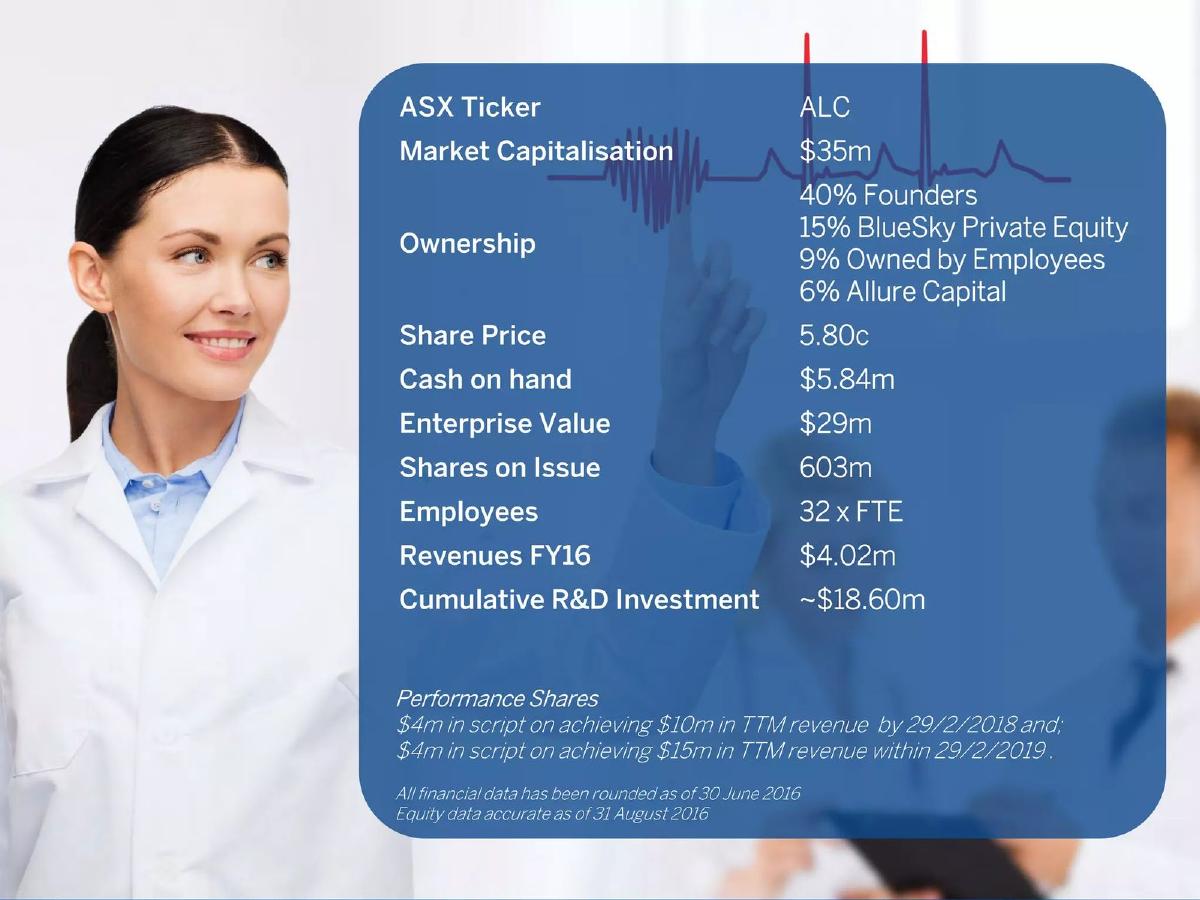
Financial Transparency: The clear statement of cash position and the explanation of the R&D tax incentive provide a clear picture of the company's runway and fiscal strategy. It shows a disciplined approach to capital management during the transition to a public entity.
What Is Missing from the Deck
Competitive Landscape: The deck does not mention other players in the clinical decision support or patient flow space. In 2016, this was a crowded market with both large incumbents (Epic, Cerner) and smaller specialized players. Investors are left to wonder how Alcidion differentiates itself technically or commercially from these giants.
Unit Economics and Pricing: There is no information on how the software is priced (SaaS vs. perpetual license) or what the typical implementation costs are. While the $2.35m MoU is a large headline number, the deck doesn't explain the margin profile of that revenue or the recurring nature of the contracts.
ANZ Market Sizing: While the deck spends significant space on the US market, it provides very little data on the total addressable market (TAM) in Australia and New Zealand. Given that their current traction is entirely in these regions, a breakdown of the number of hospitals or beds they could realistically capture in their home market would be more relevant than US GDP projections.
Founder Takeaways
Leverage Social Proof Early: Alcidion’s use of a specific quote from a Nurse Unit Manager (Slide 5) is a masterclass in B2B validation. If you are selling to a specific user group (doctors, engineers, lawyers), a quote from a mid-level manager who actually uses the tool is often more convincing to an investor than a quote from a C-suite executive who only signed the check.
Highlight Non-Dilutive Funding: If your startup qualifies for government grants or tax incentives (like the Australian R&D tax incentive mentioned on Slide 3), make it a prominent part of your financial story. It shows you are savvy about capital efficiency and reduces the perceived 'burn' of your R&D efforts.
Match Your Team to Your Problem: If you are tackling a highly regulated, complex industry like healthcare, your team slide needs to look like Alcidion’s. You need a mix of deep academic credentials, high-level administrative experience, and a track record of commercial exits. If your team lacks one of these pillars, you should address how you plan to fill that gap through advisors or key hires.
Focus on 'Preferred Status': The mention of 'preferred product status' on Slide 9 is a subtle but powerful way to show progress in a long sales cycle. Even if a contract isn't signed, being the 'preferred' vendor is a measurable milestone that investors in enterprise software will appreciate.
Frequently asked questions
- What is the primary purpose of this deck?
- This is an investor update deck from August 2016, intended to brief shareholders and potential investors on Alcidion's status following its listing on the ASX via a reverse takeover. It focuses on the transition from a research-heavy entity to a commercial software provider for the healthcare industry, highlighting recent contract wins and the strength of the leadership team.
- How does Alcidion validate its product-market fit?
- Validation is demonstrated through three primary channels: a $2.35m MoU with Western Health, existing production deployments at Royal Darwin and Alice Springs hospitals, and testimonials from clinical staff. The deck specifically quotes a Nurse Unit Manager at Western Health stating the system assists in identifying at-risk patients, providing clinical evidence of utility.
- What is the 'Miya' platform mentioned in the slides?
- Miya is Alcidion's core product suite. The deck highlights 'Miya Patient Flow' for optimizing bed management and hospital journeys, and 'Miya Clinic' for outpatient referral management. The platform is designed to reduce clinical risk and improve efficiency for both hospital executives and clinical staff by providing real-time data and decision support.
- What is the company's financial position according to the deck?
- As of July 31, 2016, the company reported $6.51m in cash (excluding a $1m R&D tax incentive provision). Post-RTO completion, this figure was stated as $6.758m. This indicates a relatively strong balance sheet for a micro-cap health tech company at that time, especially considering the 45% R&D tax rebate they utilize.
- Who are the key leaders driving the company?
- The leadership is highly specialized. Prof. Malcolm Pradhan (CMO) brings academic and government-level informatics experience. Ray Blight (CEO) provides high-level health administration experience as a former state health commission CEO. Nathan Buzza (Executive Director) brings entrepreneurial success from Commtech Wireless and Azure Healthcare, providing a balance of clinical, administrative, and commercial expertise.