Alice.Tech’s 13-slide deck is a masterclass in establishing founder-market fit. In a sector currently flooded with 'GPT-wrappers,' the company uses Slide 3 to highlight 11+ years of teaching experience alongside McKinsey and Oxford AI credentials. The deck moves quickly from team to traction, using Slide 5 to visualize a widening gap between average users and 'power users' (the top 10%). While the deck is light on specific revenue figures and competitive moats—relying instead on broad market timing arguments on Slide 9—it successfully uses social proof and engagement trends to justify a $4.8M…
Key takeaways
- The founders lead with pedigree, citing 11+ years of teaching and an Oxford MSc in Computer Science to establish immediate authority (Slide 3).
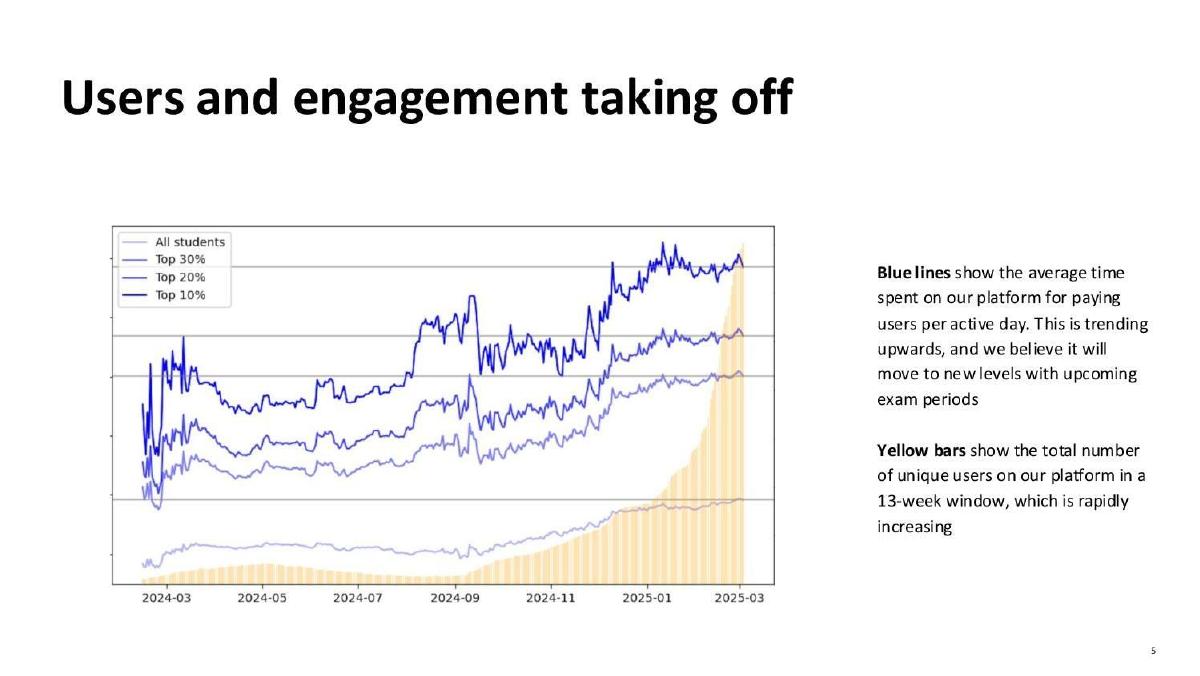
- Engagement is tracked through a 13-week window of unique users, showing a consistent upward trend from early 2024 to 2025 (Slide 5).
- The deck highlights a 'power user' segment (Top 10%) whose time spent on the platform is significantly higher and more volatile than the average (Slide 5).
- Social proof is heavily utilized, featuring five distinct user testimonials and a 5-star review from December 2024 (Slide 7).
- The 'Why Now' slide relies on macro trends: improving LLM quality, decreasing inference costs, and consumer readiness (Slide 9).
- Growth strategy is split into three pillars: Product-led growth, organic content (TikTok/Instagram), and selective paid marketing (Slide 11).
- The deck omits a formal 'Ask' slide, financial projections, and a detailed competitor matrix within the provided 13-slide sequence.
- The platform targets high-load academic environments, specifically mentioning Danish university students and non-native speakers (Slide 7).
The Pedigree Play: Alice.Tech’s $4.8M Seed Deck
Alice.Tech entered the market at a time when 'AI for Education' was becoming one of the most saturated categories in venture capital. To stand out, their 13-slide deck relies heavily on the professional and academic weight of the founding team. As reported by Business Insider, the company raised $4.8M in 2024 to scale their personalized learning platform. This teardown examines how they used engagement data and founder-market fit to secure that capital.
Slide 1-2: Branding and Identity
The deck opens with a minimalist black-and-white aesthetic. Slide 1 features the Alice.Tech logo with the tagline 'AI-driven exam prep.' Slide 2 is a repeat of the brand mark. This is a standard 'breather' opening, though it offers little in the way of a value proposition or 'hook' beyond the industry category.
Slide 3: The 'Exceptional Founders' Slide
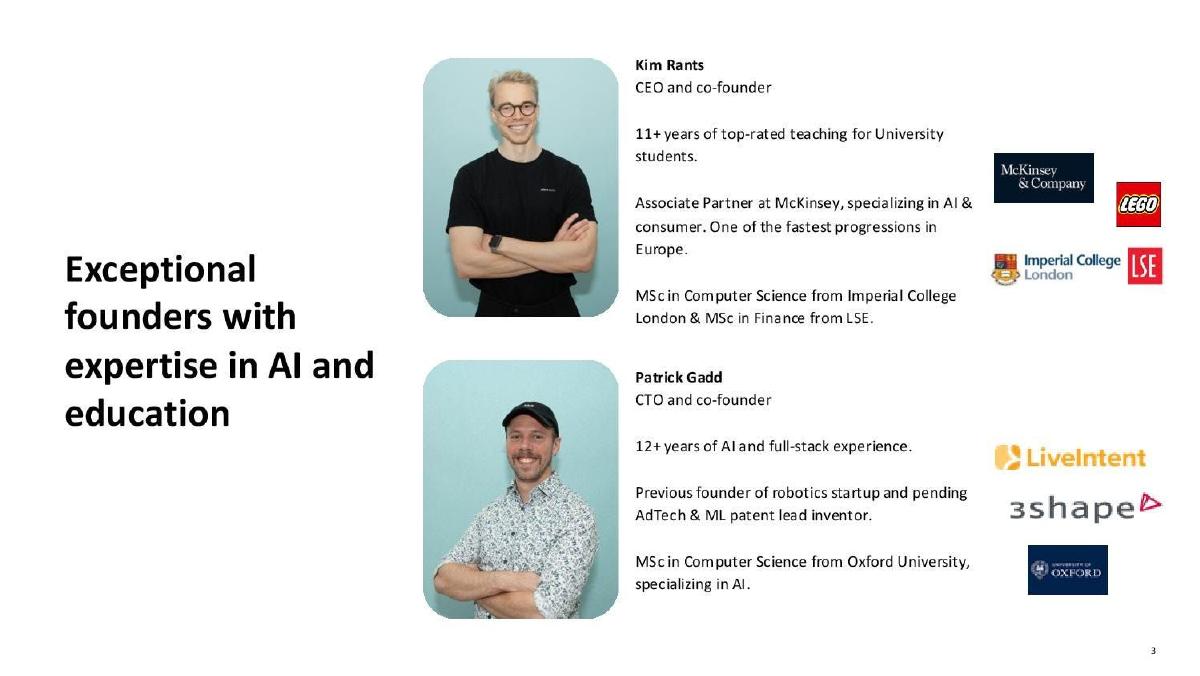
This is arguably the most important slide in the deck. In the Seed stage, investors are buying the team. Alice.Tech presents two founders with high-signal backgrounds. Kim Rants (CEO) is positioned as a hybrid of pedagogical expertise (11+ years of teaching) and corporate strategy (McKinsey Associate Partner). The slide notes he had 'one of the fastest progressions in Europe' at McKinsey, a specific detail meant to signal high velocity. Patrick Gadd (CTO) brings technical depth with an MSc in AI from Oxford and 12+ years of full-stack experience. By including logos like LEGO, McKinsey, and Imperial College London, the slide builds immediate institutional trust.
Slide 4: Transition
Slide 4 is a placeholder or transition slide (text only: Alice.Tech), maintaining the minimalist flow of the presentation.
Slide 5: Engagement and User Growth
Instead of a standard 'up and to the right' revenue chart, Alice.Tech focuses on usage depth. The slide titled 'Users and engagement taking off' uses a dual-axis visualization. The yellow bars represent unique users in a 13-week window, showing steady growth from early 2024 through March 2025. The blue lines represent average time spent on the platform for paying users. Interestingly, they segment this by 'Top 10%,' 'Top 20%,' and 'Top 30%.' This tells a story of a 'sticky' product where the most engaged users are spending significantly more time on the platform during exam seasons. It suggests that while the average user might be casual, the platform has a 'power user' base that relies on it heavily.
Slide 6: Transition
Slide 6 is a placeholder or transition slide (text only: Alice.Tech).
Slide 7: Social Proof and User Love
Slide 7 is a collage of testimonials. It includes a 5-star Trustpilot-style review from December 12, 2024, and specific feedback from a student at 'KU' (likely University of Copenhagen) who uses the tool to manage a 'huge reading load' in Danish. The feedback highlights a key differentiator: 'The advantage of Alice as compared to ChatGPT is that I can [organize] different subjects.' This addresses the 'GPT-wrapper' skepticism by suggesting the product provides a structured workflow that a generic LLM lacks.
Slide 8: Transition
Slide 8 is a placeholder or transition slide (text only: Alice.Tech).
Slide 9: The Macro Case (Why Now?)
The 'Now is the perfect time' slide is surprisingly brief. It lists three bullet points: LLM quality is rapidly improving , Inference costs are coming down fast , and Consumer readiness is taking off . While these are true of the entire AI sector, the deck doesn't explain why these factors uniquely benefit Alice.Tech over a competitor. It relies on the investor already being 'sold' on the AI thesis.
Slide 10: Transition
Slide 10 is a placeholder or transition slide (text only: Alice.Tech).
Slide 11: The Growth Strategy
The company outlines a three-pronged approach to scaling: Product , Organic Content , and Paid . They emphasize 'Product-led growth' and mention a 'study with friends' feature that launched in January, which they claim is seeing Month-over-Month (MoM) growth (though the specific percentage is redacted in this version). The 'Organic' section mentions TikTok, Instagram, and LinkedIn, supported by screenshots of what appear to be influencer collaborations or campus events. This is a standard B2C playbook: use social virality to lower CAC.
Slide 12-13: Closing
Slide 12 is a placeholder, and Slide 13 is a simple 'Thank you' slide. Notably, the provided slides do not include a 'The Ask' slide or a 'Financial Projections' slide, which are typically present in a full Seed deck. These may have been removed for the public version of the deck or handled in a separate document.
What Alice.Tech Does Well
The deck excels at Founder-Market Fit . By pairing a CEO who has actually taught students for a decade with a CTO who has an AI degree from Oxford, they neutralize the common criticism that EdTech founders don't understand the classroom or the tech. They also do a great job of segmenting engagement . Showing that the 'Top 10%' of users are spending massive amounts of time on the platform is a much stronger signal of product-market fit than just showing total sign-ups, which can be inflated by marketing spend.
What is Missing from the Deck
The most glaring omission is a Competitive Landscape . The 'exam prep' and 'AI study assistant' space is incredibly crowded with players like Quizlet, Chegg, and various AI-native startups. Alice.Tech doesn't explicitly state their 'moat'—is it their proprietary data, their specific UI/UX, or their integration with local university curricula? Additionally, there is no Business Model slide. While the engagement slide mentions 'paying users,' the deck doesn't explain the pricing tiers or the Average Revenue Per User (ARPU). Finally, the Roadmap is vague; we see that they want to grow, but we don't see the specific product milestones they intend to hit with the $4.8M.
Founder's Playbook: What to Copy
Lead with Pedigree: If your team has 'unfair advantages' (like McKinsey experience or an Oxford AI degree), put them on Slide 3. Don't wait until the end. · Use 'Power User' Data: If your average engagement metrics are mediocre, look for your 'Top 10%.' Showing that a specific cohort loves your product proves that the value proposition exists, even if you haven't scaled it to the masses yet. · Specific Testimonials: The testimonial from the non-native speaker on Slide 7 is excellent because it identifies a specific pain point (reading load in a second language) that the product solves. Generic 'I love this app' quotes are less effective. · Visual Consistency: The deck uses a very clean, high-contrast design that feels modern and 'tech-forward.' It avoids the cluttered, clip-art look of older EdTech presentations.
Frequently asked questions
- What is Alice.Tech's core product offering?
- Based on the publisher summary and user testimonials on Slide 7, Alice.Tech is an AI-driven exam prep platform. It organizes course materials, generates flashcards and practice materials, and provides an 'exam simulator' to help students manage high reading loads and prepare for university or high school assessments.
- How does the company demonstrate traction without showing revenue?
- Alice.Tech uses Slide 5 to show 'Users and engagement taking off.' They plot the total number of unique users in a 13-week window (yellow bars) and the average time spent on the platform for paying users (blue lines), emphasizing that engagement is trending upward ahead of exam periods.
- Who are the founders and what is their background?
- The team consists of CEO Kim Rants, a former McKinsey Associate Partner with 11+ years of teaching experience, and CTO Patrick Gadd, a former robotics founder with an MSc in AI from Oxford and a patent in machine learning (Slide 3).
- What is the primary growth engine for the platform?
- The company identifies 'network effects and virality' as their primary growth drivers. Specifically, Slide 11 outlines a focus on product-led growth (including a 'study with friends' feature), organic content on TikTok and Instagram, and university-level events.
- What are the biggest risks or omissions in the deck?
- The deck lacks a competitive landscape analysis, which is critical in the crowded AI EdTech space. It also omits unit economics (CAC/LTV) and a clear breakdown of how the $4.8M Seed round will be allocated across the 2025 roadmap.