FI Real Estate Fund One, LLC secured a $7M Seed round in 2021 with a 7-slide deck that breaks almost every traditional design rule. Eschewing graphics for dense blocks of text, the deck functions as a personal manifesto for founder James Berkley. It details his journey from $110,000 in student debt to a $5 million net worth, using specific property addresses and exact cash flow figures to build trust. The fund differentiates itself through a '0% management fee' model, instead focusing on a 12% hurdle rate and acquisition fees. While it lacks a formal team slide or market size analysis, the de…
Key takeaways
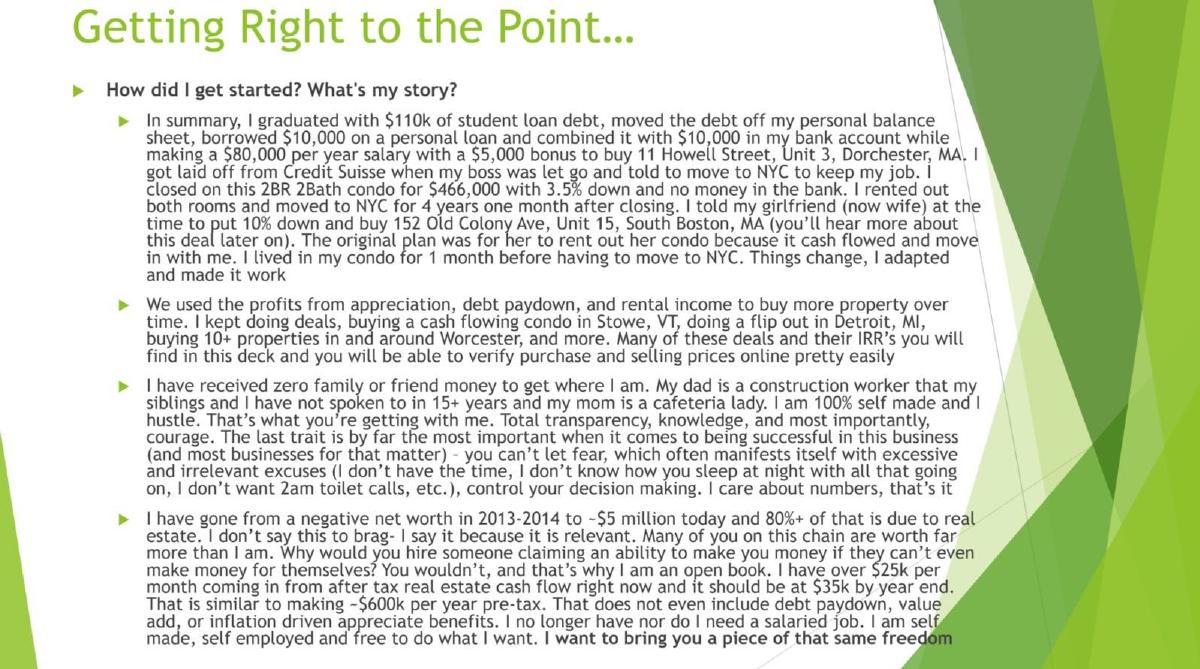
- The founder claims to have grown a personal net worth from negative in 2013 to ~$5 million by 2021, with 80%+ attributed to real estate (Slide 2).
- The fund offers a 0% Up-Front Fee, 0% AUM Fee, and 0% Administrative Fee to remain competitive against traditional private equity (Slide 7).
- The investment strategy targets a 12%+ cash-on-cash return after accounting for a 75% LTV mortgage and other operating expenses (Slide 4).
- A specific case study at 45 Wells Street shows a purchase price of $1,637,500 at a 10.3% cap rate, generating $7,500 monthly take-home for two suites (Slide 6).
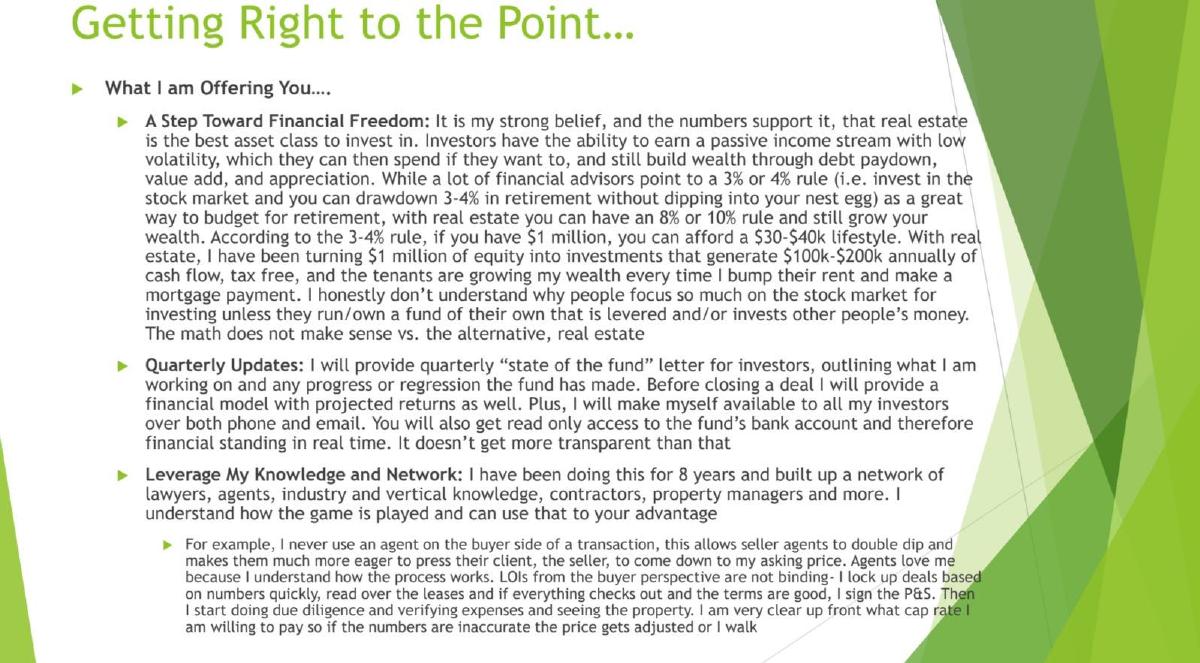
- The founder utilizes a 'no buyer agent' strategy to allow seller agents to 'double dip,' incentivizing them to lower the asking price for his offers (Slide 3).
- The fund implements a 12% compounded hurdle rate over 7 years before the founder receives a 20% profit share on exit (Slide 7).
- Transparency is a core value, with the founder promising investors read-only access to the fund’s bank account to view financial standing in real time (Slide 3).
- The deck omits a traditional team slide, market overview, or exit strategy beyond the mention of 1031 exchanges to trade up to larger buildings (Slide 6).
The Narrative-Heavy Approach to Real Estate Fundraising
The pitch deck for FI Real Estate Fund One, LLC is a departure from the high-gloss, icon-heavy presentations typical of the 2021 venture capital era. Reported by Business Insider to have raised $7M in a Seed round, the deck consists of only seven slides, each dominated by dense prose. It functions less as a visual aid and more as a written prospectus or a personal letter to potential investors. The strategy here is clear: build trust through radical transparency and a proven personal track record rather than corporate branding.
Slide 1: Title and Branding
The deck opens with a minimalist title slide. While the metadata identifies the company as FI Real Estate Fund One, the slide text simply reads 'james berkley.' This immediately signals that the fund is inextricably linked to the founder's personal brand and individual performance. There are no logos, taglines, or mission statements on the cover, which is highly unusual for a $7M raise.
Slide 2: The Origin Story and Personal Financials
Slide 2, titled 'Getting Right to the Point...', serves as the founder's biography. It details James Berkley’s journey starting with $110,000 in student loan debt and a $80,000 salary at Credit Suisse. He notes he was laid off and moved to NYC, eventually using a $10,000 personal loan and $10,000 in savings to buy his first property at 11 Howell Street, Dorchester, MA for $466,000 with 3.5% down.
The slide provides a chronological list of deals, including properties in Stowe, VT, Detroit, MI, and over 10 properties in Worcester. The most striking metric on this slide is the founder's claim of moving from a negative net worth in 2013-2014 to ~$5 million by 2021. He states he generates over $25k per month in after-tax real estate cash flow, which he equates to a $600k pre-tax salary. This slide establishes the 'why' of the fund: the founder has achieved financial independence ('FI') and wants to replicate the model for others.
Slide 3: The Value Proposition and Transparency
Continuing the 'Getting Right to the Point...' theme, Slide 3 outlines the offering. The primary product is 'A Step Toward Financial Freedom.' Berkley critiques the traditional '3-4% rule' of stock market withdrawals, arguing that real estate allows for an 8-10% rule. He claims to turn $1 million of equity into $100k-$200k of annual cash flow.
A significant portion of this slide is dedicated to transparency. Berkley promises quarterly updates and, most notably, 'read-only access to the fund’s bank account.' This is a high-trust mechanism designed to appeal to investors wary of the opaque nature of private equity. He also details his tactical advantage: never using a buyer's agent. By allowing seller agents to 'double dip' on commissions, he claims to secure better pricing on acquisitions.
Slide 4: The Commercial Strategy
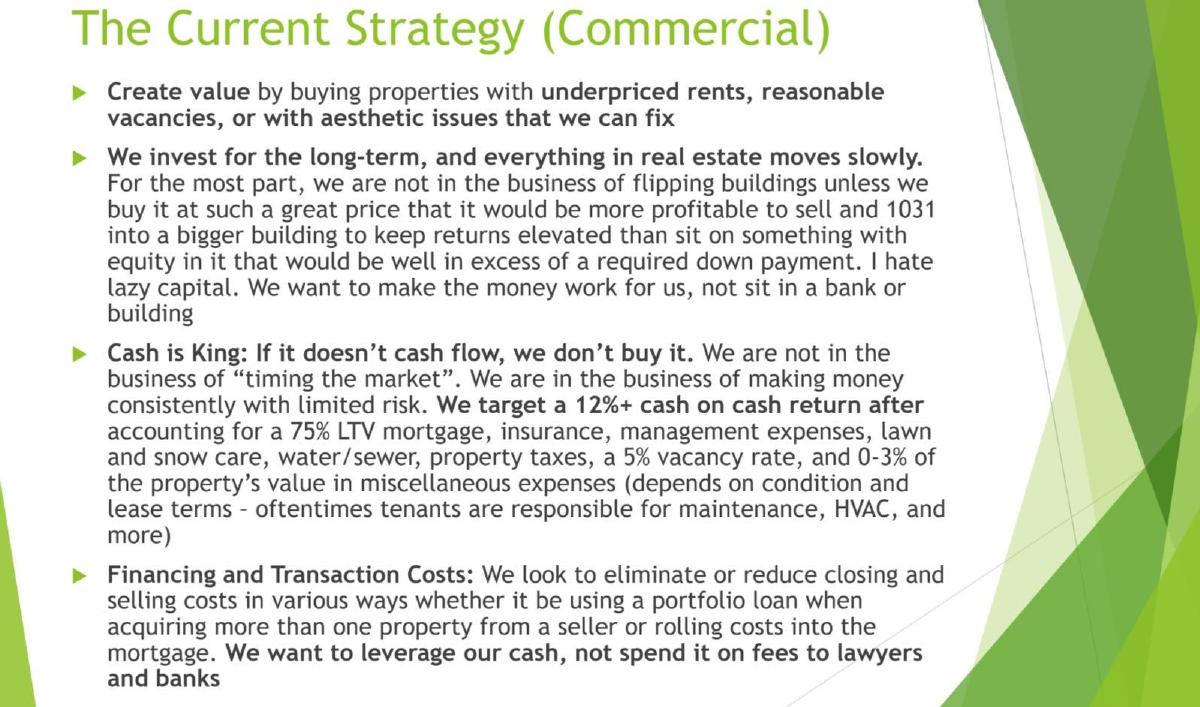
Slide 4 defines 'The Current Strategy (Commercial).' The fund targets properties with underpriced rents, reasonable vacancies, or aesthetic issues. The core philosophy is 'Cash is King,' with a stated target of 12%+ cash-on-cash return. This return is calculated after a 75% LTV (Loan to Value) mortgage, insurance, management, and a 5% vacancy reserve.
The slide also mentions a preference for long-term holds over flipping. Berkley notes he hates 'lazy capital' and seeks to minimize transaction costs by using portfolio loans or rolling closing costs into mortgages. This slide provides the first glimpse into the fund's operational mechanics and risk management profile.
Slide 5: Case Study - 45 Wells Street (Part 1)
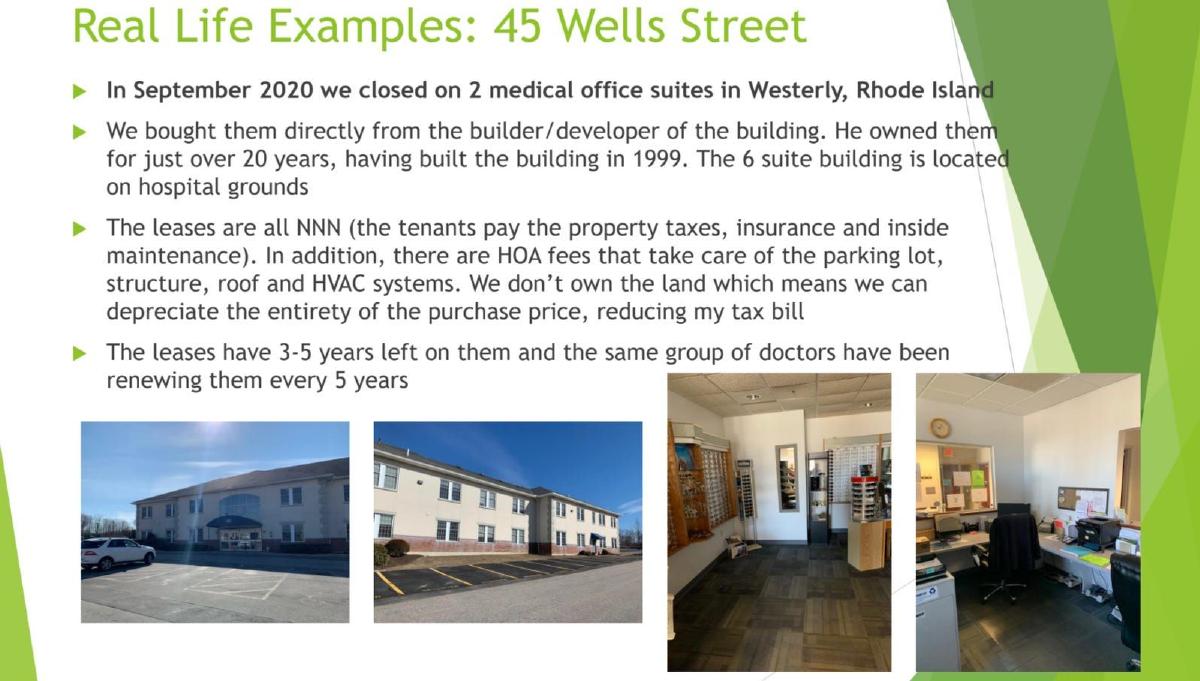
Slide 5 provides a 'Real Life Example' of a deal closed in September 2020: two medical office suites in Westerly, Rhode Island. The slide includes four photographs of the property exterior and interior. Berkley explains the deal structure: NNN (Triple Net) leases where tenants pay taxes, insurance, and maintenance. He highlights a specific tax advantage: because they don't own the land, they can 'depreciate the entirety of the purchase price,' which reduces the tax bill.
Slide 6: Case Study - 45 Wells Street (Part 2)
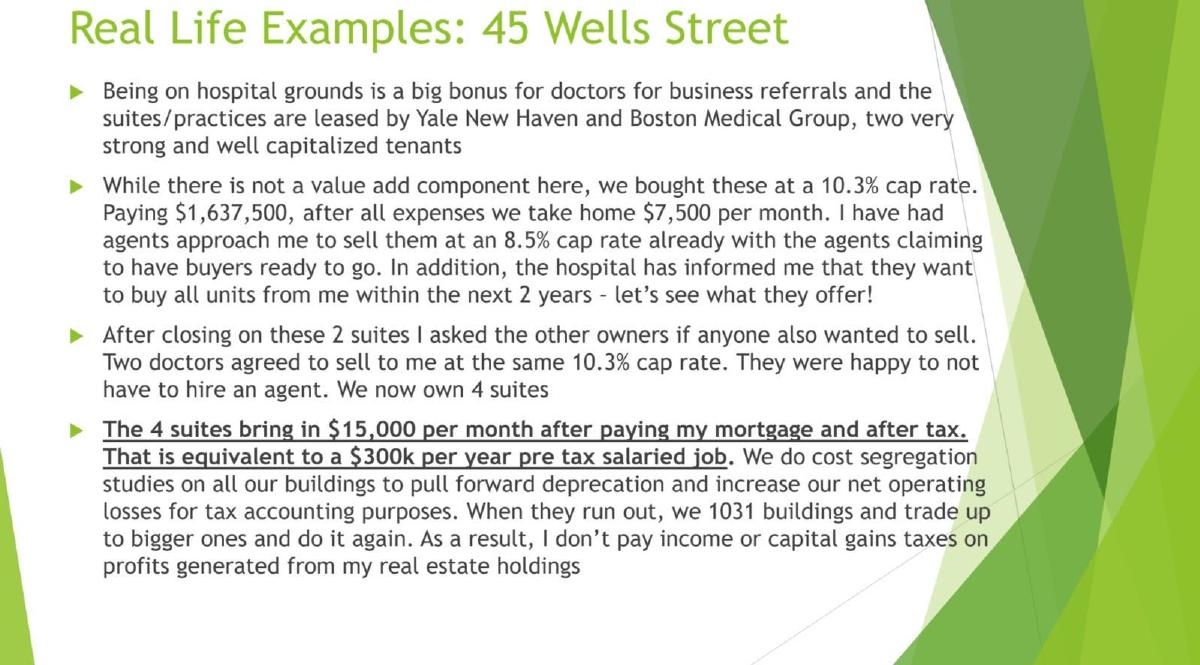
Slide 6 continues the 45 Wells Street analysis with specific financial outcomes. The suites were purchased for $1,637,500 at a 10.3% cap rate. The take-home profit is stated as $7,500 per month for the first two suites. Berkley then describes how he acquired two additional suites from other doctors at the same 10.3% cap rate without agents.
The total for the 4 suites is $15,000 per month after mortgage and taxes. Berkley uses this to reinforce his narrative, stating this is equivalent to a $300k pre-tax salaried job. He also mentions the use of 'cost segregation studies' to pull forward depreciation, a common tax strategy in high-end real estate investing. The slide concludes with the intent to use 1031 exchanges to avoid income or capital gains taxes when trading up to larger assets.
Slide 7: Structure and Terms
The final slide, 'Structure & Terms,' is perhaps the most important for an investor teardown. Berkley positions his fees against industry standards. He offers 0% for Up-Front, AUM, and Administrative fees, which he notes typically range from 1-3%. His compensation comes from a 2.5% acquisition fee (capped at $50,000) and a 20% fee on profit at exit.
Crucially, he includes a 'Hurdle Rate with Catch Up' of 12%. He must deliver a 12% compounded return over 7 years before he is eligible for the 20% profit share. The slide even includes links to external websites (origininvestments.com and glenstone-capital.com) to encourage investors to verify that his fees are below market. This 'open book' approach to fee comparison is a aggressive closing tactic.
What FI Real Estate Fund One Does Well
The deck excels at specific proof . By providing exact addresses (11 Howell Street, 152 Old Colony Ave, 45 Wells Street) and exact dollar amounts for purchase prices and monthly cash flows, the founder removes the abstraction that often plagues real estate decks. Investors can theoretically verify these numbers via public records, which builds immense credibility.
The fee transparency is also a major strength. By listing '0%' for the most common industry fees and providing a hurdle rate, the founder aligns his interests directly with the investors. He only gets paid significantly if the investors achieve a double-digit return, which is a powerful incentive for a Seed round.
What is Missing from the Deck
The most glaring omission is a Team Slide . While James Berkley’s personal story is compelling, a $7M fund usually requires more than one person to manage acquisitions, property management, and investor relations. The deck mentions a 'network' of contractors and lawyers, but no other core team members are named or profiled.
There is also no Market Analysis . The deck assumes the reader is already sold on the idea that real estate is better than stocks. It does not address why Rhode Island or Massachusetts are the right markets in 2021, nor does it discuss macroeconomic risks like rising interest rates or changes in commercial office demand post-COVID.
Finally, the Exit Strategy for the fund itself is vague. While individual properties might be 1031-exchanged, the timeline for when investors get their principal back is not explicitly detailed beyond the 7-year hurdle rate mention.
Lessons for Founders
Founders can learn two major lessons from this deck. First, narrative can trump design . If your personal track record is strong enough and your data is specific enough, you don't need a professional designer to raise millions. The 'wall of text' approach worked here because the text was filled with 'hard' numbers and verifiable facts rather than 'soft' marketing speak.
Second, radical transparency is a differentiator . Offering read-only bank account access and providing links to competitor fee structures are bold moves that signal a founder has nothing to hide. In industries like real estate or finance where trust is the primary currency, these 'proof of honesty' features can be more effective than any growth chart.
Frequently asked questions
- What is the fee structure for FI Real Estate Fund One?
- The fund employs a performance-heavy fee structure. It charges 0% for up-front, AUM, and administrative fees. Instead, it takes a 2.5% acquisition fee (capped at $50,000) and a 20% fee on profits at exit, provided a 12% compounded hurdle rate is met over a 7-year period.
- How does the founder justify his expertise without a large team?
- The founder, James Berkley, relies on a personal narrative of 'hustle' and transparency. He details his transition from $110k in debt to generating $25k per month in after-tax cash flow. He emphasizes his network of lawyers, contractors, and property managers built over 8 years rather than a formal internal executive team.
- What specific types of properties does the fund target?
- The deck highlights a shift from residential to commercial 'value-add' opportunities. A primary example provided is medical office suites with NNN (Triple Net) leases, where tenants cover taxes, insurance, and maintenance, allowing the fund to focus on depreciation benefits and cash flow.
- What is the fund's stance on market timing and flipping?
- The fund explicitly states it is not in the business of 'timing the market.' It focuses on long-term holds and cash flow. Buildings are only sold if the price is high enough to make a 1031 exchange into a larger building more profitable than holding the current equity.
- How does the fund handle investor reporting?
- Beyond standard quarterly 'state of the fund' letters and financial models for new deals, the fund offers read-only access to its bank accounts. This allows investors to verify the fund's financial standing and cash movements in real time.