Finvoice aims to disrupt the traditional lending model by connecting small businesses with investors for discounted invoice advances. While the problem—a typical 60-day pay cycle for SMBs—is clearly defined, the deck suffers from a significant lack of concrete data. Key slides for traction and the financial ask use 'X' and '$$$' placeholders instead of real figures, making it impossible to evaluate the company's actual performance or capital needs. The team slide highlights strong academic and professional backgrounds from institutions like Stanford and Cambridge, but the overall presentation…
Key takeaways
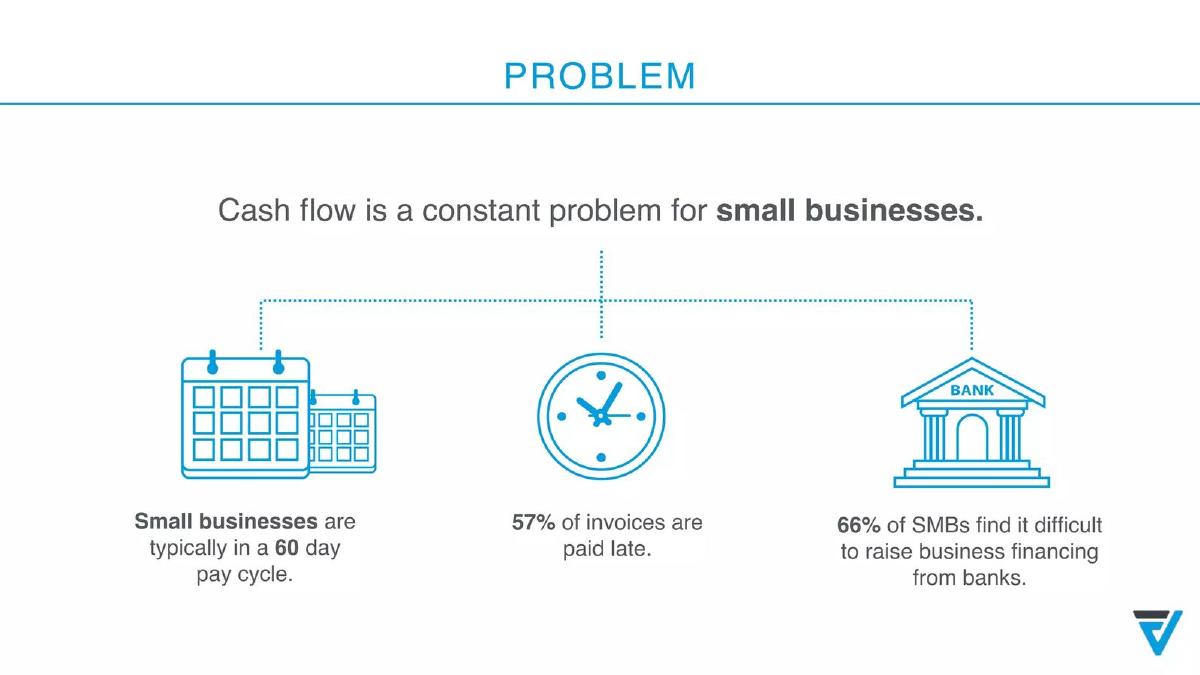
- The deck identifies that 57% of invoices are paid late, creating a significant cash flow gap for small businesses (Slide 3).
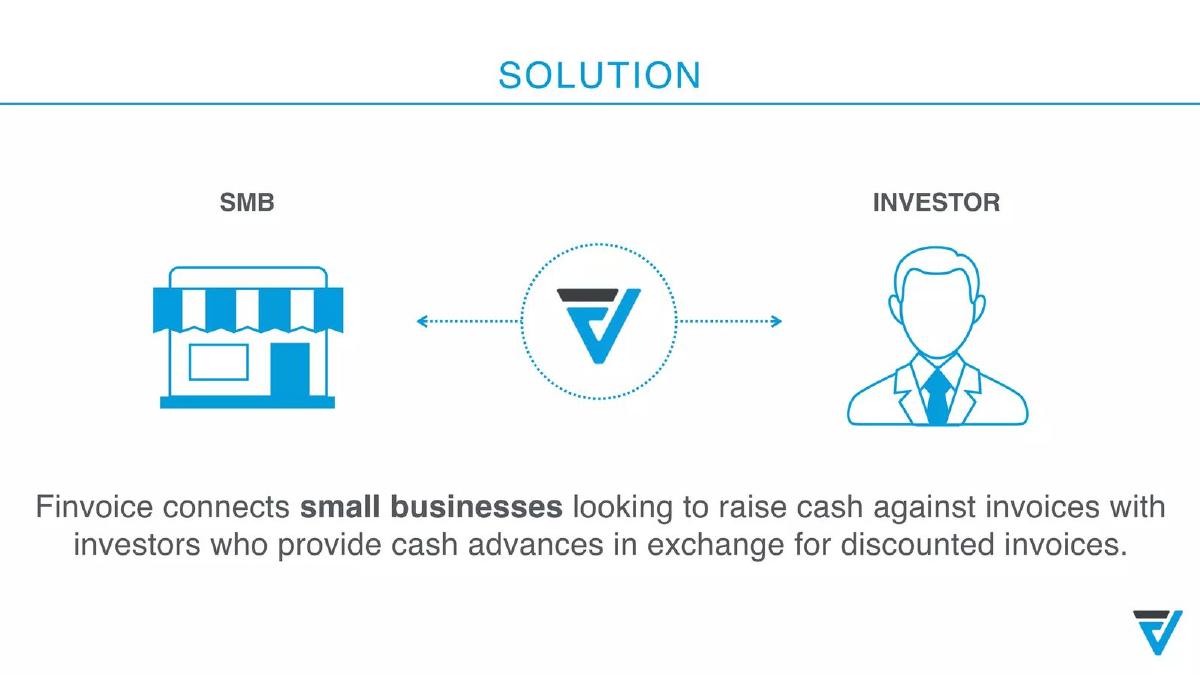
- Finvoice positions itself as a marketplace intermediary between SMBs and investors providing cash advances (Slide 4).
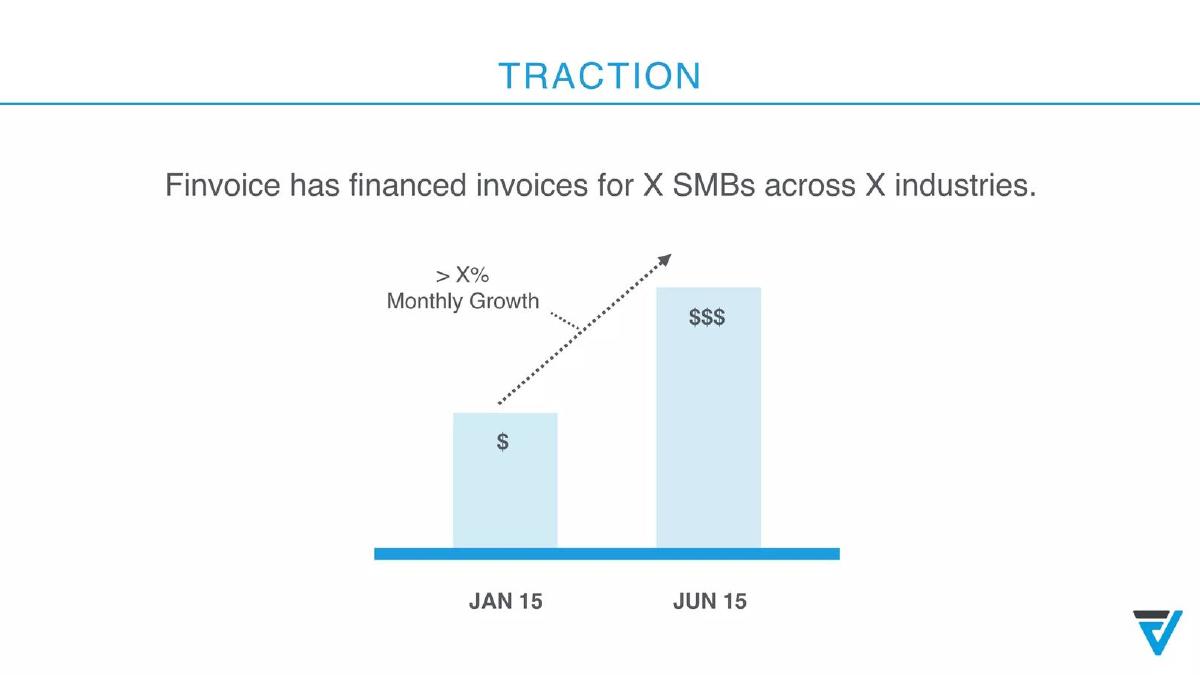
- The traction slide is entirely non-functional, using 'X SMBs' and 'X%' monthly growth as placeholders (Slide 5).
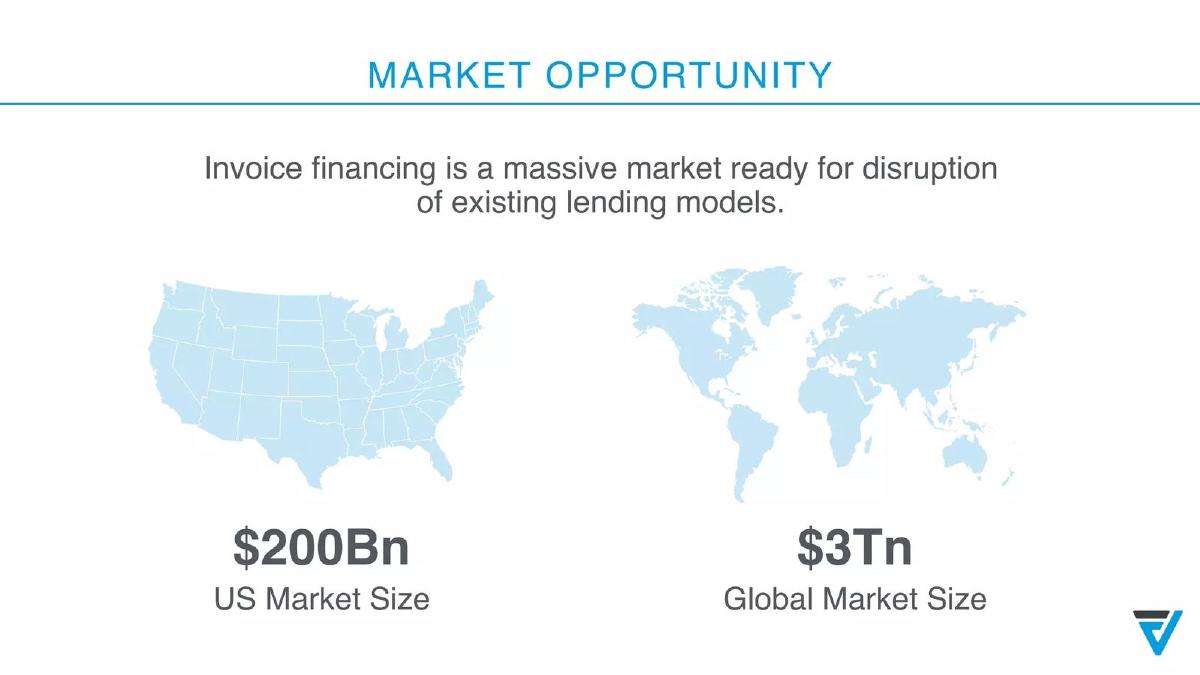
- The market opportunity is cited as $200 billion in the US and $3 trillion globally (Slide 6).
- The competitive landscape slide uses generic 'Competitor' labels without naming specific rivals or defining the axes of differentiation (Slide 7).
- Founders Andrew Bertolina and Mackenzie Lee cite experience with Amadeus Capital, Bivium Capital, and Axiom (Slide 8).
- The fundraising ask is listed as '$$$', omitting the actual dollar amount and valuation sought (Slide 9).
- Use of capital is allocated across five categories, including marketplace software and invoice investments (Slide 9).
The Finvoice Pitch Deck: A Study in Placeholders
Finvoice enters the fintech space with a clear mission: empowering small businesses through faster access to capital. However, the pitch deck provided is a paradox. It effectively communicates the 'why' and the 'how' of the business model but fails entirely on the 'what'—specifically, what has been achieved so far. By leaving placeholders in the traction and ask slides, the deck functions more as a structural wireframe than a persuasive investment document.
Slide 1: Title Slide
The deck opens with a clean, minimalist title slide featuring the Finvoice logo—a stylized 'V' with a checkmark—and a background image of a workspace. There is no tagline or immediate value proposition on this slide, relying entirely on the brand name to set the stage.
Slide 2: Mission
The mission slide is direct: "Finvoice empowers small businesses by giving them cheaper and faster access to money." The use of a simple icon depicting stacks of cash reinforces the focus on liquidity. This is a standard, effective way to start a deck by establishing the primary beneficiary of the service.
Slide 3: Problem
This slide provides the quantitative justification for the company's existence. It highlights three critical pain points: small businesses are typically in a 60-day pay cycle , 57% of invoices are paid late , and 66% of SMBs find it difficult to raise business financing from banks . This slide is the strongest in the deck because it uses specific, relatable statistics to define a massive inefficiency in the current financial system.
Slide 4: Solution
The solution is presented as a three-part marketplace diagram. Finvoice sits in the center, connecting the "SMB" with the "Investor." The text explains that investors provide cash advances in exchange for discounted invoices. It is a classic marketplace play: solving the SMB's cash flow problem while providing the investor with a yield-bearing asset.
Slide 5: Traction
This is where the deck loses momentum. Slide 5 is titled "Traction" but contains no actual data. It states, "Finvoice has financed invoices for X SMBs across X industries," and shows a bar chart with "> X% Monthly Growth" between January 2015 and June 2015. For an analyst or investor, a traction slide with placeholders is a red flag. It suggests either that the company has no traction to report or that this is a generic template. Without real numbers, the chart is meaningless.
Slide 6: Market Opportunity
Finvoice targets a massive market. The slide cites a $200Bn US Market Size and a $3Tn Global Market Size . While these numbers are large enough to interest any VC, the deck does not specify the source of these figures or how much of this "Total Addressable Market" (TAM) is realistically serviceable by a digital factoring platform.
Slide 7: Competitive Landscape
The competitive landscape uses a standard four-quadrant graph, but it is remarkably unhelpful. Every point on the graph is labeled simply as "Competitor." Finvoice places itself in the top-right quadrant (the "Many/Many" corner), but the axes are not labeled. Without knowing what the axes represent or who the specific competitors are (e.g., Fundbox, BlueVine, or C2FO), an investor cannot evaluate Finvoice's unique edge.
Slide 8: Founders
The team slide features Andrew Bertolina and Mackenzie Lee. It highlights "deep experience in Financial Services, Legal Services and Technology." The logos at the bottom—University of Cambridge, Amadeus Capital, Bivium Capital, Stanford University, and Axiom—provide significant institutional credibility. This slide suggests that while the deck lacks data, the founders possess the pedigree typically sought by early-stage investors.
Slide 9: The Ask
Similar to the traction slide, "The Ask" uses placeholders. It states, "We are raising $$$" and lists the use of capital: Engineer/employee salaries, Marketplace lending SAAS software, Legal structuring fees, Invoice investments, and Standard business operating expenses. The inclusion of "Invoice investments" is notable, as it suggests the company may intend to use raised capital to seed its own marketplace or act as a balance-sheet lender in the early days.
Slide 10: The Endgame
This slide summarizes the long-term vision. It reiterates the goal of disrupting traditional lending and creating a "new asset class" for investors. This is a standard "vision" slide meant to leave the investor thinking about the scale of the potential exit.
Slide 11: Closing Slide
The deck ends with the logo and the tagline: "Beat net 60." This is a clever, industry-specific pun referring to the "Net 60" payment terms that plague SMB cash flow. It is the most memorable piece of branding in the entire deck.
What Works in This Deck
The problem definition on Slide 3 is excellent. It uses three distinct metrics to paint a picture of a broken system. Any investor familiar with the SMB space knows that "Net 60" is a major hurdle, and Finvoice captures that pain point perfectly. Additionally, the team pedigree shown on Slide 8 is high-caliber. The combination of Stanford/Cambridge and venture/legal experience is a strong signal for a fintech startup where regulatory and financial complexity is high.
What Is Missing
The most glaring omission is actual data . A pitch deck with "X" and "$$$" placeholders cannot be used for a real fundraise. Beyond the missing numbers, the deck lacks a Business Model slide. While we know they discount invoices, we don't know the take-rate, the average invoice size, or the cost of customer acquisition (CAC). There is also no Product slide; we see icons of a storefront and a person, but we never see the actual interface or technology that makes this "faster and cheaper."
What a Founder Should Copy
Founders should emulate the clarity of the mission and tagline . "Beat net 60" is a fantastic example of a tagline that explains exactly what the company does for its customers in three words. The visual consistency is also worth noting; the deck uses a limited color palette and clean iconography that makes it very easy to scan. Finally, the market sizing (Slide 6) is presented simply and effectively, though it would be improved with citations.
Frequently asked questions
- What is the core product of Finvoice?
- Finvoice is a marketplace platform that facilitates invoice factoring. It allows small businesses to receive immediate cash advances on their outstanding invoices by selling them at a discount to investors. This is designed to bypass the traditional 60-day payment cycle and the difficulty of obtaining bank financing.
- How much money is Finvoice raising?
- The deck does not specify a fundraising amount. Slide 9, titled 'The Ask,' uses the placeholder '$$$' instead of a numerical value. This suggests the version of the deck available publicly was either a template or a redacted version intended to hide sensitive financial goals.
- Who are the founders of Finvoice?
- The company was founded by Andrew Bertolina and Mackenzie Lee. Their backgrounds include education at the University of Cambridge and Stanford University, with professional experience at firms such as Amadeus Capital, Bivium Capital, and Axiom.
- What market problem does Finvoice solve?
- Finvoice addresses the cash flow crisis facing small and medium-sized businesses (SMBs). According to Slide 3, 66% of SMBs find it difficult to raise financing from banks, and 57% of their invoices are paid late, leading to liquidity issues.
- What is the 'Endgame' for the company?
- As stated on Slide 10, the company's long-term goals are to provide SMBs with cheaper and faster access to capital, create a new asset class for investors with attractive returns, and use technology to disrupt traditional lending models.