This 2016 deck for FinPort (which rebranded to TrueLayer) is a masterclass in timing and infrastructure positioning. At just 10 slides, it focuses entirely on the friction within the European financial ecosystem—specifically the lack of programmatic access to bank data. By framing the solution as a 'Unified Distribution Platform' connecting major European banks like HSBC, Santander, and Deutsche Bank to fintech innovators, the founders successfully articulated a high-barrier-to-entry technical play. The deck relies heavily on the regulatory tailwinds of PSD2 and the proven success of US count…
Key takeaways
- The deck identifies a fragmented ecosystem with over 10,000 financial products and 1,000 institutions lacking API access (Slide 2).
- FinPort positions itself as a 'Bank-as-a-Platform' providing data normalization, fund transfers, and identity verification (Slide 3).
- The product strategy includes web/mobile scraping to build APIs from scratch where bank APIs are unavailable, citing Yodlee as a precedent (Slide 4).
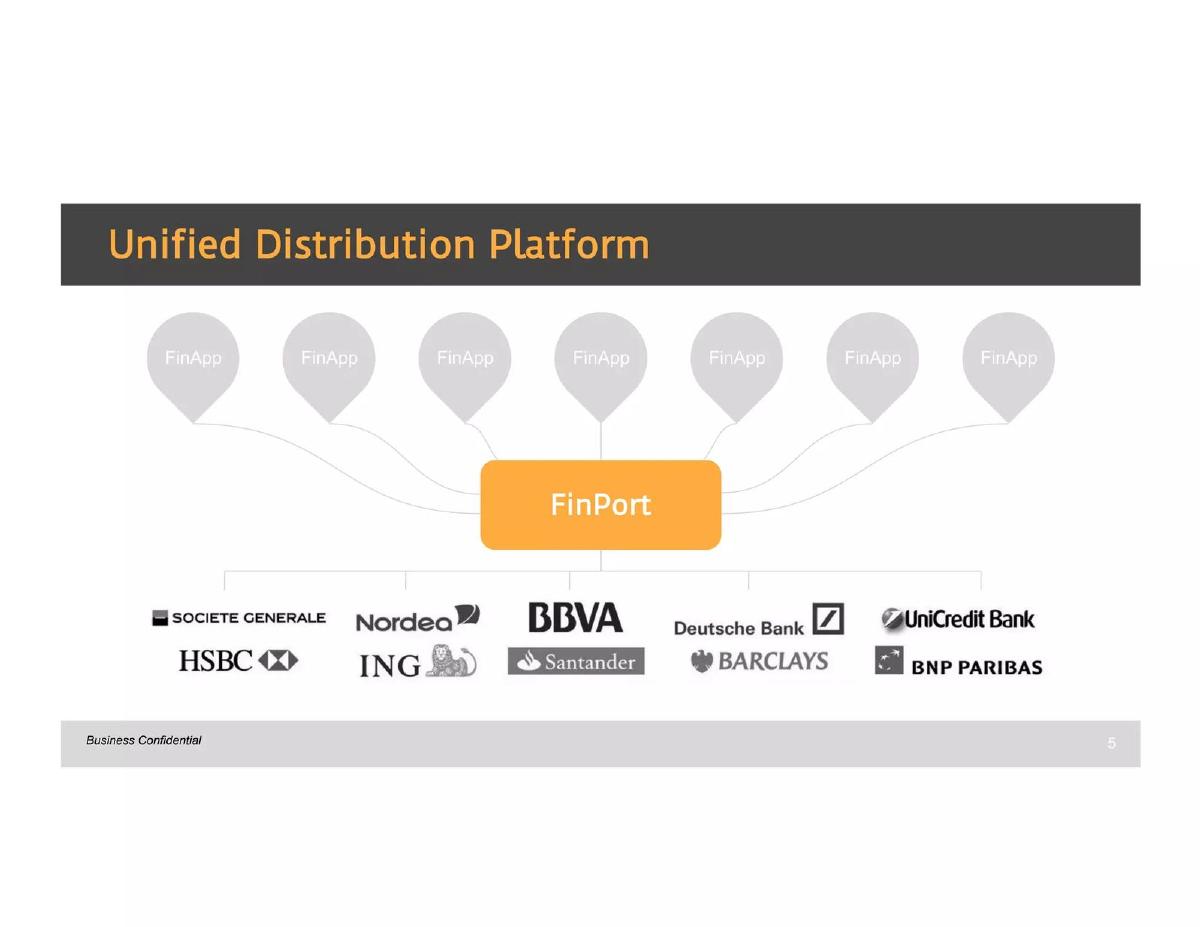
- A visual distribution map shows FinPort as the middleware between major banks (Barclays, ING, BBVA) and third-party 'FinApps' (Slide 5).
- The business model is split between a pay-per-use model for data access and a 0.5%-1.0% transaction fee for fund transfers (Slide 7).
- The opportunity is anchored in the PSD2 regulatory shift and the $600M acquisition of US-based Yodlee (Slide 8).
- The go-to-market strategy prioritizes the UK and Germany, targeting startups and SMBs first due to shorter sales cycles (Slide 9).
- The deck sets specific 18-month targets, including $70K+ MRR and 100K linked bank accounts (Slide 10).
FinPort (TrueLayer) Pitch Deck Analysis
The FinPort deck, which represents the early vision of what would become TrueLayer, is a concise 10-slide presentation focused on the infrastructure layer of fintech. It was produced at a pivotal moment in European finance, just as the Payment Services Directive (PSD2) was beginning to force banks to open their data to third parties. The deck is strictly professional, utilizing a dark gray and orange color palette, and focuses on the 'plumbing' of the financial world rather than consumer-facing features.
Slide 1: Title Slide
The title slide introduces the company as FinPort with the subtitle BANK-AS-A-PLATFORM . It is a minimalist entry point that immediately categorizes the company within the infrastructure/API sector. The footer contains a 'Business Confidential' disclaimer, which persists throughout the deck.
Slide 2: The Problem
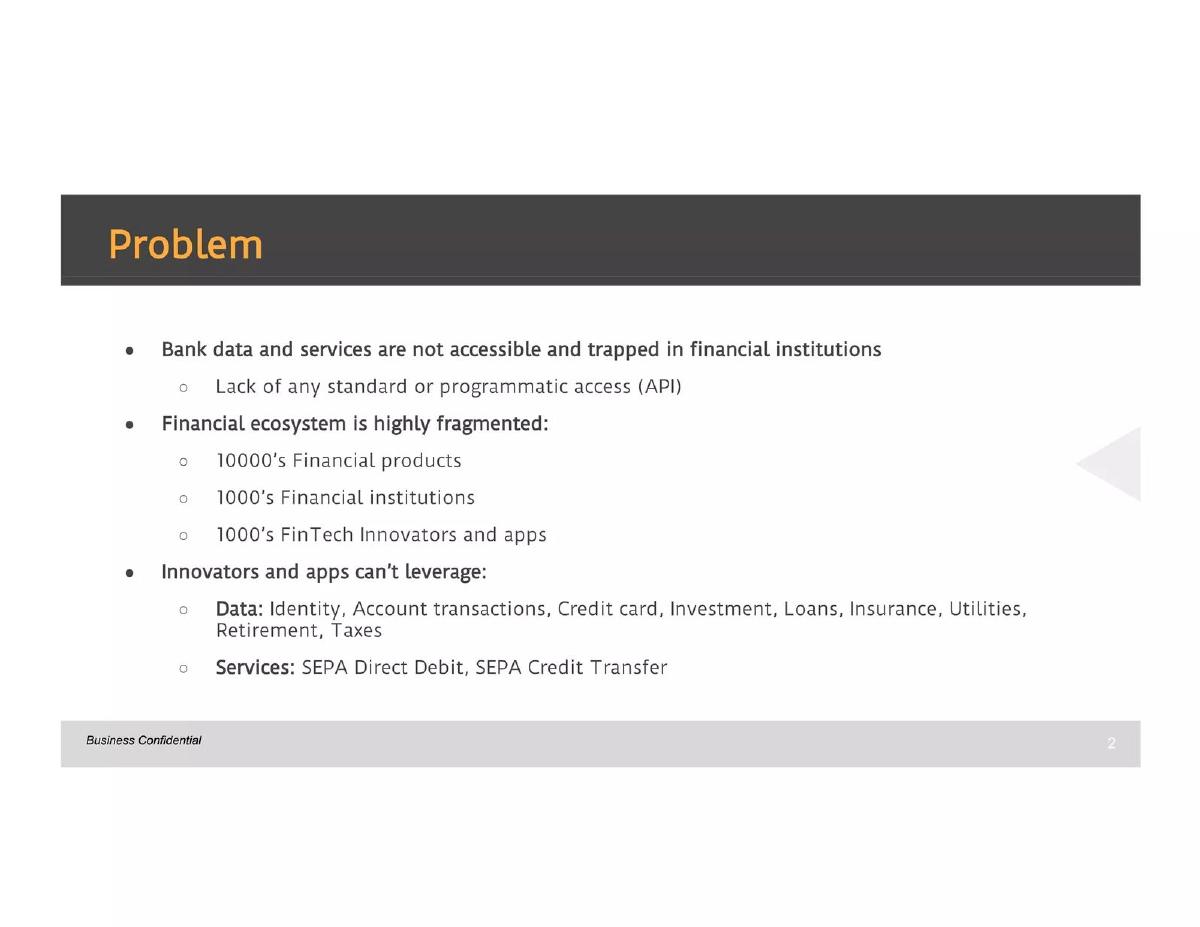
Slide 2 outlines the friction in the current market. It states that "Bank data and services are not accessible and trapped in financial institutions." The slide highlights three main pain points:
Lack of any standard or programmatic access (API). · A highly fragmented ecosystem with "10000's Financial products" and "1000's Financial institutions." · The inability for innovators to leverage data (Identity, Transactions, Credit cards) and services (SEPA Direct Debit/Credit Transfer).
Slide 3: Solution - Bank-as-a-Platform
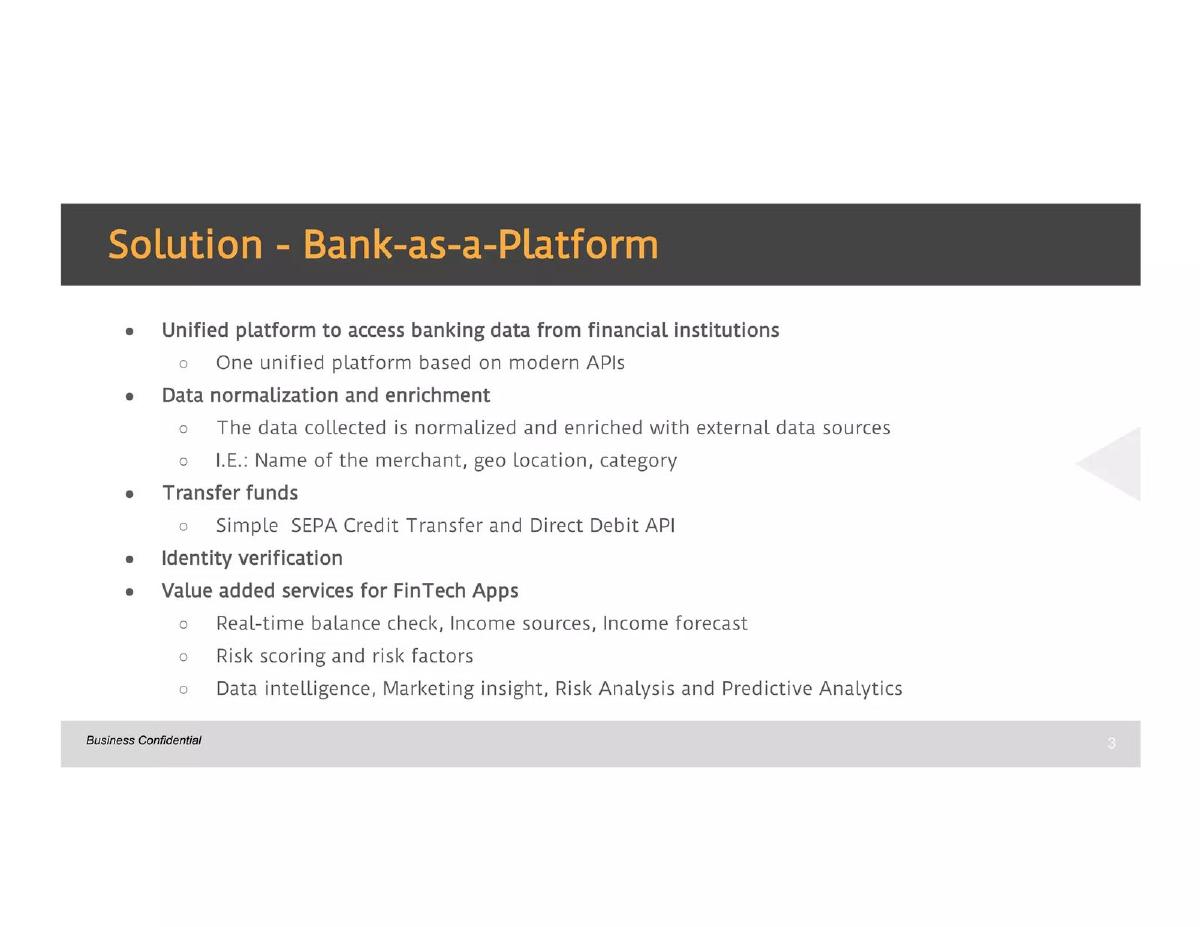
The solution is presented as a "Unified platform to access banking data from financial institutions." Key features listed on Slide 3 include:
Data normalization and enrichment (adding merchant names, geo-location, and categories). · A simple API for SEPA Credit Transfer and Direct Debit. · Identity verification. · Value-added services like real-time balance checks, income forecasting, and risk scoring.
Slide 4: Product Strategy
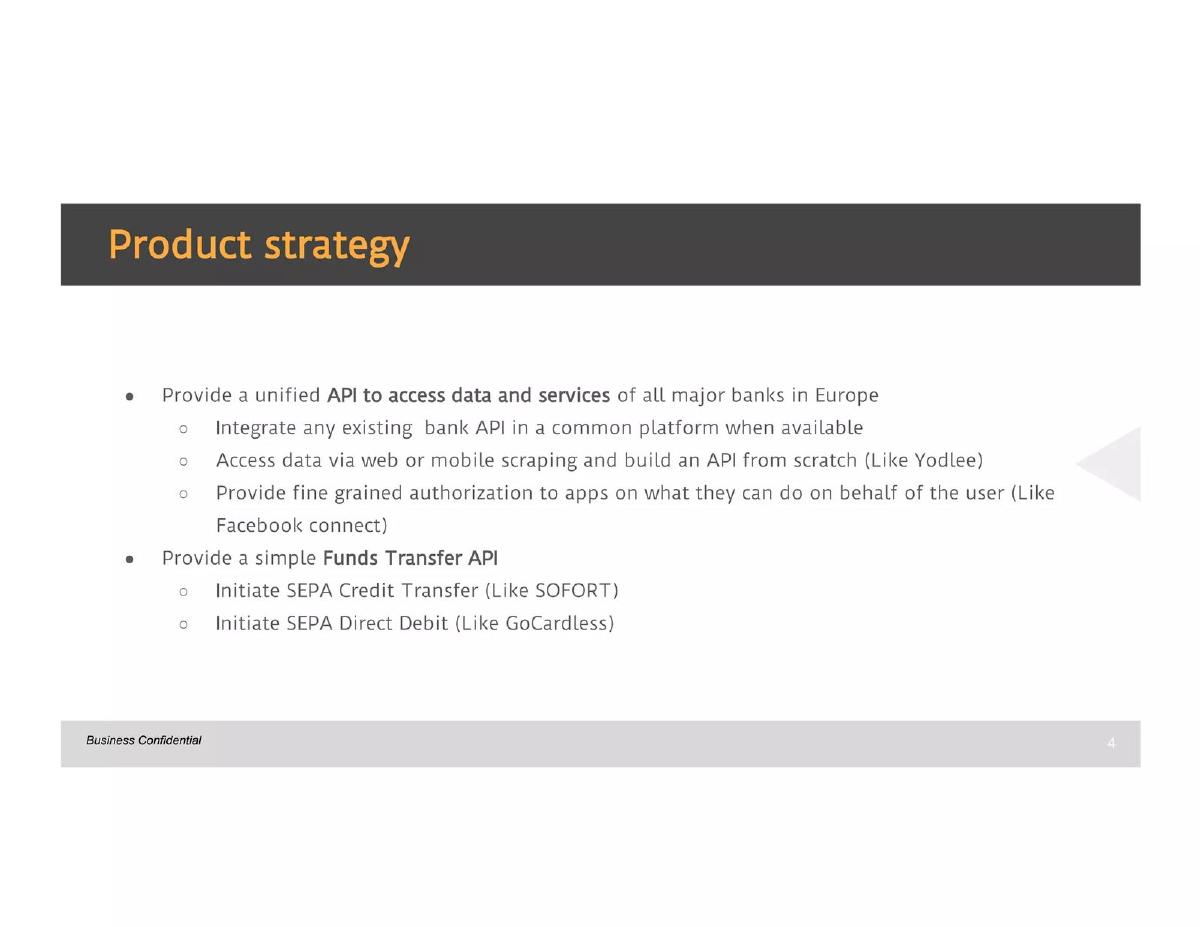
This slide explains the technical approach to building the API. FinPort admits they will "Access data via web or mobile scraping and build an API from scratch" when a bank API is not available, explicitly citing Yodlee as a comparison. They also mention providing "fine grained authorization" for apps, comparing the user experience to "Facebook connect." The fund transfer strategy is compared to SOFORT and GoCardless .
Slide 5: Unified Distribution Platform
Slide 5 is a visual representation of the business model. It shows FinPort as the central node (the 'port') connecting various "FinApps" at the top to a foundation of major European banks at the bottom. The logos displayed include Societe Generale, Nordea, BBVA, Deutsche Bank, UniCredit Bank, HSBC, ING, Santander, Barclays, and BNP Paribas . This visualizes the 'middleman' value proposition clearly.
Slide 6: Core Use-Cases
To help investors visualize the customer base, Slide 6 breaks down use cases into three buckets:
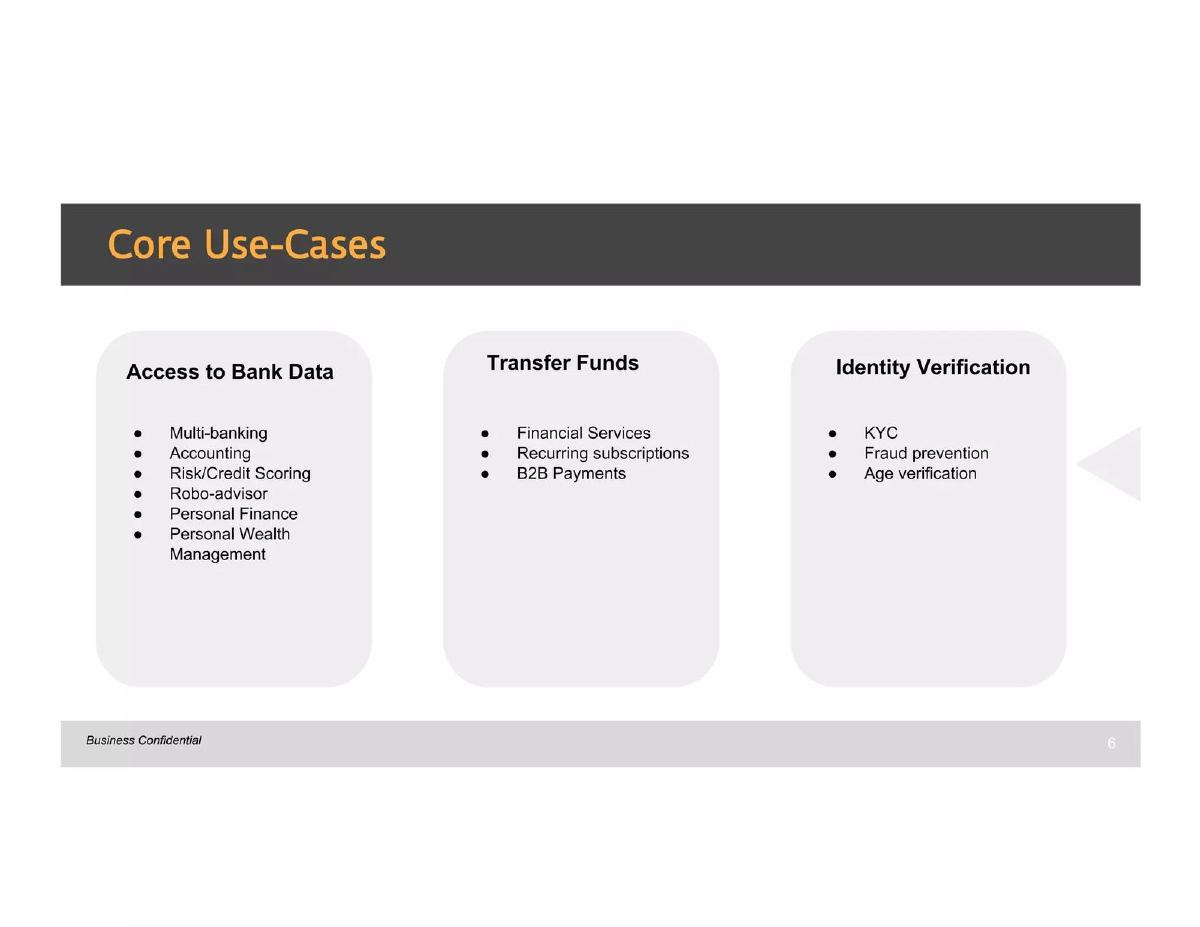
Access to Bank Data: Multi-banking, Accounting, Risk/Credit Scoring, Robo-advisors, and Personal Finance Management. · Transfer Funds: Financial Services, Recurring subscriptions, and B2B Payments. · Identity Verification: KYC, Fraud prevention, and Age verification.
Slide 7: Business Model
The revenue strategy on Slide 7 is straightforward. For data access, they propose a "Pay per use model based on the number of accounts connected," targeting a market of 400M bank accounts in the EU . For fund transfers, they cite "0.5%-1.0% transaction fees," targeting a "EUR 72 Billion" market of non-cash transactions (2014 figure).
Slide 8: The Opportunity
Slide 8 provides the macro-economic justification for the business. It points to PSD2 as the catalyst for the EU ecosystem. It also uses US benchmarks to prove the exit potential, noting that Yodlee was acquired for $600M and Plaid had raised $15M in Series A. It quotes a "$700Bn EU FinTech Market Size" and notes that EMEA spend on market data topped $10Bn .
Slide 9: Go-to-market
The strategy for growth is to focus on "UK and Germany first." They explicitly target "Startups/SMB first" because these early adopters have shorter sales cycles and allow FinPort to "grow with the momentum of the industry." The slide also mentions distribution partnerships with payment providers and KYC services.
Slide 10: 18 Months Goals
The final slide sets measurable milestones. Product goals include transaction data and payment initiation support for the UK and Germany, with beta support for France, Italy, and Spain. Traction goals are highly specific:
$70K+ MRR · 50%+ blended growth MoM · 4 larger customers in the sales pipeline · 100K linked bank accounts
What FinPort (TrueLayer) Did Well
The deck excels at category positioning . By using the phrase "Bank-as-a-Platform" and comparing themselves to Plaid and Yodlee, the founders bypassed the need to explain what an API aggregator does and instead focused on why it was needed in Europe specifically. The use of recognizable bank logos on Slide 5 creates an immediate sense of scale and necessity, even if those integrations were not yet fully realized.
The market timing argument is also exceptionally strong. By citing PSD2 on Slide 8, the deck creates a sense of regulatory urgency. Investors are led to believe that the market is being forced open by law, making the success of an infrastructure provider like FinPort seem inevitable rather than speculative.
What is Missing from the Deck
The most glaring omission is a Team Slide . In early-stage infrastructure startups, the technical pedigree of the founders is often the most important factor for investors. Building a secure, scalable API that scrapes data from hundreds of legacy banks is a massive engineering challenge; the deck provides no evidence that the team has the background to execute this.
Additionally, there is no Current Traction slide. While Slide 10 lists future goals, there is no mention of how many accounts were linked at the time of the pitch or if any of the "FinApps" mentioned in the diagram were actual paying customers. Finally, the Fundraising Ask is missing. A standard pitch deck should conclude with the amount of capital being raised and the specific milestones that capital will unlock.
Founder's Playbook: What to Copy
Founders building in the B2B infrastructure space should copy the comparative validation used on Slide 8. If a similar model has succeeded in a different geography (like the US), use those metrics ($600M acquisition, $15M Series A) to anchor your valuation and potential. It reduces the perceived risk of the business model itself.
Another excellent element is the segmentation of use cases on Slide 6. Instead of saying "we provide data," they list specific industries (Accounting, Robo-advisors, KYC). This helps investors understand the diverse revenue streams and the breadth of the customer base, making the "$700Bn market" claim feel more grounded in reality.
Frequently asked questions
- What was the primary problem FinPort aimed to solve?
- FinPort addressed the 'trapped' nature of bank data. According to Slide 2, financial institutions lacked standard programmatic access (APIs), making it impossible for innovators to leverage identity, transaction, or credit card data. The ecosystem was described as highly fragmented, consisting of thousands of institutions and products that could not communicate with modern fintech applications.
- How did FinPort plan to generate revenue?
- The business model detailed on Slide 7 was two-pronged. For 'Data Access,' they proposed a pay-per-use model based on the number of accounts connected. For 'Transfer Funds,' they planned to charge transaction fees ranging from 0.5% to 1.0% for SEPA credit transfers and direct debits. They estimated the total addressable market for these transactions at EUR 72 billion.
- Which markets did the company target for its initial launch?
- Slide 9 and Slide 10 specify that the company intended to launch in the UK and Germany first. The 18-month roadmap included achieving 'General Availability' support for these two countries while moving into beta support for the largest banks in France, Italy, and Spain to expand their European footprint.
- What competitive benchmarks did the deck use to justify the opportunity?
- The deck utilized the success of US-based fintech infrastructure companies to validate the model. Slide 8 highlights Yodlee, noting it was a public company acquired for $600M, and Plaid, which at the time had raised $15M in Series A funding. This comparison helped investors understand the potential value of a similar 'data provider' in the European market.
- What is missing from this pitch deck?
- This deck is notably missing a Team slide, which is usually critical for infrastructure plays that require high technical competence. It also lacks a 'The Ask' slide detailing how much capital they were seeking. Furthermore, there are no slides regarding current traction or unit economics, as the deck focuses primarily on the 18-month future goals and the regulatory opportunity.