Finic presents a 16-slide deck targeting the $47B wall art and decor industry, specifically the $2B online print segment. The company positions itself as a premium alternative to incumbents like Shutterfly and Zazzle by emphasizing 'thoughtful UX' and a 'secure hanging system.' The most striking aspect of the deck is the funding status: the founders claim to be 100% bootstrapped, having already burned $1.4M with $1.1M remaining. While the deck shows early traction—200 sales in two weeks via Facebook—it lacks a specific investment 'ask' or detailed financial projections. The team is large for…
Key takeaways
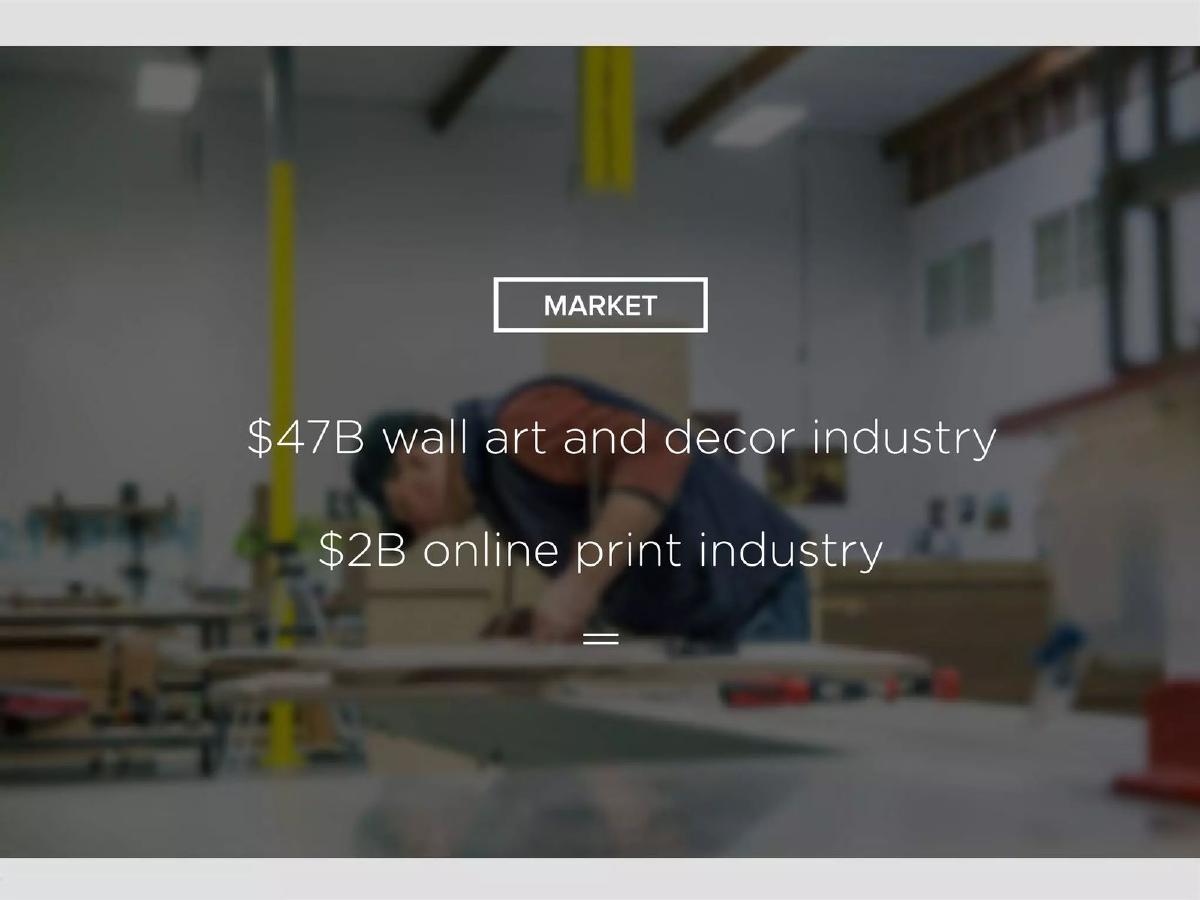
- The wall art and decor industry is valued at $47B, with the online print industry representing a $2B subset (Slide 5).
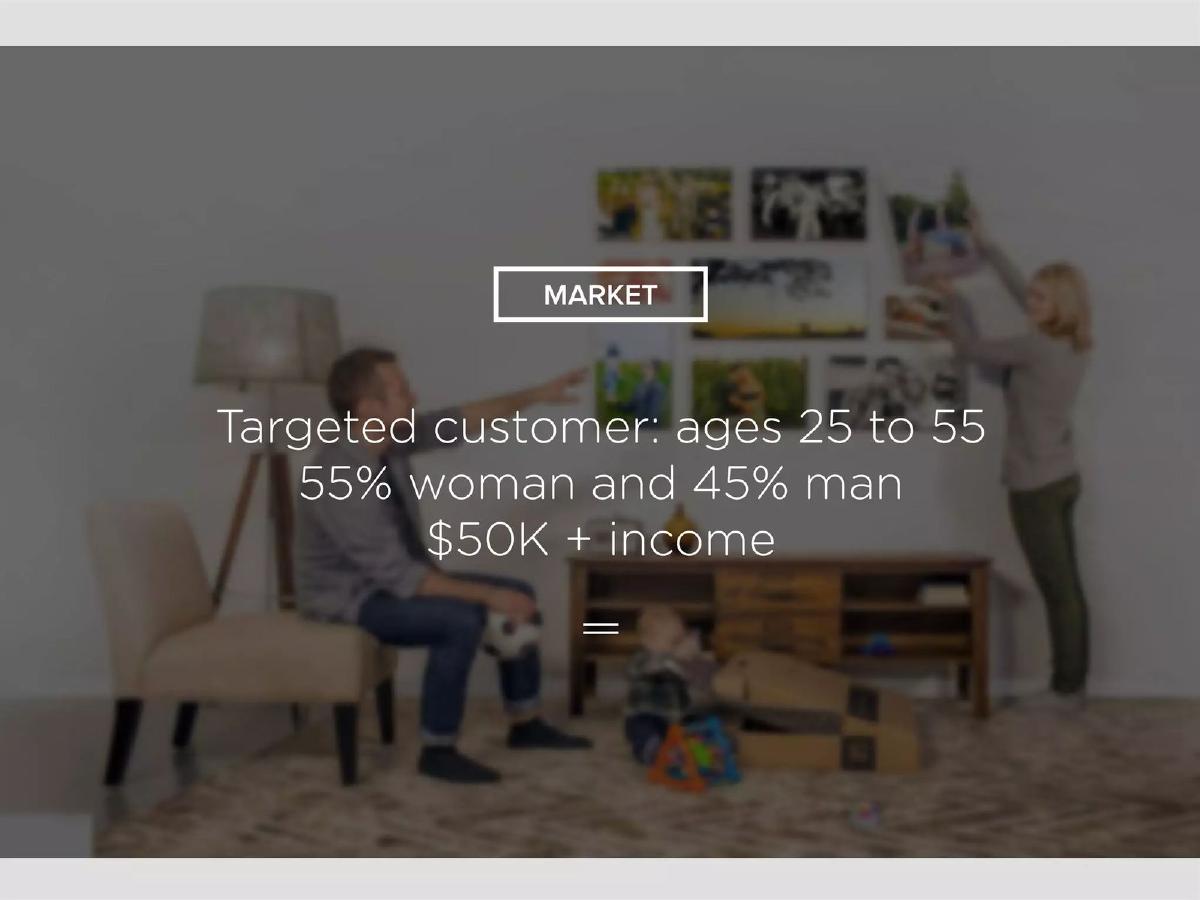
- Finic targets a specific demographic: ages 25 to 55 with an annual income of $50K+ (Slide 6).
- The company claims the wall art industry has seen no significant innovation in the last 10 years (Slide 2).
- Initial online traction resulted in 200 sales within the first two weeks of Facebook campaigns (Slide 11).
- Offline word-of-mouth efforts generated close to 100 additional orders (Slide 12).
- The business model relies on direct product sales and potential referral fees for B2B services (Slide 10).
- The founders have invested $2.5M of their own capital, with $1.1M still available for operations (Slide 15).
- The deck identifies Shutterfly, Zazzle, and Art.com as primary competitors, positioning Finic as higher quality with better customer experience (Slide 13).
Finic Pitch Deck Analysis
Finic enters the market with a clean, visually-driven pitch deck that focuses on the intersection of home decor and digital convenience. The deck is structured to highlight a perceived stagnation in the wall art industry and offers a technology-led solution. Below is a slide-by-slide breakdown of the presentation.
The Vision and the Problem (Slides 1-2)
Slide 1: Title The deck opens with a minimalist title slide featuring the Finic logo and the tagline: "Brings innovation and quality into wall art and decor industry." The background image of a modern living room sets the aesthetic tone for the brand.
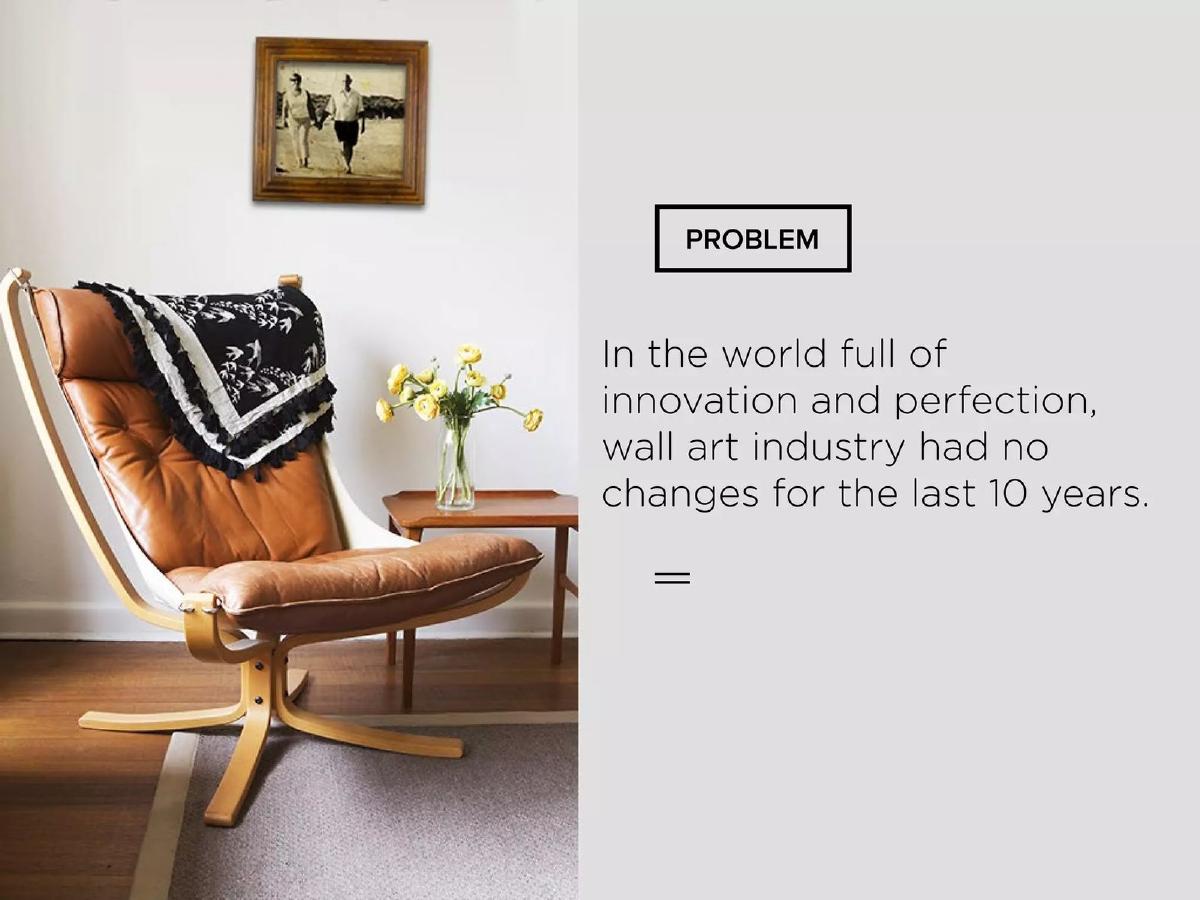
Slide 2: Problem Finic identifies a lack of innovation as the primary market pain point. The slide states: "In the world full of innovation and perfection, wall art industry had no changes for the last 10 years." This is a bold claim that sets the stage for a disruptive narrative, though it does not specify what technical or service-based changes have been lacking.
The Solution and Product (Slides 3-4, 7-9)
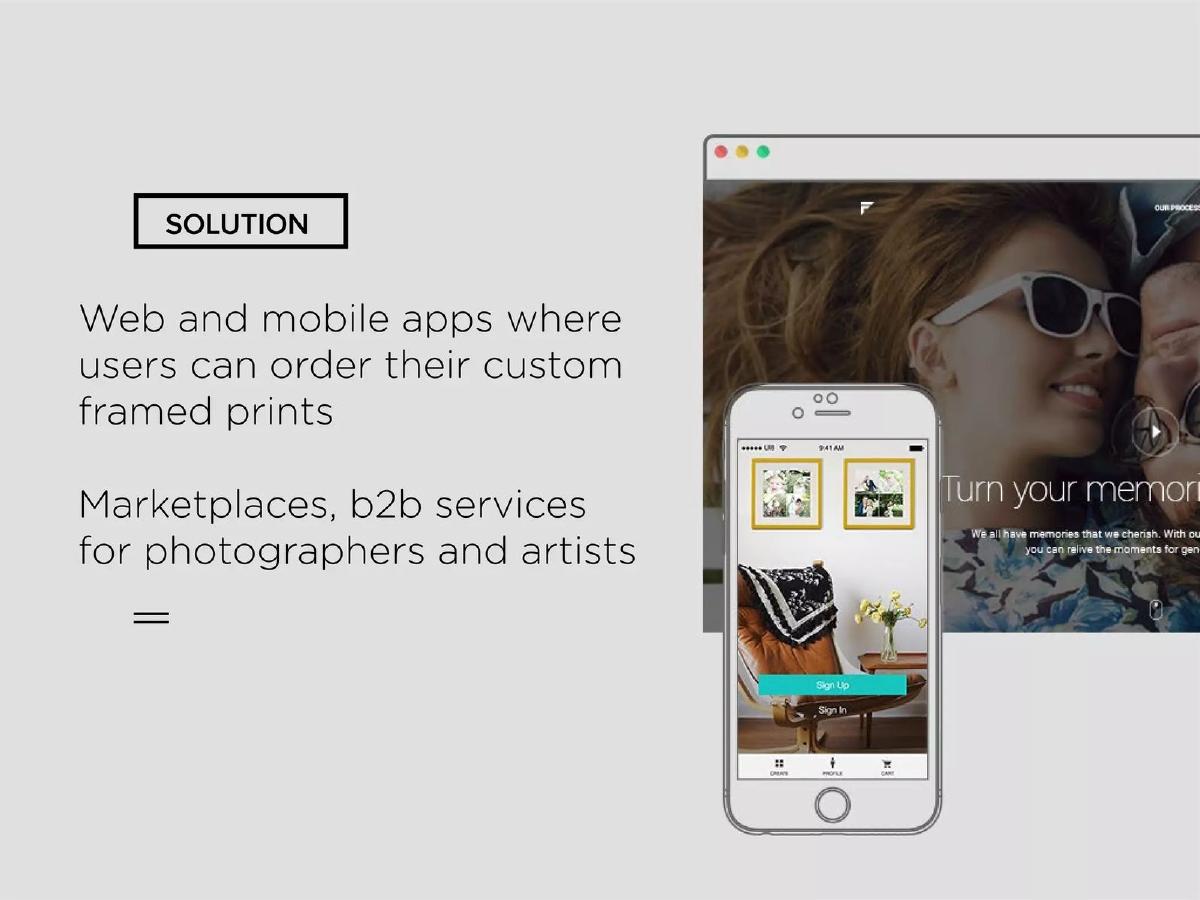
Slide 3: Solution (Digital) The solution is presented as a multi-platform approach: web and mobile apps for custom framed prints, alongside marketplaces and B2B services for photographers and artists. This suggests a two-sided marketplace strategy, though the focus remains on the consumer experience.
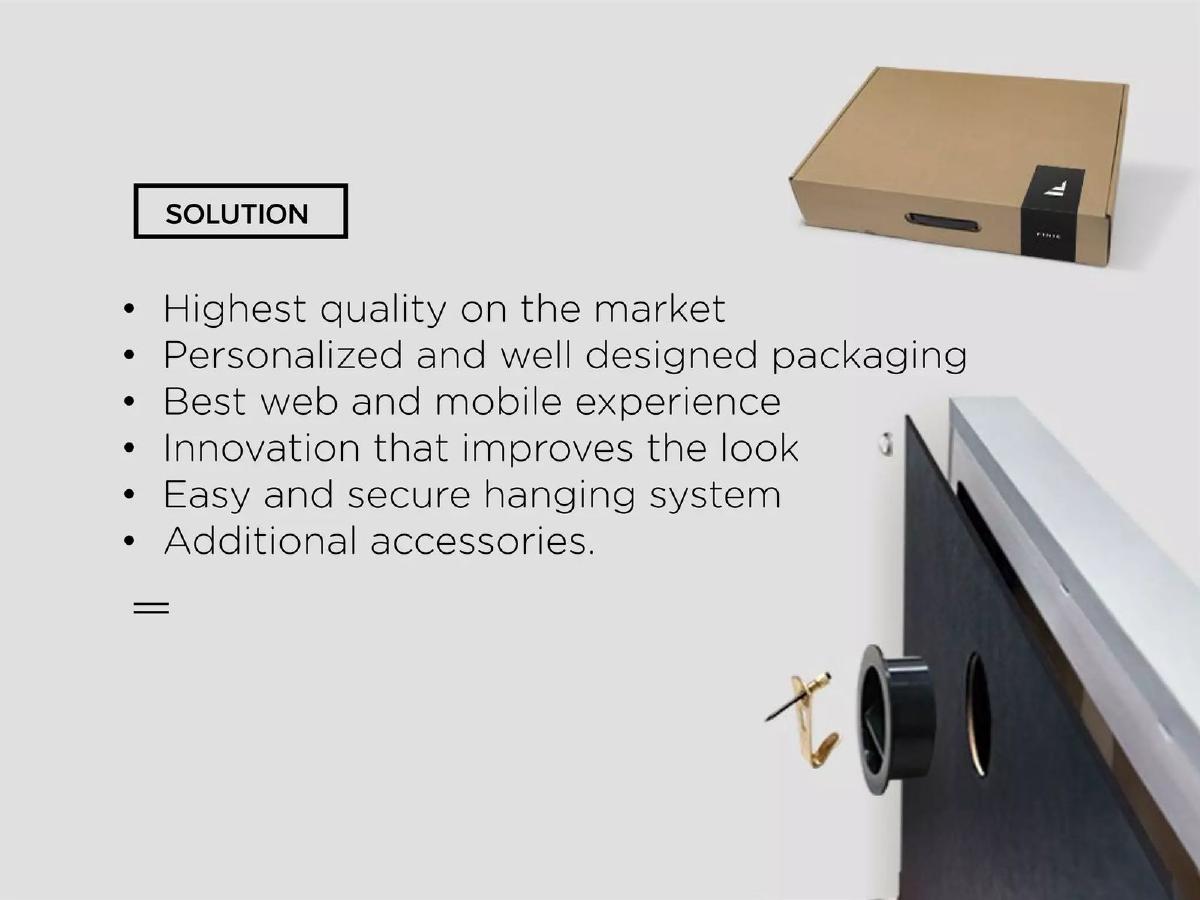
Slide 4: Solution (Physical) Finic emphasizes the physical product quality, listing "highest quality on the market," "personalized and well designed packaging," and an "easy and secure hanging system." The inclusion of a photo showing the back of a frame and a specialized hanging bracket suggests they have invested in proprietary or high-end hardware.
Slide 7 & 8: Product UX These slides showcase the user interface. Slide 7 focuses on the desktop web experience, highlighting a "Thoughtful UX, Easy Order Flow, Friendly Interface." The screenshots show a step-by-step customization process for canvas sizes and frames. Slide 8 replicates this for mobile, showing a clean, tile-based layout for image selection and layout configuration.
Slide 9: Product Detail This is a full-bleed image of a canvas print corner. It serves to reinforce the "quality" claim made earlier in the deck, showing the texture of the material and the precision of the wrap.
Market Opportunity and Demographics (Slides 5-6)
Slide 5: Market Size The deck cites a "$47B wall art and decor industry" and a "$2B online print industry." By highlighting the online segment as a small fraction of the total market, Finic implies a significant opportunity for digital migration.
Slide 6: Targeted Customer Finic provides a specific customer profile: ages 25 to 55, 55% women and 45% men, with an income of $50K+. This demographic targeting aligns with the premium branding seen throughout the deck.
Business Model and Traction (Slides 10-12)
Slide 10: Business Model The model is illustrated as a three-step cycle: 1. We Sell the Product, 2. Fulfill The Order, 3. We Get The Rest. It also mentions a "Referral Fee (in some cases)." The note at the bottom states they will create different websites and apps for different customer sets, which suggests a white-label or multi-brand strategy that isn't fully explained.
Slide 11: Online Traction The company reports that after creating finicprint.com, they achieved 200 sales in two weeks via Facebook campaigns. This was followed by another 340 sales within five months. While these numbers are modest, they provide proof of concept for their digital acquisition strategy.
Slide 12: Offline Traction Offline efforts, primarily word-of-mouth and direct sales to friends and family, resulted in "close to 100 orders." This slide demonstrates early grassroots interest but also highlights the small scale of the current operation.
Competition and Team (Slides 13-14)
Slide 13: Competition A standard 2x2 matrix places Finic in the top-right quadrant (High Quality Product / Great Customer Experience). Competitors like Shutterfly, Zazzle, and CafePress are positioned lower on both axes, while Art.com is noted for high quality but lower customer experience. This is a subjective positioning common in early-stage decks.
Slide 14: Team The team slide features seven members: Vitaliy Rizhkov (CEO), Vlad Nestereno (CBDO), Arkadiy Dorokhov (CTO), Evgeniy Vasilyev (CFO), Oleg Yagolnikov (Creative Director), Sergey Kuzminskiy (CMO), and Vladimir Ryzhkov (CPO). The deck does not provide any background information, past company experience, or educational credentials for these individuals.
Financials and Contact (Slides 15-16)
Slide 15: Funding This is the most unconventional slide in the deck. It states the company is "100% bootstrapping" with "$1.4M Burned" and "$1.1M Left." This indicates the founders have committed $2.5M of their own capital. However, the slide does not state how much they are looking to raise from outside investors, which is the typical purpose of a funding slide.
Slide 16: Contact The deck concludes with the CEO's contact information, including an email and a phone number with a 360 area code (Washington state, USA).
What Finic Does Well
Visual Consistency: The deck is professionally designed and mirrors the high-end aesthetic of the product they are trying to sell. · Clarity of Product: Between the UX screenshots and the close-up product photography, there is no ambiguity about what Finic actually makes. · Skin in the Game: The disclosure of $2.5M in bootstrapped capital is a significant signal of founder conviction, which can be persuasive to investors. · Demographic Focus: Rather than saying "everyone," they have identified a specific age and income bracket, which makes their marketing plan (Facebook ads) more believable.
What is Missing from the Deck
The Ask: The most critical omission is a clear funding request. Investors need to know how much capital is being sought and what milestones that capital will achieve. · Team Pedigree: With seven people on the team slide, the lack of bios is a missed opportunity to build trust. Investors back people as much as products. · Unit Economics: There is no mention of the Cost Per Acquisition (CPA) for those Facebook sales, nor the Average Order Value (AOV) or gross margins. Without these, the traction numbers lack context. · Roadmap: The deck mentions B2B services and multiple apps, but there is no timeline for when these will launch or how they scale the business beyond the initial $540+ sales. · Market Dynamics: While they claim the industry hasn't changed in 10 years, they don't address why incumbents haven't innovated or how Finic's "innovation" is defensible (e.g., patents on the hanging system).
Founder Takeaways
Show, Don't Just Tell Quality Finic’s use of high-resolution product photography (Slide 9) and detailed hardware views (Slide 4) is a great way to justify a "premium" label without relying solely on adjectives. If you are selling a physical good, the quality must be visible in the deck.
Be Transparent About Capital While Finic was transparent about their burn, they failed to connect it to a future goal. If you have bootstrapped a significant amount, use that as leverage to show how much "de-risking" you have already done, then clearly state what the next level of outside capital will unlock.
Focus the Business Model Slide 10 is somewhat vague, mentioning "referral fees in some cases" and "different websites for different customers." Founders should strive for a business model slide that is easy to grasp at a glance. If the model is simple direct-to-consumer (DTC) sales, just state the margins and the distribution channels.
Frequently asked questions
- What is Finic's core product offering?
- Finic offers web and mobile applications that allow users to order custom framed prints. Their value proposition centers on high-quality materials, personalized packaging, a secure hanging system, and a superior user interface compared to traditional online printers. They also mention B2B services for professional photographers and artists.
- How much traction has the company achieved?
- According to slides 11 and 12, Finic launched finicprint.com and achieved 200 sales in two weeks through Facebook ads, followed by 340 more sales over five months. Offline, they secured nearly 100 orders through word-of-mouth and direct outreach to friends and family.
- Who is the target audience for this platform?
- Finic targets adults between the ages of 25 and 55. The demographic breakdown is cited as 55% women and 45% men, specifically those with an annual household income of $50,000 or more, suggesting a mid-to-high-end market positioning.
- What is the current financial status of the company?
- The company is entirely bootstrapped. Slide 15 states they have 'burned' $1.4M to date and have $1.1M in remaining capital. This indicates a total founder commitment of $2.5M, which is unusually high for a startup at the initial traction stage.
- What information is missing from the pitch deck?
- The deck lacks a formal 'Ask' slide detailing how much money they want to raise and at what valuation. It also omits detailed team bios, unit economics (CAC/LTV), a roadmap for future product development, and multi-year financial projections.