Finovo’s 8-slide deck functions more as a product concept overview than a comprehensive investment proposal. The company identifies a legitimate market gap: the exclusion of freelancers from traditional credit scoring and the high cost of expert financial advice. Their proposed solution combines AI-driven budgeting, SIP planning, and on-demand video consultations with experts. However, the deck is critically thin on operational data. It lacks a team slide, a business model, a competitive analysis, and a specific financial ask. While the market overview slide projects the global financial advi…
Key takeaways
- The deck identifies four primary problems: expense tracking struggles, overwhelming investment options, credit exclusion for gig workers, and expensive financial advice (Slide 2).
- Finovo proposes an 'Alternative credit scoring model' that uses AI to analyze spending behavior for those without a CIBIL score (Slide 3).
- The product vision includes a human element through on-demand video consultations with certified financial advisors (Slide 4).
- Market projections show the global financial advisory market growing from approximately $14 billion in 2024 to over $50 billion in 2029 (Slide 5).
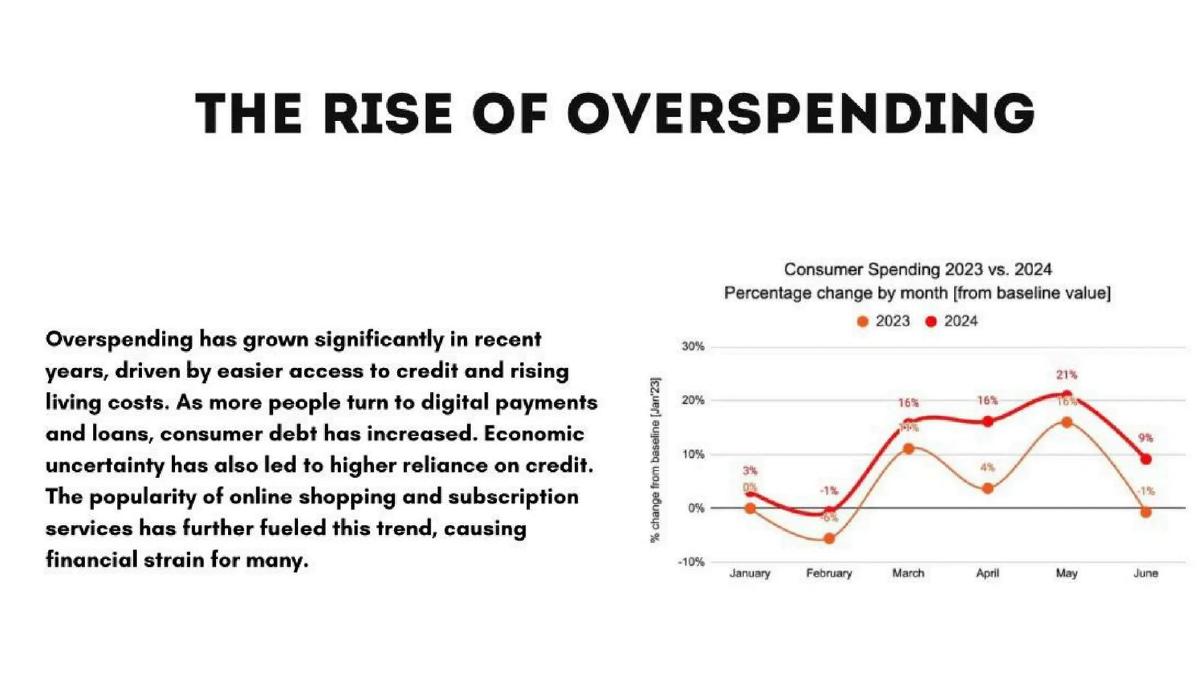
- The deck highlights a specific trend in consumer spending, noting a 21% increase from the baseline in May 2024 compared to 2023 (Slide 6).
- Finovo claims to solve 'Financial Procrastination' and 'Lack of Emergency Savings' through its mobile interface (Slide 7).
- The deck contains no information regarding the founding team, their background, or their technical expertise.
- There is no mention of a business model, revenue streams, or unit economics across the 8 slides.
Finovo Pitch Deck Analysis
The Finovo pitch deck is a brief, 8-slide presentation that outlines a conceptual framework for a comprehensive personal finance application. It focuses heavily on the 'why' and the 'what'—identifying the financial struggles of modern workers and proposing a multi-feature app to solve them. However, it almost entirely ignores the 'how' and 'who,' leaving significant gaps that would prevent a professional investor from performing due diligence.
Slide 1: Title Slide
The deck opens with a minimalist title slide featuring the Finovo logo—a four-pointed star-like icon—against a split pink and black background. There is no tagline, mission statement, or indication of the company's stage. It is a purely branding-focused entry point.
Slide 2: Problem Statement
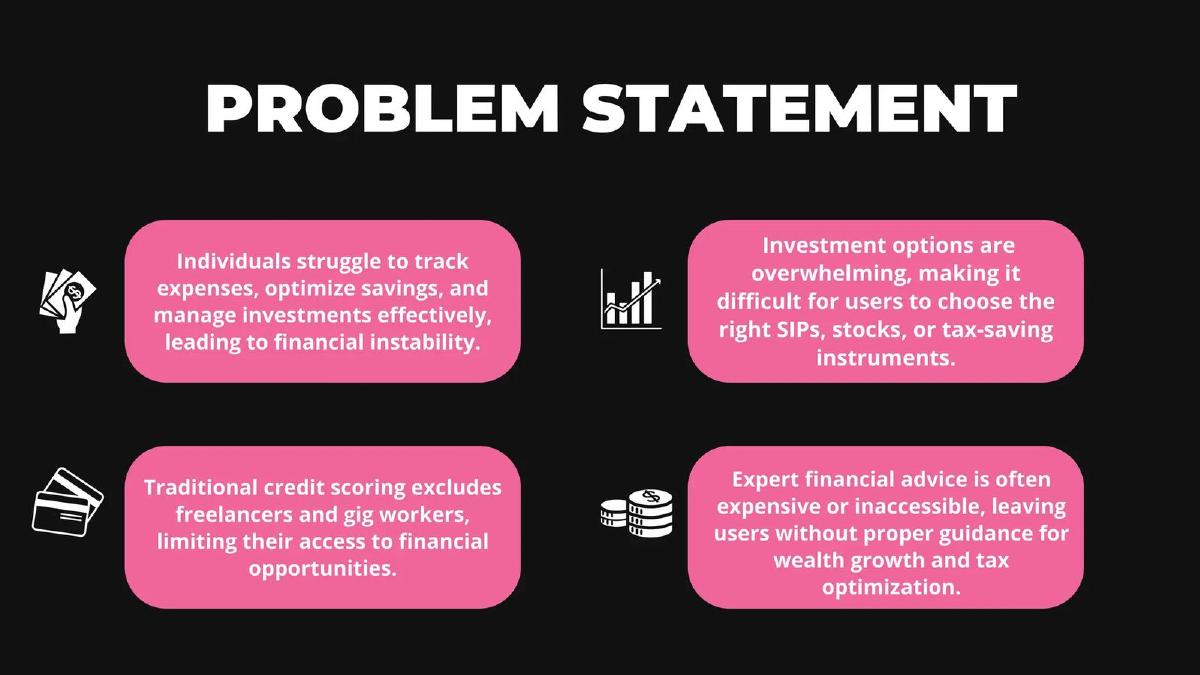
Finovo identifies four core pain points. First, the general struggle of individuals to track expenses and optimize savings. Second, the 'overwhelming' nature of investment options like SIPs and stocks. Third, a specific niche problem: traditional credit scoring excludes freelancers and gig workers. Finally, the high cost and inaccessibility of expert financial advice. This slide effectively sets up a broad market need, though it lacks specific data to quantify these problems at this stage.
Slide 3: Solution Overview
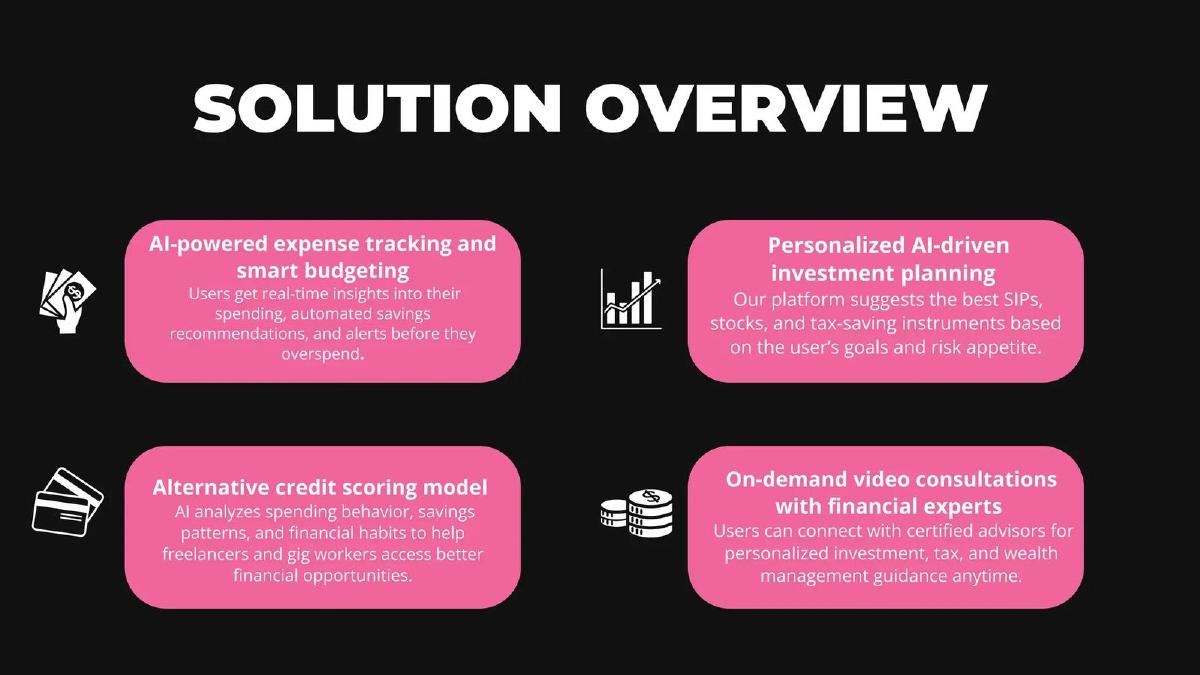
The solution mirrors the problems identified on the previous slide. Finovo proposes a four-pillar solution: AI-powered expense tracking for real-time insights, personalized AI-driven investment planning , an alternative credit scoring model for gig workers, and on-demand video consultations . The inclusion of 'on-demand video' is a notable differentiator, suggesting a marketplace or service layer beyond simple software.
Slide 4: Our Features
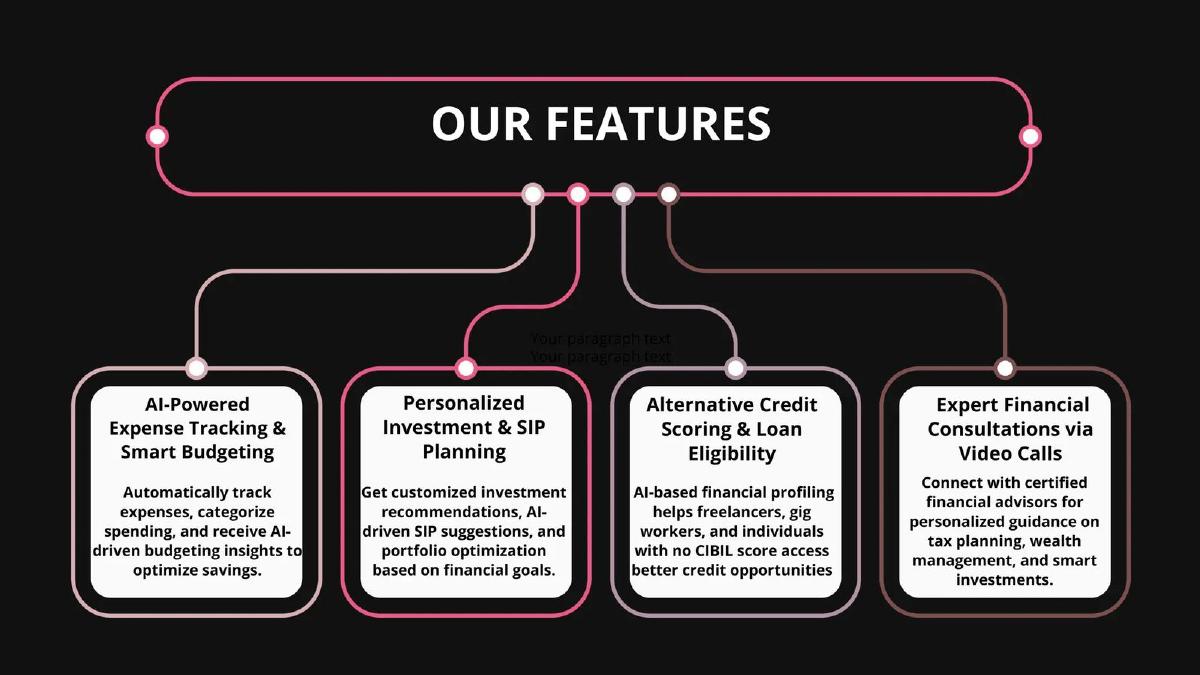
This slide reiterates the solution pillars but adds more granular detail. It mentions 'AI-based financial profiling' to help those with 'no CIBIL score' (referencing the Indian credit rating agency) access loans. It also specifies that the video consultations are for 'tax planning, wealth management, and smart investments.' Curiously, the slide contains placeholder text ('Your paragraph text') in the center, indicating the deck may have been rushed or is an incomplete draft.
Slide 5: Market Overview
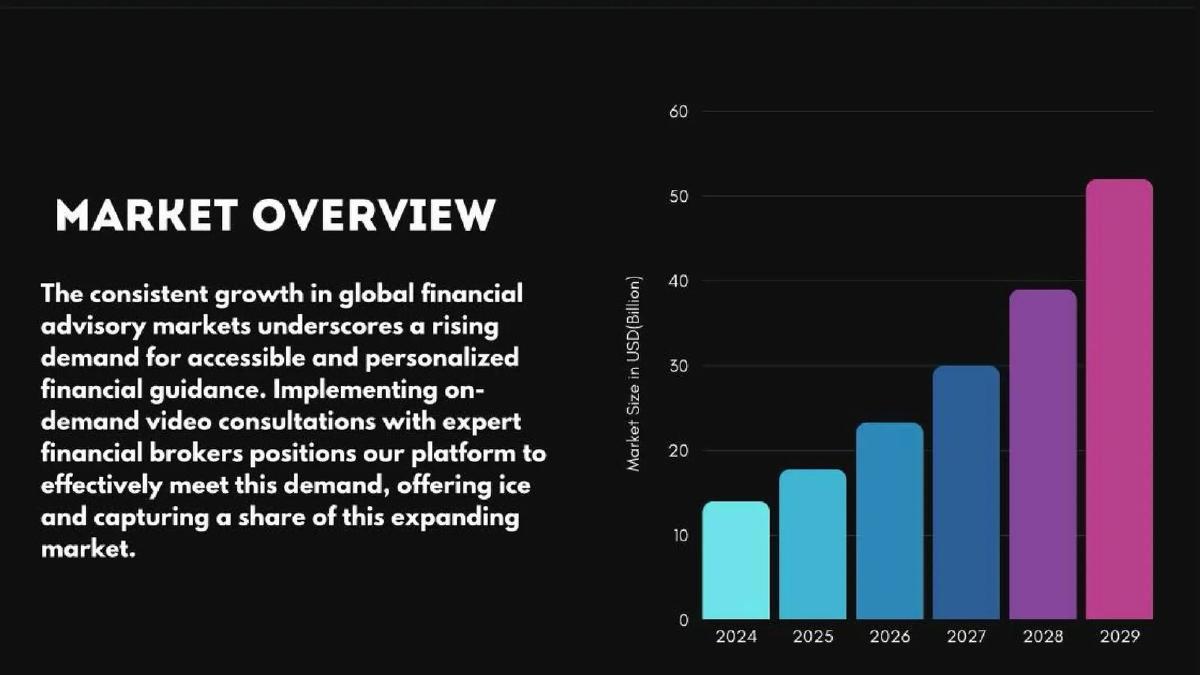
Finovo presents a bar chart showing the 'Market Size in USD(Billion)' from 2024 to 2029. The chart projects growth from roughly $14 billion in 2024 to over $50 billion in 2029 . The text claims that on-demand video consultations position the platform to capture a share of this expanding global financial advisory market. The source for these figures is not cited on the slide.
Slide 6: The Rise of Overspending
This slide provides a more detailed look at consumer behavior. It features a line graph comparing consumer spending in 2023 versus 2024. It notes a peak in May 2024, where spending was 21% above the baseline . The text attributes this trend to easier access to credit, rising living costs, and the popularity of online shopping. This slide serves to validate the need for the 'expense tracking' and 'budgeting' features of the app.
Slide 7: What Have We Solved?
Finovo lists six outcomes of their platform, including solving 'Lack of Emergency Savings' and 'Financial Procrastination.' A mobile mockup is shown on the right. The mockup shows a user named 'Antonio Diaz' with a balance of $115.000 . The UI includes tabs for 'Shop,' 'Group,' 'Goals,' and 'Expenses,' as well as an activity feed. This is the only visual representation of the product in the deck.
Slide 8: Thank You
The deck ends abruptly with a 'Thank You' slide. There is no contact information, no website URL, and no call to action. Most importantly, there is no 'Ask' slide detailing how much capital the company is looking to raise or what milestones that capital will fund.
What Finovo Does Well
The deck is visually consistent and uses a clear, readable layout. It does a good job of identifying a specific, underserved demographic: the gig worker who lacks a traditional credit score. By mentioning the 'CIBIL score,' the founders signal a specific geographic focus (India), which helps narrow the massive 'global financial advisory' market mentioned later. The combination of AI automation and human video consultation is a logical way to address the 'trust gap' often found in purely automated fintech apps.
What is Missing from the Finovo Deck
The omissions in this deck are substantial and would be considered disqualifying by most institutional investors. First, there is no Team slide. In fintech, the background of the founders—specifically their experience in finance, regulatory compliance, and AI—is the most important factor. Second, there is no Business Model. It is unclear if Finovo plans to charge a subscription fee, take a commission on investments, charge for video calls, or act as a lead generator for lenders. Third, there is no Competitive Analysis. The fintech space is incredibly crowded with players like Mint, YNAB, and various neo-banks; Finovo does not explain why a user would choose them over established incumbents. Finally, there is no 'Ask' or Roadmap. Investors need to know what the founders want and where the company is going next.
What Other Founders Should Copy
Founders can learn from the way Finovo uses a specific market trend (Slide 6) to justify a product feature. Instead of just saying 'people spend too much,' they used a month-over-month comparison graph to show that spending volatility is increasing. This makes the 'problem' feel more urgent and data-driven. Additionally, the use of a 'Solution Overview' (Slide 3) followed by a 'Features' breakdown (Slide 4) is a good way to bridge the gap between high-level value propositions and actual product functionality, provided the placeholder text is removed.
Final Analyst Verdict
The Finovo deck is a 'concept deck' rather than a 'pitch deck.' It outlines a plausible product for a growing market but fails to provide any evidence that the founders have the capability, the plan, or the traction to build it. To be viable for fundraising, the company needs to add at least four more slides: a detailed Team bio, a clear Revenue Model, a Competitive Matrix, and a specific Funding Request with a 12-18 month milestone roadmap.
Frequently asked questions
- What is Finovo's primary target audience?
- Based on Slide 2 and Slide 4, Finovo specifically targets freelancers, gig workers, and individuals who are excluded from traditional credit scoring systems. The deck mentions helping those with 'no CIBIL score' access better credit opportunities by using an alternative AI-based profiling model that looks at spending and savings patterns rather than just traditional credit history.
- How does Finovo plan to differentiate itself from automated robo-advisors?
- Finovo differentiates itself by blending AI automation with human expertise. While Slide 3 mentions AI-powered budgeting and investment planning, Slide 4 and Slide 5 emphasize 'on-demand video consultations with expert financial brokers.' This hybrid approach suggests they are positioning themselves as a more personalized, accessible alternative to both high-cost traditional advisors and purely algorithmic platforms.
- What specific financial instruments does the platform support?
- According to Slide 3 and Slide 4, the platform focuses on Systematic Investment Plans (SIPs), stocks, and tax-saving instruments. The AI is intended to suggest these specific products based on the user's individual financial goals and risk appetite, while also providing guidance on tax planning and wealth management through their consultation feature.
- Is there any evidence of traction or a working prototype in the deck?
- The deck shows a single mobile app mockup on Slide 7, displaying a balance of '$115.000' and various UI elements like 'Shop,' 'Goals,' and 'Expenses.' However, there are no metrics regarding user growth, waitlist size, partnerships with financial institutions, or actual revenue. The deck remains entirely conceptual without evidence of a live product or pilot program.
- What are the biggest red flags for an investor in this deck?
- The most significant red flags are the omissions. There is no team slide, which is critical for early-stage fintech where regulatory and technical expertise is mandatory. Additionally, the lack of a business model (how they make money) and a specific funding ask makes it impossible to evaluate the investment opportunity. The deck also fails to address the competitive landscape in a crowded fintech market.