Woodoo’s pitch deck is a concise, visually-driven document that successfully raised $31M in 2024. The deck avoids the common trap of over-explaining complex biochemistry, instead focusing on the 'before and after' of their material transformation. By categorizing their technology into three distinct verticals—Slim (glass alternative), Flow (leather alternative), and Solid (metal alternative)—they demonstrate a versatile platform technology with a combined SAM exceeding $450B. The deck leans heavily on carbon performance metrics, claiming significant CO2 reductions compared to traditional mate…
Key takeaways
- The deck identifies concrete and steel as responsible for 21% of global greenhouse gas emissions on slide 2.
- Woodoo positions wood as a carbon sink, stating it holds 1 ton of CO2 per cubic meter on slide 3.
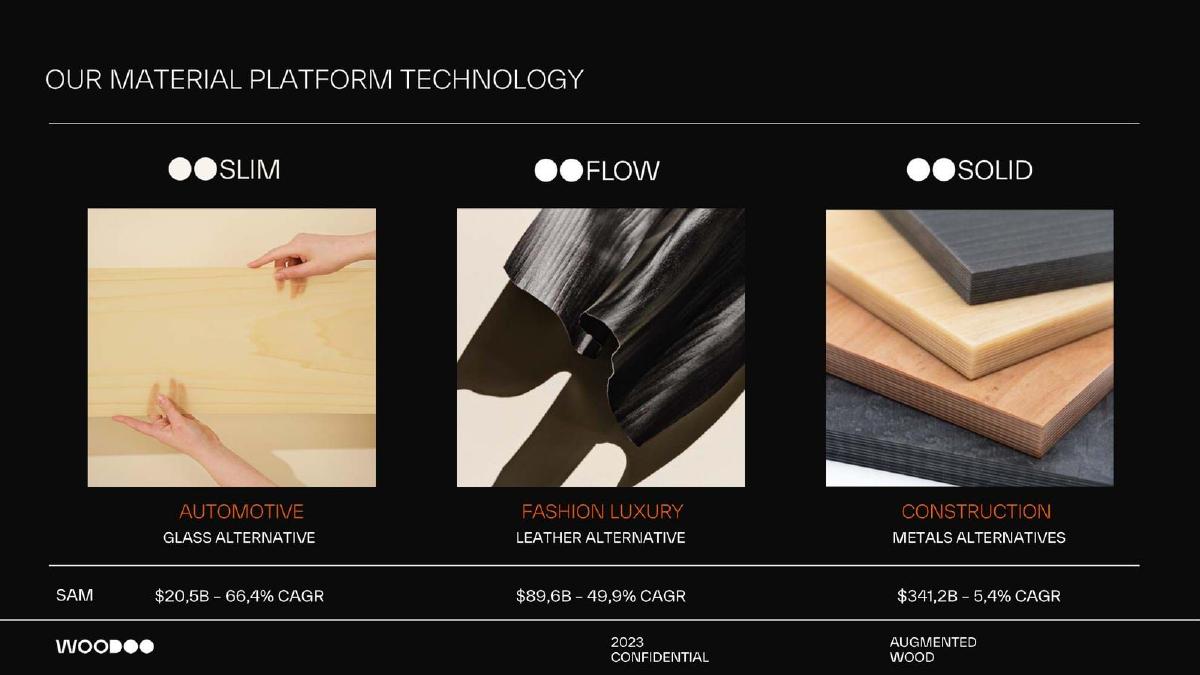
- The company segments its technology into three brands: Slim, Flow, and Solid, targeting automotive, fashion, and construction respectively (slide 4).
- The 'Solid' material line targets a $341.2B SAM as a metals alternative in construction (slide 4).
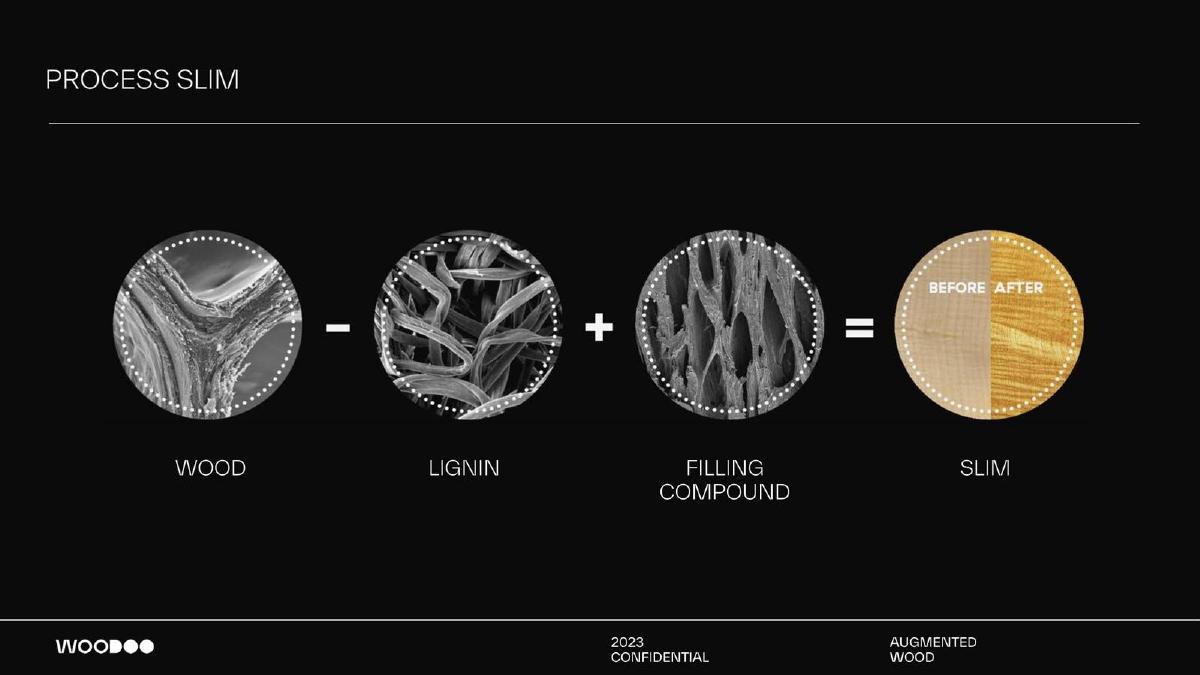
- The core process involves removing lignin from wood and adding a filling compound to create 'Augmented Wood' (slide 5).
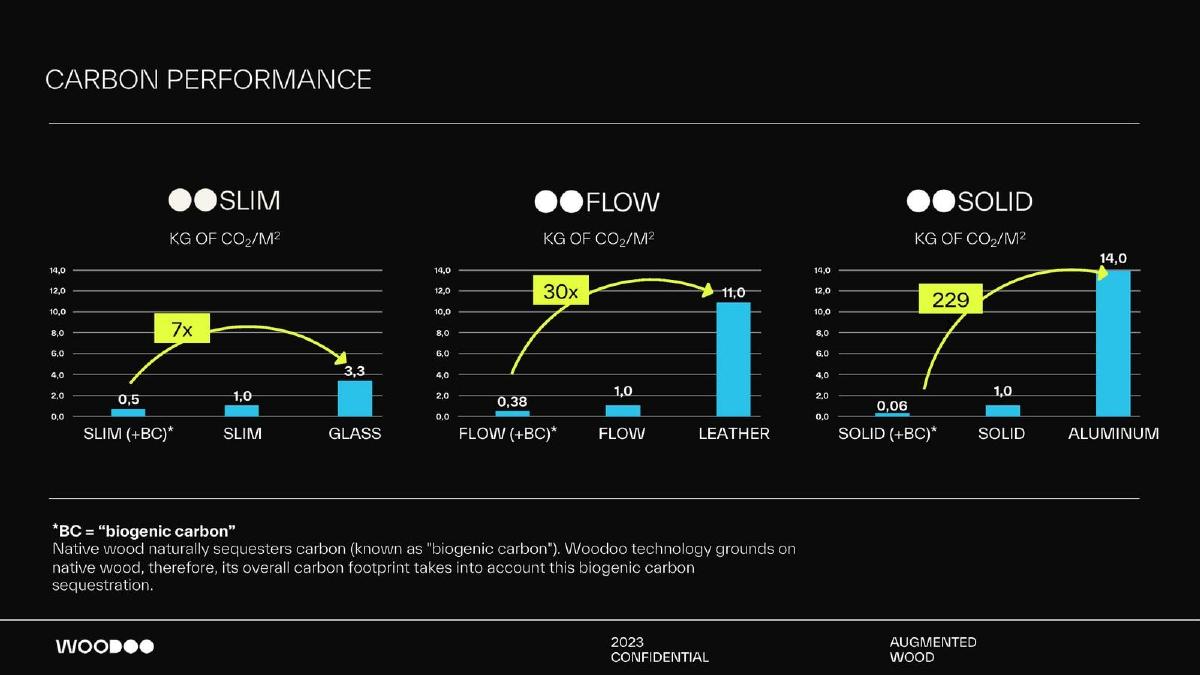
- Woodoo claims its 'Solid' material has a carbon footprint 229x lower than aluminum when accounting for biogenic carbon (slide 6).
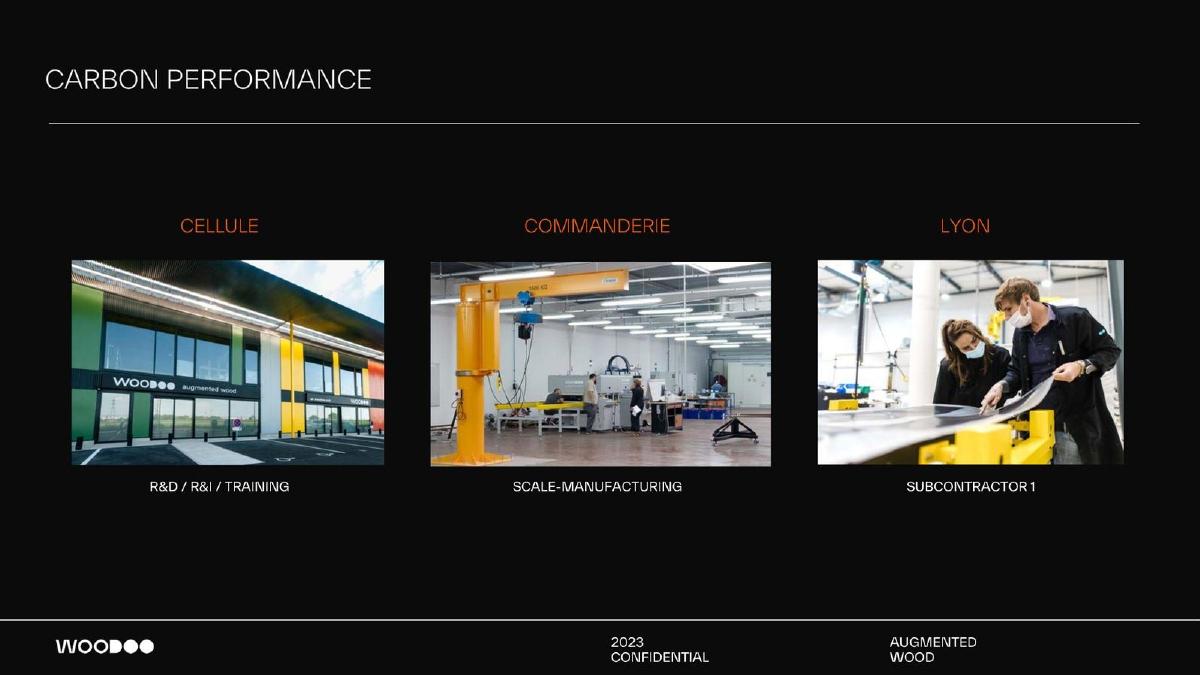
- The deck highlights three physical locations: Cellule (R&D), Commanderie (Scale-Manufacturing), and Lyon (Subcontractor) on slide 7.
- The presentation omits a dedicated team slide, detailed roadmap, and specific funding ask within the 8-slide sequence.
Introduction: The Power of Visual Material Science
Woodoo’s pitch deck is a masterclass in brevity. In just eight slides, the Paris-based biotech startup manages to communicate a complex scientific process and its massive industrial implications. According to publisher-reported facts from Business Insider, this deck supported a $31M Venture round in 2024. The company operates at the intersection of Biotech and Construction, aiming to replace high-emission materials with 'Augmented Wood.'
Slide 1: Title and Visual Hook
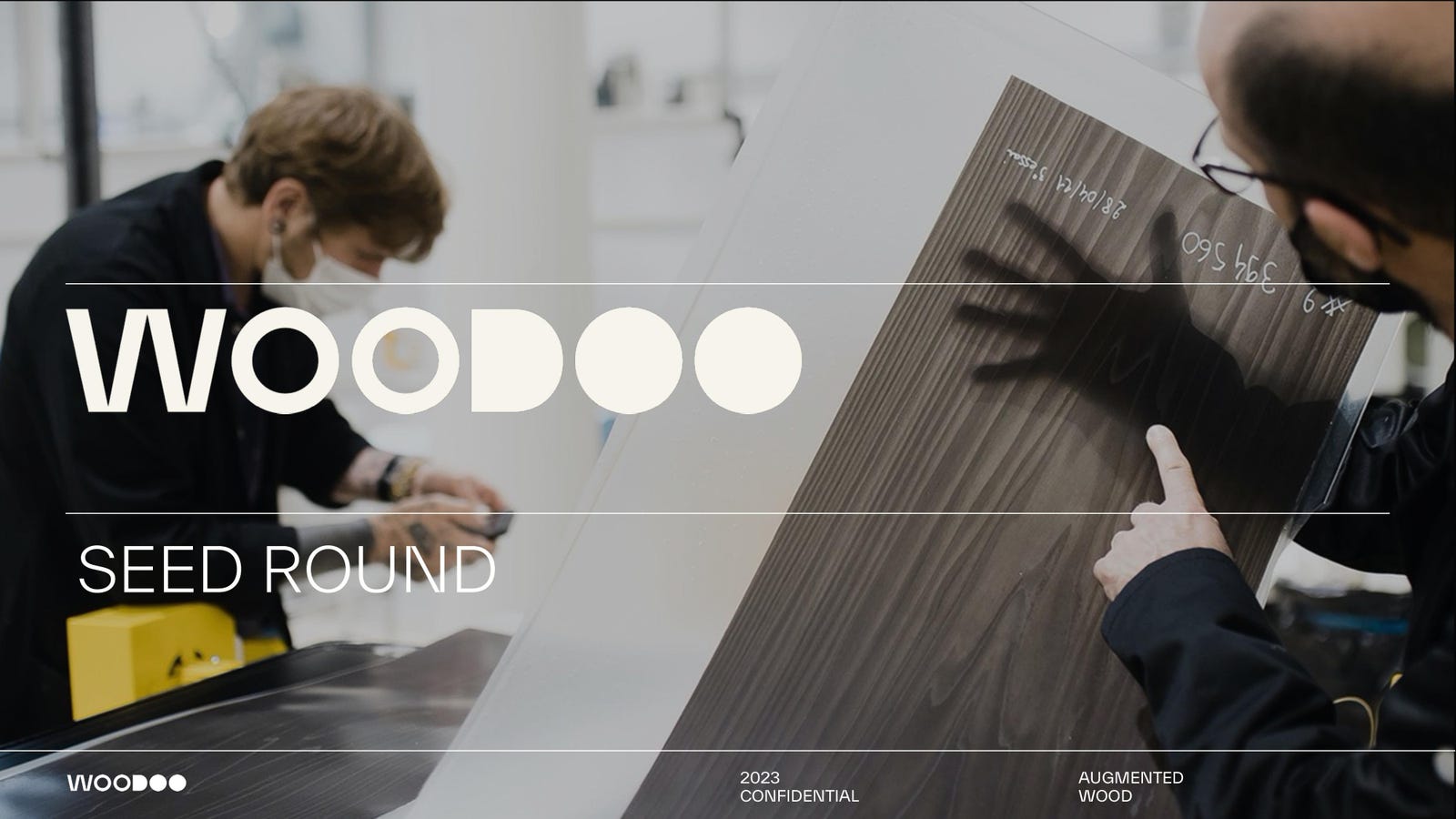
The cover slide is minimalist, featuring the Woodoo logo and the text 'SEED ROUND.' The background image is the most important element here: it shows two individuals in a lab setting interacting with a translucent, wood-grained panel. This immediately establishes the 'Augmented Wood' concept—a material that looks like wood but possesses properties (translucency, durability) that natural wood does not. The footer notes '2023 CONFIDENTIAL' and 'AUGMENTED WOOD,' setting a professional, high-tech tone.
Slide 2: The Macro Problem
Slide 2, titled 'OUR MATERIAL PLATFORM TECHNOLOGY,' addresses the 'Why Now?' question. It uses a stark image of an open-pit mine to contrast with their organic solution. The slide lists three critical drivers: 'CONCRETE + STEEL = 21% GLOBAL GHG,' the 'NEED TO BUILD 10x NYC/YEAR GLOBALLY BY 2050,' and 'SCARCER MATERIAL RESERVES + PRICE INCREASE.' By anchoring the problem in global greenhouse gas (GHG) emissions and the sheer scale of urban development, Woodoo positions its technology as a necessity for the future of the planet, not just a niche alternative.
Slide 3: The Solution - Wood as a Carbon Sink
Titled 'WOOD IS THE SOLUTION,' slide 3 pivots to the supply side. It notes a 'GLOBAL FORESTS GROWTH OF 233M M3/YEAR' and highlights that 'WOOD IS A CARBON SINK = 1 TON OF CO2 PER M3.' Interestingly, it also mentions that '1/3 OF TREES THREATEN BY CLIMATE CHANGE,' perhaps suggesting that utilizing this wood in long-lived materials is a way to preserve that carbon rather than letting it release through decay or wildfire. The imagery of vast timber stacks reinforces the idea of abundant raw material.
Slide 4: Market Segmentation and SAM
This is the 'Business' slide. Woodoo breaks its 'Material Platform Technology' into three distinct product lines: SLIM , FLOW , and SOLID . Each is mapped to a specific industry and a Serviceable Addressable Market (SAM):
SLIM: Automotive (Glass Alternative) - $20.5B SAM at 66.4% CAGR. · FLOW: Fashion Luxury (Leather Alternative) - $89.6B SAM at 49.9% CAGR. · SOLID: Construction (Metals Alternatives) - $341.2B SAM at 5.4% CAGR.
This slide is highly effective because it shows the versatility of the core technology. It isn't just a construction company; it is a materials company with horizontal reach across high-value sectors.
Slide 5: The Science of 'Augmented Wood'
Slide 5, 'PROCESS SLIM,' explains the 'How.' It uses a simple mathematical formula: WOOD - LIGNIN + FILLING COMPOUND = SLIM . Microscopic images show the cellular structure of wood, the extracted lignin, and the resulting augmented structure. The 'Before/After' circle on the right shows a piece of wood becoming translucent. This simplifies a complex chemical engineering process into a digestible visual that any investor can understand without a PhD in biochemistry.
Slide 6: Carbon Performance Metrics
Sustainability is a core value proposition for Woodoo, and slide 6 provides the data to back it up. It compares the KG of CO2 per square meter for their three products against incumbents. The most striking figure is the '229x' improvement for SOLID compared to ALUMINUM . The slide includes a footnote explaining 'BC = biogenic carbon,' noting that their technology accounts for the carbon naturally sequestered in wood. This transparency is crucial for ESG-focused investors who are wary of greenwashing.
Slide 7: Physical Traction and Scale
Slide 7 moves from theory to reality. It displays three facilities: CELLULE (R&D / R&I / Training), COMMANDERIE (Scale-Manufacturing), and LYON (Subcontractor 1). By showing actual buildings and industrial machinery, Woodoo proves they have moved past the 'lab bench' phase. The mention of a 'Subcontractor' suggests they are already integrating into existing supply chains, which reduces the perceived risk of scaling manufacturing from scratch.
Slide 8: Contact and Socials
The final slide is a standard 'THANK YOU' page dated '20/04/23.' It provides links to LinkedIn, Twitter, Instagram, and their website. It is clean and maintains the brand aesthetic established in the previous seven slides.
What Woodoo Does Exceptionally Well
The primary strength of this deck is its visual hierarchy . The founders understand that in a seed or venture round, investors are looking for a 'big idea' backed by 'real science.' By using high-quality photography and simple icons, they make the technology feel tangible. The categorization of products (Slim, Flow, Solid) is a brilliant way to organize a platform technology that could otherwise feel unfocused. Furthermore, the focus on 'Biogenic Carbon' aligns perfectly with current regulatory and investment trends in Europe, where the company is headquartered.
What is Missing from the Woodoo Deck
Despite raising $31M, this specific 8-slide sequence is missing several 'standard' pitch deck components: 1. The Team: There is no mention of the founders, their scientific backgrounds, or their previous exits. In deep-tech, the pedigree of the R&D team is usually a top-three concern for investors. 2. Competitive Landscape: While they compare themselves to glass, leather, and aluminum, they do not mention other 'mycelium' or 'bio-plastic' competitors. Investors will want to know why 'Augmented Wood' is superior to other sustainable alternatives. 3. Financial Projections: There are no charts showing revenue growth, burn rate, or path to profitability. While SAM is mentioned, the company's specific capture plan is absent. 4. The Ask: The deck does not explicitly state how much money they are looking for or how they intend to spend it (e.g., '50% for new factory, 30% for R&D').
Founder Takeaways: Copy the Clarity, Not the Omissions
Founders should emulate Woodoo’s ability to simplify complex processes . If your startup involves 'hard science,' don't drown your slides in text; use the 'Wood - Lignin + Compound' approach to explain your 'magic.' Additionally, the way Woodoo maps one technology to three distinct, high-CAGR markets is a great way to show massive upside. However, unless you have the significant pre-existing reputation that Woodoo likely had in the French ecosystem, do not omit your team or your specific funding ask. Those are usually non-negotiable for a successful pitch.
Frequently asked questions
- What is Woodoo's core technology?
- Woodoo develops 'Augmented Wood' by removing lignin—the organic polymer that makes wood rot and burn—and replacing it with a proprietary filling compound. As shown on slide 5, this process transforms natural wood into a high-performance material that can replace glass, leather, or metal depending on the specific formulation used.
- Which markets is Woodoo targeting?
- The company targets three primary Serviceable Addressable Markets (SAM) as detailed on slide 4: Automotive ($20.5B) for glass alternatives, Fashion Luxury ($89.6B) for leather alternatives, and Construction ($341.2B) for metal alternatives. This multi-vertical approach positions them as a horizontal material platform rather than a single-product company.
- How does Woodoo justify its sustainability claims?
- Woodoo uses 'Carbon Performance' charts on slide 6 to compare their materials against incumbents. They emphasize 'biogenic carbon'—the CO2 naturally sequestered by trees. By their metrics, their 'Solid' material produces only 0.06 kg of CO2/m2 compared to 14.0 kg for aluminum, representing a massive reduction in carbon intensity.
- What manufacturing capabilities does Woodoo have?
- Slide 7 showcases three distinct operational pillars: 'Cellule' for R&D and training, 'Commanderie' for scale-manufacturing, and a facility in 'Lyon' for subcontracting. This indicates the company has moved beyond laboratory-scale prototypes and into industrial production phases, which is critical for a $31M venture round.
- What is missing from the Woodoo pitch deck?
- The 8-slide deck is remarkably lean, omitting several standard sections. There is no team slide highlighting founder expertise, no competitive landscape analysis, no financial 'ask' or use of funds, and no detailed five-year roadmap. It functions more as a high-level technology and market overview than a comprehensive business plan.