Women Cycles is a digital health platform targeting women aged 45+ with natural, science-based healing solutions for chronic issues like pelvic floor dysfunction. The 11-slide deck is notable for its heavy emphasis on unit economics and traction, reporting a 2x return on ad spend for the first purchase and an 84% renewal rate after the initial 12-week program. The company positions itself as a 'root cause' alternative to traditional Western medicine, which it labels as a 'wrong toolbox' for chronic female symptoms. With a first product priced at 349 USD, the deck outlines a clear expansion st…
Key takeaways
- The company reports 4,932 symptoms that uniquely or predominantly affect women as the core problem space on slide 2.
- The first product is a 12-week pelvic issue program priced at 349 USD, featuring a personalized schedule and care team as shown on slide 4.
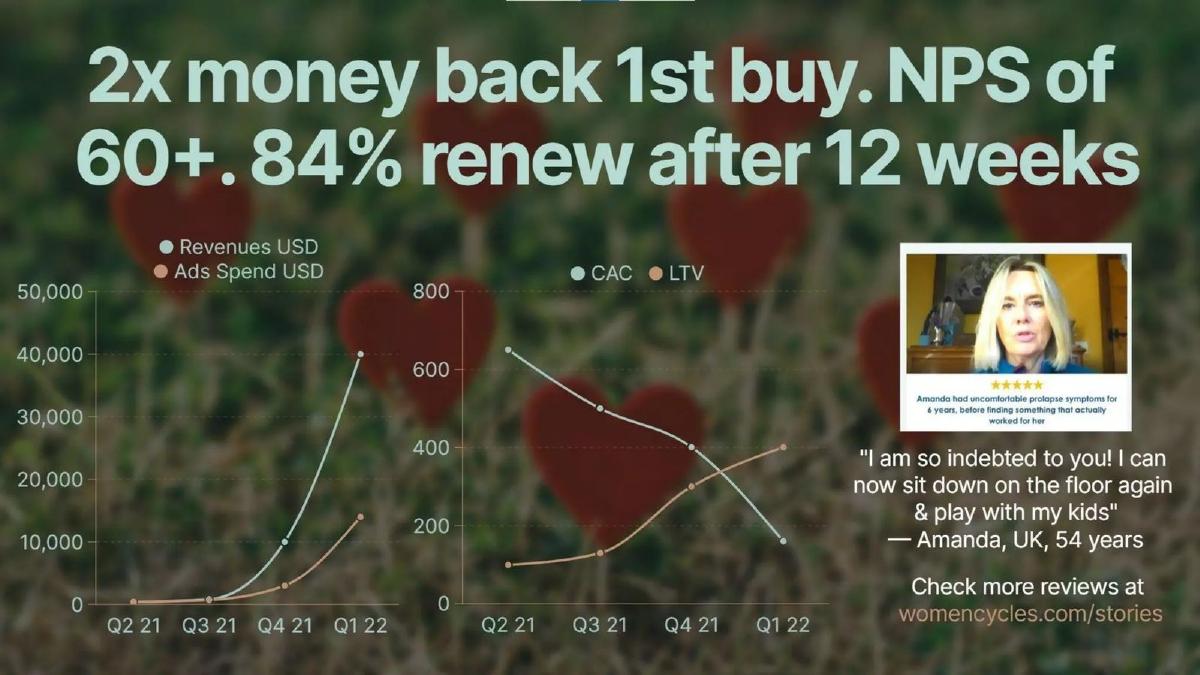
- Traction data on slide 5 shows revenue growing significantly from Q2 2021 to Q1 2022, while CAC decreased and LTV increased over the same period.
- The deck claims an 84% renewal rate after the initial 12-week program on slide 5.
- Market sizing on slide 8 targets a SOM of 3.6M women, with a goal of reaching 1M paying users and 500M USD ARR by 2030.
- The competitive landscape on slide 9 positions the brand as the only 'Holistic' and 'Root Cause/Natural' solution compared to competitors like Elvie and Kindbody.
- Co-founder Mahesh Kumar previously co-founded FitnessCollection, which was sold to Classpass in 2019, according to slide 10.
- The investment ask is 2M EUR for 20% dilution, with the claim that 50% of capital remains from their Q2 2021 fundraising on slide 11.
Executive Summary: The Pivot to Holistic FemTech
Women Cycles entered the market in 2020, a time when the 'FemTech' sector was beginning to move beyond simple period tracking into more complex chronic health management. This 11-slide pitch deck focuses on a specific niche: women over 45 facing chronic issues that traditional Western medicine often fails to resolve. By combining a high-ticket digital program (349 USD) with strong retention metrics (84% renewal), the company presents a business model that prioritizes unit economics over raw user acquisition. The deck is a classic example of a 'traction-first' seed pitch, using early revenue data to justify a 2M EUR ask.
Slide 1: Title and Branding
The cover slide is minimalist, featuring the company name, 'Women Cycles,' and the subtitle 'Seed Investment Round.' It includes the URL and a circular watercolor logo. The dark green background and serif typography suggest a premium, wellness-oriented brand identity. There are no taglines or mission statements on this slide, leaving the following slides to define the value proposition.
Slides 2-3: The Problem and the 'Natural' Solution
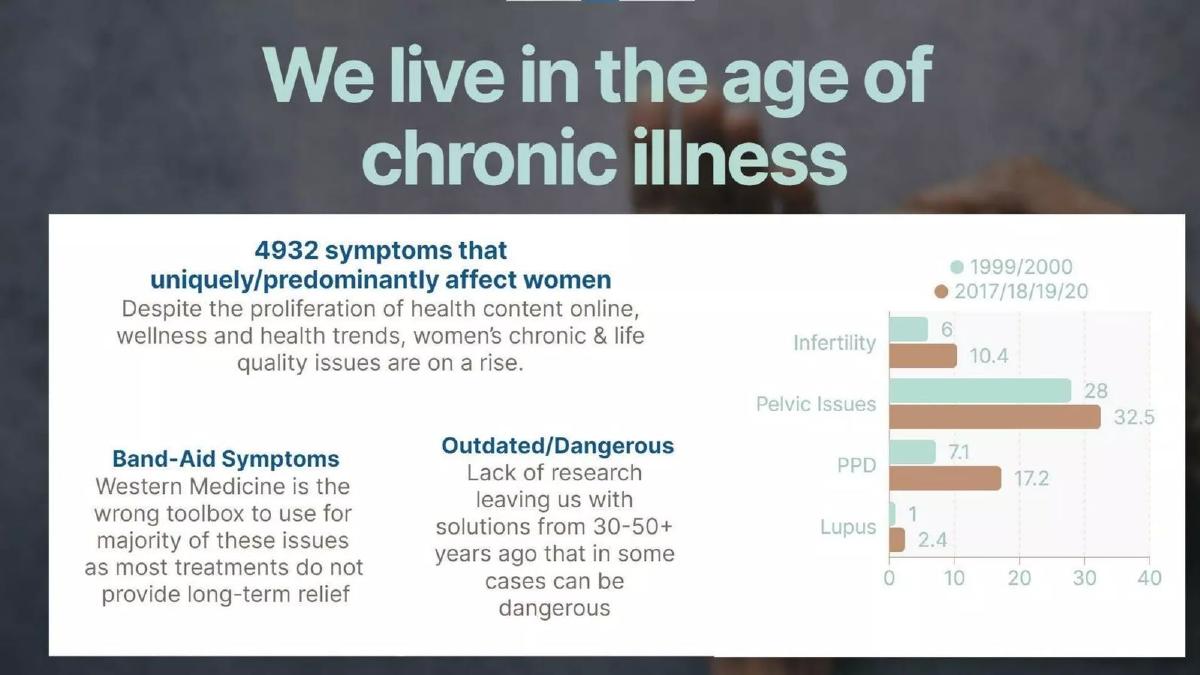
Slide 2 establishes the 'age of chronic illness.' It cites a specific figure of 4,932 symptoms that uniquely or predominantly affect women. The slide uses a bar chart to show the rising prevalence of conditions like Infertility, Pelvic Issues, PPD (Postpartum Depression), and Lupus between 1999/2000 and 2017-2020. For example, Pelvic Issues rose from 28 to 32.5, and PPD rose from 7.1 to 17.2. The slide critiques Western Medicine as the 'wrong toolbox' that offers 'Band-Aid' solutions and lacks modern research.
Slide 3 introduces the 'Science-Based Natural Healing' framework. It emphasizes three pillars: Root Cause Health, No Pills/No Surgeries, and Healing (not just managing). The visual of a large, deeply rooted tree reinforces the 'root cause' messaging. This slide serves as the philosophical bridge between the medical problem and the company's product offering.
Slides 4-5: Product Mechanics and Traction Metrics
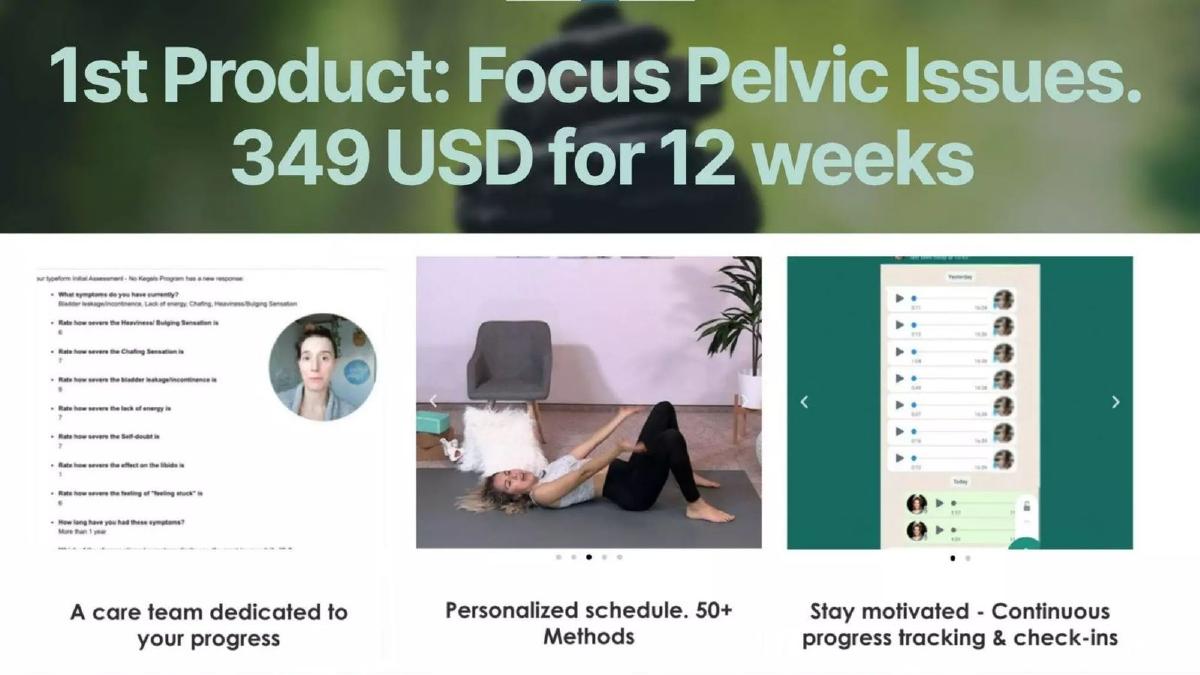
Slide 4 gets specific about the first product. It is a 12-week program focused on pelvic issues, priced at 349 USD. The slide shows three screenshots: an initial assessment form, a video of an instructor performing floor exercises, and a mobile chat interface for progress tracking. The text highlights a 'personalized schedule' with '50+ methods' and a 'dedicated care team.' This indicates the product is a blend of content, community, and coaching rather than a pure software-as-a-service (SaaS) play.
Slide 5 is the most data-dense slide in the deck. It leads with a headline claiming a 2x money-back return on the first purchase, an NPS of 60+, and an 84% renewal rate. Two line graphs show the trajectory from Q2 2021 to Q1 2022. The first graph shows revenues (in USD) climbing sharply to approximately 40,000 in Q1 2022, while ad spend grows at a slower rate. The second graph shows CAC (Customer Acquisition Cost) dropping from roughly 650 to 150, while LTV (Lifetime Value) steadily climbs to 400. A customer testimonial from 'Amanda, UK, 54 years' provides social proof.
Slides 6-7: Unfair Advantages and Future Value Drivers
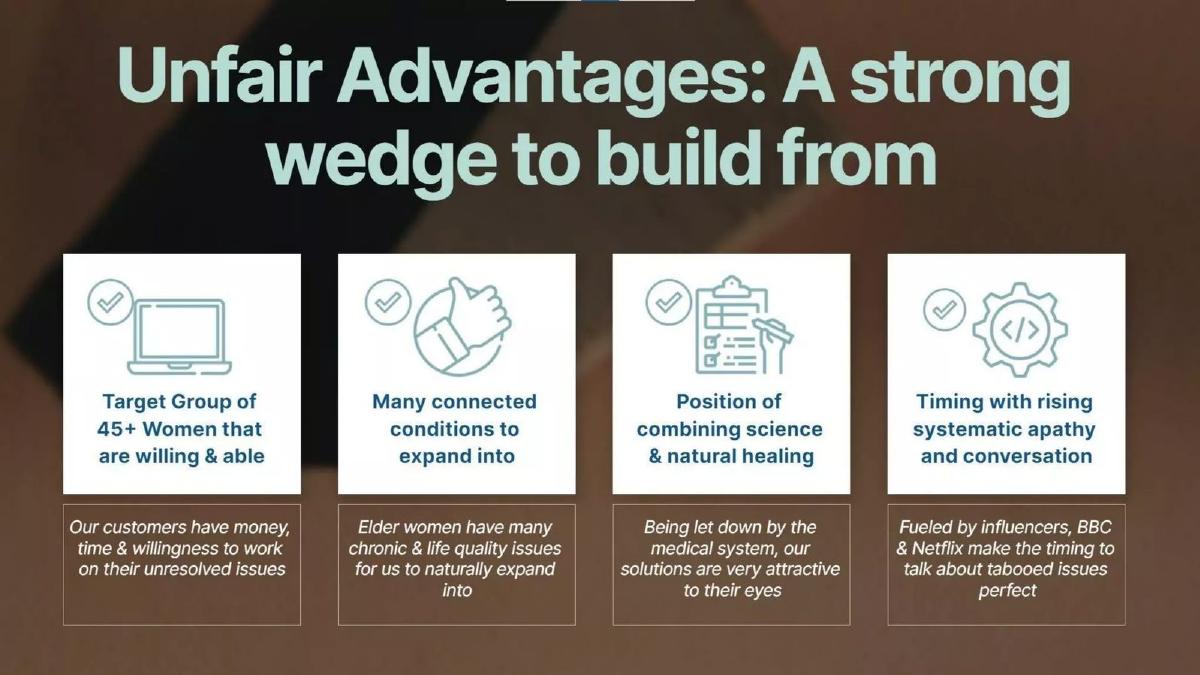
Slide 6 outlines four 'Unfair Advantages': a target group (45+) with disposable income, the ability to expand into connected chronic conditions, a unique market position, and favorable timing fueled by media coverage from the BBC and Netflix. The slide argues that the medical system's 'apathy' toward these issues makes their solution more attractive.
Slide 7 details how the company plans to move unit economics from 'good to great.' The four drivers are: 1) Cross-selling into menopause and thyroid issues, 2) Adopting a 'MasterClass' model by onboarding influencers, 3) Localizing content into German, French, Spanish, and Nordic languages, and 4) Building a 'Kajabi for Women's Health'—a marketplace for products and services featuring over 100 content creators.
Slides 8-9: Market Size and Competitive Landscape
Slide 8 defines the market. The TAM is 100M women in the West, the SAM is 24M (those who believe in natural healing and feel let down by existing solutions), and the SOM is 3.6M (those who want to work preventively). The company sets a goal of 200,000 paying members to reach 100M USD ARR, and a long-term goal of 1M users and 500M USD ARR by 2030.
Slide 9 uses a standard four-quadrant competitive map. The axes are Single Solution vs. Holistic Solution and Band-Aid/Symptom Management vs. Root Cause/Natural. Women Cycles places itself in the top-right quadrant (Holistic/Root Cause). Competitors listed include Hatch, Keriton, and Kindbody (Single/Root Cause), Flo and Natalist (Single/Band-Aid), and Elvie, Bloomlife, and Peanut (Holistic/Band-Aid). The slide claims they are the 'only long-term no side effect solution' for the issues they cover.
Slides 10-11: Team and Investment Ask
Slide 10 presents the team. Filippa Odevall is highlighted for her background in yoga networks and as an author. Mahesh Kumar is noted for co-founding FitnessCollection and selling it to Classpass. The slide also lists advisors and investors, including Jens Lapinski (AngelInvest), Auxxo Female Catalyst Fund, and CalmStorm VC. This slide aims to establish credibility through past exits and existing institutional backing.
Slide 11 concludes with the 'Investment Opportunity.' It summarizes the key points: 30% month-on-month growth, 50% of capital remaining from the previous round, and the specific ask of 2M EUR for 20% dilution. The mention of 'Standard Terms' suggests a straightforward equity round without complex liquidation preferences or structures.
What Works in This Deck
Strong Unit Economics: The deck does not shy away from the numbers. Showing a declining CAC alongside an increasing LTV (Slide 5) is exactly what seed investors look for to prove scalability. · Specific Product Focus: Instead of claiming to solve all women's health issues at once, they lead with a single, high-value product (pelvic health) and a clear price point (349 USD). This makes the business model easy to understand. · Founder-Market Fit: The combination of Odevall’s experience in wellness/yoga and Kumar’s experience with a successful exit to Classpass creates a balanced 'visionary and operator' dynamic that reduces perceived execution risk. · High Retention: The 84% renewal rate cited on Slide 5 is an exceptional metric for a digital health program, suggesting high product efficacy and customer satisfaction.
What is Missing from This Deck
Regulatory and Clinical Validation: While the deck uses the term 'science-based,' it does not provide details on clinical trials, white papers, or medical partnerships that validate their 'natural' methods. In the health sector, this is a significant omission. · Detailed Use of Funds: The ask is 2M EUR, but there is no breakdown of how that money will be spent. Investors typically want to see a percentage split between R&D, marketing, and hiring. · Technology Depth: The product screenshots show Typeform and WhatsApp-like interfaces. It is unclear if the company has built proprietary technology or if they are currently a 'tech-enabled service' running on third-party tools. · Churn Definition: While they mention an 84% renewal rate, they do not define what a 'renewal' looks like for a 12-week program. Is it a subscription, or a second purchase of a different module?
What a Founder Should Copy
The 'Wedge' Strategy: Follow the example on Slide 6. Identify a specific, underserved 'wedge' (women 45+ with pelvic issues) and explain how that provides a foothold to expand into a much larger market (menopause, thyroid, etc.). · Visualizing the Competitive Gap: The competitive matrix on Slide 9 is effective because it doesn't just list competitors; it categorizes them by their approach (Band-Aid vs. Root Cause). This helps define the brand's unique identity. · Traction over Hype: Use Slide 5 as a template. If you have revenue, show the relationship between what you spend to get a customer (CAC) and what that customer is worth (LTV). This is the most persuasive slide in any seed deck. · Clear Investment Terms: Don't be vague about what you want. Slide 11 clearly states the amount, the dilution, and the current capital state of the company.
Frequently asked questions
- What is the primary product offered by Women Cycles?
- According to slide 4, the primary product is a 12-week program focused on pelvic issues. It costs 349 USD and includes a personalized schedule with over 50 methods, continuous progress tracking, and access to a dedicated care team. The slide shows screenshots of a Typeform assessment, exercise videos, and a WhatsApp-style communication interface for check-ins.
- How does the company justify its market opportunity?
- The company uses a TAM/SAM/SOM model on slide 8. They identify a Total Addressable Market of 100M women in the West aged 45+. They narrow this to a Serviceable Obtainable Market (SOM) of 3.6M women who specifically want to work preventively and believe in natural healing. They state that obtaining just 200,000 paying members would result in 100M USD in ARR.
- What are the key financial metrics shared in the deck?
- Slide 5 and slide 11 highlight several metrics: a 2x money-back return on the first purchase, an NPS of 60+, and an 84% renewal rate. Slide 11 also claims 30% top-line growth month-on-month. The charts on slide 5 indicate that by Q1 2022, LTV had overtaken CAC, and revenues were trending upward while ad spend remained relatively stable.
- Who are the founders and what is their background?
- As detailed on slide 10, the team is led by Filippa Odevall and Mahesh Kumar. Odevall is the founder of Skolyoga and an author of four books. Kumar is the co-founder of FitnessCollection, which was acquired by Classpass in 2019, and was previously the CEO of Result. The team also includes leads for content, care, and product/UX.
- What is the specific investment ask and valuation?
- Slide 11 states the company is raising 2M EUR in exchange for 20% dilution under 'Standard Terms.' This implies a post-money valuation of 10M EUR. The slide also mentions that they are capital efficient, still holding 50% of the capital raised during their previous Q2 2021 funding round.