WisePass is a lifestyle subscription app that launched in Ho Chi Minh City (HCMC) in late 2014, offering members one complimentary bottle per night at participating venues for a $250 monthly fee. The deck, dated November 2016, seeks a $500,000 investment at a $2,000,000 pre-money valuation. The business model relies on a high-LTV ($140) to low-CAC ($30) ratio, targeting a predominantly male millennial demographic that uses the service for dating and social status. While the deck provides clear unit economics and a specific geographic focus, it lacks a detailed go-to-market strategy for region…
Key takeaways
- The core product offering is one complimentary bottle per night at bars and restaurants for a $250 monthly subscription (Slide 2).
- The company claims a Lifetime Value (LTV) of $140 against a Customer Acquisition Cost (CAC) of $30 (Slide 7).
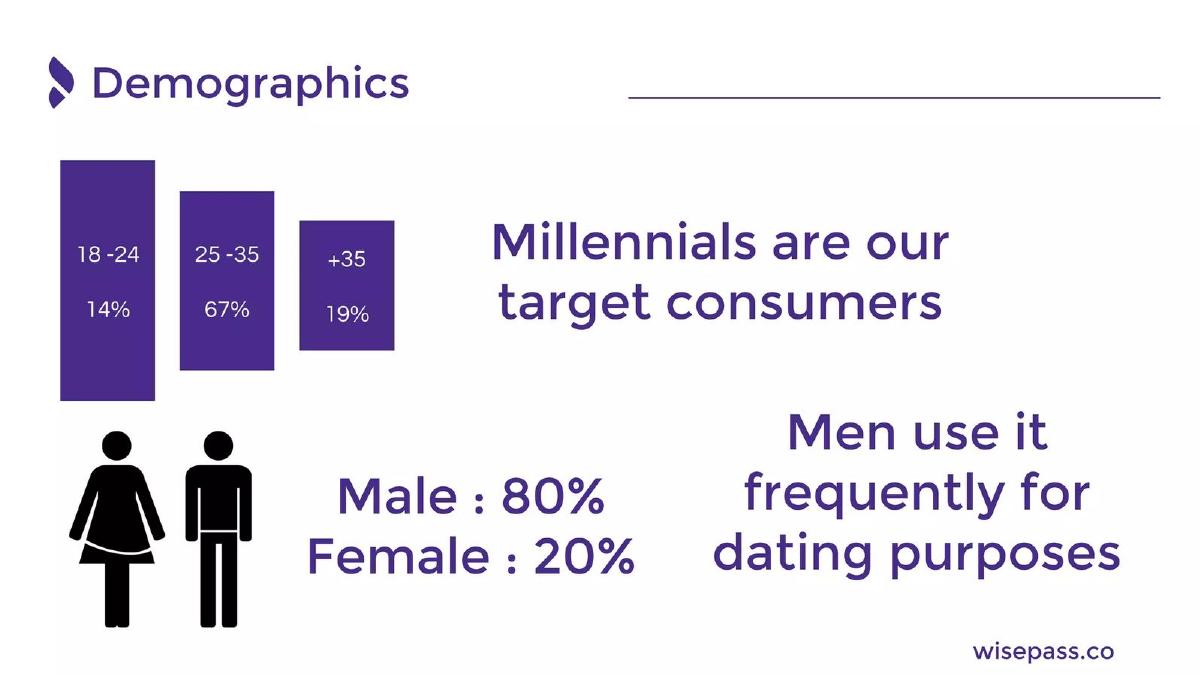
- The target demographic is 80% male, with 67% falling in the 25-35 age bracket (Slide 5).
- WisePass identifies Hooch as its main competitor, noting Hooch's $9.99/month model and recent $2.5M funding (Slide 8).
- The team includes an ex-Googler CEO and a CTO with over 10 years of experience, both starting the company in October 2014 (Slide 6).
- The financial ask is $500,000 USD at a $2,000,000 pre-money valuation (Slide 9).
- Expansion plans include hiring a General Manager in Ha Noi and an accountant in Singapore (Slide 9).
- The deck highlights a growth cadence of adding one new venue weekly and new alcohol selections monthly (Slides 3 and 4).
Executive Summary and Mission
Slide 1: Title and Mission
The deck opens with a clean, purple-branded title slide. The mission statement is clearly defined: "build a genuine relationship between brands & consumers through mobile." This suggests that WisePass views itself not just as a consumer app, but as a B2B2C platform that facilitates brand engagement for alcohol distributors and venues.
The Core Value Proposition
Slide 2: Problem and Solution
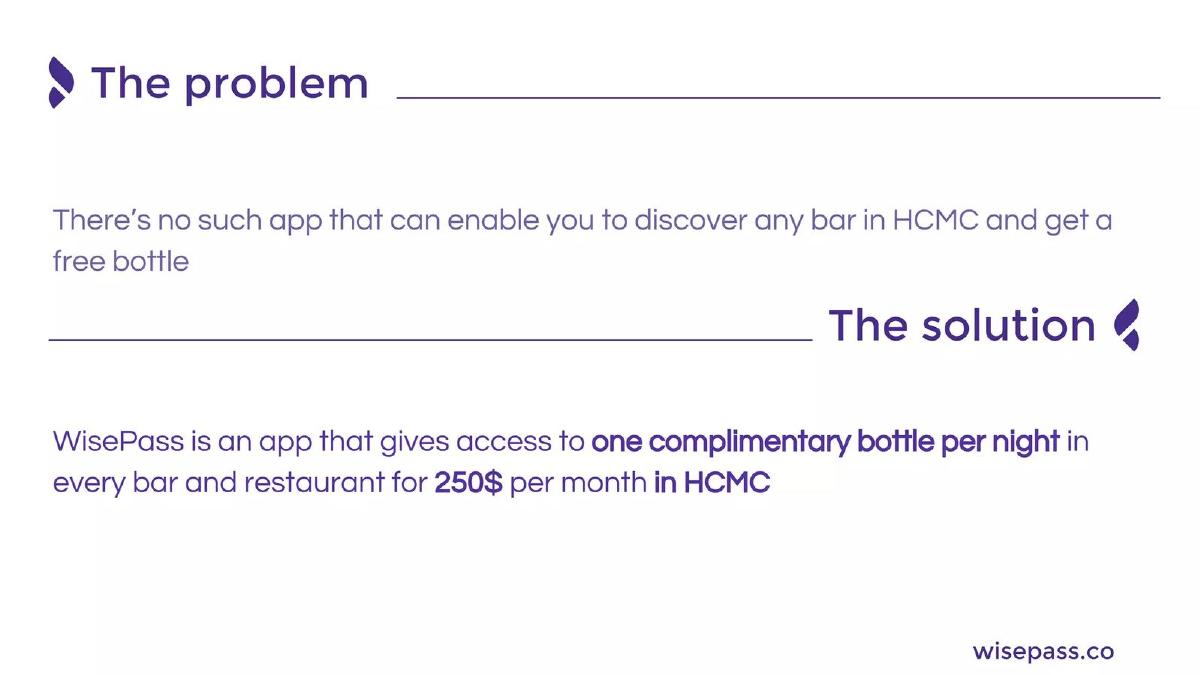
The problem statement is highly localized: "There’s no such app that can enable you to discover any bar in HCMC and get a free bottle." The solution is a direct response: a mobile app providing access to "one complimentary bottle per night in every bar and restaurant for 250$ per month in HCMC." This slide establishes the premium nature of the service, moving away from the 'free drink' model common in other markets toward a high-ticket 'bottle service' model.
Slide 3: Product Selection
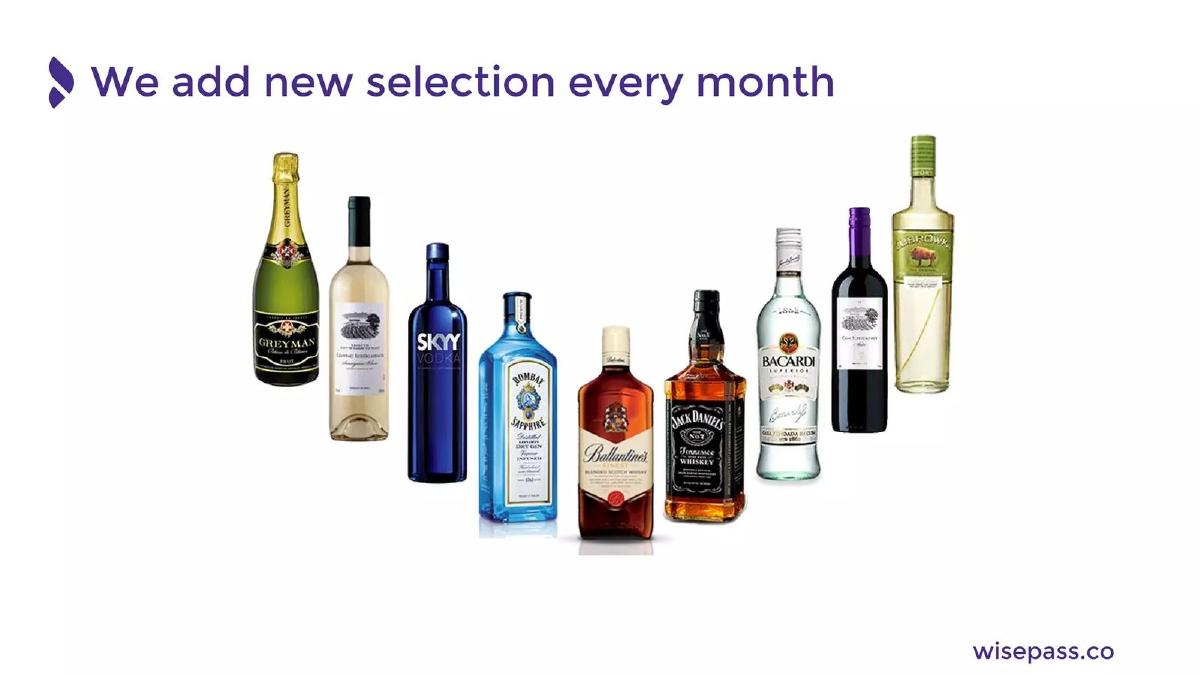
This slide displays a range of spirits and wines, including brands like Grey Man, Skyy Vodka, Bombay Sapphire, Ballantine’s, and Jack Daniel’s. The text states, "We add new selection every month," indicating a rotating inventory that keeps the subscription fresh for long-term members.
Slide 4: Venue Partnerships
WisePass highlights its network growth by stating, "We add 1 venue weekly." The slide features logos for several HCMC establishments, including Blanchy's Tash, Broma, Cuba, Pullman Hotels and Resorts, Zuma, Last Call, Namo, The Society, and The Light House. The inclusion of a major hotel brand like Pullman suggests the service has traction with high-end corporate hospitality venues.
Market and Demographics
Slide 5: User Demographics
The deck provides a specific breakdown of its user base. Millennials are the primary target , with the 25-35 age group making up 67% of users. The gender split is significantly imbalanced at 80% Male and 20% Female. A notable qualitative insight is included: "Men use it frequently for dating purposes." This suggests the app functions as a status symbol or a tool to reduce the cost of high-end dating.
Team and Operations
Slide 6: The Team
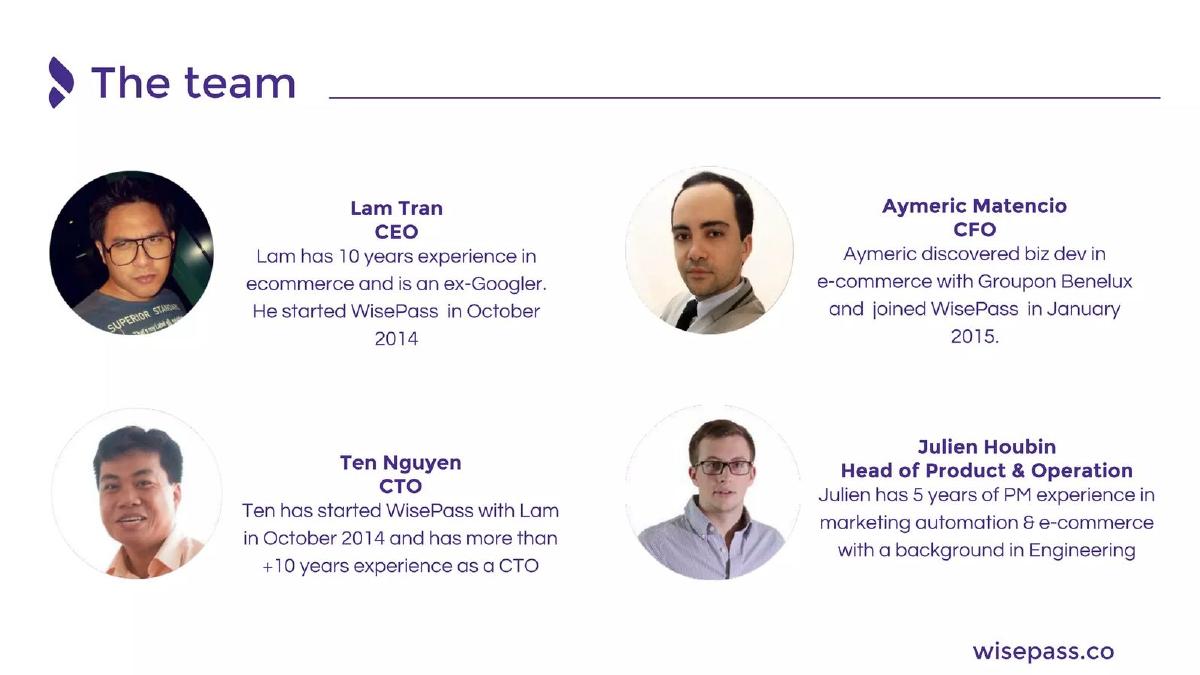
The leadership team consists of four members. Lam Tran (CEO) is described as an ex-Googler with 10 years of e-commerce experience who started the company in October 2014. Ten Nguyen (CTO) co-founded the company and brings over 10 years of technical experience. Aymeric Matencio (CFO) joined in January 2015 after working with Groupon Benelux. Julien Houbin (Head of Product & Operation) has 5 years of PM experience in marketing automation. The team appears balanced between technical, operational, and sales backgrounds.
Business Model and Competition
Slide 7: Business Model
WisePass defines itself as a "subscription based service." The slide provides two key metrics: a Lifetime Value (LTV) of $140 and a Customer Acquisition Cost (CAC) of $30. The visual diagram shows a flow from End Consumer to WisePass to Brands, reinforcing the idea that WisePass acts as a middleman for brand marketing budgets.
Slide 8: Competition
The deck identifies Hooch.co as the main competitor. It notes that Hooch raised $1M in March 2016 and $1.5M in October 2016 , and was heading for a Series A of $4M to $5M in early 2017. WisePass differentiates by price and offering ($250/bottle vs $9.99/cocktail), positioning itself in the luxury tier compared to Hooch's mass-market approach.
Financials and Future Outlook
Slide 9: Financials and HR
The company is "Looking to Raise 500,000 USD" at a "Valuation: 2,000,00$ Pre-Money." (Note: The slide contains a typo in the valuation figure, likely intended to be $2,000,000). The revenue goal is to reach $500,000 monthly within 24-36 months. The hiring plan is specific: a Head of Marketing for HCMC, a GM for Ha Noi, and an accountant for Singapore.
Slide 10: Conclusion
The deck concludes with a simple "Thank You!" and the company URL.
What Works in the WisePass Deck
Clear Pricing: Unlike many lifestyle apps that hide their pricing, WisePass is upfront about the $250 monthly cost, which immediately qualifies the lead and defines the market segment. · Specific Unit Economics: Stating LTV and CAC (Slide 7) gives investors a baseline for profitability, even if the math behind those numbers isn't fully transparent in the deck. · Localized Traction: By listing specific, recognizable venues in HCMC (Slide 4), the founders prove they can execute on the ground in a specific market. · Competitor Awareness: Acknowledging Hooch's funding rounds (Slide 8) shows that the founders are tracking the global market and understand the valuation benchmarks for their niche.
What is Missing from the WisePass Deck
Current Revenue: While the deck mentions a future revenue target of $500,000/month, it omits current Monthly Recurring Revenue (MRR). For a company that had been operating for two years at the time of the deck, this is a significant omission. · Churn Rate: Given the $140 LTV and $250 monthly subscription, the average customer stays for less than one month ($140 / $250 = 0.56 months). This suggests either a very high churn rate or that the LTV calculation is based on net profit rather than gross revenue, which is not clarified. · Brand Partnerships: The deck mentions building relationships with brands, but it does not specify if the alcohol brands shown on Slide 3 are paying partners or just available inventory. · Market Size (TAM): There is no slide addressing the Total Addressable Market for high-end bottle subscriptions in Southeast Asia.
Founder Lessons: What to Copy and What to Avoid
Copy the specific hiring plan: Slide 9 doesn't just say "we will hire people." It names the roles and the specific cities where they will be based. This shows strategic geographic planning. · Avoid confusing LTV/Subscription ratios: If your monthly subscription price is higher than your stated Lifetime Value (as seen on Slide 2 and Slide 7), it signals to investors that your churn is extremely high or your math is flawed. Always clarify if LTV is gross or net. · Copy the demographic focus: Slide 5 is excellent because it doesn't just give age and gender; it gives a use case ("dating purposes"). Understanding why people use a luxury service is as important as knowing who they are. · Avoid typos in the 'Ask': The valuation on Slide 9 has a misplaced comma ($2,000,00$). In a document asking for half a million dollars, numerical precision is mandatory to maintain professional credibility.
Frequently asked questions
- What is the primary value proposition of WisePass?
- WisePass offers a high-end subscription service where members pay $250 per month to receive one complimentary bottle of alcohol every night at participating venues in Ho Chi Minh City. According to slide 2, the goal is to solve the lack of an app that enables bar discovery combined with free bottle incentives.
- How does WisePass justify its unit economics?
- On slide 7, the company states a Lifetime Value (LTV) of $140 and a Customer Acquisition Cost (CAC) of $30. This suggests a healthy 4.6x LTV/CAC ratio, though the deck does not provide the underlying data or timeframes used to calculate these specific figures.
- Who is the target audience for this service?
- Slide 5 explicitly states that millennials are the target consumers. The user base is heavily skewed toward men (80%), and the company notes that these users frequently utilize the app for 'dating purposes.' The largest age segment is 25-35, representing 67% of the base.
- What is the competitive landscape for WisePass?
- Slide 8 identifies Hooch.co as the primary competitor. WisePass differentiates itself by price point; while Hooch charges $9.99 for a daily cocktail, WisePass charges $250 for a daily bottle. The deck also mentions indirect competitors in CRM, analytics, and loyalty fields.
- How does the company plan to use the $500,000 investment?
- Slide 9 outlines specific HR goals for the funding, including hiring a Head of Marketing in Ho Chi Minh City, a General Manager in Ha Noi to facilitate geographic expansion, and a General Accountant in Singapore, likely for corporate structuring or regional oversight.