Homebot’s 16-slide pitch deck from 2015 is a highly focused presentation that successfully secured $4.5 million in Seed funding. The deck excels by identifying a specific friction point in the real estate market: the disconnect between mortgage brokers and homeowners after a transaction. By positioning itself as a 'wealth building intelligence' layer, Homebot demonstrates clear value for both the professional (21x ROI) and the consumer (maximizing home equity). The narrative moves logically from a massive problem ($100b lost annually) to a proven solution with early traction ($15k MRR). While…
Key takeaways
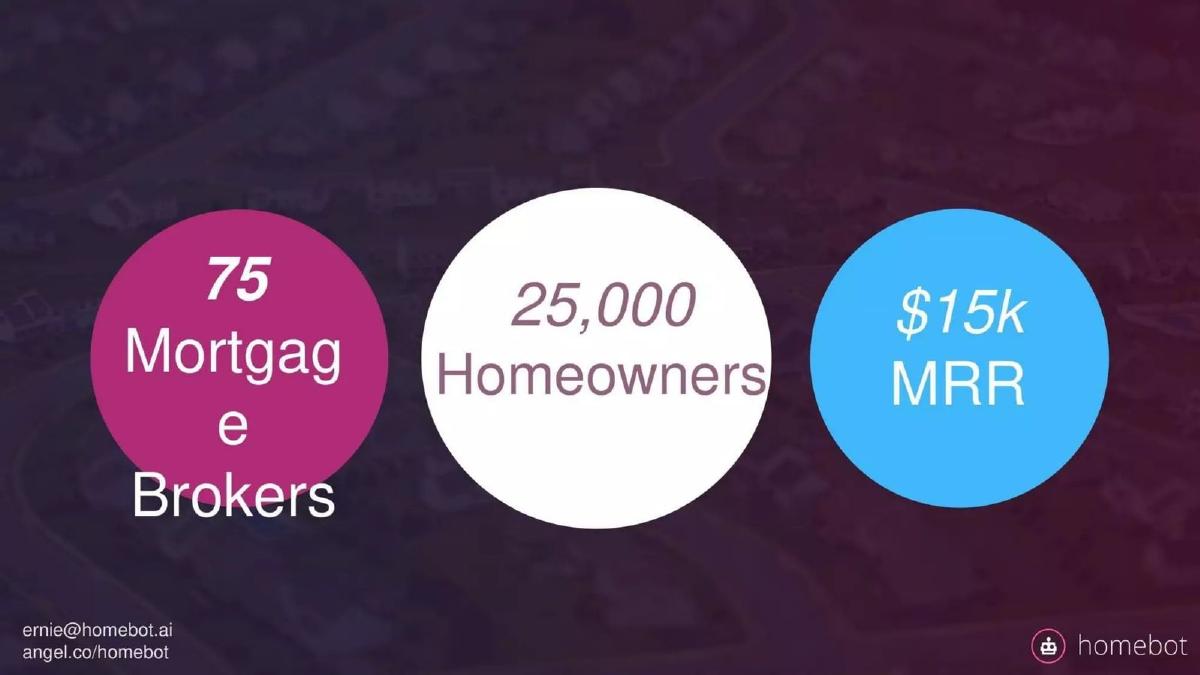
- The company launched with significant early traction, reporting 75 mortgage brokers and 25,000 homeowners on slide 2.
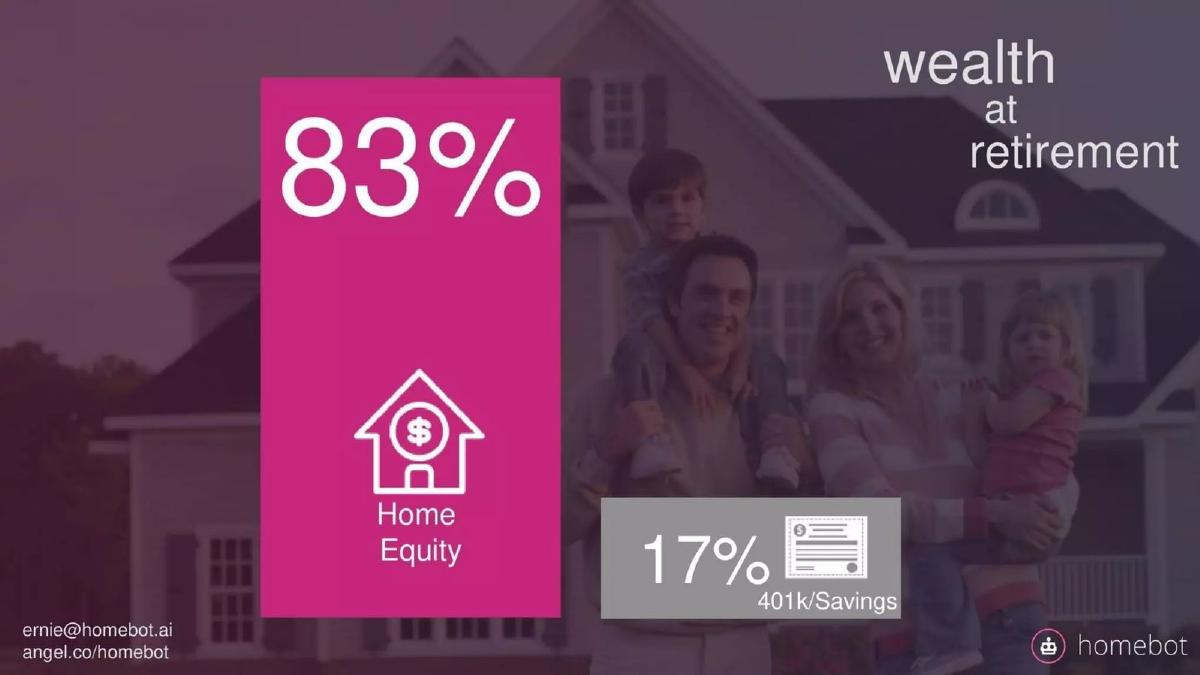
- Homebot identified a massive financial gap, stating on slide 3 that 83% of retirement wealth comes from home equity, yet only 17% comes from 401k/savings.
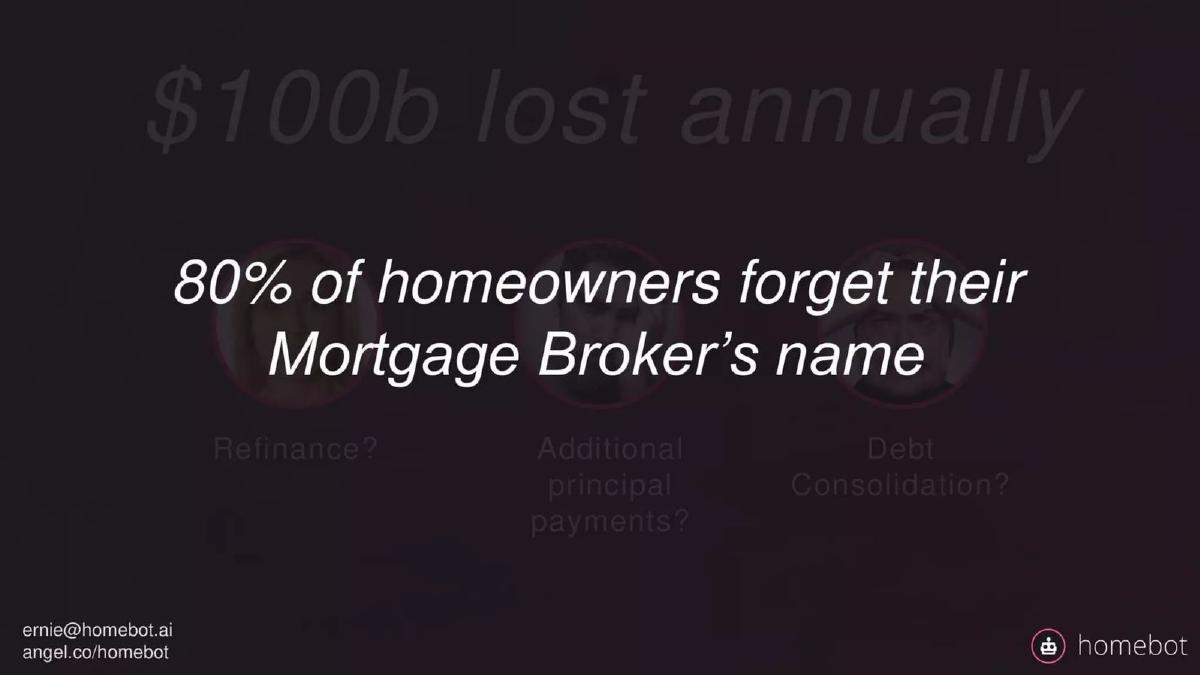
- The deck highlights a major retention problem for professionals: 80% of homeowners forget their mortgage broker's name (slide 5).
- The business model is a B2B2C play where brokers provide 'wealth building intelligence' to homeowners in exchange for 'repeat & referral business' (slide 7).
- The product delivers a specific, quantified value proposition for the B2B customer, claiming a 21x ROI on slide 12.
- The market opportunity is framed in two stages: a $5b Mortgage Broker SaaS market (slide 13) and a broader $28 trillion US home value market (slide 14).
- The founding team is exceptionally senior for a Seed stage, citing 50+ years of experience and 2 previous IPOs on slide 15.
- The deck uses a 'Holly Homeowner' persona throughout slides 7-10 to illustrate the user journey and equity growth over time.
The Homebot Pitch Deck: A Strategy for Dominating Home Equity
Homebot’s 2015 Seed deck is a masterclass in the B2B2C (Business-to-Business-to-Consumer) narrative. Instead of trying to acquire millions of homeowners directly—a prohibitively expensive task—Homebot pitched a solution that empowered mortgage brokers to do the heavy lifting for them. This teardown examines how they used a 16-slide deck to turn a niche SaaS tool into a $4.5 million Seed round.
The Hook: Traction and the Wealth Gap (Slides 1-3)
Slide 1 is a minimalist title slide featuring the Homebot logo and the tagline "build wealth." It sets a professional, financial-focused tone immediately.
Slide 2 is the "Traction" slide, and it is positioned unusually early in the deck. This is a power move. By showing 75 Mortgage Brokers , 25,000 Homeowners , and $15k MRR right away, the founders eliminate any doubt about product-market fit. They aren't pitching an idea; they are pitching a growing machine.
Slide 3 establishes the macro-economic stakes. It presents a stark contrast: 83% of wealth at retirement comes from Home Equity , while only 17% comes from 401k/Savings . This slide justifies the company's existence. If the majority of American wealth is tied up in a single asset, a tool to manage that asset is not a luxury—it is a necessity.
The Problem: Lost Money and Forgotten Names (Slides 4-6)
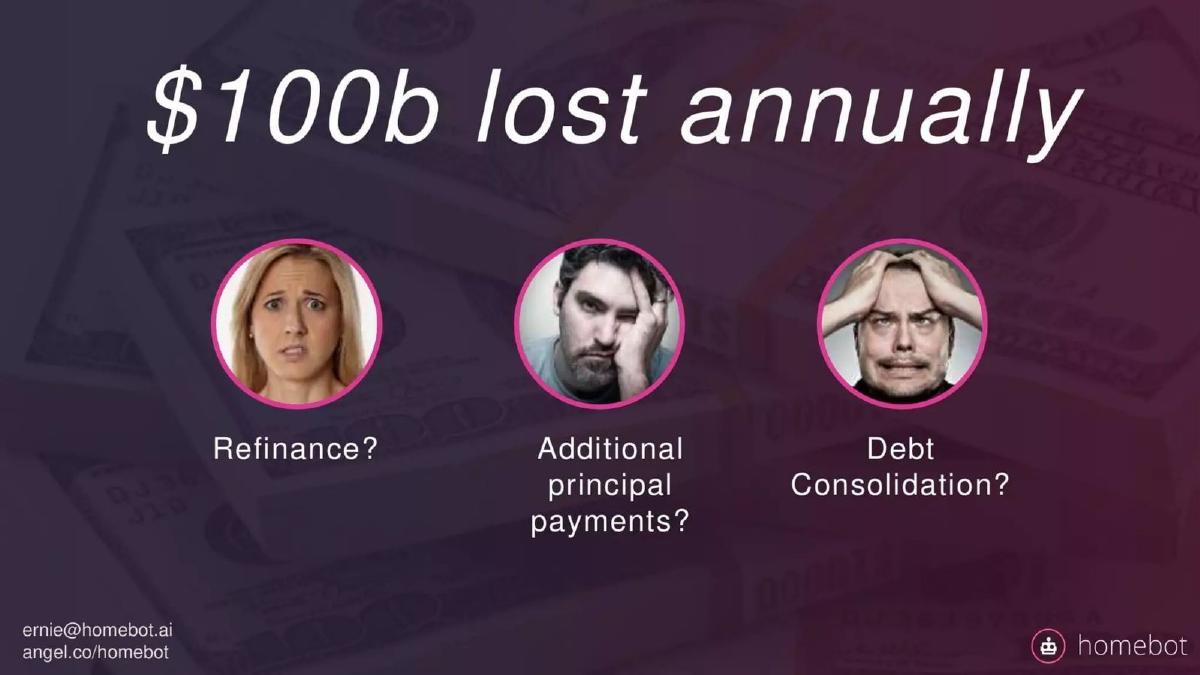
Slide 4 quantifies the consumer pain point: $100b lost annually . It uses three personas to illustrate the confusion homeowners face regarding refinancing, additional principal payments, and debt consolidation. The imagery of stressed individuals reinforces the emotional weight of financial mismanagement.
Slide 5 pivots to the professional's pain point. It states that 80% of homeowners forget their Mortgage Broker’s name . This is the "aha!" moment for an investor. It identifies a massive retention problem in the mortgage industry. Brokers close a deal and then disappear, losing out on future refinances or referrals.
Slide 6 highlights the predatory nature of the current solution. It shows a low-quality, "spammy" mortgage advertisement and a figure of $12 billion / year spent on this type of marketing. This slide positions Homebot as the sophisticated, relationship-based alternative to junk mail and cold calls.
The Solution: The Wealth Building Intelligence Loop (Slides 7-10)
Slide 7 introduces the core mechanics of the platform. It features "Mortgage Mike" and "Holly Homeowner." The relationship is symbiotic: Mike provides Wealth building intelligence , and in return, he receives Repeat & Referral Business . Homebot is the "bot" in the middle facilitating this exchange.
Slide 8 provides a product visualization. It shows a mobile interface displaying an estimated home value of $432,000 and a net worth of $146,000 . This demonstrates that the product is data-driven and provides immediate, high-value information to the consumer.
Slide 9 and 10 use a graph to show the "Homebot Effect." Slide 9 compares a homeowner's equity growth "On her own" versus with Homebot. Slide 10 adds specific triggers: Refinance? Remodel? Airbnb? This shows that Homebot isn't just a tracker; it's a decision-support engine that helps homeowners maximize their asset over time.
The Business Case: ROI and Market Size (Slides 11-14)
Slide 11 shows the broker's dashboard. It lists 52 Homes , 57 Clients , and 49 CMA (Comparative Market Analysis) Requests . This is crucial because it proves the software generates active engagement (leads) for the broker.
Slide 12 is perhaps the most important slide for a B2B investor. It simply states: 21X ROI . By quantifying the return for the paying customer, Homebot makes the purchase decision seem like a mathematical certainty for any broker.
Slide 13 defines the initial Total Addressable Market (TAM). It identifies the Mortgage Broker SaaS market as being worth $5b . This is a respectable, venture-scale niche to start in.
Slide 14 reveals the true ambition of the company. It places the Homebot logo under categories like Financial Products, Insurance, Buy/Sell/Rent, and Home Improvement . Below this is the staggering figure: $28 Trillion (value of all US homes) . This slide tells investors that while they are starting with brokers, they intend to be the gateway to the entire US residential real estate economy.
The Team and Conclusion (Slides 15-16)
Slide 15 is the Team slide. For a Seed round, this team is overqualified in the best way possible. They cite 50+ years in real estate & technology , 5 successful startups , and 2 IPOs . The logos at the bottom (realtor.com, UBS, etc.) provide massive institutional credibility. In a complex industry like real estate, having "been there, done that" founders is a significant de-risking factor.
Slide 16 is a simple contact slide with CEO Ernie Graham’s email. It repeats the logo and the imagery of a happy family in front of a home, bringing the narrative back to the human element of homeownership.
What Works in the Homebot Deck
The B2B2C Logic: The deck clearly explains why they are selling to brokers (retention/ROI) to reach homeowners (wealth management). This is a much more efficient go-to-market strategy than direct consumer acquisition. · Quantified Value: Using specific numbers like "21x ROI" and "80% forget their broker" makes the problem and solution feel concrete rather than theoretical. · Early Traction: Leading with $15k MRR and 25k users in 2015 was very strong for a Seed stage, proving the founders could execute. · Founder-Market Fit: The team slide is exceptionally strong, showing deep domain expertise in both real estate and scaling tech companies to IPO.
What is Missing from the Homebot Deck
The Ask: There is no slide stating how much money they are looking for or what the specific milestones for the next 18 months are. While this is sometimes left for the verbal pitch, it is a standard expectation in a deck. · Competition: The deck ignores other players in the space (like Zillow or traditional CRM tools). Explaining why Homebot is a "Financial Planner" and not just another "Home Value Estimator" would have strengthened the moat argument. · Unit Economics: While they show ROI for the broker, they don't show the LTV (Lifetime Value) or CAC (Customer Acquisition Cost) for Homebot itself. Investors want to know how much it costs Homebot to acquire one of those $15k MRR-generating brokers.
What a Founder Should Copy
The Macro-to-Micro Narrative: Start with a massive problem (the $28T market and the 83% wealth gap) and then zoom in on a specific, solvable friction point (brokers losing clients). · The Persona Journey: Using "Mortgage Mike" and "Holly Homeowner" makes the product's utility easy to understand without needing a live demo. · Visualizing the "Gap": Slide 9, showing the difference between a user "on her own" versus using the product, is a classic and effective way to visualize value. · High-Impact Traction: If you have revenue and users, put them on slide 2. Don't make the investor wait until the end to find out if anyone actually wants your product.
Frequently asked questions
- What is the core problem Homebot is solving?
- Homebot addresses the 'lost wealth' in home equity. According to slide 4, $100 billion is lost annually because homeowners lack the intelligence to decide on refinancing, additional principal payments, or debt consolidation. Simultaneously, it solves a business problem for mortgage brokers who lose touch with clients, as 80% of homeowners forget their broker's name (slide 5).
- How does Homebot generate revenue based on this deck?
- The deck identifies the model as 'Mortgage Broker SaaS' on slide 13. At the time of the pitch, they had achieved $15k MRR from 75 mortgage brokers (slide 2). This implies a subscription model where the professional pays for the platform to stay connected with their homeowner database.
- What traction did Homebot have at the time of the Seed round?
- Homebot showed strong early-stage traction for a 2015 Seed round. Slide 2 lists 75 mortgage brokers using the platform, 25,000 homeowners onboarded, and $15,000 in Monthly Recurring Revenue (MRR). Slide 11 also shows a mobile interface with a single broker managing 52 homes and 57 clients.
- Who are the target customers for Homebot?
- The primary paying customer is the mortgage broker ('Mortgage Mike' on slide 7). However, the end-user is the homeowner ('Holly Homeowner'). The deck also hints at future expansion into other verticals like insurance, buy/sell/rent, and home improvement on slide 14.
- What is missing from the Homebot pitch deck?
- The deck is missing several standard elements: a specific 'Ask' slide (valuation or amount being raised), a detailed competitor analysis, and a clear breakdown of unit economics (CAC/LTV). It also lacks a roadmap or timeline for future product development beyond the initial SaaS offering.