Home61’s deck is a study in operational efficiency within the real estate sector. Rather than focusing solely on the consumer interface, the company leans heavily into the 'agent enablement' narrative, showing how their technology allows agents to close 15.80 transactions in their first year compared to the industry average of just 3. The deck is remarkably transparent with its financials, detailing a $1.3M burn in 2017 and a projected $1MM burn for 2018. While it lacks a traditional team slide—a significant omission for a Series A—it compensates with strong social proof from 1,200 clients an…
Key takeaways
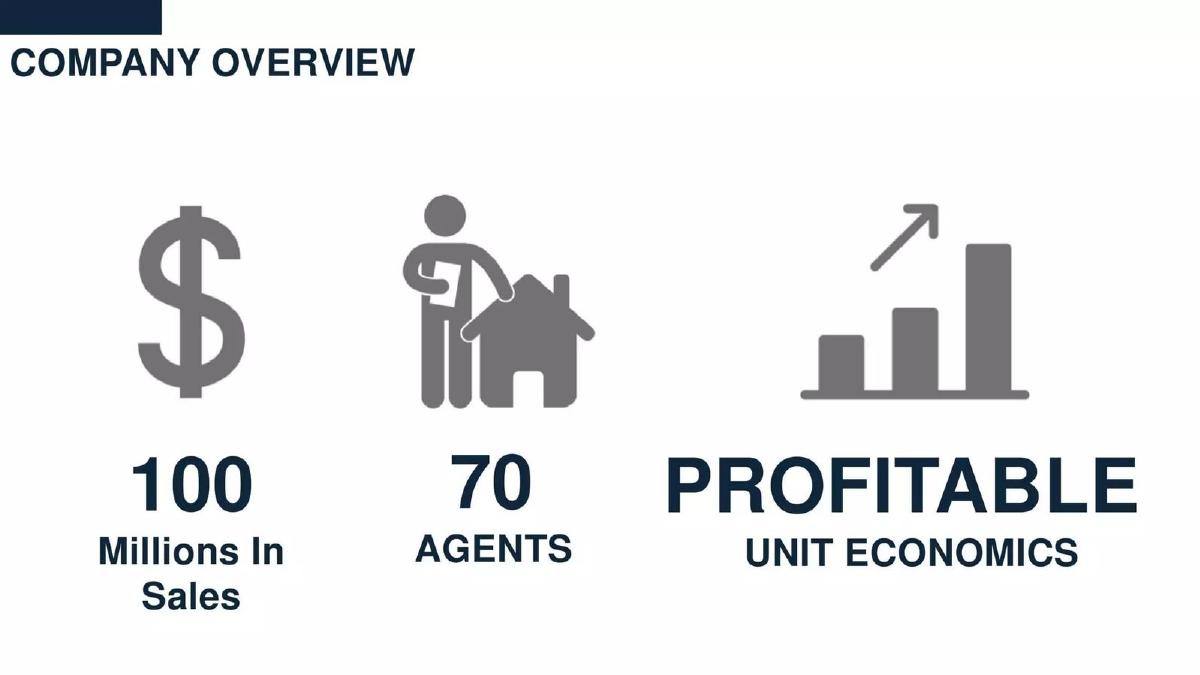
- The company anchors its traction on Slide 02 with $100 million in sales and a roster of 70 agents.
- Home61 claims their agents achieve 15.80 transactions in year one, which is 7 times the market average of 3 transactions, according to Slide 12.
- Unit economics are split by category on Slide 15: Rental margins are $0.4K on a $0.2K CAC, while Sales margins are $4K on a $3K CAC.
- The deck explicitly states a 2017 burn of $1.3M and a 2018 projected burn of $1MM on Slide 16.
- Market distribution data on Slide 08 suggests that 75% of the market is held by local brokers, rather than major franchises like Century 21 or RE/MAX.
- The company targets a specific consumer demographic, using photos of families and individuals on Slide 10 to contrast against high-end 'luxury' stereotypes shown on Slide 09.
- There is no dedicated team slide in this 18-slide deck, leaving the founders' backgrounds unaddressed.
- The funding ask on Slide 18 is for $1MM at a $15MM pre-money valuation, with $350K already raised at the time of the deck's use.
The Efficiency Play in Real Estate
Home61 enters a crowded prop-tech market with a deck that prioritizes operational metrics over flashy app mockups. The narrative is built on the premise that the traditional real estate brokerage model is broken—not just for the consumer, but for the agent. By positioning themselves as a 'next generation' brokerage, they aim to solve the lack of transparency and low efficiency that plagues the industry. The deck is structured to move quickly from the 'what' to the 'how much,' making it a very data-forward presentation.
Introduction and High-Level Traction
Slide 01 sets the tone with the tagline "Real Estate Reinvented: Better, Simpler, Smarter Real Estate." It is a standard cover slide that leads immediately into a high-impact Company Overview on Slide 02. Here, the company highlights three key pillars: $100 Millions in Sales, 70 Agents, and Profitable Unit Economics. This is a strong opening for a Series A deck because it anchors the conversation in scale and sustainability immediately.
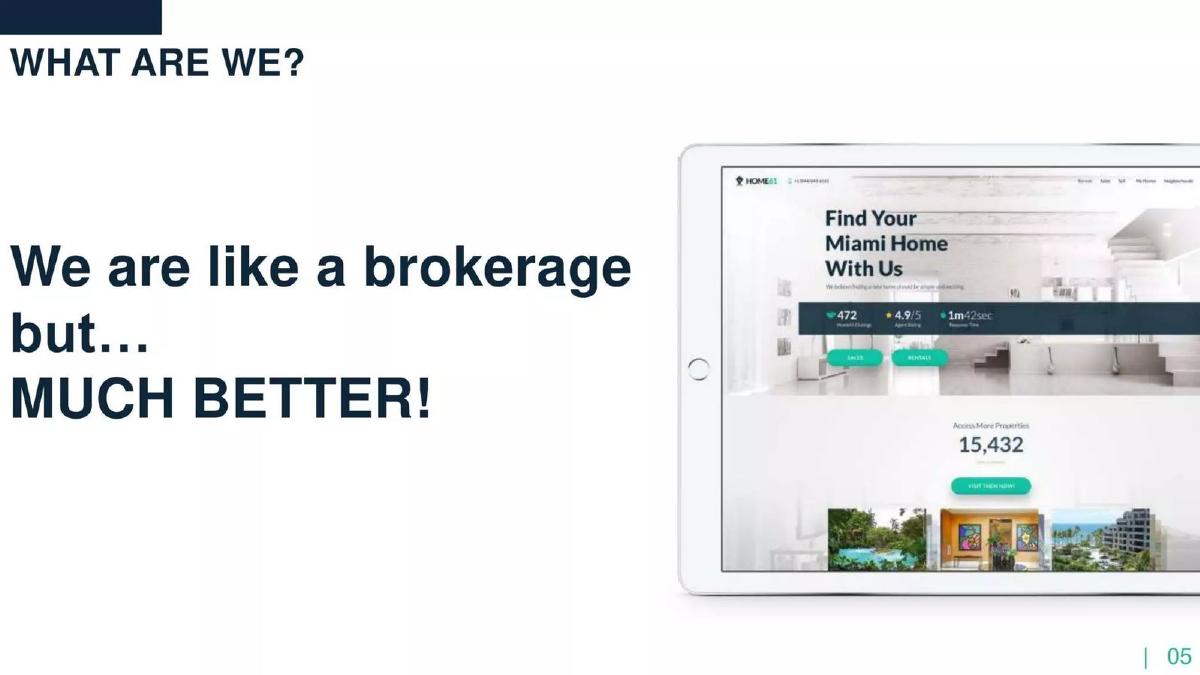
Slide 03, titled 2018 Objective , sets a clear target for the year: $100M in sales and 150 agents. It is worth noting that Slide 02 claims they have already hit $100M in sales, suggesting that Slide 03 might be referring to an annual run rate or a specific calendar year goal that they are currently tracking toward. Slide 04 and 05 attempt to define the company, using the phrase "We are like a brokerage but... MUCH BETTER!" accompanied by a tablet mockup of their web interface showing 15,432 accessible properties.
The Problem and Market Opportunity
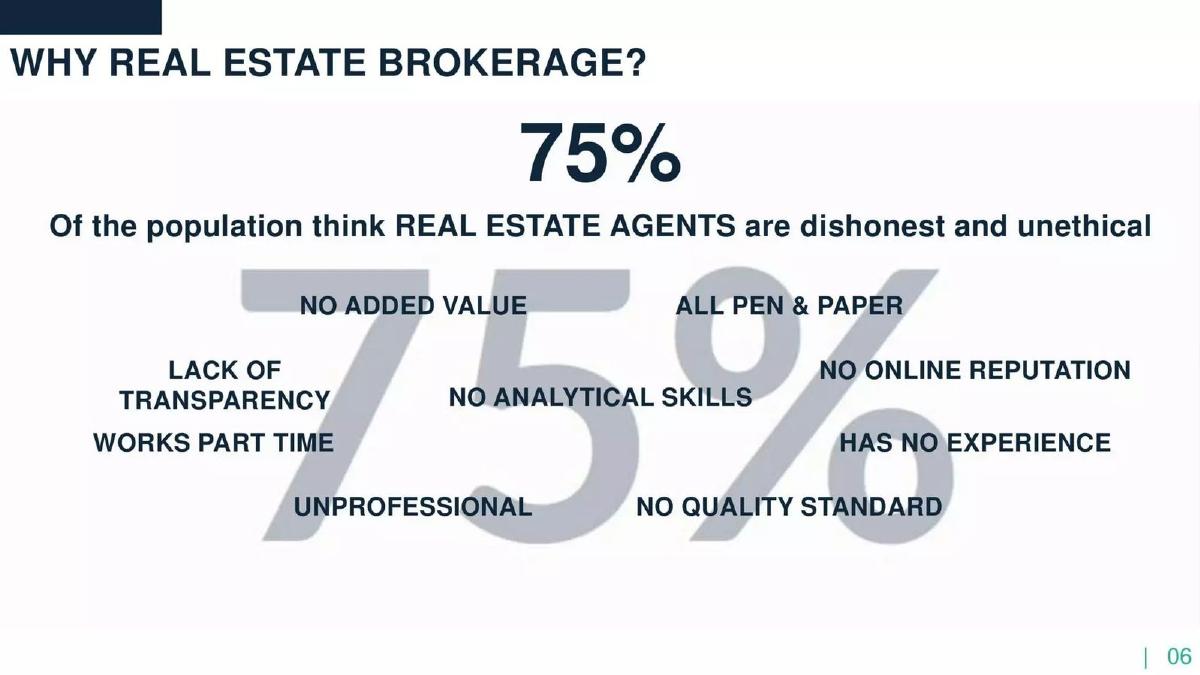
Slide 06 tackles the Why Real Estate Brokerage? question by citing a statistic that 75% of the population thinks real estate agents are dishonest and unethical. The slide lists grievances such as "No Analytical Skills," "All Pen & Paper," and "Lack of Transparency." This slide effectively sets up the 'villain' of the story—the traditional, unprofessional agent.
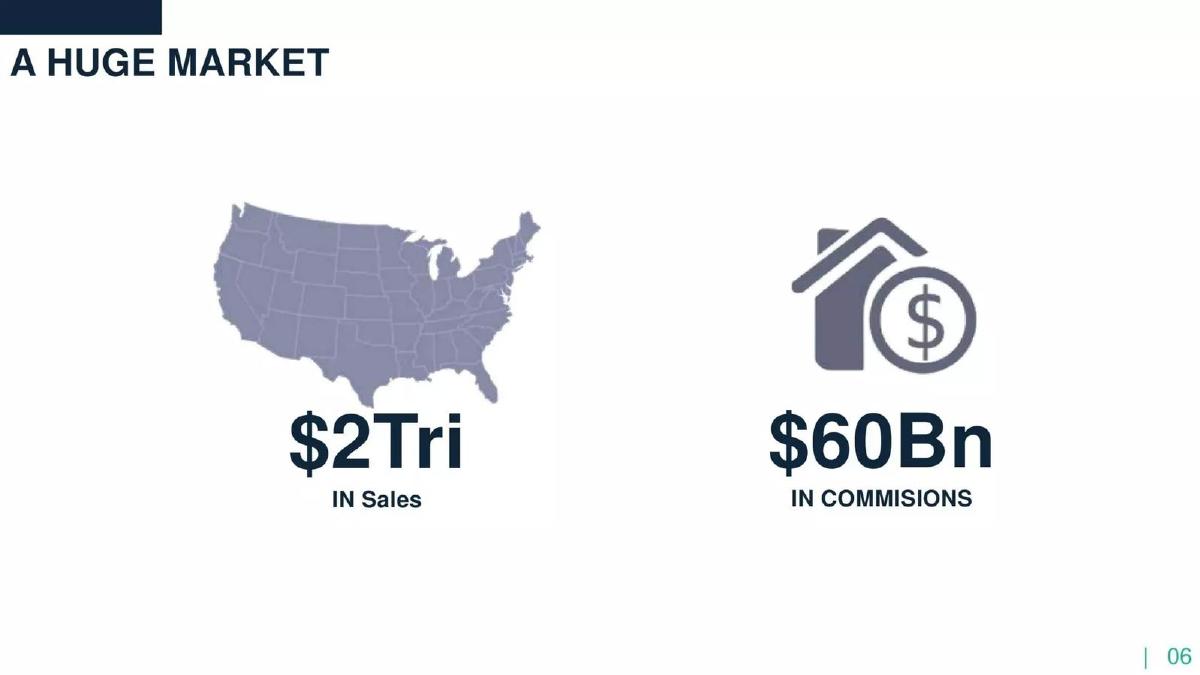
The market size is addressed on Slide 07 (labeled as 06 in the footer), citing a $2 Trillion market in sales and $60 Billion in commissions. Slide 08 provides an interesting Unexpected Distribution chart, showing that 75% of the market is controlled by local brokers, while major franchises like Century 21, RE/MAX, and EWM only account for 25%. This supports the argument that the market is highly fragmented and ripe for a tech-enabled consolidator.
Targeting and Product Offering
Slides 09 and 10 define the target audience. Slide 09, titled Our Target? Not Them! , shows images of high-end, suit-wearing individuals (including a still of Dwayne Johnson), implying they are not chasing the luxury 'celebrity agent' niche. Slide 10, Who We Serve , shows photos of everyday families and individuals holding teddy bears, signaling a focus on the mass-market consumer. This is a strategic choice that aligns with their high-volume, efficiency-based model.
Slide 11 details the What We Offer . The buy-side remains at a traditional 3% commission but promises "Qualified Agents" and "Time Saved." The sell-side is where the disruption occurs, offering a flat $6.1K fee instead of a percentage commission. This "One Fair Fee" model is a direct attack on the traditional commission structure and is central to their value proposition of transparency.
The Engine: Automation and Agent Productivity
Slide 12 (labeled 10) is perhaps the most important slide for a technical investor. It simply says How We Do It? Automatize... EVERYTHING! with a cloud icon. While it lacks technical detail, the results of this automation are shown on Slide 13 (labeled 08). The comparison is stark: a traditional agent does 3 transactions per year for $10K in revenue, while a Home61 agent does 15.80 transactions for $40.3K in revenue. Claiming a 7x increase over the market average is a bold statement that justifies their Series A valuation.
Slide 14 provides social proof, stating they have been Reviewed by over 1,200 clients with 5.0 ratings on Facebook and Yelp, and a 4.9 on Google+. This mitigates the concern that high volume might lead to poor service quality.
Financials, Unit Economics, and The Ask
The final section of the deck is the most transparent. Slide 15 breaks down Unit Economics for both rentals and sales. For sales, they show a $344K GMV resulting in $9K revenue. After $5K in commissions and $3K in CAC, they are left with a $4K margin. The rental side shows a tighter but still positive margin of $0.4K on a $0.2K CAC. This level of detail is exactly what Series A investors look for to understand the scalability of the customer acquisition model.
Slide 16, Financials & Projections , compares 2017 to 2018. Revenue is shown growing from $1.3MM to $2.8MM, while the burn rate is projected to decrease from $1.3M to $1MM. This shows a path toward narrowing losses even as the company scales GMV from $45MM to $100MM.
Slide 17 highlights their Amazing Investors , including Founders Fund, FJ Labs, and 500 Startups, and notes a previous $4MM raise at a $12MM post-money valuation. Finally, Slide 18 presents the ask: Raising 1MM at a $15MM Pre-money valuation , with $350K already raised. The funds are earmarked for a TV campaign, launching the sell-side, and expanding to a new city.
What Works in This Deck
The Agent Efficiency Metric: The most compelling part of this deck is the comparison between traditional agent productivity and Home61 agent productivity. By showing a 7x improvement in transactions (15.80 vs 3), they move the conversation from "we have a better website" to "we have a better business engine."
Granular Unit Economics: Many decks hide their CAC or blend it across all segments. Home61’s decision to separate Rental vs. Sales unit economics shows a deep understanding of their own data and gives investors a clear picture of where the most profitable growth lies.
Clear Market Positioning: By explicitly stating who they are not targeting (the luxury, high-end agent market), they define their niche clearly. This makes their flat-fee sell-side model much more believable, as it appeals to the cost-conscious mass market shown in their photography.
What is Missing
The Team Slide: This is the most significant omission. In venture capital, especially at the Series A stage, the "who" is often as important as the "what." There is no mention of the founders' backgrounds, their experience in real estate, or their technical capabilities. This is a major red flag that would require immediate follow-up in a meeting.
Technology Depth: The deck claims to "Automatize Everything" but never explains how. Is it a proprietary CRM? An AI lead-scoring engine? Automated document processing? Without a peek under the hood, the "How We Do It" slide feels like a black box.
Competitive Landscape: While they compare themselves to "Traditional Agents," they do not mention other tech-enabled brokerages like Redfin or Compass, which were already active or scaling during this period. Investors would want to know how Home61 defends its territory against other well-funded tech competitors.
What a Founder Should Copy
The Traction-First Approach: Start with the numbers. Slide 02 is a masterclass in summarizing why a company is worth talking to: big sales numbers, a growing team, and a focus on profitability.
The "Villain" Slide: Slide 06 effectively uses industry pain points to create a sense of urgency. If you can make the current industry standard look incompetent or unethical using data, your solution becomes the obvious hero.
The Transparent Burn: Being honest about your burn rate (Slide 16) builds trust. Showing that you are scaling revenue while simultaneously reducing burn is a powerful narrative for any growth-stage company.
Specific Ask and Use of Funds: The final slide doesn't just ask for money; it explains exactly what that money will buy (TV campaign, new city, sell-side launch). This allows investors to visualize the immediate impact of their capital.
Company: Home61 · Sector: Real Estate / PropTech · Stage: Series A · Year: 2014 (Catalogue) / 2018 (Deck content) · Slides: 18 · Deck Type: Investor Pitch Deck · Outcome: Raised $5,100,000 (per catalogue) · HQ: Miami, FL
Frequently asked questions
- What is Home61's primary value proposition for real estate agents?
- According to Slide 12, the primary value is efficiency and revenue. Home61 claims their agents generate $40.3K in first-year revenue by completing 15.80 transactions. This is contrasted against traditional agents who reportedly earn only $10K in their first year from an average of 3 transactions. The deck attributes this 7x performance increase to their technology and automation.
- How does the company differentiate its buy-side and sell-side offerings?
- Slide 11 outlines two distinct models. For the buy-side, they charge a 3% commission and focus on qualified agents and time saved. For the sell-side, they move away from percentage-based commissions to a 'One Fair Fee' of $6.1K, emphasizing transparency and thousands of dollars in savings for the seller.
- What are the specific unit economics for a home sale versus a rental?
- Slide 15 provides a granular breakdown. A rental generates $1K in revenue with a $0.4K margin after a $0.2K CAC. A sale generates $9K in revenue with a $4K margin after a $3K CAC. This shows that while sales have higher absolute margins, the CAC-to-margin ratio is actually more favorable in their rental segment.
- Who are the existing investors mentioned in the deck?
- Slide 17 lists three prominent venture entities: Founders Fund, FJ Labs, and 500 Startups. The slide also notes that the company previously raised a $4MM Series A at a $12MM post-money valuation, establishing a baseline for the current $15MM pre-money valuation ask.
- What is the most significant omission in the Home61 deck?
- The most glaring omission is the lack of a Team Slide. In a Series A round, investors typically require a detailed look at the founders' expertise, previous exits, or industry experience. By excluding this, Home61 relies entirely on their $100M sales figure and unit economics to carry the pitch's credibility.