Holdbar’s pitch deck is a masterclass in establishing founder-market fit. By prominently featuring the acquisition of their previous company, Truestory, by Smartbox Group on slide 2, the founders immediately bypass the 'why you' question. The deck frames the 'experience economy' as a fragmented, digitally immature vertical ripe for a 'business in a box' solution. While the deck is light on current revenue metrics and specific unit economics, it compensates with a clear two-phase product roadmap that projects a Customer Lifetime Value (CLV) increase from $40,000 to over $60,000. This narrative…
Key takeaways
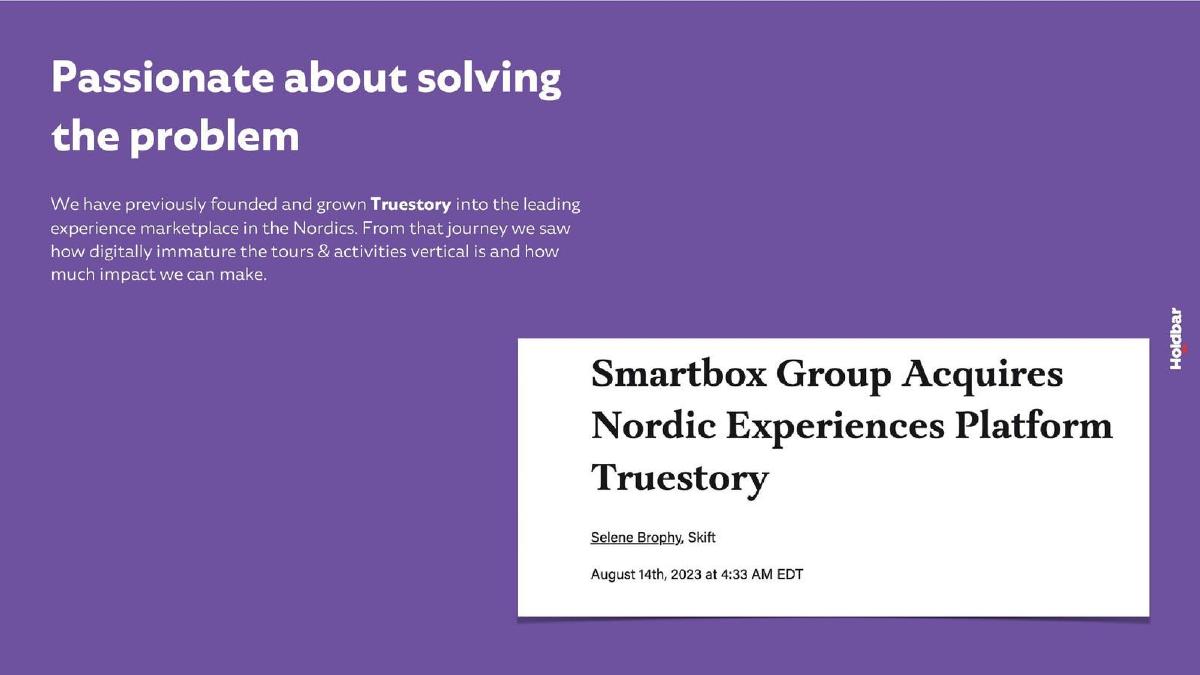
- The deck leads with founder credibility, highlighting the acquisition of their previous startup, Truestory, by Smartbox Group (Slide 2).
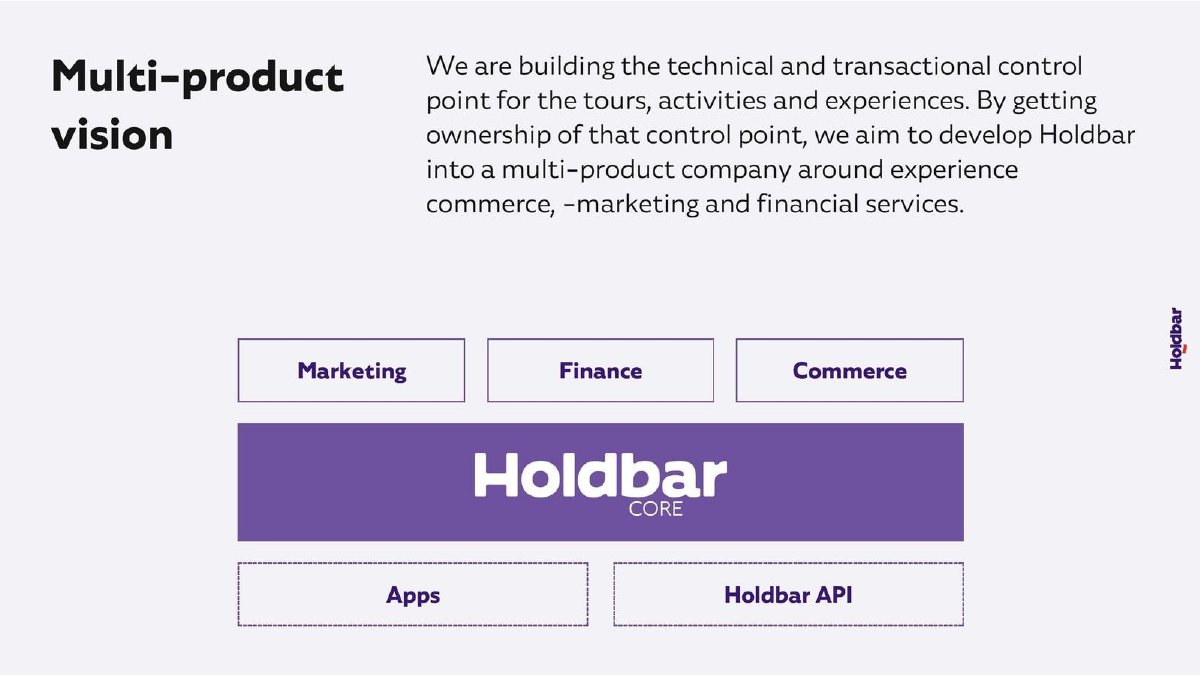
- Holdbar positions itself as a 'Business in a box' to replace fragmented tools like sheets, manual booking plugins, and separate gift card modules (Slide 3).
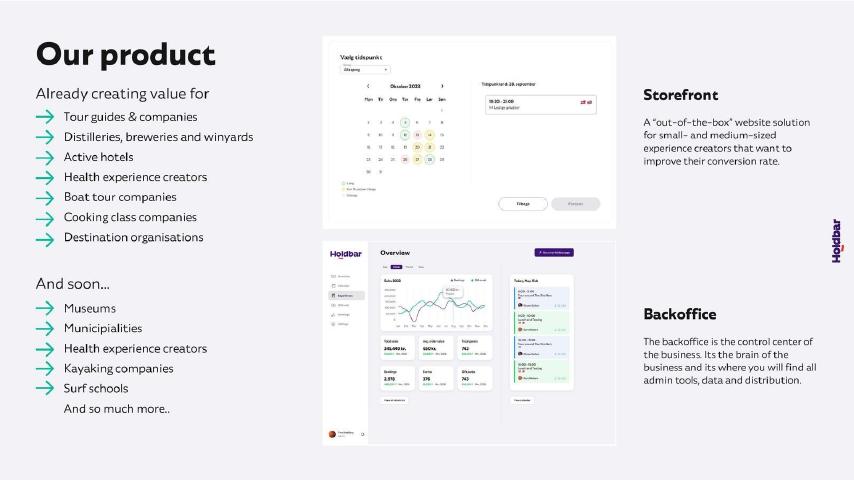
- The product is already serving seven distinct niches, including distilleries, boat tours, and cooking classes, with five more in the immediate pipeline (Slide 4).
- Market validation is supported by a macro trend chart showing U.S. consumer spending on experiences rebounding to nearly 4% of total spending by 2022 (Slide 5).
- The company projects a significant CLV expansion from $40,000 in Phase 1 to $60,000+ in Phase 2 through AI-powered automation and financial products (Slide 6).
- The distribution strategy relies on 'Holdbar Connect' to link experience creators with local marketplaces and OTAs (Slide 7).
- The team slide emphasizes a 'bias towards action' and lists prior experience at Stibo, Truestory, and Lunar (Slide 8).
- The deck lacks a specific 'Ask' slide detailing the exact use of funds or the valuation sought for the $3.5M round.
Holdbar Pitch Deck Analysis
Holdbar, a Denmark-based startup, raised $3.5M in Seed funding in 2024 to tackle the digital fragmentation of the 'experience economy.' The deck is a lean, 17-slide presentation that prioritizes founder pedigree and a clear product vision over dense financial modeling. By positioning their software as the 'operating system' for tour and activity providers, the team makes a compelling case for consolidation in a traditionally low-tech sector.
Slide 1: Title Slide
The deck opens with a minimalist title slide featuring the Holdbar logo against a purple background, paired with a high-quality lifestyle image of a traveler looking out over a mountain range. This establishes the brand identity immediately: clean, modern, and focused on the end-user experience of travel and discovery.
Slide 2: The 'Why Us' (Founder Pedigree)
Slide 2 is arguably the most important slide in the deck. Titled 'Passionate about solving the problem,' it features a large screenshot of a Skift article announcing that Smartbox Group acquired the founders' previous company, Truestory, in August 2023. The text explains that their experience building the 'leading experience marketplace in the Nordics' gave them a front-row seat to how 'digitally immature' the tours and activities vertical is. This slide effectively eliminates the need for a long explanation of why this team is qualified to build Holdbar.
Slide 3: The Problem and Solution (Before vs. After)
Slide 3 uses a classic 'Before and After' framework. On the left, 'Before Holdbar' shows a scattered array of icons representing the fragmented tools creators currently use: marketing, booking plugins, payments, gift card modules, ticket shops, customer service, and 'sheets with customers.' On the right, 'With Holdbar,' these icons are all funneled into a single 'Holdbar Core' box. The slide also teases future modules: Apps, Finance, and Marketing, signaling that the platform intends to be more than just a booking engine.
Slide 4: Product and Market Traction
This slide provides a concrete look at the software. It displays screenshots of the 'Storefront' (a website solution for conversion) and the 'Backoffice' (the 'brain' of the business for admin and distribution). Crucially, it lists the types of businesses already using the platform, such as distilleries and boat tours, and lists upcoming targets like museums and surf schools. This demonstrates that the product is versatile and has already found early product-market fit across multiple niches.
Slide 5: The Macro Trend
To justify the market size, Slide 5 presents a line graph of 'U.S. Consumer Spending on Experiences vs. Things.' The data, sourced from the Bureau of Economic Analysis and Skift Research, shows a long-term decline in spending on goods and a steady rise in experiences, which rebounded sharply post-2020 to nearly 4% of total spending. This slide contextualizes Holdbar within a 'rebounded mega-trend,' assuring investors that the underlying market is growing.
Slide 6: The Roadmap and CLV Expansion
Slide 6 outlines the business's evolution. Phase 1 (2023-2024) focuses on the core ICP (Ideal Customer Profile) with a projected $40,000 CLV based on booking engines and payments. Phase 2 (2025+) projects a $60,000+ CLV by adding high-margin services like AI-powered advertising, insurance, lending, and dynamic pricing. This is a critical slide for a Seed round, as it shows a clear path from a simple SaaS tool to a comprehensive financial and marketing platform.
Slide 7: Distribution and Ecosystem
Slide 7 illustrates the 'Holdbar Connect' ecosystem. It shows how 'Experience Customers' using Holdbar Core are linked via 'Holdbar Distribution' to Destinations, Local Marketplaces, and Online Travel Agencies (OTAs). This visualizes the company's role as a central hub, creating a network effect where the more creators use the platform, the more valuable the distribution network becomes.
Slide 8: The Team
The team slide features six key members, led by Co-Founders Lars Rasmussen (Computer Science) and Lasse Kjær. The slide highlights a 'bias towards action' and includes logos for Stibo, Truestory, and Lunar. By placing the team slide near the end, the deck reinforces the earlier credibility established on slide 2, showing the full bench of talent supporting the founders.
Slide 9: Contact Information
The final slide is a simple purple screen with the contact details for Co-Founder Lasse Kjær, including his email and a Danish phone number. It maintains the minimalist aesthetic of the rest of the deck.
What Holdbar Does Well
The Holdbar deck excels at narrative simplicity. Instead of overwhelming the reader with technical specifications, it focuses on the 'Business in a Box' concept. The use of the Truestory acquisition as an anchor for credibility is a professional move that immediately builds trust. Furthermore, the clear distinction between Phase 1 and Phase 2 product features shows that the founders have a long-term strategic vision for monetization beyond simple subscription fees, specifically through fintech and AI integrations.
What is Missing from the Holdbar Deck
While the deck is visually appealing and tells a strong story, it omits several key data points that investors typically look for in a Seed round. There is no mention of current revenue (ARR), the number of active customers, or the current burn rate. The 'Ask' is also missing—there is no slide detailing how much capital is being raised (though we know from publisher reports it was $3.5M) or how that capital will be allocated between hiring, marketing, and R&D. Additionally, a competitive landscape slide is absent, which might leave investors wondering how Holdbar differentiates itself from established players like FareHarbor or Peek.
What Other Founders Should Copy
Founders should emulate Holdbar’s 'Before vs. After' visualization (Slide 3). It is one of the most effective ways to communicate the value of a consolidation play. If you have a previous exit, make it the centerpiece of your 'Why Us' argument, as Holdbar did on Slide 2. Finally, the use of a two-phase roadmap (Slide 6) is an excellent way to show how a company can grow its average revenue per user (ARPU) or CLV over time without needing to constantly acquire new customers, which is a key driver of long-term profitability.
Frequently asked questions
- What is Holdbar's core value proposition?
- Holdbar provides an all-in-one 'Business in a Box' software for the experience economy. As shown on slide 3, it consolidates fragmented operations—marketing, booking plugins, payments, gift cards, and customer service—into a single back-office and storefront solution to help small-to-medium experience creators improve conversion rates and streamline admin tasks.
- How does the team demonstrate founder-market fit?
- The founders previously built Truestory, which became a leading experience marketplace in the Nordics. Slide 2 explicitly mentions that this journey revealed the digital immaturity of the tours and activities vertical. Their successful exit to Smartbox Group in 2023 serves as the primary validation for their ability to execute in this specific sector.
- What are the projected financial outcomes for Holdbar's customers?
- Slide 6 outlines a two-phase growth plan for Customer Lifetime Value (CLV). In Phase 1 (2023-2024), they target a $40,000 CLV through core features like booking engines and payments. In Phase 2 (2025 onwards), they aim to exceed $60,000 CLV by adding AI advertising, insurance, lending, and dynamic pricing.
- Which industries does Holdbar target?
- According to slide 4, Holdbar currently serves tour guides, distilleries, breweries, wineries, hotels, health experience creators, boat tours, cooking classes, and destination organizations. They plan to expand into museums, municipalities, kayaking companies, and surf schools in the near future.
- Does the deck include a competitive analysis?
- No, the provided slides do not include a traditional 2x2 matrix or a list of competitors. Instead, slide 3 focuses on the 'status quo' as the competitor, illustrating the mess of disconnected tools (spreadsheets, manual emails) that Holdbar aims to replace with its integrated 'Core' platform.