Holiday Online is a UK-based property management and listing aggregator targeting the rural and coastal holiday home market. Their core thesis is that existing giants like Airbnb and Booking.com, along with management startups like Airsorted, are overly focused on urban centers, leaving 200,000 rural listings underserved. The company proposes a 'hyperlocal' brand strategy—launching specific identities like 'Norfolk Holiday' or 'Cumbria Getaway'—backed by a centralized technical platform that pushes listings to major OTAs. With a team featuring Rightmove alumni, they seek £200k at a £1.3M pre-…
Key takeaways
- The company identifies a specific market gap of 200,000 available listings in coastal and rural UK areas (Slide 3).
- The business model is based on a 10% commission on every booking, with an estimated annual commission value of £1,000 per listing after the first year (Slide 7).
- The strategy involves launching multiple hyperlocal brands such as 'Aberdeen Away' and 'Suffolk Stays' to attract less tech-savvy owners (Slide 4).
- The team includes significant industry experience, specifically citing the CEO's 7 years at Rightmove and an advisor's 13 years at the same firm (Slide 6).
- Financial projections target over £2M in revenue by Year 4, predicated on reaching 2,000 property listings (Slide 7).
- The deck explicitly names competitors Airsorted, Hostmaker, and Under the Doormat as being too city-focused (Slide 3).
- The funding ask is for £200,000 at a £1.3M pre-money valuation, utilizing SEIS/EIS tax incentives (Slide 9).
- The exit strategy focuses on trade sales, citing historical acquisitions ranging from $32M (Magallan Travel) to $1.5BN (Dufy) (Slide 8).
Executive Summary: The Rural Aggregator
Holiday Online enters the crowded short-term rental market with a specific geographic and demographic wedge. While the 'Airbnb management' sector saw a boom in the mid-2010s, most players focused on high-density urban environments like London, Manchester, and Edinburgh to maximize operational efficiency. Holiday Online argues that this has left a massive inventory of 200,000 rural and coastal UK properties in the hands of 'less tech-savvy' owners who are currently underserved by modern platforms. Their solution is a multi-brand approach supported by a single backend, aiming to capture 1% of that market (2,000 listings) to generate £2M in annual revenue.
Slide 1: Title and Identity
The deck opens with a clean, high-resolution image of a modern lakeside cabin, immediately establishing the 'coastal/rural' aesthetic. The logo is a minimalist 'H' inside a square, and the slide identifies Shameem Golamy as the Founder and CEO. It is a standard, professional cover that sets the tone for a lifestyle-adjacent tech business.
Slide 2: The Value Proposition
Slide 2 provides a concise mission statement: "We help owners of holiday homes in rural and coastal UK to get more online exposure and bookings for their holiday homes." Crucially, it lists HomeAway (now Vrbo), Airbnb, and Booking.com at the bottom. This positions the company not as a competitor to the giants, but as a channel manager and service layer that helps owners access those platforms.
Slide 3: Market Gap and Competitor Analysis
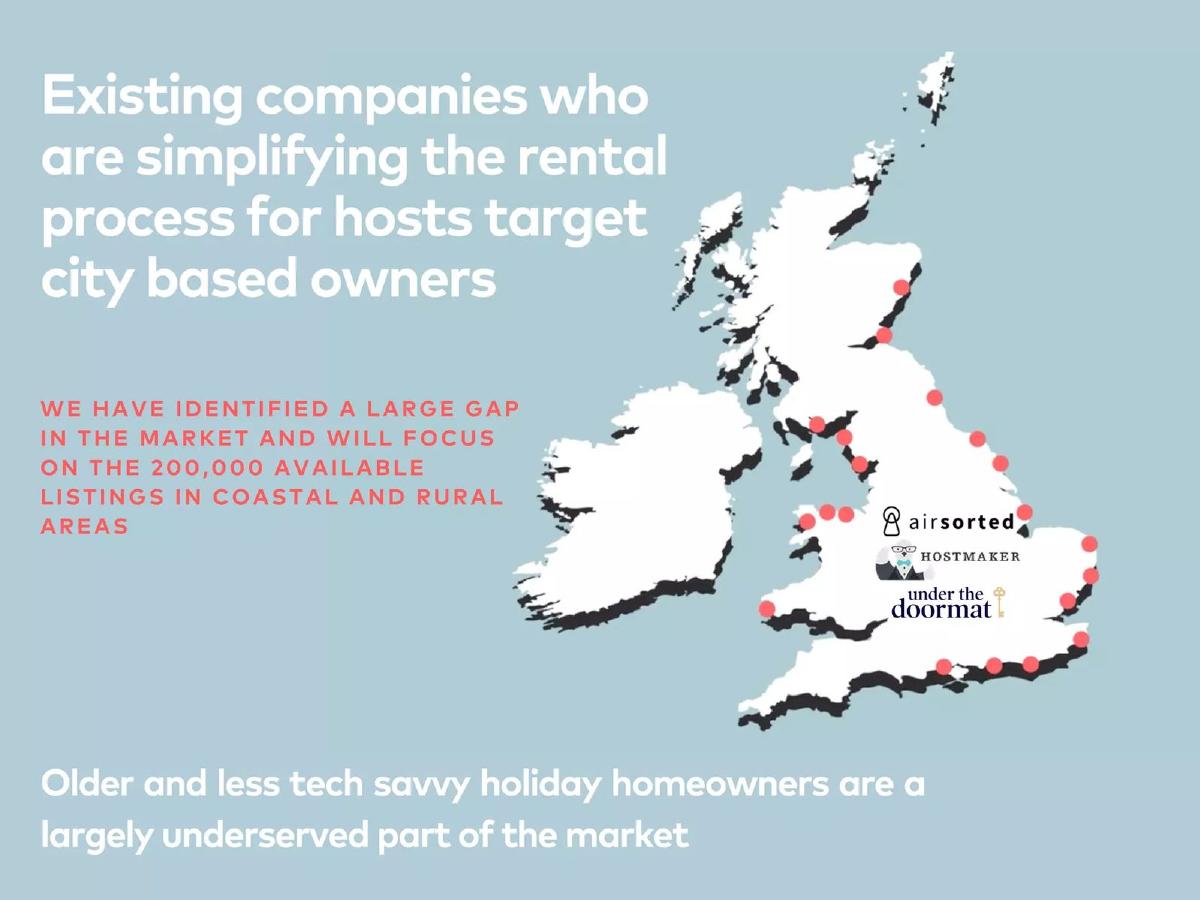
This is the 'Why Now' slide. It features a map of the UK with red dots concentrated in cities, representing competitors like Airsorted, Hostmaker, and Under the Doormat. The text explicitly states that these companies target city-based owners. Holiday Online identifies a "large gap in the market" consisting of 200,000 available listings in coastal and rural areas. They further define their target persona as "older and less tech savvy holiday homeowners," which justifies the need for a service-heavy management model rather than a pure software-as-a-service (SaaS) tool.
Slide 4: The Hyperlocal Solution
Slide 4 introduces the 'Hyperlocal' strategy. Instead of marketing a single national brand, the company aims to launch regional identities. The slide shows examples like 'Aberdeen Away,' 'Cumbria Getaway,' 'Norfolk Holiday,' and 'Suffolk Stays.' The logic is that local owners will trust a regional brand more than a generic national one. The slide also illustrates the technical flow: individual properties feed into a centralized database, which then distributes the data to multiple external booking sites.
Slide 5: Customer Examples and Social Proof
This slide provides six specific examples of properties and owners currently using the service. It includes a range of property types: a large guest house (The White House), caravans on a Haven site, farm barns (Grove Farm Barns), and a B&B (Little Holme B&B). The testimonials highlight different pain points: saving admin time, reducing high commissions from legacy players like Hoseasons, and helping 'tech-savvy but time-poor' owners. This slide is critical because it proves the model works across diverse rural property types, not just high-end cottages.
Slide 6: The Team
The team slide is a strong point for this deck. CEO Shameem Golamy and Advisor Robin Wilson both bring significant experience from Rightmove, the UK's dominant property portal. Golamy's experience launching Properstar.com adds international portal credibility. The inclusion of Lionel Rudaz (Swiss Property Portals) and Sam Kazerounian (IT veteran) rounds out the technical and strategic advisory board. The deck describes the team as a "blend of first timer entrepreneurs alongside online industry pros."
Slide 7: Financial Projections and Revenue Model
The revenue model is straightforward: a 10% commission on bookings. The slide estimates that a listing is worth £500 in Year 1 and £1,000 in subsequent years. A bar chart shows a growth trajectory from 2020 to 2023. By 2023, the company projects approximately 2,800 listings (indicated by the red line) generating roughly £1.7M in sales (light blue bar) against roughly £900k in expenses (dark bar). The slide notes a goal of reaching 2,000 listings to provide the foundation for >£2M revenue in Year 4.
Slide 8: Exit Strategy
To appeal to investors, Slide 8 lists 'Exit Examples.' It cites a range of trade sales in the travel and property tech space, including Booking.com ($133M), Hotel Tonight ($400M), and Dufy ($1.5BN). It also includes a news snippet about Snaptrip raising £2.1M and acquiring Last Minute Cottages. The core message is that "trade sales are commonplace in travel in the race to win the listings war," suggesting Holiday Online is building an acquisition target for larger players hungry for rural inventory.
Slide 9: The Ask
The final slide summarizes the investment opportunity. They are raising £200,000 at a £1.3M pre-money valuation. The round is SEIS/EIS eligible, which is a significant draw for UK angel investors due to the tax reliefs. Interestingly, the slide mentions they are seeking direct investors "ahead of our next Seedrs round," indicating they are using this private capital to build momentum for a larger public crowdfunding campaign.
What Works in This Deck
Specific Market Sizing: By identifying the exact number of rural listings (200,000) and naming the specific competitors they are avoiding, the founders demonstrate a deep understanding of their niche. They aren't trying to beat Airbnb; they are trying to be the gatekeeper for the inventory Airbnb finds hard to reach.
Team-Market Fit: The Rightmove pedigree is highly relevant. Rightmove is the gold standard for property listings in the UK, and having leadership that understands how to scale a portal and manage property data is a significant de-risking factor for investors.
Clear Monetization: The 10% commission model is standard and easy to understand. The projection of £1,000 per listing per year gives investors a clear 'unit of value' to track as the company scales.
What Is Missing or Lacks Detail
Marketing Efficiency of Multi-Branding: While the hyperlocal strategy (Slide 4) might help with trust, it is incredibly expensive to maintain SEO and brand awareness for ten different brands (e.g., 'Norfolk Holiday' vs. 'Suffolk Stays') compared to one national brand. The deck does not explain how they will manage the marketing spend across these fragmented identities without ballooning their Customer Acquisition Cost (CAC).
Operational Complexity: Managing rural properties is logistically harder than managing city apartments. Issues like key handovers, cleaning, and maintenance in remote areas require a different infrastructure than urban management. The deck focuses on the 'online exposure' but is light on how they handle the physical 'boots on the ground' operations, which is often where these businesses fail.
Technology Depth: The deck mentions 'centralised tech' but doesn't specify if this is proprietary software or if they are white-labeling an existing Channel Manager like Guesty or Kigo. For a £1.3M valuation, investors would likely want to know if they are building a defensible tech moat or just a service business.
Founder Takeaways: What to Copy
The 'Anti-Competitor' Map: Slide 3 is a masterclass in positioning. By showing where competitors are, you implicitly show where they aren't. If you are entering a crowded market, use a map or a matrix to show the 'white space' you intend to occupy.
Tangible Social Proof: Slide 5 doesn't just use quotes; it shows the actual properties. This makes the business feel real and operational. If you have customers, show their faces and their assets; it builds far more trust than a generic logo wall.
Tax Incentive Highlighting: For UK-based startups, mentioning SEIS/EIS eligibility on the 'Ask' slide is essential. It changes the risk-reward calculation for angel investors and should be stated as clearly as Holiday Online does on Slide 9.
Frequently asked questions
- What is the primary problem Holiday Online is trying to solve?
- According to Slide 3, the problem is that existing rental management companies focus almost exclusively on city-based owners. This leaves older, less tech-savvy holiday homeowners in rural and coastal areas underserved. Holiday Online aims to bridge this gap by providing a simplified rental process for the 200,000 listings located outside of major UK urban centers.
- How does the 'hyperlocal' brand strategy work?
- Slide 4 explains that the company launches distinct brands for specific regions, such as 'Wales Trip' or 'Hastings Holiday.' These brands act as the front-end to attract local homeowners. Behind the scenes, a centralized technology platform aggregates these properties and feeds them to major booking sites like Airbnb and Booking.com, allowing for operational efficiency despite the fragmented brand appearance.
- What are the projected unit economics for a single listing?
- Slide 7 outlines the revenue model. The company charges a 10% commission on bookings. They estimate a single listing is worth approximately £500 in commission during the first year, increasing to £1,000 in subsequent years as the listing matures. They also plan to generate affiliate revenue by monetizing their databases of travellers and owners.
- Who are the key members of the leadership team?
- The team, shown on Slide 6, is led by CEO Shameem Golamy, who spent 7 years at Rightmove and launched Properstar.com. He is supported by Caroline Ellis (Sales & Marketing), and advisors Robin Wilson (13 years at Rightmove), Lionel Rudaz (Tech Advisor), and Sam Kazerounian (Investor & Advisor). The deck emphasizes a blend of 'first timer entrepreneurs' and 'online industry pros.'
- What is the specific investment ask and valuation?
- On Slide 9, the company seeks a £200,000 investment. This is positioned as an SEIS/EIS eligible round with a pre-money valuation of £1.3M. The slide also notes that they are seeking direct investors specifically ahead of a planned future round on the crowdfunding platform Seedrs.