The Hni deck is a preliminary conceptual document for a luxury web portal (proposed as www.hnw.net) targeting High Net Worth Individuals. Spanning eight slides, the presentation focuses heavily on listing potential inventory and service offerings—ranging from diamonds and space travel to offshore company registration in jurisdictions like Cyprus and Gibraltar. However, the deck lacks critical business fundamentals: there are no financial projections, no competitive analysis, no team biographies, and no specific capital request. It functions more as a brainstorming list for a 'super-app' for t…
Key takeaways
- The project proposes a web portal located at www.hnw.net to serve as a network and information hub for High Net Worth Individuals (Slide 1).
- The first-year plan includes site promotion in 20 countries using luxury media, TV adverts, and conferences (Slide 1).
- Revenue is intended to come from six 'Profit centers,' including an online shop, advertising, and marketing services (Slide 2).
- The proposed online shop inventory is extremely broad, covering everything from 'Space Travel' and 'Helicopters' to 'Old Books' and 'I pods' (Slides 2-3).
- The deck lists specific offshore company registration locations including the Isle of Man, Cyprus, and Gibraltar (Slide 3).
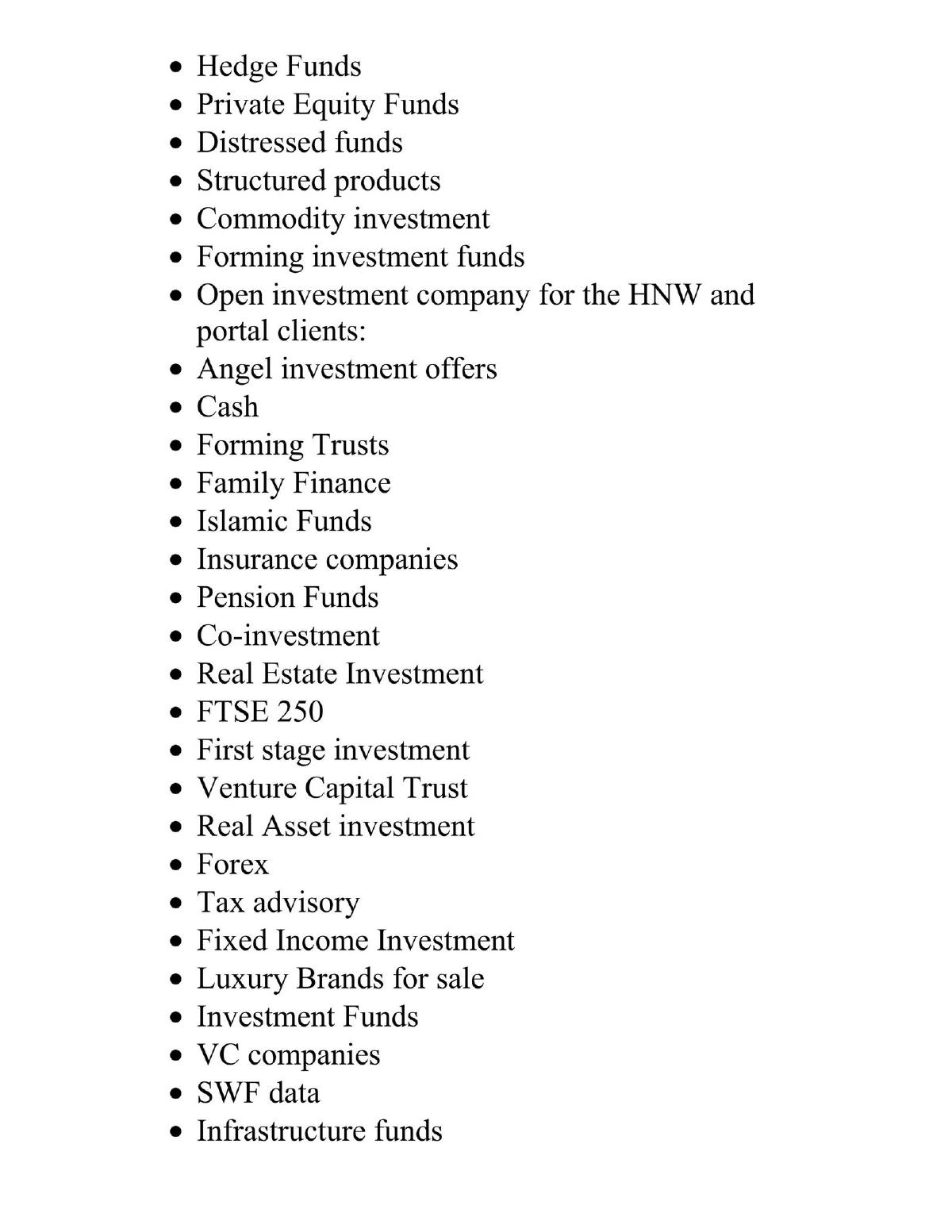
- Financial services are a major focus, listing hedge funds, private equity, distressed funds, and Islamic funds as potential offerings (Slide 5).
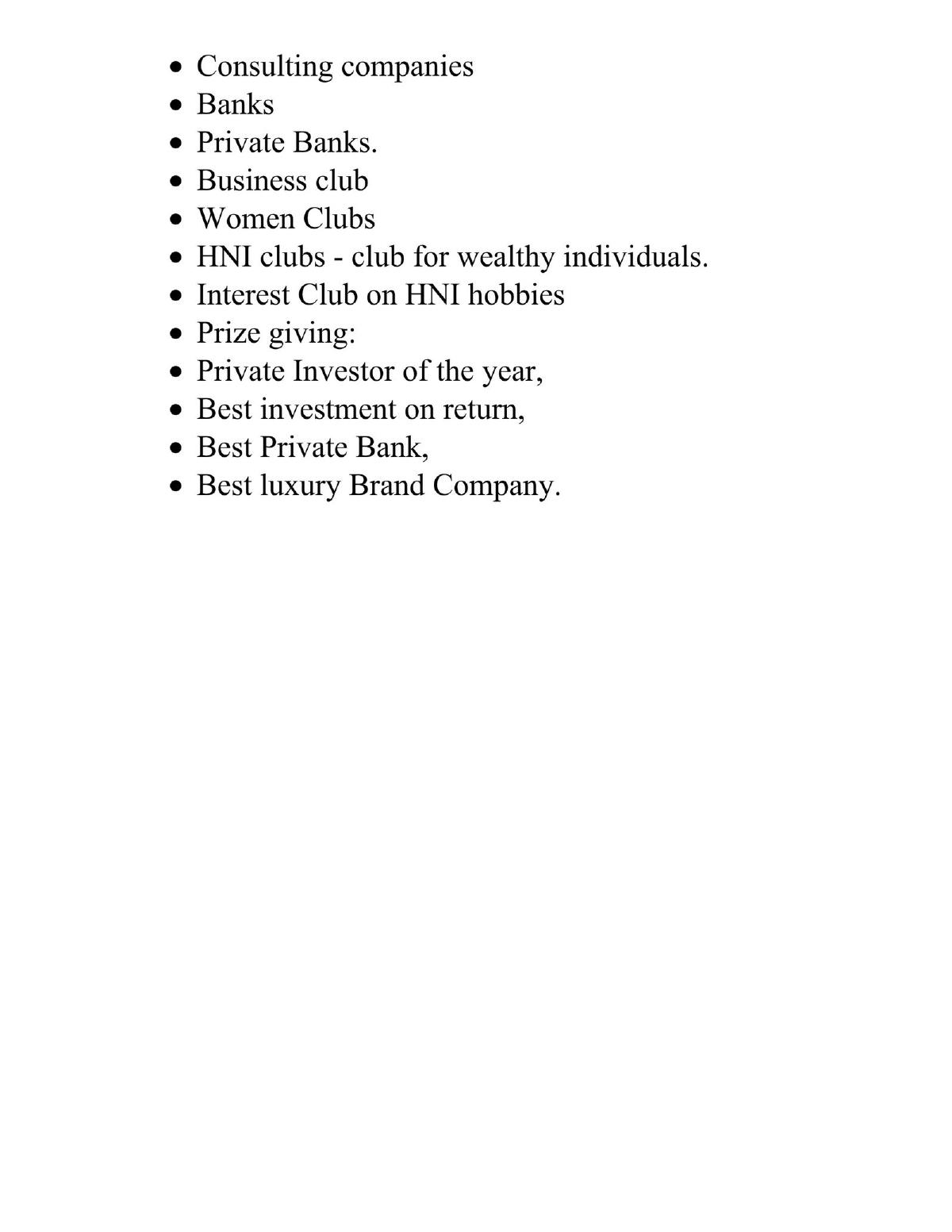
- The platform intends to host awards such as 'Private Investor of the year' and 'Best Private Bank' (Slide 6).
- The deck omits all financial metrics, team history, market sizing, and a specific funding 'ask' amount (Slides 1-8).
Executive Summary: A Broad Vision for the Ultra-Wealthy
The Hni pitch deck is a high-level conceptual outline for a digital ecosystem dedicated to High Net Worth Individuals (HNIs). The presentation, totaling eight slides, functions less as a traditional startup pitch and more as a comprehensive list of features and services that could theoretically be offered to a wealthy demographic. The proposed domain, www.hnw.net, is positioned as a central hub for networking, luxury commerce, and financial services. While the scope is ambitious—covering everything from space travel to offshore company formation—the deck is notably devoid of the data, team credentials, and financial modeling required by institutional investors.
Slide 1: Mission and Immediate Roadmap
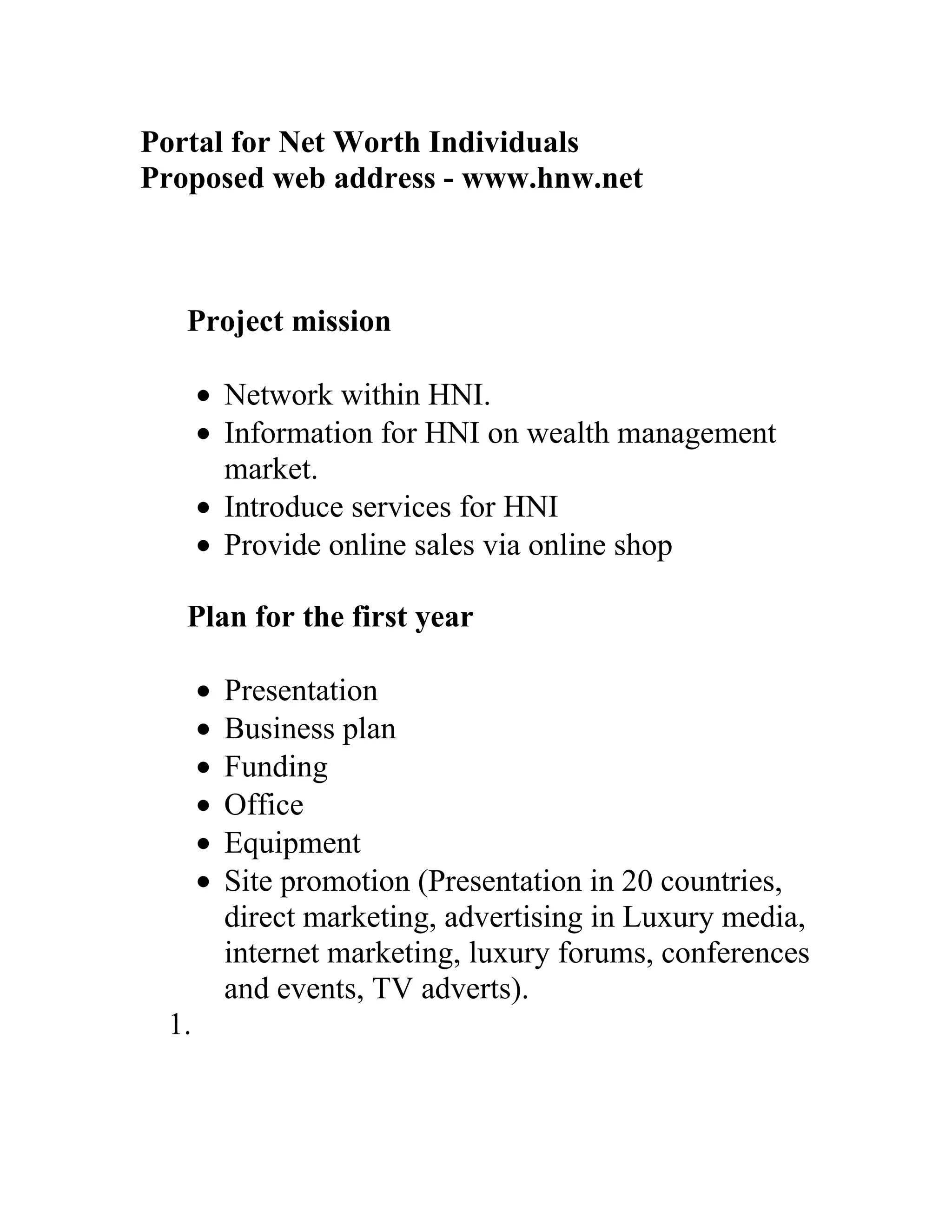
The opening slide establishes the project's identity as a 'Portal for Net Worth Individuals.' The mission is four-fold: networking within the HNI community, providing wealth management information, introducing specialized services, and facilitating online sales. The 'Plan for the first year' is a standard operational checklist: creating the presentation and business plan, securing funding, and establishing an office and equipment. Most notably, it outlines an aggressive marketing strategy involving site promotion in 20 countries, utilizing luxury media, TV adverts, and conferences to build the brand.
Slide 2: Revenue Streams and Luxury Inventory
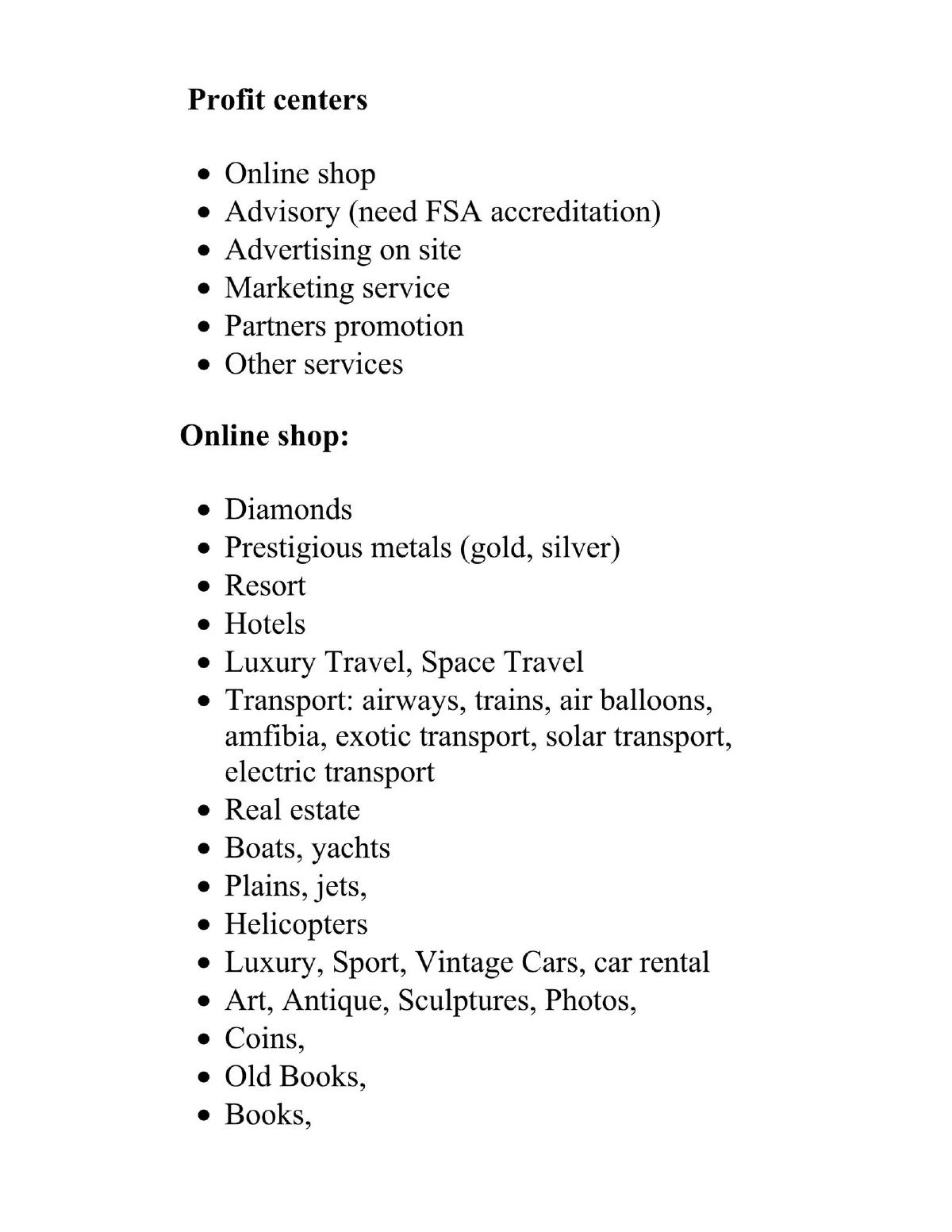
Slide 2 introduces the 'Profit centers,' which include an online shop, advisory services, advertising, and marketing. A significant disclaimer is included for the advisory branch, stating the need for FSA (Financial Services Authority) accreditation. The slide then begins a long list of inventory for the online shop. The items listed are quintessentially luxury: diamonds, prestigious metals (gold, silver), resorts, and hotels. It also touches on high-end transport, mentioning 'Space Travel' alongside more traditional luxury modes like yachts and jets.
Slide 3: Expanding the E-commerce Catalog
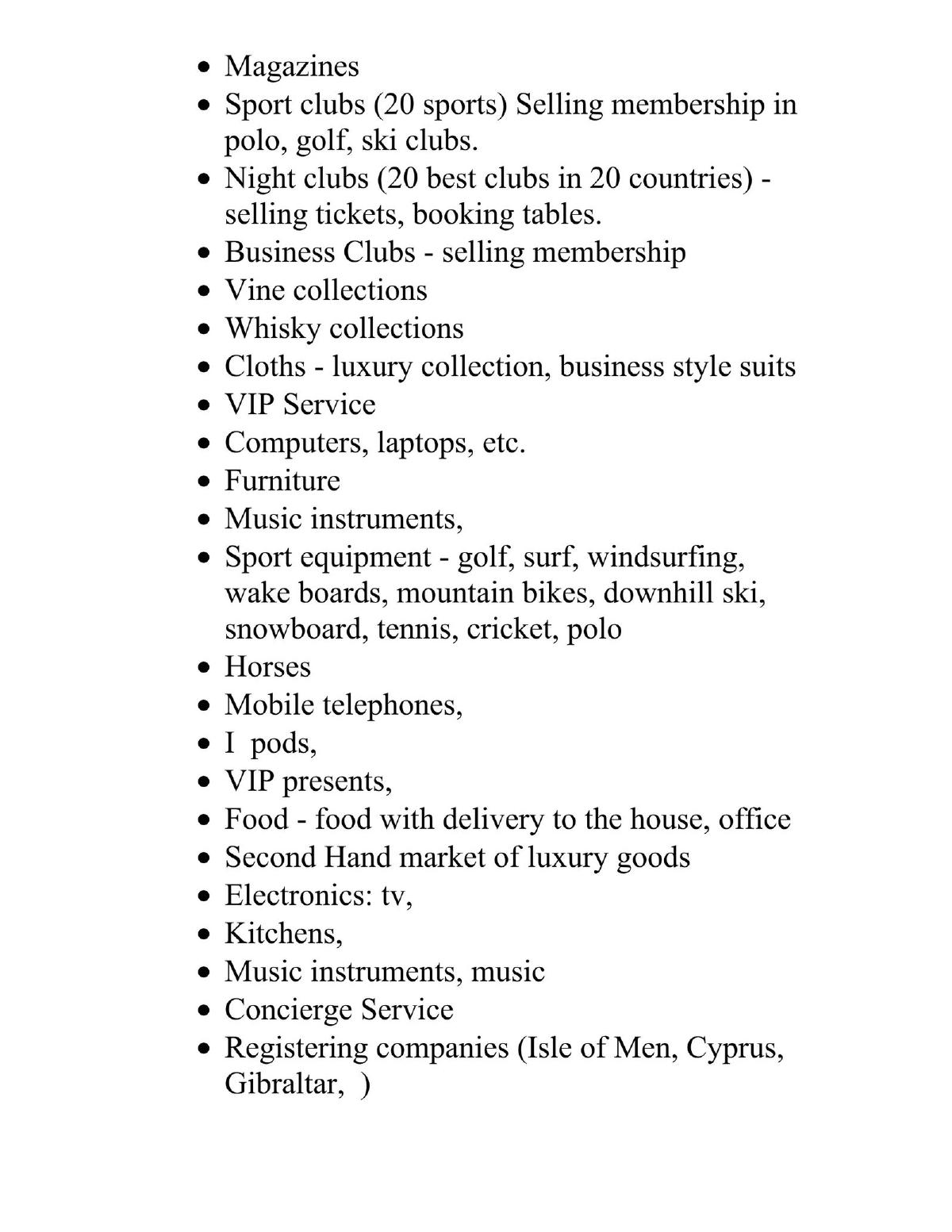
The third slide continues the inventory list, demonstrating a 'super-app' ambition. The categories range from entertainment (night clubs in 20 countries, sport club memberships) to personal assets (vine and whisky collections, luxury suits, furniture). Interestingly, the list mixes extremely high-value items like 'Registering companies (Isle of Man, Cyprus, Gibraltar)' with consumer electronics like 'I pods' and 'mobile telephones.' This slide highlights a lack of focus, as the logistics of selling a yacht are vastly different from selling a music player or a kitchen.
Slide 4: Service Provider Network
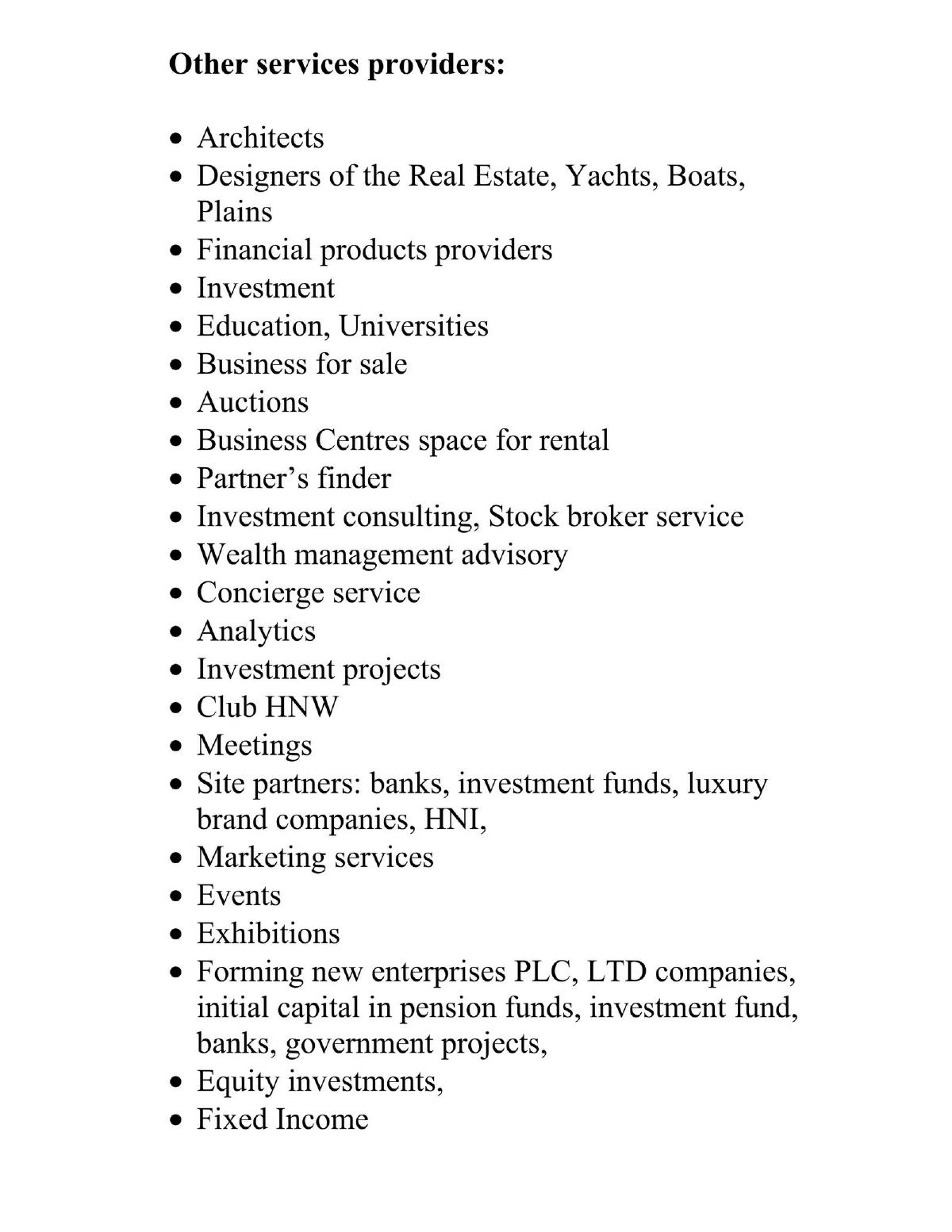
Moving beyond physical goods, slide 4 focuses on professional services. The portal aims to connect HNIs with architects, real estate designers, and financial product providers. It also lists 'Business for sale' and 'Auctions' as potential features. The slide reinforces the platform's role as a matchmaker, including a 'Partner’s finder' service and wealth management advisory. This section positions the portal as a B2B2C marketplace where luxury service providers pay to access the HNI user base.
Slide 5: Financial Services Depth
Slide 5 delves deeper into the financial aspect of the portal. It lists a wide array of investment vehicles that the platform intends to feature or facilitate, including Hedge Funds, Private Equity, Distressed funds, and Structured products. It also mentions 'Islamic Funds' and 'SWF (Sovereign Wealth Fund) data.' The inclusion of 'Angel investment offers' and 'Venture Capital Trust' suggests the platform wants to be a source of deal flow for its members, further expanding its utility as a financial tool.
Slide 6: Community and Recognition
Slide 6 focuses on the 'Club' aspect of the project. It lists various types of clubs (Business club, Women Clubs, HNI clubs) and interest-based groups. A unique feature mentioned here is 'Prize giving,' where the platform would award titles such as 'Private Investor of the year' and 'Best luxury Brand Company.' This appears to be a strategy for engagement and industry authority, creating a reason for both HNIs and brands to participate in the ecosystem.
Slide 7: Content Strategy and User Profiles
Slide 7 outlines the 'Site content' for the proposed domain. The platform intends to profile 'Politicians, Sportsmen, Businessmen, Famous people, Nobles, Government leaders, and Stars.' These profiles would include wealth estimates, business descriptions, and personal interests. The 'Type of the presentation' for this content includes business stories, interviews, and success stories. This suggests a media-heavy approach, functioning partly as a digital magazine or a 'LinkedIn for the elite.'
Slide 8: Conclusion and Contact
The final slide reiterates the profit centers (Parties, Events, Advisory, Online shop, etc.) and the expected outcomes of the project: profit, a network of investors, and new business solutions. The deck concludes with a call for partners and provides contact information for Tikhon Vorogushin of the 'Private Investment Club.' The use of a Yandex email address and the lack of a formal company structure or website link (other than the proposed one) reinforces the early-stage, individual-led nature of the proposal.
What Hni Does Well
The Hni deck succeeds in identifying a high-value niche . The High Net Worth segment is notoriously difficult to reach, and a dedicated portal that aggregates their specific needs—from offshore banking to luxury travel—is a clear value proposition. By listing such a wide variety of services, the founder demonstrates an understanding of the diverse interests of the wealthy, moving beyond just 'money management' into lifestyle, prestige, and networking.
Furthermore, the inclusion of regulatory requirements (Slide 2) shows a degree of realism. Many early-stage decks ignore the legal complexities of financial advisory, but Hni explicitly notes the need for FSA accreditation. The strategy of using awards and 'Prize giving' (Slide 6) is also a clever way to build a moat; by becoming the arbiter of 'Best Private Bank' or 'Investor of the Year,' the platform could create significant gravity in the luxury and finance sectors.
What is Missing from the Hni Deck
The most glaring omission is any form of financial data . There are no projections, no breakdown of how much capital is required to launch, and no explanation of the revenue split between the online shop and the advisory services. For a project that proposes marketing in 20 countries and buying TV adverts (Slide 1), the lack of a budget is a major red flag for investors.
The team slide is also missing . Investors in the luxury and finance space bet on the 'who' as much as the 'what.' Without biographies showing that the founders have the connections to reach 'Nobles' and 'Government leaders' (Slide 7), the deck remains a wishlist. Additionally, there is no competitive analysis . The deck ignores existing players like private banks, luxury concierge services (e.g., Quintessentially), and elite social networks (e.g., ASmallWorld), leaving the reader to wonder how Hni plans to differentiate itself or capture market share.
Founder's Guide: What to Copy and What to Avoid
What to Copy: Founders should emulate the comprehensive ecosystem approach seen in slides 4 and 5. Instead of just offering one service, Hni looks at the 'whole client,' considering their professional, financial, and lifestyle needs. This 'sticky' ecosystem is what makes platforms like Bloomberg or high-end concierge services successful. Also, the idea of industry awards (Slide 6) is a low-cost, high-impact way to generate PR and industry buy-in.
What to Avoid: Avoid the 'everything but the kitchen sink' inventory list seen on slides 2 and 3. Listing 'Space Travel' next to 'I pods' makes the business look unfocused and suggests the founder hasn't considered the vastly different supply chains and margins involved. Furthermore, never omit the 'Ask' and 'Team' slides . A pitch deck without a specific request for capital and a reason to trust the people behind it is merely a brochure. Finally, ensure your contact information looks professional; using a generic provider like Yandex for a project targeting the world's wealthiest individuals creates a significant credibility gap.
Frequently asked questions
- What is the primary business model for Hni?
- According to slide 2 and slide 8, the business model relies on multiple 'Profit centers.' These include an online shop for luxury goods, financial advisory (contingent on FSA accreditation), advertising on the site, marketing services for partners, and hosting high-end events or parties. It essentially acts as a middleman and media platform for the luxury and wealth management industries.
- Does the deck provide any evidence of market traction?
- No. The deck is entirely conceptual. Slide 1 lists 'Funding' and 'Office' as part of the 'Plan for the first year,' suggesting the company was in the pre-incorporation or very early ideation stage at the time of the presentation. There are no user numbers, partner agreements, or revenue figures mentioned.
- What kind of products does Hni plan to sell?
- The product list on slides 2 and 3 is exhaustive and highly varied. It includes high-ticket items like diamonds, yachts, jets, and real estate, alongside lifestyle products like luxury suits, furniture, and 'I pods.' It also includes niche collectibles such as coins, antique sculptures, and vine (wine) collections.
- What are the regulatory requirements mentioned in the deck?
- On slide 2, under the 'Profit centers' heading, the founder explicitly notes that for the 'Advisory' portion of the business, they 'need FSA accreditation.' This indicates an awareness of the regulatory hurdles involved in providing financial advice to high-net-worth clients, though no plan for obtaining this is detailed.
- Who is the target audience for the portal content?
- Slide 7 specifies that the site content is designed for 'Politicians, Sportsmen, Businessmen, Famous people, Nobles, Government leaders, and Stars.' The content would include business descriptions, wealth estimates, and personal 'credo' or interests for these individuals.