Hiverge’s 7-slide pitch deck is a masterclass in 'founder-market fit' for a deep-tech venture. Rather than leading with market size or revenue, the deck leads with the team’s involvement in landmark AI projects like AlphaFold and AlphaTensor (Slide 3). The company targets the 'global algorithmic bottleneck' (Slide 4), proposing a platform called 'the Hive' that combines LLMs, formal methods, and search to discover new algorithms (Slide 6). While the deck is light on business model specifics and lacks a formal 'Ask' slide, it successfully frames a highly technical solution for high-value marke…
Key takeaways
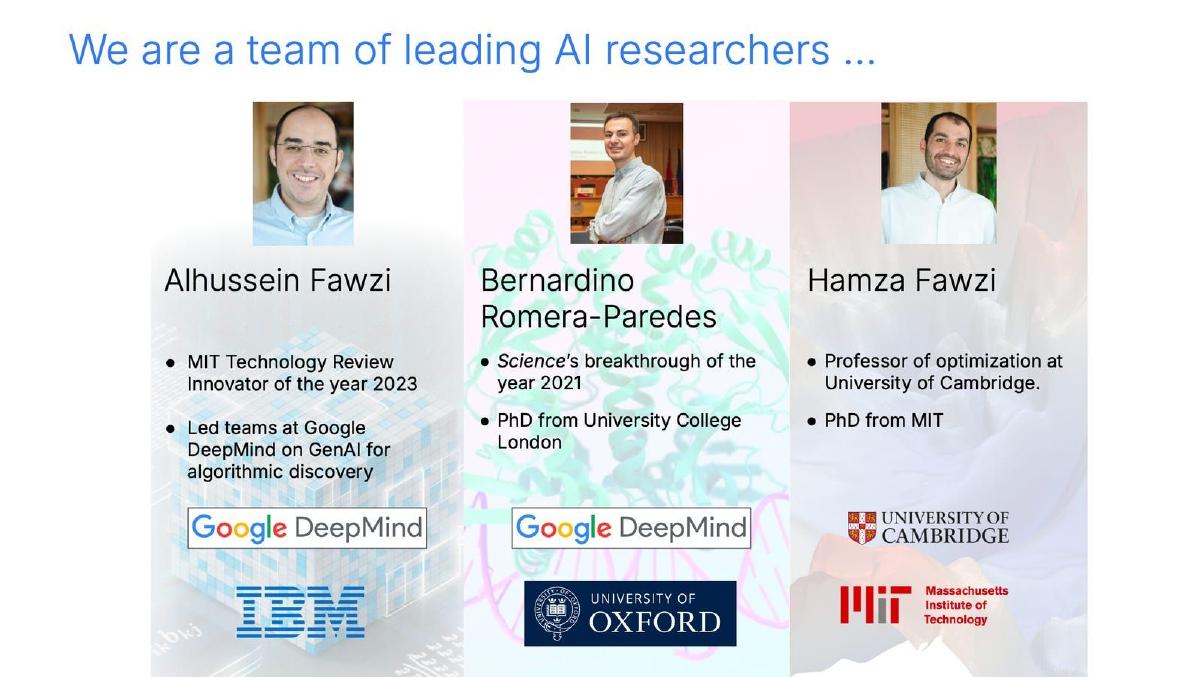
- The deck leads with team credentials, highlighting Alhussein Fawzi as the MIT Technology Review Innovator of the Year 2023 (Slide 2).
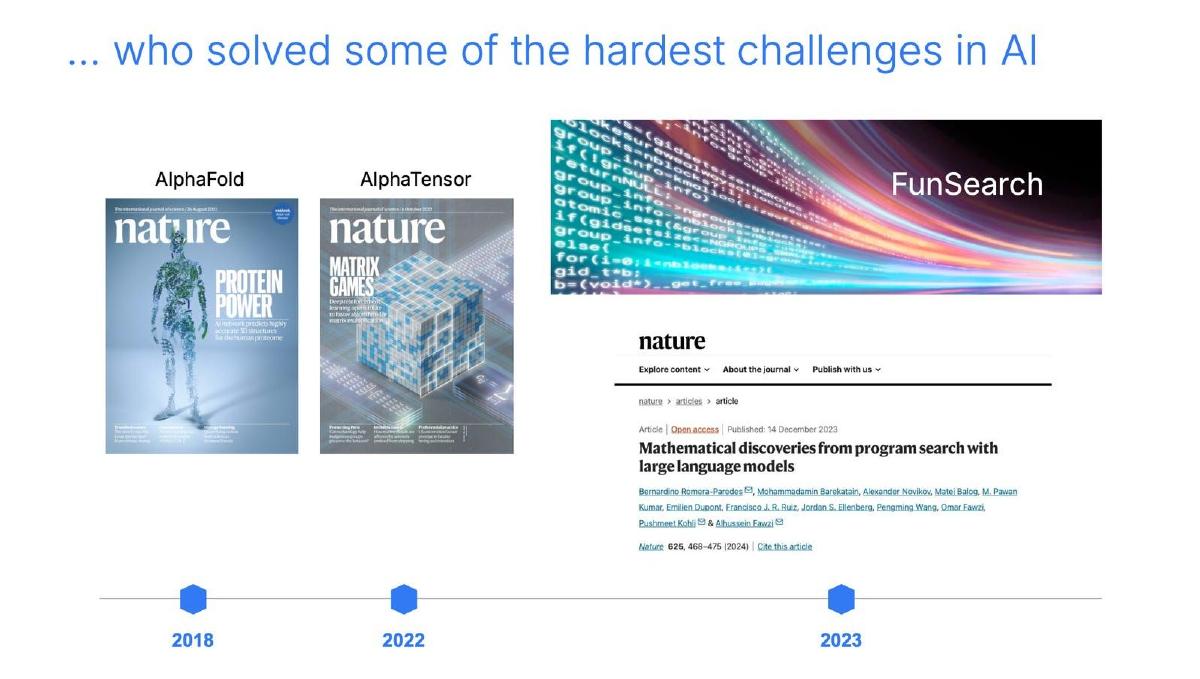
- Founders leverage past success at Google DeepMind, specifically citing their work on AlphaFold, AlphaTensor, and FunSearch (Slide 3).
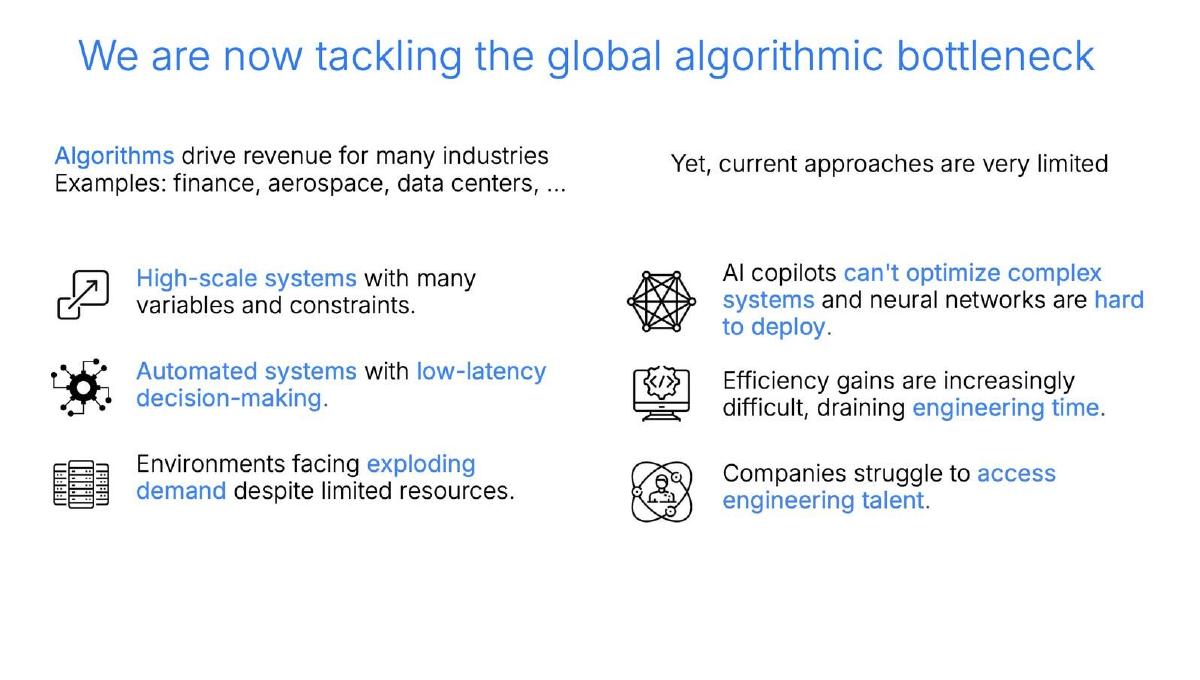
- The problem is defined as a 'global algorithmic bottleneck' where current AI copilots cannot optimize complex systems (Slide 4).
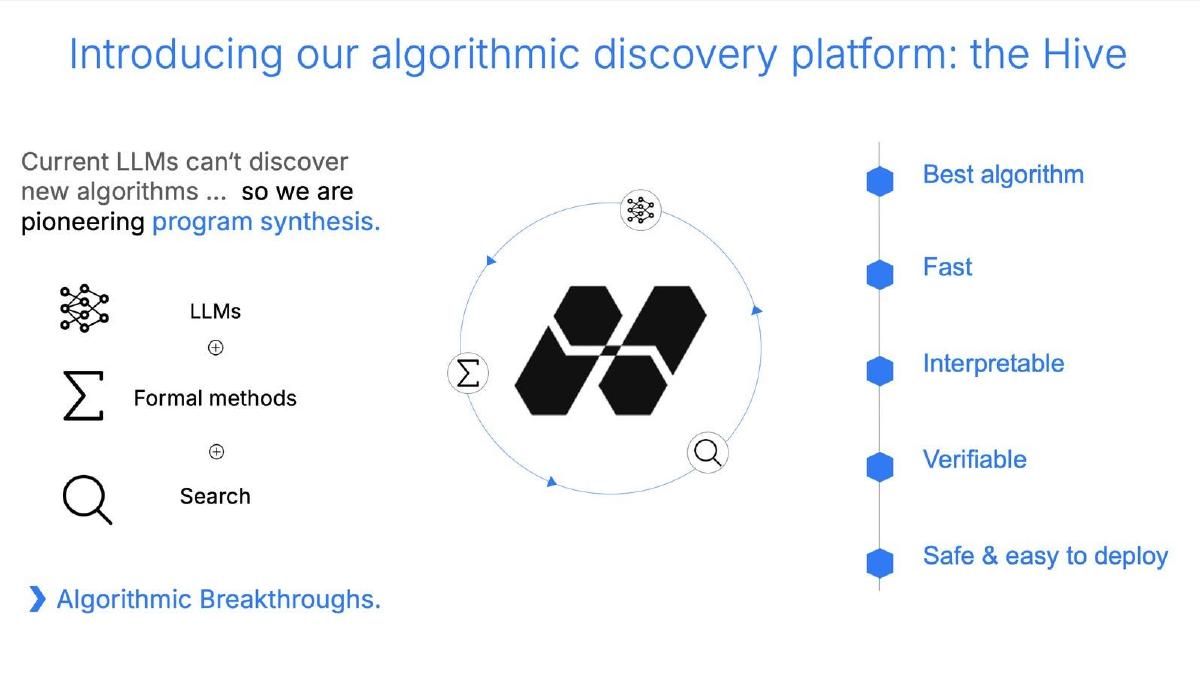
- The solution, 'the Hive,' is positioned as a pioneer in program synthesis, distinct from standard LLMs (Slide 6).
- The platform claims to deliver algorithms that are 'Interpretable,' 'Verifiable,' and 'Safe & easy to deploy' (Slide 6).
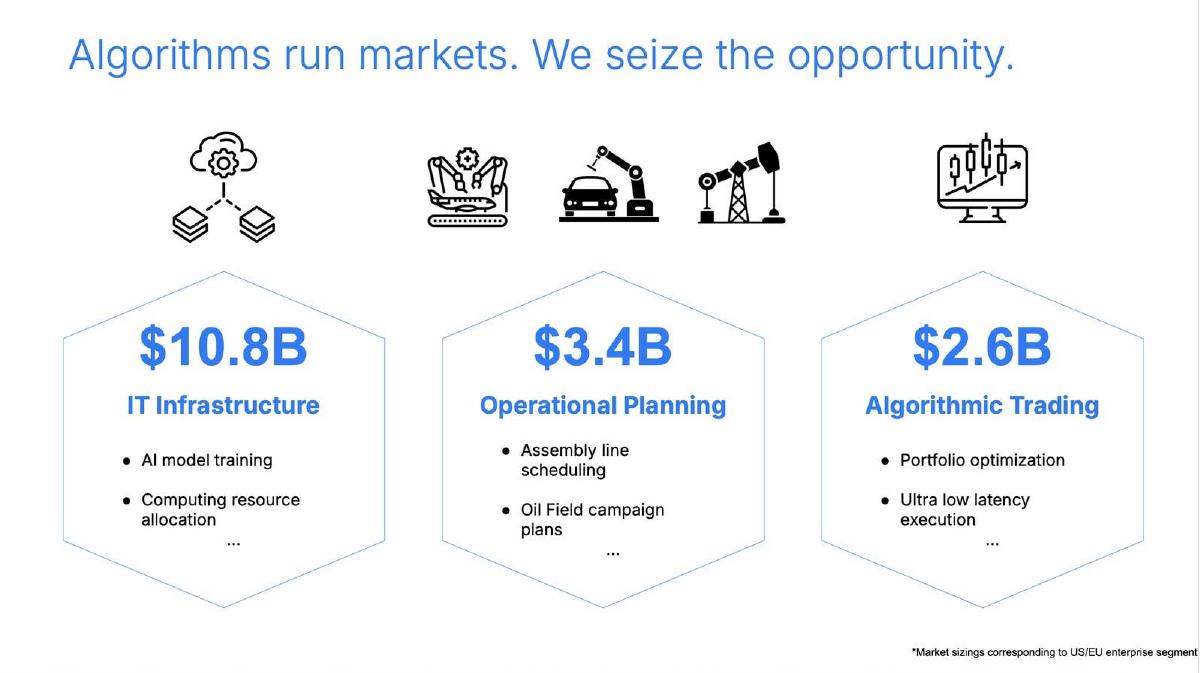
- Market opportunity is segmented into three high-value verticals: IT Infrastructure ($10.8B), Operational Planning ($3.4B), and Algorithmic Trading ($2.6B) (Slide 7).
- The deck completely omits a business model, go-to-market strategy, and a specific fundraising ask.
- Hiverge successfully raised $5M in a 2024 Seed round despite the lack of operational metrics, relying on technical moats (Reported by Business Insider).
Hiverge: The Power of Pedigree in Deep-Tech Fundraising
Hiverge’s 7-slide pitch deck is a textbook example of how elite technical founders raise capital in the current AI cycle. Reported by Business Insider as a $5M Seed round in 2024, the company—based in Cambridge, UK—doesn't lead with a product demo or a customer list. Instead, it leads with a resume. When your founding team consists of the researchers behind AlphaFold and AlphaTensor, the traditional rules of the pitch deck are suspended. This teardown examines how Hiverge used technical authority to bypass the need for traditional business metrics.
Slide 1: Title Slide
The deck opens with a minimalist title slide featuring the Hiverge logo—a stylized, hexagonal 'H' that evokes both a hive and a network. There is no tagline or mission statement here. It is a clean, corporate entry point that signals a focus on engineering and precision.
Slide 2: The Team Slide
Unusually, the team slide appears second. This is a strategic choice. For a company tackling 'algorithmic discovery,' the credibility of the researchers is the product. The slide introduces three key figures: Alhussein Fawzi (MIT Technology Review Innovator of the year 2023, ex-DeepMind), Bernardino Romera-Paredes (Science's breakthrough of the year 2021, ex-DeepMind), and Hamza Fawzi (Professor of optimization at University of Cambridge, PhD from MIT). By listing logos for Google DeepMind, IBM, Oxford, and MIT , the slide establishes an immediate 'tier-one' status that justifies a $5M seed round before a single line of the problem is explained.
Slide 3: Proof of Capability
Slide 3 functions as a 'Traction' slide, but instead of revenue, it shows scientific impact. It highlights three major AI milestones: AlphaFold (2018), AlphaTensor (2022), and FunSearch (2023). By including the Nature journal covers and article snippets, the founders are telling investors: 'We have already solved the hardest challenges in AI; Hiverge is the commercial application of that expertise.' This slide bridges the gap between academic research and venture-backed potential.
Slide 4: The Global Algorithmic Bottleneck
This is the 'Problem' slide. Hiverge identifies a 'global algorithmic bottleneck' across finance, aerospace, and data centers. They argue that current AI tools (copilots) are insufficient because they cannot optimize complex systems or neural networks that are 'hard to deploy.' The slide lists three specific pain points: high-scale systems with many constraints, the need for low-latency decision-making, and exploding demand vs. limited resources. It frames the problem not just as a coding issue, but as a resource efficiency crisis.
Slide 5: The Vision Transition
Slide 5 is a simple transition slide with the text: 'Re-imagining algorithms through program synthesis.' It serves to pivot the deck from the 'Why' to the 'How,' introducing the technical methodology that differentiates Hiverge from the crowded field of AI coding assistants.
Slide 6: The Solution - The Hive
Slide 6 introduces 'the Hive,' described as an 'algorithmic discovery platform.' The technical 'secret sauce' is presented as a combination of LLMs + Formal methods + Search . This is a critical distinction; they are explicitly stating that LLMs alone cannot discover new algorithms. The slide promises five key outcomes for the generated code: Best algorithm, Fast, Interpretable, Verifiable, and Safe & easy to deploy . The use of the term 'Interpretable' is particularly important for enterprise clients in regulated industries like finance or aerospace.
Slide 7: Market Opportunity
The final slide quantifies the opportunity across three verticals in the US/EU enterprise segment. IT Infrastructure is the largest at $10.8B (focused on AI model training and resource allocation). Operational Planning is valued at $3.4B (assembly lines and oil fields). Algorithmic Trading is listed at $2.6B (portfolio optimization and low latency). By providing these specific figures, the deck attempts to ground its high-level research goals in tangible, multi-billion dollar markets.
What Works in the Hiverge Deck
Unassailable Authority: The deck does an excellent job of establishing the founders as the world's leading experts in their niche. By Slide 3, any technical investor would be convinced that this team has the 'right to win' in the algorithmic discovery space.
Clear Technical Differentiation: Slide 6 clearly explains why Hiverge is different from a standard LLM-based coding tool. By adding 'Formal methods' and 'Search' to the equation, they appeal to investors who are skeptical of the hallucinations and lack of optimization inherent in pure LLM solutions.
Vertical Specificity: Rather than saying 'we optimize all code,' Slide 7 picks three high-value, high-complexity industries. This shows a level of commercial maturity, suggesting the founders know where the highest willingness to pay resides.
What is Missing from the Hiverge Deck
The Business Model: There is no mention of how Hiverge intends to make money. Is this a seat-based SaaS tool for engineers? Is it a consultancy-heavy enterprise play? Or is it a licensing model based on the efficiency gains they generate? The deck is silent on this.
The 'Ask': Standard pitch decks end with a slide detailing how much money is being raised and what the milestones for that capital are. Hiverge omits this entirely, likely because the round was pre-empted or handled through high-level networking where the terms were already understood.
Competitive Landscape: The deck ignores other players in the AI coding space (like GitHub Copilot, Anysphere/Cursor, or Cognition). While Hiverge operates at a lower level of the stack (algorithms vs. boilerplate code), a slide addressing why they won't be commoditized by larger players would have been beneficial.
Product Visuals: For a platform called 'the Hive,' there are no screenshots, mockups, or workflow diagrams. The deck remains entirely theoretical and vision-based.
What Founders Should Copy
The 'Pedigree First' Approach: If you have a world-class team, do not bury them on Slide 12. Hiverge puts their credentials front and center because, at the Seed stage, the team is the most de-risked element of the venture.
Linking Research to Revenue: Slide 7 is a great example of how to take a very abstract technical concept (program synthesis) and map it to specific, dollar-denominated industry problems. Founders in deep tech should always provide this 'translation layer' for investors.
Minimalist Design: The deck uses a consistent, clean aesthetic with professional iconography. It doesn't distract with unnecessary animations or cluttered text, allowing the weight of the credentials and the market sizes to do the heavy lifting.
Conclusion
Hiverge’s deck is a 'prestige' pitch. It relies on the fact that the founders are among the few people on earth who have successfully used AI to discover new mathematical and biological structures. While it lacks the operational details of a typical startup pitch, it succeeds because it perfectly matches the expectations of Seed-stage deep-tech investors: a massive problem, a unique technical insight, and a team that has already proven they can execute at the highest level of science.
Frequently asked questions
- Why is the Hiverge deck so short at only 7 slides?
- For deep-tech startups founded by world-class researchers (ex-DeepMind), the 'team' is the primary traction. The deck focuses on proving the founders are the only people capable of solving this specific technical problem. At the Seed stage, investors are often betting on the talent and the size of the potential breakthrough rather than current revenue or a detailed 5-year plan.
- What is 'program synthesis' in the context of this deck?
- As described on Slide 6, Hiverge defines program synthesis as a combination of Large Language Models (LLMs), formal methods, and search. The goal is to move beyond simple code generation to 'algorithmic discovery,' creating code that is not just functional but optimized for performance, safety, and verifiability in complex backend systems.
- How does Hiverge quantify its market opportunity?
- On Slide 7, Hiverge identifies three specific segments within the US/EU enterprise market: IT Infrastructure ($10.8B), Operational Planning ($3.4B), and Algorithmic Trading ($2.6B). They specifically mention use cases like AI model training, assembly line scheduling, and ultra-low latency execution as the primary drivers for these valuations.
- What are the most notable omissions in this pitch deck?
- The deck lacks several standard components: there is no slide detailing the business model (SaaS vs. Licensing), no competitive landscape analysis, no roadmap or milestones, and no 'Ask' slide detailing how the $5M will be spent. It functions more as a technical manifesto than a traditional business plan.
- Who are the key people behind Hiverge according to the deck?
- The team includes Alhussein Fawzi (ex-DeepMind, MIT Tech Review Innovator of the Year), Bernardino Romera-Paredes (ex-DeepMind, Science breakthrough of the year 2021), and Hamza Fawzi (Professor at University of Cambridge, PhD from MIT). Their collective background spans Google DeepMind, IBM, Oxford, and MIT (Slide 2).