Aether’s 2023 Series A deck is a masterclass in translating deep-tech capabilities into high-value industrial applications. The company positions itself not just as a biotech firm, but as a manufacturer of 'molecular assemblers' capable of building materials atom-by-atom. By highlighting a proprietary screening platform that operates 20x faster than the state-of-the-art, Aether builds a credible bridge from laboratory protein engineering to three massive total addressable markets: PFAS remediation ($40bn), high-performance materials (+$20bn), and lithium extraction ($5bn). The deck successful…
Key takeaways
- The platform generates data at ultra-high throughput, exceeding 20,000 samples per day per laser (Slide 7).
- Aether claims a 50X lower CapEx than comparable technology through miniaturization (Slide 7).
- The company has demonstrated a 64X product yield improvement and 190X enantioselectivity improvement in four months (Slide 12).
- Aether targets three distinct markets with a combined TAM exceeding $65 billion (Slide 17).
- The technology aims to unlock 15% of global lithium reserves currently trapped in North American brines (Slide 20).
- The business model shifts from slow fermentation to standardized biocatalysis for faster scale-up (Slide 15).
- The Series A ask was exactly $49M to deploy product lines and build the executive team (Slide 22).
- The deck omits a team slide, which is unusual for a Series A deep-tech raise (Slide 1-24).
The Vision: Manufacturing at the Atomic Scale
Slides 1-3: The Hook and the Future
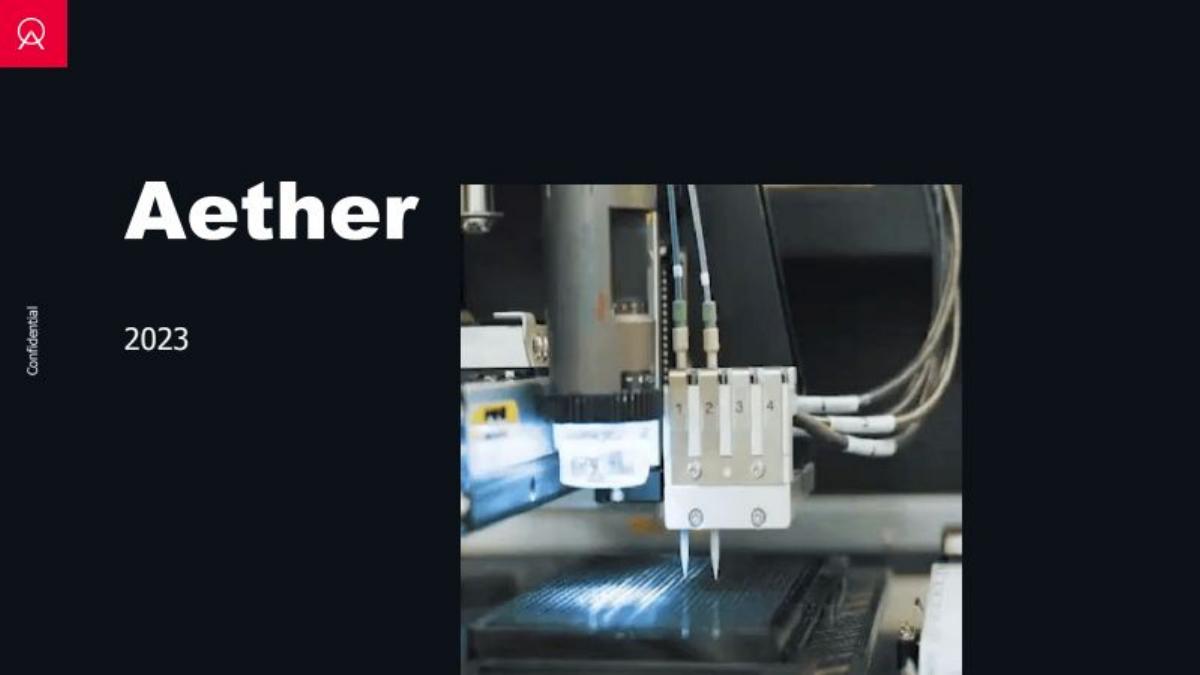
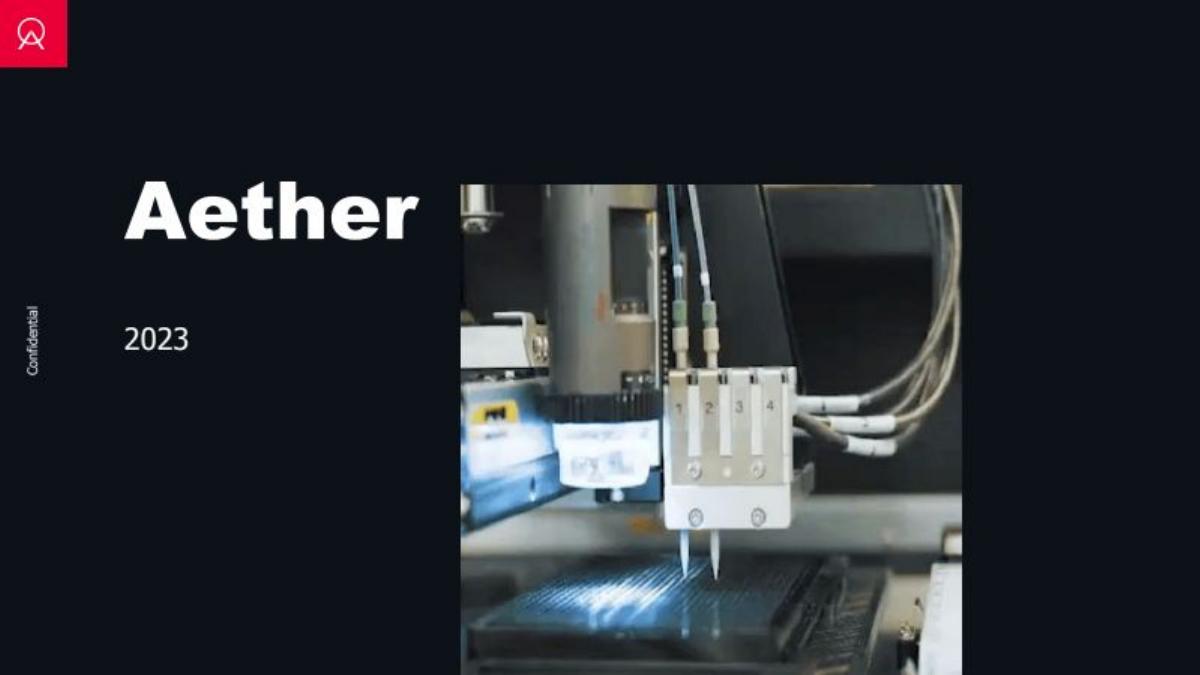
Aether opens with a minimalist title slide featuring a piece of laboratory robotics, immediately signaling a focus on automation and hardware. Slide 2 presents a bold vision statement: "Imagine a future where anything can be built atom by atom." This is a classic 'Moonshot' opening, common in deep-tech decks to prime investors for a high-ceiling opportunity.
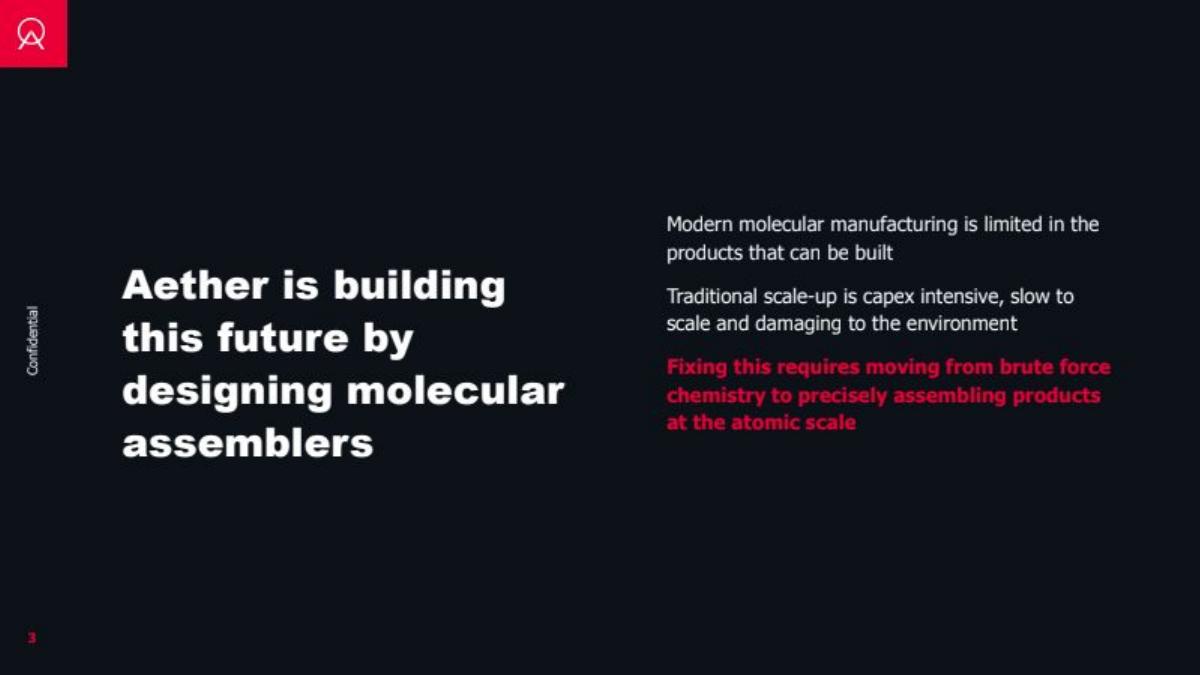
On Slide 3, the company defines its mission: building this future by designing "molecular assemblers." They frame the problem as a limitation of modern molecular manufacturing, which they describe as capex-intensive, slow, and environmentally damaging. The solution, according to Aether, is moving away from "brute force chemistry" toward precise atomic assembly.
Slides 4-7: The Technical Edge—Protein Indexing
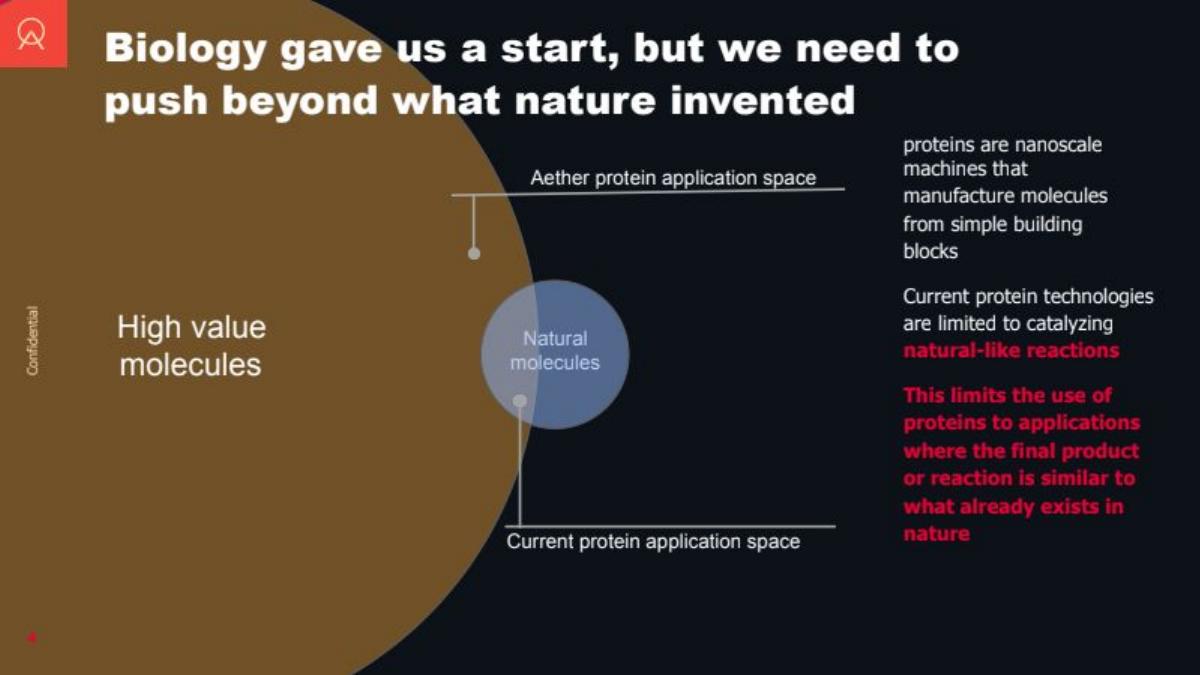
Slide 4 introduces the biological component. Aether argues that while nature gave us a start with proteins (nanoscale machines), current technology is limited to "natural-like reactions." Aether intends to push into the "Aether protein application space," which targets high-value molecules that do not exist in nature.
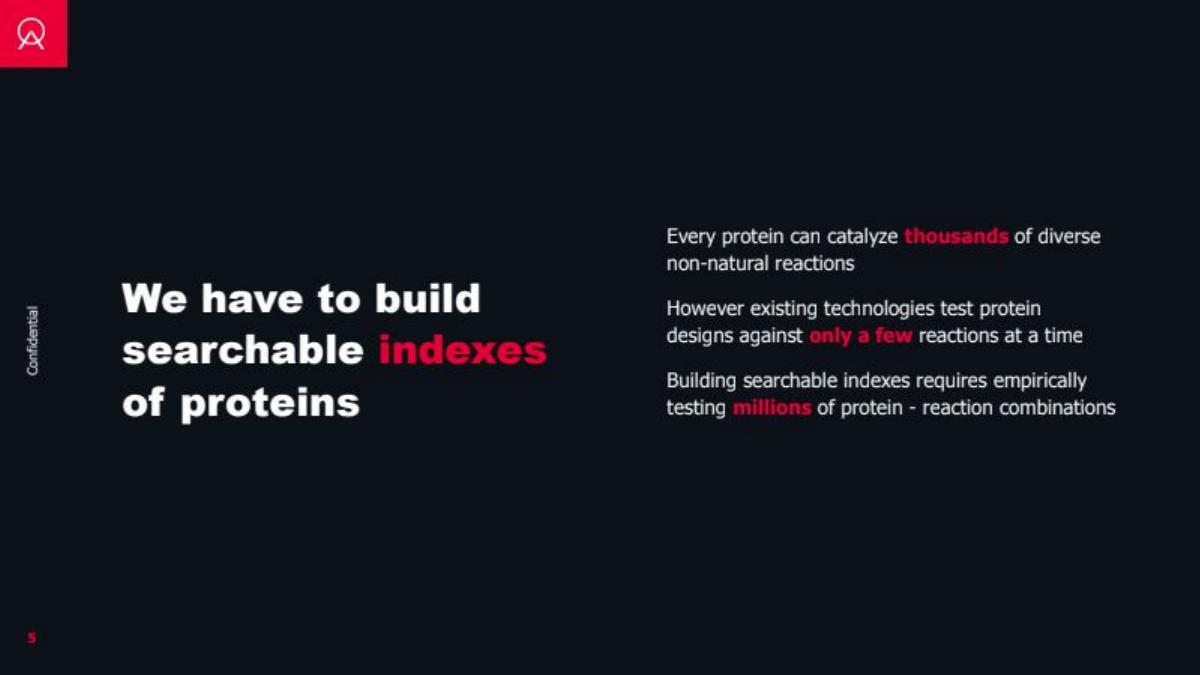
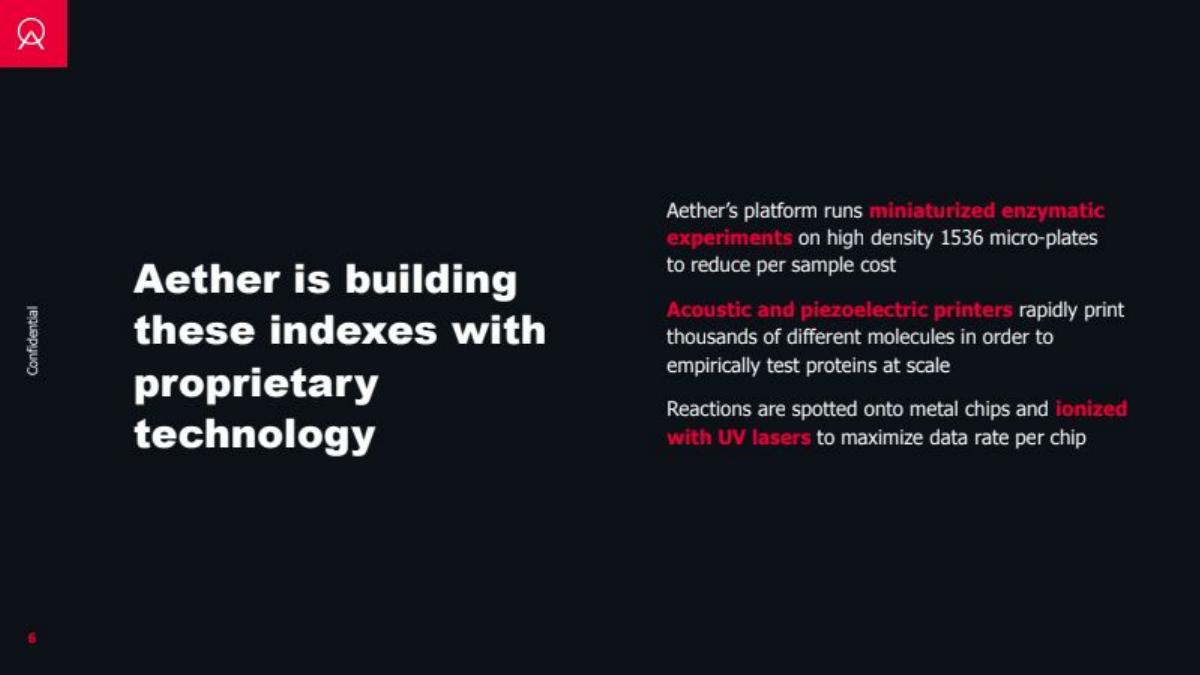
To do this, Slide 5 explains they must build "searchable indexes of proteins." This requires testing millions of protein-reaction combinations. Slide 6 details the proprietary hardware used to achieve this: miniaturized enzymatic experiments on 1536 micro-plates, acoustic and piezoelectric printers, and UV lasers for ionization. This is the 'how' that justifies their claims of speed.
Slide 7 provides the key performance indicators (KPIs) for their platform: ">20,000 samples/day per laser" (20X faster than state-of-the-art), detection of over 10,000 different reactions per screen, and "50X lower CapEx than comparable tech." For a Series A investor, these numbers are the core of the value proposition, suggesting a massive data advantage over incumbents.
Slides 8-12: Overcoming Technological Challenges
Slide 8 lists the three primary applications: detoxifying water, synthesizing new materials, and extracting high-value metals. Slide 9 then identifies the two hurdles to these goals: the lack of catalysts for desired reactions and the fact that reaction yields are rarely optimized for scale.
Slide 10 and 11 describe the two-step solution: Protein Indexing (identifying the reaction) and Protein Optimization (improving the yield). Slide 11 claims they have already identified new reaction types for three product lines and can screen over 30,000 molecules against individual proteins. Slide 12 is the 'proof' slide, showing a graph of protein activity over 16 weeks. They report a "64X product yield improvement" and "190X enantioselectivity improvement" in just four months, beating their own six-month targets.
The Business Case: Markets and Strategy
Slides 13-16: Go-To-Market and De-risking
Slide 13 addresses the "synbio trap." Many synthetic biology companies fail because of the time and cost to deploy products (3+ years and $15M+). Aether’s GTM strategy is designed to bypass this. Slide 14 explains that they "mine" their indexes for novel reactions, creating a foundation for "novel IP owned by Aether."
Slide 15 is a critical pivot in the business model. They state their platform allows for "5+ product lines to be started per year" and utilizes "biocatalysis (instead of fermentation)" for fast, low-risk scale-up. This is a significant claim, as fermentation is often the most expensive and difficult part of scaling biotech. Slide 16 reinforces their focus on high-impact, unique applications where the final product is "impossible without Aether’s proteins."
Slides 17-20: The Three Product Lines
Slide 17 is the 'Money Slide.' It breaks down the three product lines and their respective Total Addressable Markets (TAM):
PFAS Degradation: $40bn TAM. Strategy: Co-develop with municipal water utility partners. · High Performance Materials: +$20bn TAM. Strategy: License products to advanced materials manufacturers. · Strategic Metals (Lithium): $5bn TAM. Strategy: Build pilot scale refineries and then license or vertically integrate.
Slides 18, 19, and 20 dive deeper into each. Slide 18 focuses on the "forever chemicals" (PFAS) that do not degrade in nature. Slide 19 discusses "High Complexity Polymers" with greater tensile strength. Slide 20 highlights that "15% of global lithium reserves are locked in inaccessible brines in North America" and claims Aether’s technology could "30X domestic production of lithium."
The Ask and Conclusion
Slides 21-24: The Summary and The Raise
Slide 21 provides an executive summary, restating that Aether is the first platform capable of building these indexes by testing millions of combinations. Slide 22 contains the formal ask: "Aether is raising $49M to deploy its product lines." The use of funds is categorized into three buckets: building out product lines, prototyping second-generation technology, and building the executive team. Slide 23 and 24 are standard closing slides.
What Works in the Aether Deck
Quantified Technical Advantage: The deck doesn't just say they are fast; it says they are "20X faster" and "50X lower CapEx." These specific figures (Slide 7) provide a concrete basis for a Series A valuation. · Clear Market Segmentation: By splitting their technology into three distinct, massive markets (Slide 17), they show that the platform is versatile and not a 'one-trick pony.' · The 'Anti-Fermentation' Narrative: In a market where investors have become wary of the high costs of biological fermentation, Aether’s pivot to biocatalysis (Slide 15) is a savvy strategic move. · Strong Visual Hierarchy: The deck uses a consistent dark theme with red highlights for key metrics, making it very easy to scan for the most important data points.
What is Missing from the Aether Deck
Team Slide: This is a glaring omission. For a $49M Series A, the pedigree of the founders and the technical team is usually a primary driver of the investment. The catalogue listing mentions machine learning and robotics, but the deck does not introduce the people behind these systems. · Competitive Landscape: While the deck mentions "conventional technologies," it does not name competitors like Ginkgo Bioworks, Zymergen, or specific lithium extraction startups. Investors want to know why Aether wins against named incumbents. · Financial Projections: The deck provides TAM figures but no revenue projections, unit economics for the lithium extraction, or a timeline for when the first $1 of revenue will be recognized. · Regulatory Path: Especially for PFAS degradation (Slide 18), the regulatory environment is complex. The deck does not address how they will navigate EPA or municipal approvals.
What Founders Should Copy
The 'Problem-Solution' Bridge: Slide 9 and 10 do an excellent job of taking a complex technical problem and boiling it down to two specific challenges, then showing exactly how the technology addresses both. · The Proof Slide: Slide 12 is a perfect example of how to show progress. It uses a clear graph, sets a target ("6 month targets"), and shows how they exceeded it in less time. · The TAM/Strategy Table: Slide 17 is a model of clarity. It combines the product, the commercial strategy, and the market size into a single, high-impact table. · Consistent Branding: The use of the 'A' logo and the red-on-black color scheme creates a professional, high-tech feel that matches the company's ambitious 'atom-by-atom' vision.
Frequently asked questions
- What is Aether's core technology?
- Aether uses robotics and machine learning to create 'searchable indexes' of proteins. Their proprietary platform uses acoustic and piezoelectric printers to run miniaturized enzymatic experiments on high-density micro-plates. This allows them to test millions of protein-reaction combinations to find 'molecular assemblers'—proteins that can catalyze non-natural reactions for industrial use, such as extracting lithium or breaking down PFAS.
- How does Aether differentiate itself from other synthetic biology companies?
- Aether differentiates by focusing on 'biocatalysis' rather than traditional 'fermentation.' As stated on slide 15, this allows for a faster and lower-risk process scale-up. They also emphasize their speed, claiming they can optimize proteins to industrial specifications in under six months, whereas traditional methods can take over three years and cost upwards of $15M.
- What are the primary use cases for Aether's proteins?
- The deck identifies three primary product lines: 1) Degrading 'forever chemicals' (PFAS) in drinking water and soil. 2) Designing high-performance polymers with superior tensile strength. 3) Extracting high-value metals, specifically lithium, from previously inaccessible brine sources in North America.
- What metrics does the deck use to prove its technical advantage?
- Aether provides several hard benchmarks: throughput of >20,000 samples/day per laser (20x faster than state-of-the-art), 10x lower per-sample cost, and 50x lower CapEx. They also highlight a specific case study showing 15 iterations over 4 months resulting in a 64x yield improvement.
- What is missing from the Aether pitch deck?
- The most notable omissions are a team slide and a detailed competition slide. While the deck mentions 'conventional technologies' and 'state of the art,' it does not name specific competitors. It also lacks a detailed roadmap or financial projections beyond the high-level TAM figures and the $49M use-of-funds slide.