Aevus presents a seed-stage pitch for a clinical decision support platform specifically targeting Type-2 Diabetes (T2D). The deck outlines a clear problem: adverse drug reactions and prolonged therapeutic gestation, which they claim costs the healthcare system $3.5 billion annually. With a team heavily weighted toward data science and Johns Hopkins alumni, the company proposes a SaaS model charging $5,000 per active physician user per year. The deck highlights a successful $127,000 pre-seed raise from regional investors and outlines a roadmap leading to a Series A in early 2022. While the tec…
Key takeaways
- The company is seeking a target raise of $420,000 for its seed round according to the source listing.
- Aevus identifies a $3.5 billion annual healthcare cost drain caused by Type-2 Diabetes adverse drug reactions (Slide 2).
- The team consists of six members, including four with data science or machine learning expertise and three Johns Hopkins alumni (Slide 3).
- The revenue model is a SaaS subscription priced at $5,000 per Active Physician User (APU) per facility per year (Slide 4).
- The Total Addressable Market (TAM) is estimated at $2.5 billion, covering all primary care and specialty doctors in the US (Slide 5).
- Aevus has already raised $127,000 in pre-seed funding from i2E inc, OCAST, Piyush Patel, and Dr. Lee Bird (Slide 7).
- The development lifecycle aims for a large-scale trial in July 2021 and Series A financing in February 2022 (Slide 6).
- The product promises a 48-hour report turnaround time and direct EMR integration (Slide 4).
Executive Summary: The Precision Medicine Play for Diabetes
Aevus enters the crowded digital health space with a narrow, high-value focus: clinical decision support for Type-2 Diabetes (T2D). The deck, titled for a $420,000 seed raise, positions the company as a technical solution to a multi-billion dollar inefficiency in how chronic diseases are managed. By targeting the point of prescription, Aevus aims to reduce adverse drug reactions and shorten the time it takes for patients to reach therapeutic stability.
Slide 1: Title and Value Proposition
The cover slide introduces the brand "Aevus PrecisionRx" and its core mission: "Automated Clinical Decision Support for Type-2 Diabetes." The branding uses a clinical blue and green palette, signaling a professional healthcare orientation. The sub-logo "pRx" suggests a focus on precision prescribing, which aligns with the broader industry trend toward personalized medicine.
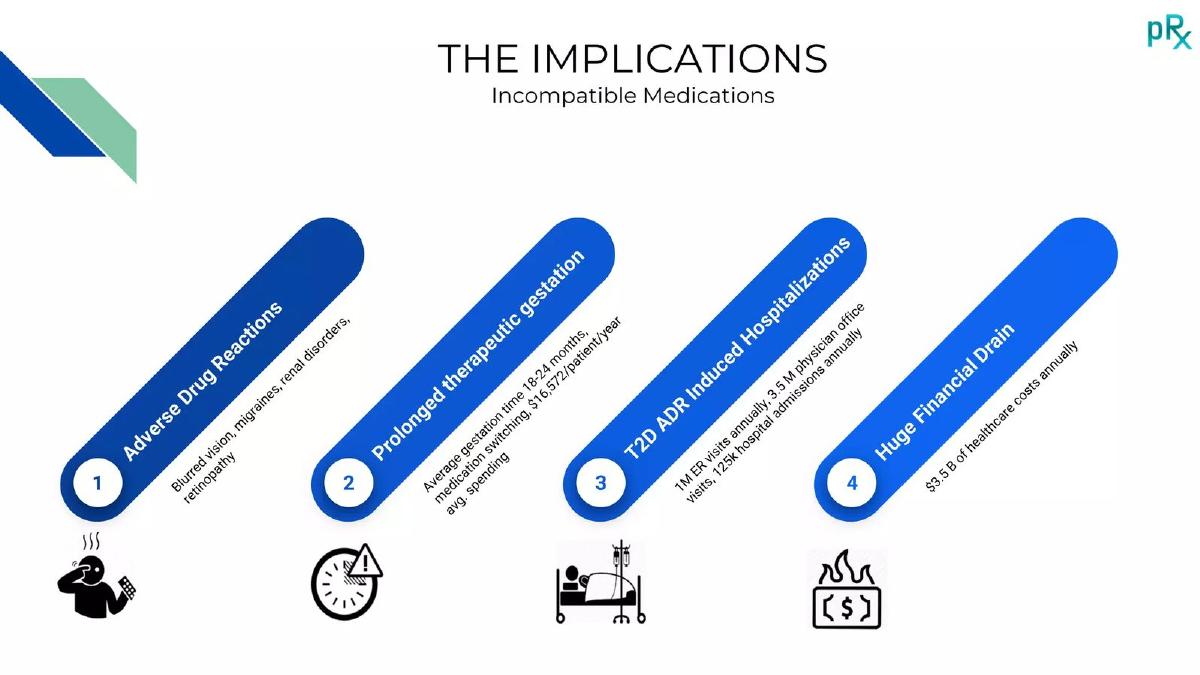
Slide 2: The Implications of Incompatible Medications
This slide serves as the "Problem" slide, breaking down the consequences of current T2D management into four categories. Adverse Drug Reactions: Citing blurred vision, migraines, and renal disorders. Prolonged therapeutic gestation: Stating an average gestation time of 18-24 months and medication switching costs of $16,572 per patient per year. T2D ADR Induced Hospitalizations: Listing 1 million ER visits and 125,000 hospital admissions annually. Huge Financial Drain: Quantifying the total cost at $3.5 billion in annual healthcare spending. This slide effectively uses data to justify the need for a more precise intervention.
Slide 3: The Team
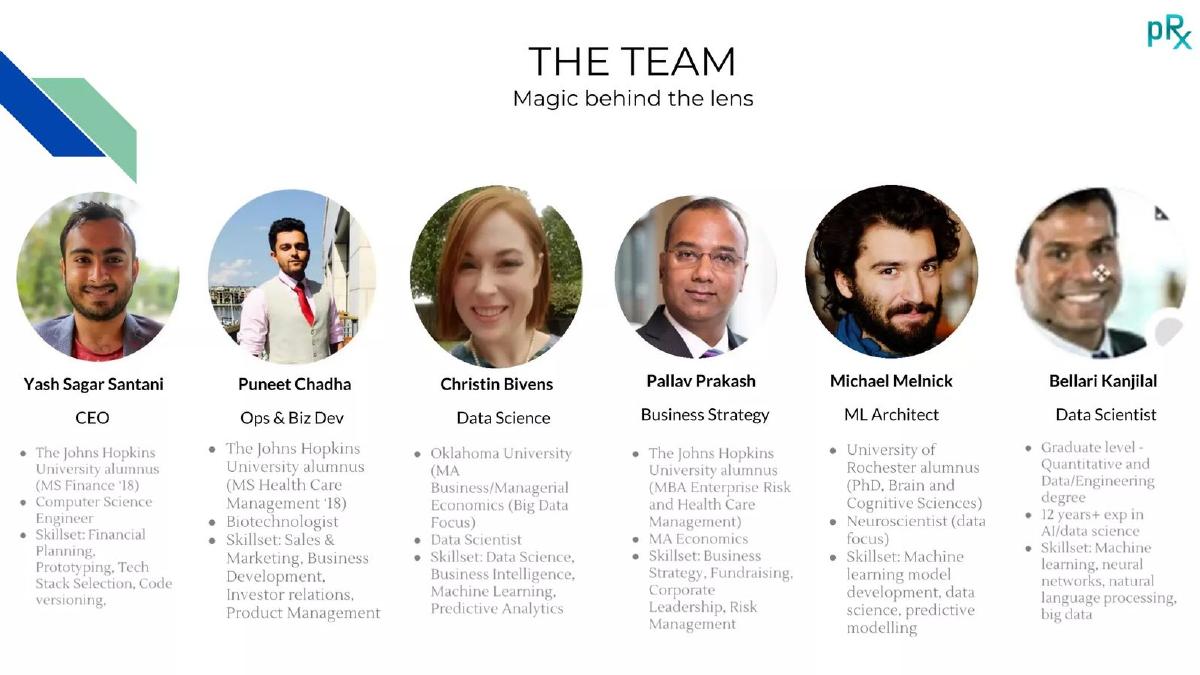
The team slide highlights six individuals with a strong academic and technical pedigree. CEO Yash Sagar Santani and two other members are alumni of The Johns Hopkins University, a prestigious institution in the medical field. The technical depth is significant: Christin Bivens (Data Science), Michael Melnick (PhD, ML Architect), and Bellari Kanjilal (Data Scientist with 12+ years of experience). The inclusion of a PhD in Brain and Cognitive Sciences and multiple data scientists suggests the "automated" part of their value proposition is built on sophisticated modeling rather than simple rules-based logic.
Slide 4: Revenue Model
Aevus proposes a straightforward SaaS model. They quote a price of $5,000 per APU (Active Physician User) / facility / yr . The offering includes unlimited tests and, crucially, "Direct EMR Integration." In the healthtech world, EMR integration is often the largest hurdle to adoption, so listing it as a core feature of the revenue model is an ambitious claim. The slide also specifies a "Report Turnaround Time 48 hrs," which sets a clear service level agreement (SLA) for potential customers. Target customers are segmented into Integrated Healthcare Systems, University Hospitals, and Stand-Alone facilities with six or more physicians.
Slide 5: Market Sizing
The market sizing follows the standard TAM/SAM/SOM framework. TAM ($2.5B): Total Primary Care and Specialty Doctors in the US. SAM ($1.5B): Primary Care Physicians in Integrated Health Care Systems (citing Kaiser, Ascension, HCA, and the VA). SOM ($250M): Primary Care Physicians in Integrated Health Care Systems on the West Coast. The use of specific regional targets (West Coast) for the SOM makes the market entry strategy feel more grounded and attainable than a generic national rollout.
Slide 6: Development Lifecycle
This roadmap slide provides a timeline from July 2020 to February 2022. Key milestones include:
Jul 2020: Proof of Concept Ready (Cerner Data fully utilized). · Oct 2020: Prototype Ready. · Nov 2020: Seed Round Raised (intended). · Apr 2021: MVP ready. · Jul 2021: Large-Scale Trial (Live study with an integrated provider). · Feb 2022: Series A Financing Raised.
The mention of "Cerner Data" is a vital detail, as it indicates the company has already had access to real-world clinical data to train its models.
Slide 7: Pre-Seed Round
Aevus shows transparency regarding its capitalization to date. The company has raised $127,000 . The contributors include institutional/regional players i2E inc and OCAST ($52k combined), and individual investors Piyush Patel ($50k) and Dr. Lee Bird ($25k). Showing existing investment from a doctor (Dr. Lee Bird) provides a small but meaningful amount of clinical validation.
Slide 8: Questions?
The final slide is a standard closing slide. It lacks contact information or a call to action, which is a missed opportunity to direct interested investors to a specific next step or website.
What Works in the Aevus Deck
The deck excels at identifying a specific, high-cost problem within a massive disease state. By focusing only on Type-2 Diabetes, they avoid the "boil the ocean" trap many healthtech startups fall into. The team's technical credentials, particularly the data science depth and the Johns Hopkins connection, provide the necessary "right to play" in the clinical decision support space. Furthermore, the revenue model is clear and avoids the complexity of value-based care shared savings, which can be difficult to track and collect in early stages.
What is Missing from the Aevus Deck
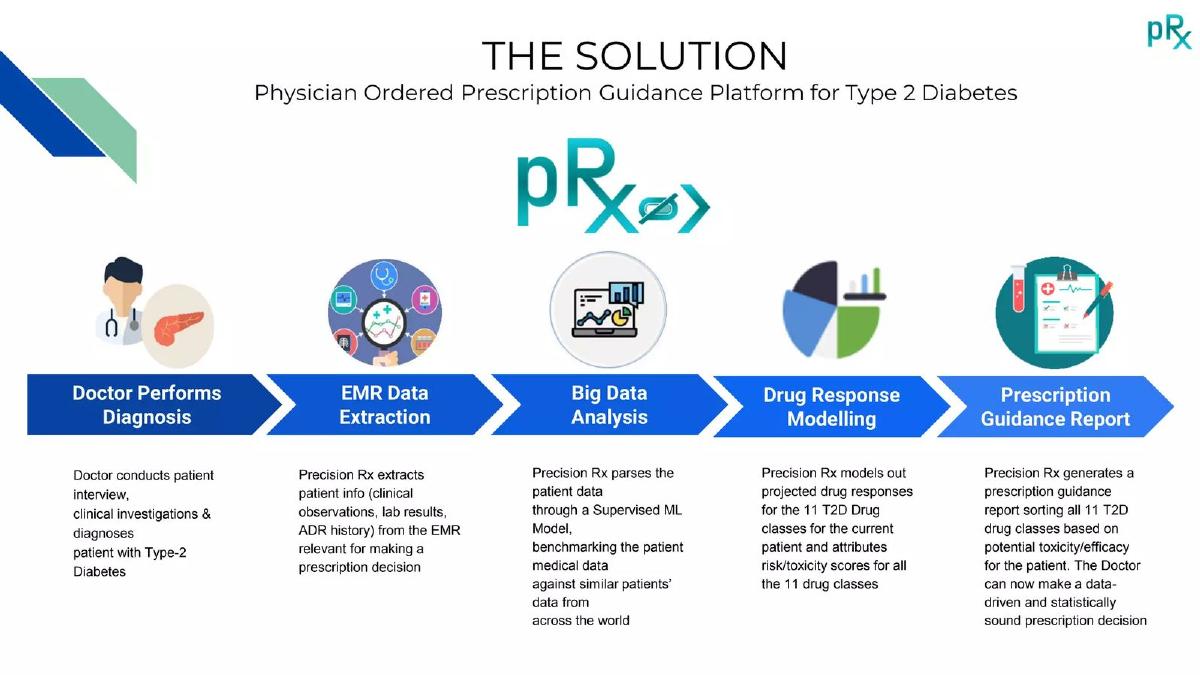
The most glaring omission is the Product Slide . While they describe what the product does, there are no screenshots, mockups, or flowcharts showing how a physician actually interacts with the software. For a product promising "Direct EMR Integration," investors would want to see how this fits into a doctor's workflow. Additionally, there is no Competition Slide . The clinical decision support market is crowded with both legacy players and new AI startups; failing to acknowledge them makes the founders look less prepared. Finally, the Ask Slide is missing from the provided 8 slides, though the source listing mentions a $420k target. A slide detailing exactly how that $420k would be spent (e.g., hiring, clinical trials, EMR licensing) is essential.
Founder Takeaways
Specificity Wins: Don't just say you are an "AI Health" company. Aevus wins points by saying they are "Automated Clinical Decision Support for Type-2 Diabetes." · Quantify the Pain: Slide 2 does an excellent job of translating clinical problems (adverse reactions) into financial problems ($3.5B drain). Investors invest in solutions to financial problems. · Show the Data Source: Mentioning that the Proof of Concept utilized Cerner data (Slide 6) is a major credibility booster. It shows the models aren't just theoretical. · Regionalize your SOM: By limiting their Serviceable Obtainable Market to the West Coast (Slide 5), Aevus makes their $250M target feel like a concrete sales plan rather than a math exercise.
Frequently asked questions
- What specific problem is Aevus solving?
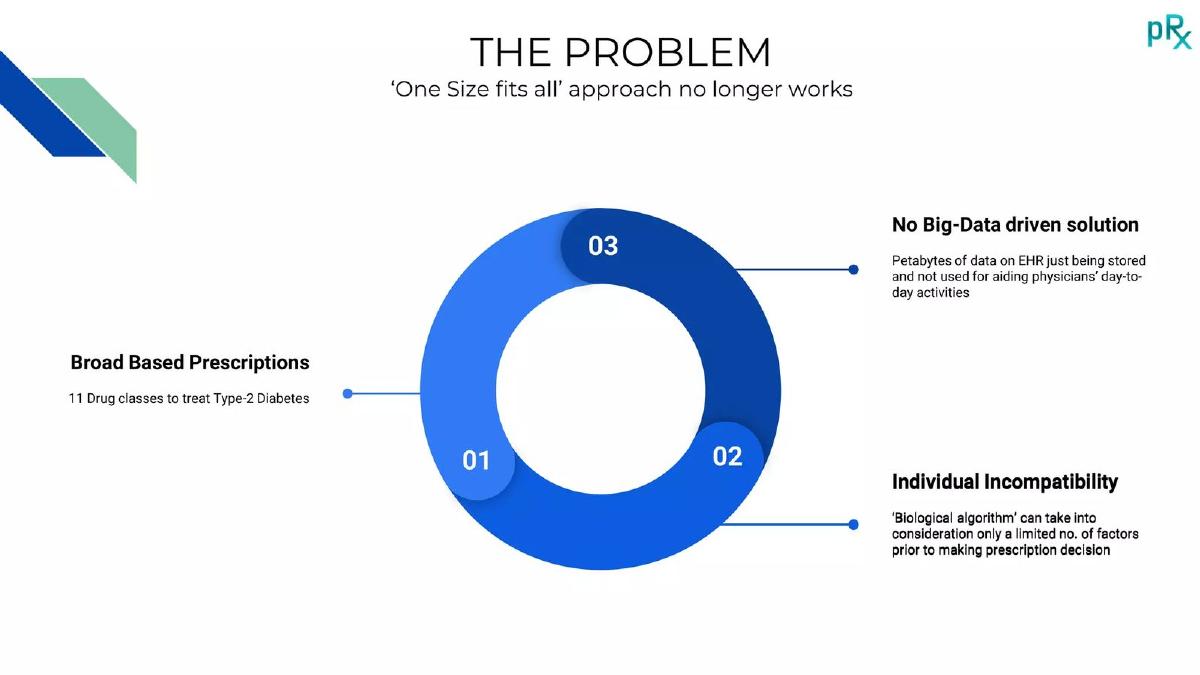
- Aevus focuses on the implications of incompatible medications in Type-2 Diabetes treatment. According to Slide 2, these include adverse drug reactions like blurred vision and renal disorders, a prolonged therapeutic gestation period of 18-24 months, and 125,000 annual hospital admissions. They quantify the financial impact as a $3.5 billion annual drain on the healthcare system.
- How does Aevus plan to generate revenue?
- As shown on Slide 4, the company utilizes a SaaS model. They charge $5,000 per Active Physician User (APU) per facility per year. This fee includes an unlimited number of tests, direct EMR integration, and point-of-care prescription guidance. They define APU as an internal KPI used to track customer acquisition.
- Who are the target customers for this platform?
- Slide 4 identifies three primary segments: Integrated Healthcare Systems (e.g., Kaiser Permanente, Veterans Affairs), University Hospitals (e.g., Johns Hopkins, Stanford), and Stand-Alone Physician Facilities with six or more physicians. Their Serviceable Obtainable Market (SOM) specifically targets West Coast integrated systems, valued at $250 million (Slide 5).
- What is the current stage of the product's development?
- According to the 'Development Lifecycle' on Slide 6, Aevus reached 'Proof of Concept Ready' in July 2020 using Cerner data. The roadmap indicates they expected to be 'Prototype Ready' in October 2020 and aimed for an 'MVP ready' status by April 2021, followed by live studies in July 2021.
- What is the composition of the founding and management team?
- The team (Slide 3) is technically oriented, featuring CEO Yash Sagar Santani (Johns Hopkins MS Finance), an Ops lead, a Business Strategy lead, and three data/ML specialists. Notably, Michael Melnick holds a PhD in Brain and Cognitive Sciences, and Bellari Kanjilal has over 12 years of experience in AI and data science.