The September 2010 investor presentation for American Dairy, Inc. (ADY), also known as Feihe International, serves as a comprehensive update for a publicly traded company on the NYSE. The deck highlights the company's long history, dating back to 1962, and its strategic positioning as a domestic leader in the Chinese infant formula market. Key themes include the successful navigation of the 2008 melamine crisis, significant capital raises (including $63 million from Sequoia Capital), and a shift toward a cleaner balance sheet by eliminating convertible notes. While showing strong historical r…
Key takeaways
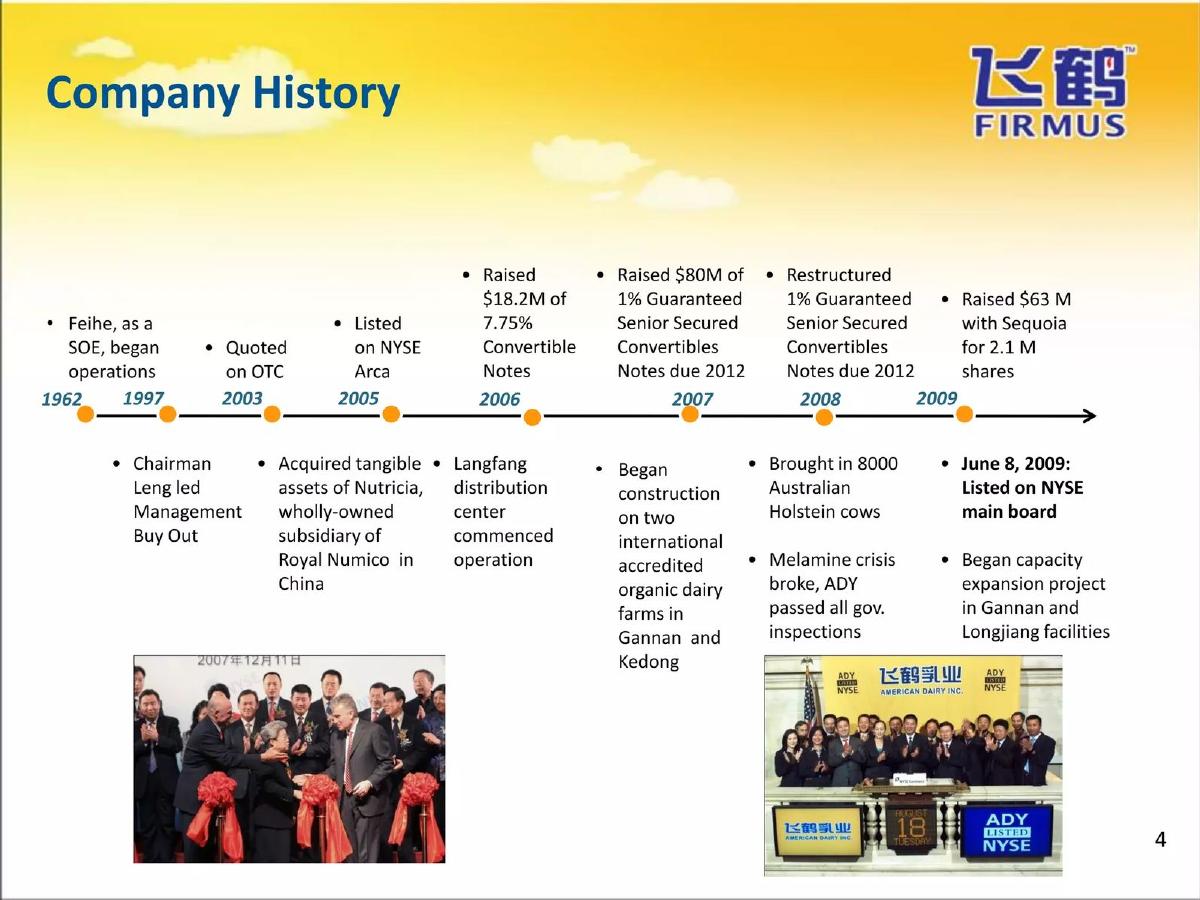
- The company successfully passed all government inspections during the 2008 melamine crisis, a critical trust factor for the infant formula industry (Slide 4).
- ADY secured a major $63 million investment from Sequoia Capital in 2009 for 2.1 million shares (Slide 4, Slide 22).
- The company achieved 40% organic growth in fiscal 2009 compared to 2008, reaching $271.1 million in revenue (Slide 19).
- A significant strategic focus is placed on vertical integration, with international accredited organic dairy farms in Gannan and Kedong (Slide 4).
- The deck highlights a simplified capital structure, noting the full pay-down or conversion of all senior secured and convertible notes by late 2009 (Slide 22).
- Despite historical growth, the company reported an operating loss of $22.1 million and a net loss of $15.0 million for the first half of 2010 (Slide 25).
- Geographic expansion is aggressive, with new production facilities in Gannan and Longjiang projected to add 700 and 900 tons per day respectively (Slide 13).
- The competitive landscape identifies ADY as a dominant player in tier 2 and 3 cities, contrasting with international brands like Nestle and Mead Johnson that lead in tier 1 (Slide 10).
Executive Summary: A Public Market Post-Mortem and Growth Roadmap
The September 2010 investor presentation for American Dairy, Inc. (ADY), trading as Feihe International, is a classic example of a mid-stage public company deck designed to reassure investors of stability while pitching an aggressive expansion narrative. Coming off the heels of the 2008 melamine crisis, the deck prioritizes safety, vertical integration, and a cleaned-up balance sheet. While the financials show a recent dip into losses, the operational slides paint a picture of a company building the infrastructure necessary to dominate the Chinese domestic market.
Slide 1: Title and Branding
The cover slide establishes the dual identity of the company: American Dairy, Inc. for the NYSE investors and Feihe International (Firmus) for the operational brand. The imagery of a healthy infant and the slogan "Persistent Quality, Consistent Milk Powder" immediately addresses the industry's primary concern: product safety. The date, September 2010, places this deck at a time when the company was scaling its production capacity significantly.
Slide 4: Company History and Resilience
This timeline is one of the most information-dense slides in the deck. It tracks the company from its 1962 origins as a State-Owned Enterprise (SOE) through its management buyout in 1997 and its eventual NYSE listing in 2009. Crucially, it highlights the 2008 melamine crisis, noting that ADY passed all government inspections. This slide also documents the company's history of capital raises, including convertible notes in 2006 and 2007, and the pivotal $63 million Sequoia Capital investment in 2009. The inclusion of the NYSE bell-ringing photo serves as a validation of its status as a global public entity.
Slide 7: Company Overview Transition
A simple transition slide that marks the shift from historical context to current operations. In a 25-slide deck, these markers are helpful for pacing during a live presentation.
Slide 10: The Three-Tier Competitive Landscape
This slide provides a sophisticated analysis of the Chinese infant formula market, divided into International, Domestic National, and Domestic Regional players. International players (Nestle, Abbott, etc.) are noted for premium pricing and strong R&D but limited reach in smaller cities. Domestic National players , where ADY (Feihe) is listed alongside Yili and Synutra, are described as dominant in tier 2 and 3 cities. The slide claims ADY is gaining market share from foreign producers in tier 1 cities. Domestic Regional players are characterized by limited brand recognition and unstable quality, positioning ADY as the superior domestic choice.
Slide 13: Geographic Footprint and Infrastructure
This map is a testament to ADY's commitment to vertical integration. It details production centers in Gannan, Baiquan, and Qiqihaer, along with dairy farms in Kedong and Gannan. The call-out box is particularly important for growth projections: it notes that the Gannan facility will add 700 tons per day by August 2010, and the Longjiang facility will add 900 tons per day by May 2011. This slide visualizes the company's transition from a regional player to a national powerhouse with a robust supply chain.
Slide 16: Strategic Growth Initiatives
Presented as a rising staircase, these initiatives outline the management's priorities. The foundation is "Continue Leadership in Quality Control," followed by brand equity, human resources, nutrition education, and customer service. The final step, "Improving Operating Efficiency at Each Retail Point," suggests a move toward optimizing the bottom line after a period of heavy capital expenditure. The overarching goal is stated clearly: "We are committed to become the leading infant formula manufacturer."
Slide 19: Revenue Performance and Growth
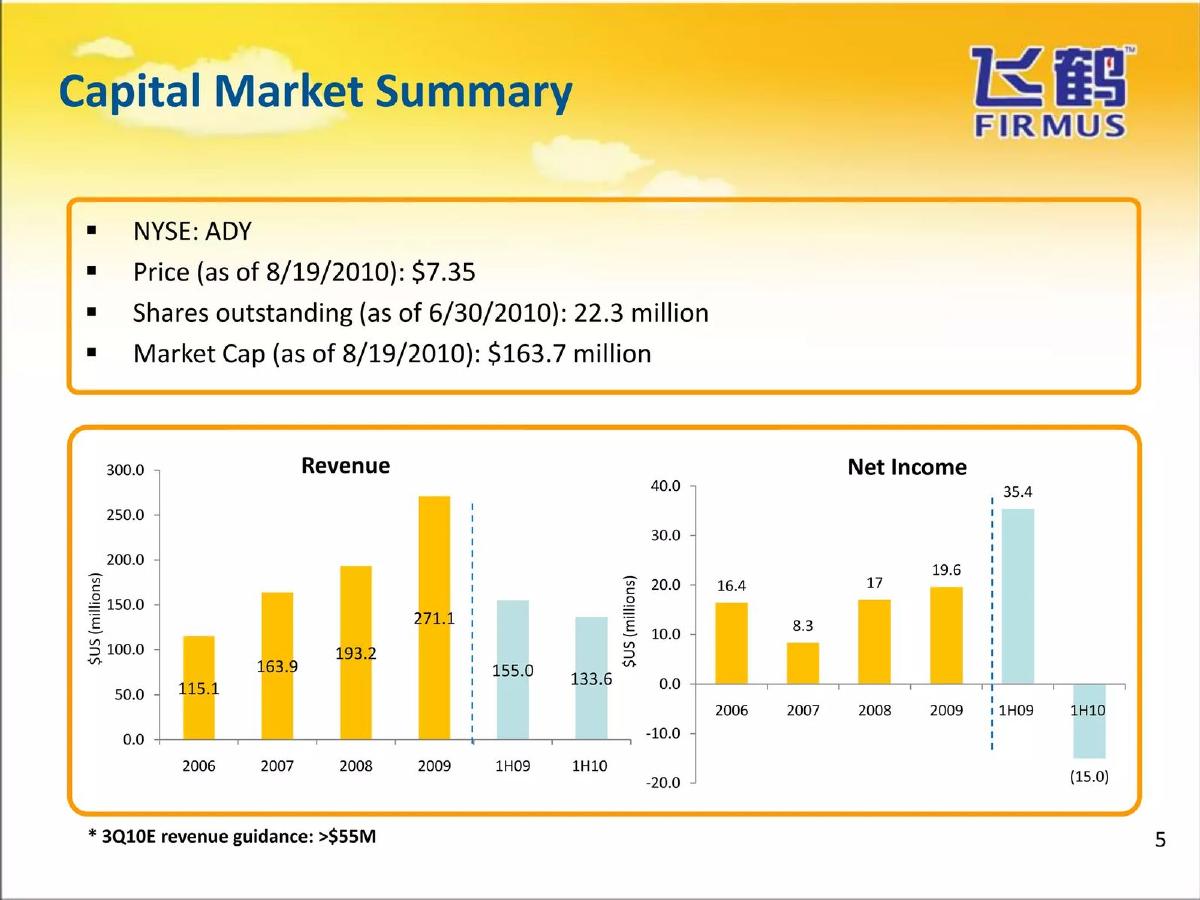
The revenue charts show a strong upward trajectory from 2006 ($115.1 million) to 2009 ($271.1 million). The slide proudly states a 40% organic growth rate for fiscal 2009 over 2008. However, the quarterly chart for 2010 shows a decline from Q1 ($81.4 million) to Q2 ($52.2 million). The company provides guidance for Q3 2010 of over $55 million, suggesting a stabilization after a volatile start to the year.
Slide 22: Balance Sheet and Capital Simplification
This slide is targeted directly at institutional investors concerned about debt and dilution. It lists total assets of $421.8 million as of June 30, 2010. The text box explains the aggressive deleveraging strategy: the company paid down $34 million in senior secured convertible notes in late 2009 and saw other notes fully converted. The headline "Simplified Capital Structure with No Convertible Notes" is a clear signal that the company is moving toward a more traditional, equity-heavy public profile. The mention of the $63 million Sequoia deal reinforces the presence of high-tier institutional backing.
Slide 25: Key Financial Items and the 2010 Downturn
The final slide in the provided set reveals the financial challenges of 2010. While sales in 1H 2010 ($133.6 million) were roughly half of the 2009 total, the company swung to an operating loss of $22.1 million and a net loss of $15.0 million. This is a stark contrast to the $19.6 million net income in 2009. The cash flow items show a significant investing cash flow deficit ($30.8 million in 1H 2010), likely tied to the massive capacity expansions shown on Slide 13. This slide is an honest, if sobering, look at the costs of rapid scaling.
What ADY Does Well
The deck excels at contextualizing safety . In an industry traumatized by the melamine scandal, ADY repeatedly emphasizes its clean record and government certifications. This is not just a footnote; it is the bedrock of their brand equity. The deck also does a masterful job of visualizing the supply chain . By showing the actual photos of their production centers and dairy farms alongside a map of China, they prove they are not just a marketing shell but a vertically integrated manufacturer with tangible assets.
Furthermore, the clarity on capital structure is excellent. Many companies at this stage have messy cap tables filled with legacy debt and convertible instruments. ADY's explicit statement that they have eliminated these notes is a major "de-risking" signal for new investors.
What is Missing from the Deck
The most glaring omission in the provided slides is a detailed breakdown of the 2010 losses . While the numbers are there on Slide 25, there is no narrative explanation for why the company swung from a $19.6 million profit to a $15 million loss in six months. Investors would want to know if this was due to rising raw material costs, a price war, or purely the one-time costs of opening new facilities.
Additionally, the Team Slide is missing from this selection. For a company that underwent a management buyout and a major Sequoia investment, the profiles of the leadership team are crucial. Finally, there is no Unit Economics slide. We see total revenue and gross profit, but we don't see the margin per tin of formula or the acquisition cost of a new customer in tier 1 vs. tier 3 cities.
Lessons for Founders
Address the Elephant in the Room: If your industry is facing a crisis (like the melamine scandal), don't ignore it. ADY put their clean inspection record front and center. · Visualize Your Moat: If your advantage is your physical infrastructure or geographic reach, use maps and photos. It makes the business feel "real" and harder to replicate. · Clean Up Your Cap Table: ADY recognized that convertible notes were a point of friction for new investors and made a concerted effort to pay them down or convert them, then shouted about it in the deck. · Be Honest with Financials: Even though the 2010 numbers were trending downward, ADY included them. In a public or late-stage private setting, transparency builds more trust than selective reporting.
Frequently asked questions
- What was the significance of the 2008 melamine crisis for ADY?
- The 2008 melamine crisis was a defining moment for the Chinese dairy industry. Slide 4 explicitly mentions that ADY passed all government inspections during this period. For an infant formula manufacturer, this is not just a regulatory milestone but a core marketing asset, establishing the brand's safety and reliability in a market where consumer trust was severely compromised.
- How did ADY's capital structure change leading up to this presentation?
- The company underwent a major financial cleanup. Slide 22 details that in September 2009, ADY paid down $34 million (75%) of its 1% Guaranteed Senior Secured Convertible Notes, with the remainder paid in October 2009. Combined with the conversion of 7.75% notes, the company entered late 2010 with no remaining convertible notes, simplifying its balance sheet for investors.
- What is ADY's competitive advantage against international brands?
- According to Slide 10, ADY's primary advantage is its dominance in tier 2 and 3 cities. While international brands like Nestle and Dumex have 'limited reach' in these areas due to fragmented retail channels and logistics, ADY leverages its domestic infrastructure to capture these markets while simultaneously attempting to gain share from foreign producers in tier 1 cities.
- Why did the company report a net loss in the first half of 2010?
- Slide 25 shows a net loss of $15.0 million for 1H 2010. While the deck doesn't provide a single-sentence explanation, the data shows a massive spike in Sales & Marketing expenses ($57.9 million in just six months compared to $105.1 million for the full year 2009) and increased 'Loss on Disposal of Biological Assets,' suggesting heavy reinvestment and operational restructuring.
- What are the key growth drivers identified in the deck?
- Growth is driven by capacity expansion and operational efficiency. Slide 13 shows massive new facilities coming online in 2010 and 2011. Slide 16 outlines a six-step growth initiative including quality control leadership, brand equity strengthening, human resources development, nutrition education, enhanced customer service, and improved retail point efficiency.