Adventure Bucket List's 2014 seed deck is a masterclass in identifying a massive, technologically stagnant niche: the $100B global tour industry. By positioning themselves as an 'Enterprise SaaS for Tourism Boards,' the company moved beyond a simple consumer app to become infrastructure for entire regions like Tahiti and Vietnam. The deck highlights a significant $650K run rate and $7.5M in processed transactions, proving early product-market fit. While the deck lacks a specific 'Ask' slide and detailed unit economics, its strength lies in its clear B2B2C distribution strategy through white-l…
Key takeaways
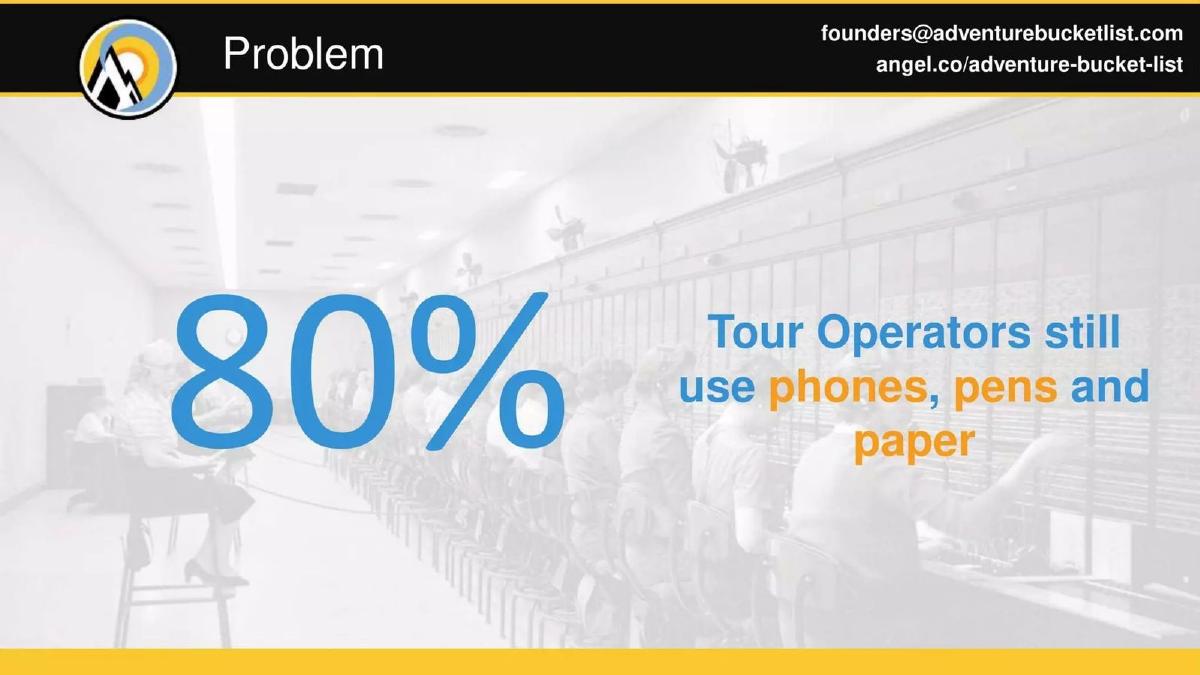
- The company identifies that 80% of tour operators still use phones, pens, and paper for bookings (Slide 5).
- Traction is a core highlight, reporting $7.5M+ in transactions and a $650K run rate (Slide 7).
- The business model combines enterprise subscriptions with transaction fees (Slide 13).
- Distribution is achieved through white-labeled marketplaces for tourism boards, such as Tahiti Tourisme (Slides 8-10).
- The 12-month roadmap shows a clear sales pipeline, categorizing countries as 'In Discussion,' 'Signed LOIs,' or 'Closed' (Slide 14).
- The Total Available Market is estimated at $100B for global tours, with a $20B Serviceable Market (Slide 15).
- The team slide leverages logos from Expedia, Fairmont, and Relais & Chateaux to establish domain expertise (Slide 16).
- The deck completely omits a slide detailing the specific funding amount sought or the intended use of funds.
Introduction: The Digitization of the Last Frontier in Travel
Adventure Bucket List entered the market in 2014 with a clear mission: to bring the 'OpenTable' model to the world of tours and activities. While flights and hotels had been digitized for over a decade, the 'things to do' segment remained stubbornly offline. This teardown looks at the 16-slide deck used to raise their $200,000 seed round, focusing on how they leveraged enterprise partnerships to solve a fragmented market problem.
Slides 1-2: The Hook and the Identity
The deck opens with a minimalist title slide featuring the company logo—a stylized mountain and sun. Slide 2 immediately clarifies the business model with the subtitle: "Enterprise SaaS For Tourism Boards." This is a critical positioning move. By targeting tourism boards rather than individual small tour operators, the company signals a high-leverage distribution strategy. It moves the conversation from 'selling to thousands of small businesses' to 'selling to a few dozen government entities.'
Slides 3-5: The Problem and the 'Imagine' Gap
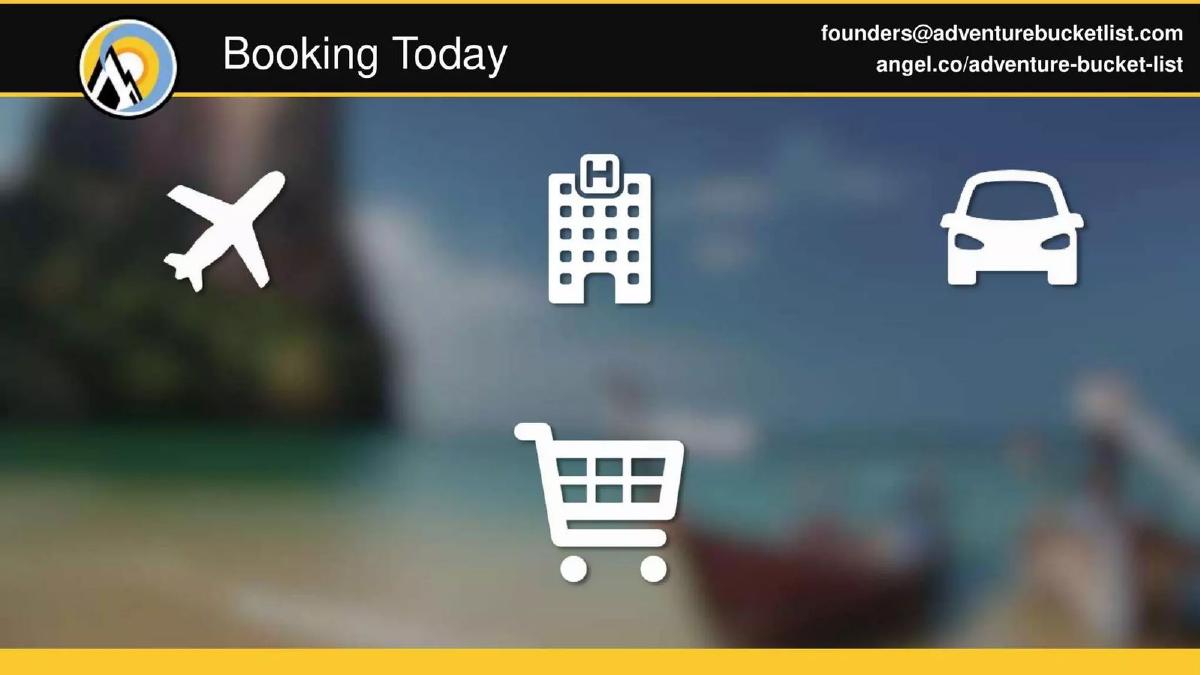
Slide 3, titled "Booking Today," uses icons for planes, hotels, cars, and shopping carts to remind the investor that every other part of the travel journey is already digital. Slide 4 uses a stock photo of a man punching a computer screen with the caption "Imagine?" to evoke the frustration of trying to book activities online. Slide 5 delivers the quantitative punch: "80% Tour Operators still use phones, pens and paper." This slide is effective because it defines the market not just by size, but by its technological deficit.
Slide 6: The Solution
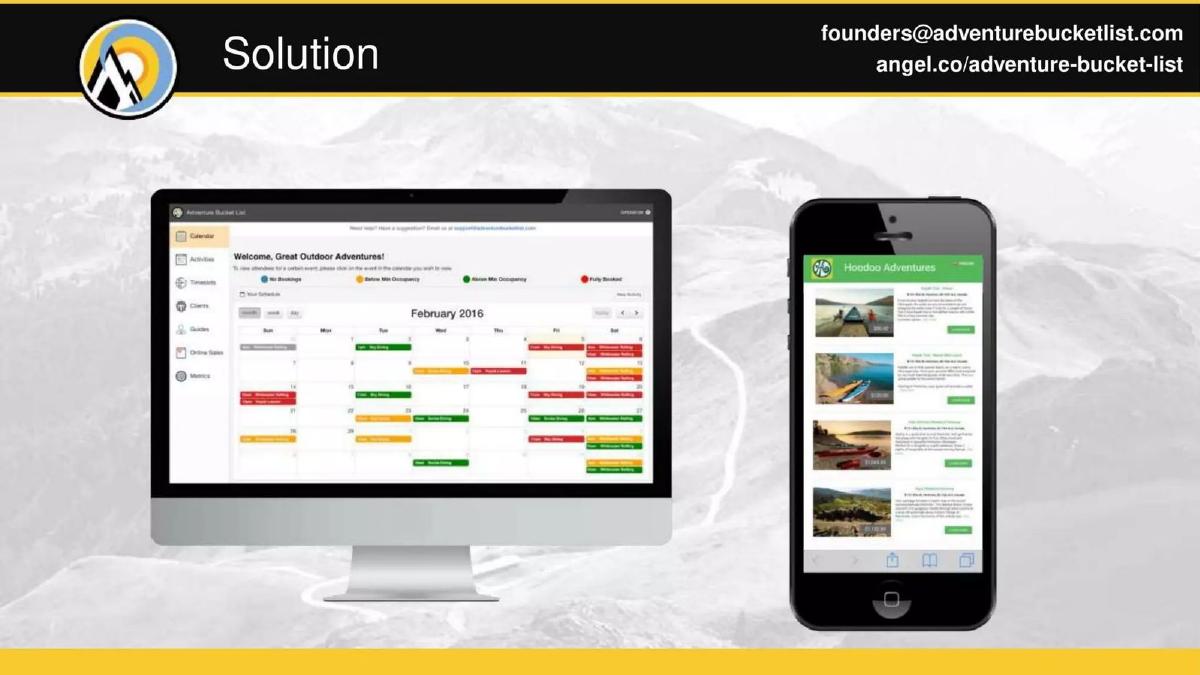
The solution slide provides a visual representation of the product across two platforms: a desktop view showing a calendar-based management system for operators and a mobile view showing a consumer-facing booking interface for "Hoodoo Adventures." This demonstrates that the software is a full-stack solution, handling both the back-end logistics for the business and the front-end experience for the traveler.
Slide 7: Traction and Validation
This is arguably the strongest slide in the deck. It presents three key metrics:
$7.5m+ Transactions: Proving the platform can handle significant volume. · 21% MoM (12 Months): Showing consistent, high-velocity growth over a full year. · $650K Run Rate: Establishing that this is a real business with significant revenue, not just a pilot project.
The use of simple icons and bold text makes these figures impossible to miss.
Slides 8-11: The White-Labeled Marketplace
Slides 8 through 10 walk the investor through a live use case: Tahiti Tourisme . The slides show the official Tahiti tourism website, then the search interface, and finally the booking page for a "Surfing Group Lesson." This sequence proves the "Enterprise SaaS" claim from slide 2. It shows that Adventure Bucket List isn't just a website; it is the invisible infrastructure powering national tourism brands. Slide 11 is a lifestyle photo of surfers, serving as a visual break to reinforce the 'adventure' aspect of the brand.
Slides 12-13: Revenue Model and Business Logic
Slide 12 is a transition slide. Slide 13, "Revenue Model," keeps it simple with two icons: a dollar sign for "Enterprise Subscription" and a percentage sign for "Transactions." While it lacks specific pricing tiers or take-rate percentages, it clearly communicates that the company has two distinct revenue streams, one recurring and one performance-based.
Slide 14: The 12-Month Roadmap
This slide uses national flags to visualize the sales pipeline. It categorizes prospects into three stages:
In Discussion: Thailand, Philippines, Cambodia, Cuba, Malaysia, Japan, Argentina, Mexico. · Signed LOIs: Fiji, Chile, Laos, Costa Rica. · Closed: Vietnam, Tahiti, Samoa.
This is an excellent way to show momentum and a global ambitions. It proves the model is geographically agnostic and that the sales team has a repeatable process for entering new markets.
Slides 15-16: Market Size and Team
Slide 15 defines the market opportunity. The Total Available Market (TAM) is $100B (Tours Booked Globally), and the Serviceable Market is $20B . These are large enough numbers to justify venture scale. Finally, Slide 16 introduces the team. The founders—Ryan Stobie, Kevin Adams, Blake Pridham, and Rita LeBlanc—are backed by the logos of Expedia, Fairmont, and Relais & Chateaux . This establishes 'founder-market fit,' showing they understand the industry from the perspective of both the tech giants and the high-end service providers.
What Works in This Deck
The B2B2C Strategy: By focusing on tourism boards, Adventure Bucket List solves the customer acquisition cost (CAC) problem that kills most travel startups. The tourism boards provide the traffic; Adventure Bucket List provides the utility. This is clearly demonstrated through the Tahiti example.
Hard Traction: Reporting a $650K run rate in a seed deck is impressive. It moves the investment thesis from 'taking a bet on an idea' to 'fueling a working engine.'
Visual Pipeline: The roadmap slide (Slide 14) is a brilliant way to show the future without relying on a boring spreadsheet. It gives investors a sense of the company's global footprint and sales velocity.
What is Missing
The Ask: There is no slide stating how much money is being raised, the terms of the round, or what the milestones for the next 18 months will be. This is a significant omission that leaves the investor guessing about the company's capital needs.
Unit Economics: While the revenue model is mentioned, there is no data on the average contract value (ACV) for a tourism board or the average transaction fee. Investors would want to know the margins on the $650K run rate.
Competitive Landscape: The deck assumes there are no other players in the space. In 2014, companies like Peek and GetYourGuide were already active. Failing to address how Adventure Bucket List differs from these competitors is a missed opportunity to define their unique value proposition.
What a Founder Should Copy
The 'Analog to Digital' Comparison: Slide 3 and 5 are perfect for any startup disrupting a legacy industry. Showing that every other part of a user's life is digital except for the specific niche you are targeting is a compelling way to frame the 'why now.'
Proof of Concept through Screenshots: Don't just say you have a white-label product; show it. The three-slide walkthrough of the Tahiti integration is much more powerful than a bulleted list of features.
Logo Association: If your team has worked at industry leaders, use those logos. The Expedia and Fairmont logos on the team slide do more to build trust than any paragraph of text could.
Conclusion
Adventure Bucket List's deck is a lean, traction-heavy presentation that focuses on a high-leverage sales strategy. By positioning themselves as infrastructure for tourism boards, they carved out a defensible niche in a crowded travel market. While the lack of an 'Ask' slide is a tactical error, the strength of the revenue and the global pipeline likely made this an easy 'yes' for seed investors looking for a B2B play in the travel sector.
Frequently asked questions
- What was the primary problem Adventure Bucket List aimed to solve?
- According to slide 5, the primary problem was the lack of digitization in the tour operator industry. The deck states that 80% of tour operators were still using manual methods like phones, pens, and paper to manage their businesses. This inefficiency prevented these businesses from capturing online spending and made it difficult for tourists to book experiences with the same ease as flights or hotels.
- How does the company generate revenue?
- Slide 13 outlines a dual revenue model. The company charges an 'Enterprise Subscription' fee, likely to the tourism boards or larger operators using the white-labeled software, and also takes a percentage of 'Transactions.' This hybrid model allows for steady recurring revenue while providing upside as the volume of bookings through their platform increases.
- What is the 'White Labeled Marketplace' strategy mentioned in the deck?
- Slides 8, 9, and 10 demonstrate how Adventure Bucket List provides a turn-key booking engine for government tourism boards. Instead of building a standalone consumer brand, they power the official websites of destinations like Tahiti. This allows the tourism board to offer a seamless booking experience to visitors while Adventure Bucket List captures the transaction data and fees behind the scenes.
- Who are the key team members and what is their relevant experience?
- Slide 16 introduces the four-person leadership team: Ryan Stobie (CEO), Kevin Adams (CTO), Blake Pridham (COO), and Rita LeBlanc (CCO). The deck highlights relevant industry experience through logos for Expedia, Fairmont Hotels & Resorts, and Relais & Chateaux, suggesting the team has deep roots in both travel technology and luxury hospitality.
- What major information is missing from this pitch deck?
- The most notable omission is the 'Ask' slide. The deck does not state how much money the company is looking to raise, the valuation, or how the capital will be allocated. Additionally, there is no detailed breakdown of unit economics (CAC/LTV) or a competitive landscape analysis, which are standard requirements for most seed-stage investors.