The Adobe × Figma acquisition deck is a masterclass in justifying a high-premium acquisition through the lens of strategic synergy and financial excellence. At the time of the announcement, Figma was projected to exit 2022 with over $400 million in ARR and boasted a best-in-class net dollar retention rate of over 150%. The deck emphasizes Figma’s transition from a simple design tool to a collaborative platform used by developers, marketers, and project managers—not just designers. While the $20 billion deal eventually collapsed due to regulatory pressure in 2023, the deck remains a definitive…
Key takeaways
- Figma was expected to add approximately $200 million in ARR in 2022, surpassing $400 million by year-end (Slide 5).
- The company maintained an efficient business model with gross margins of approximately 90% (Slide 5).
- Figma's net dollar retention was cited as being greater than 150%, indicating massive expansion within existing accounts (Slide 5).
- The user base is highly diversified: designers make up only a portion, with developers, project managers, and marketers forming a significant majority of the pie chart (Slide 7).
- Adobe identified a Total Addressable Market (TAM) of $16.5 billion by 2025 for Figma's categories (Slide 5).
- The deal was structured as a $20 billion transaction, split roughly 50/50 between cash and stock (Slide 14).
- Strategic value was placed on Figma's web-native, multi-player platform to accelerate Adobe's Creative Cloud transition to the web (Slide 11).
- The acquisition included an additional 6 million restricted stock units for Figma’s CEO and employees, vesting over four years (Slide 14).
The Strategic Logic of a $20 Billion Bet
When Adobe announced its intent to acquire Figma for $20 billion in September 2022, the tech world was stunned by the valuation—roughly 50x ARR. This pitch deck, or rather, the investor presentation released alongside the announcement, serves as the formal defense of that price tag. It is not a traditional startup pitch deck; it is a corporate strategy document designed to convince Wall Street that the premium was worth the price. The deck focuses on Figma's unprecedented growth metrics, its expansion beyond the design department, and how its web-native architecture would modernize Adobe’s legacy suite.
Slides 1-3: The Formalities
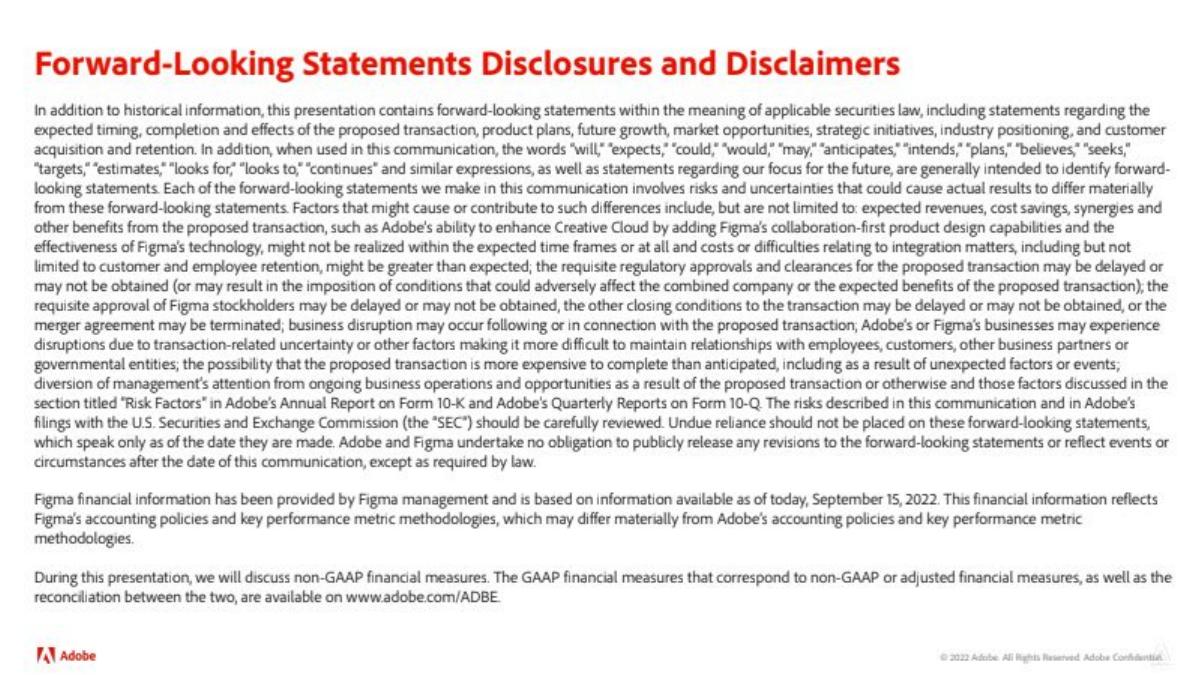
The presentation opens with a standard title slide (Slide 1) dated September 15, 2022. This is immediately followed by two dense slides of legal disclaimers (Slides 2 and 3). These cover 'Forward-Looking Statements' and 'Additional Disclaimers.' For founders, these are a reminder that in the world of public markets and massive M&A, every metric shared carries significant legal weight. These slides explicitly mention that the transaction is subject to regulatory approvals—a prescient inclusion given the deal's eventual fate.
Slide 4: The Vision Statement
Slide 4 is a high-impact visual featuring the Adobe and Figma logos joined by a plus sign over a vibrant, cloud-like background. The headline, 'The Future of Creativity + Productivity,' sets the stage. This is the 'Why' of the deal: Adobe (Creativity) plus Figma (Productivity/Collaboration). It positions the acquisition not as a defensive move to kill a competitor, but as a synergistic leap forward.
Slide 5: The 'God Tier' Metrics
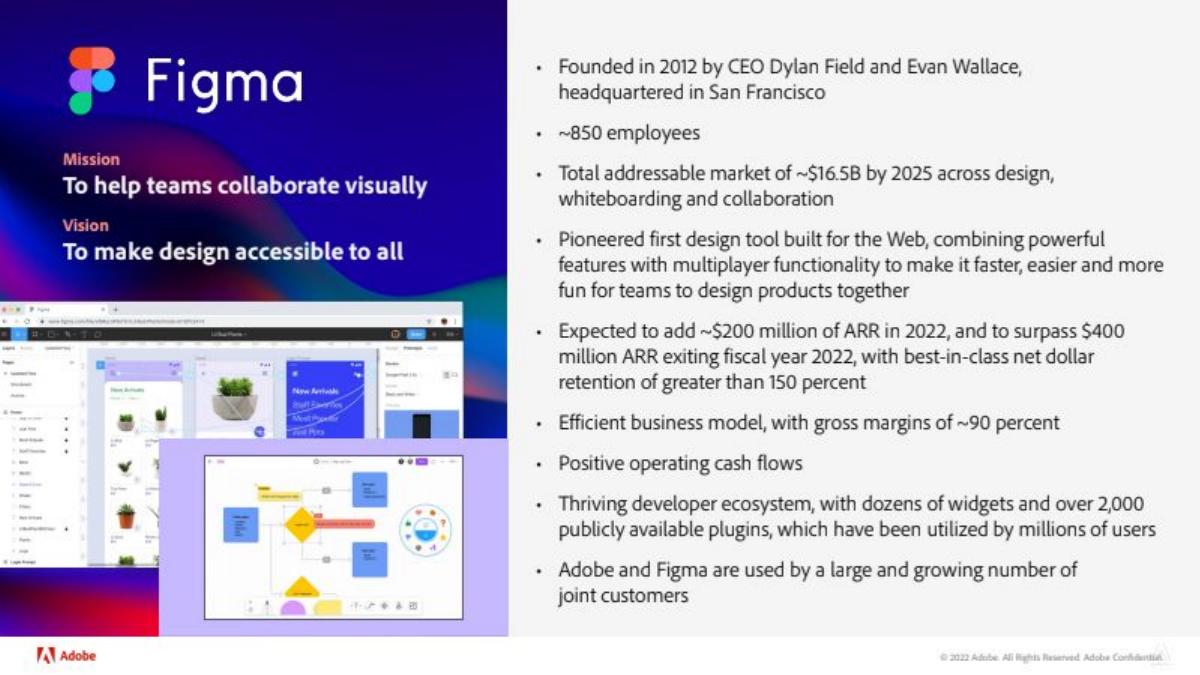
Slide 5 is arguably the most important slide for any student of SaaS. It provides a snapshot of Figma’s business health at the time of the acquisition. Key data points include:
Founding: 2012 by Dylan Field and Evan Wallace. · Headcount: ~850 employees. · TAM: ~$16.5B by 2025 across design, whiteboarding, and collaboration. · ARR Growth: Expected to add ~$200 million in ARR in 2022, surpassing $400 million exiting the year. · Retention: Best-in-class net dollar retention of greater than 150 percent. · Margins: Gross margins of ~90 percent. · Cash Flow: Positive operating cash flows.
These figures represent the top 0.1% of SaaS performance. A 150% net dollar retention rate means that even if Figma never signed a new customer, their existing revenue would grow by 50% annually just through expansion. This slide alone justifies why Adobe felt compelled to pay a massive premium.
Slides 6-8: Product and Community
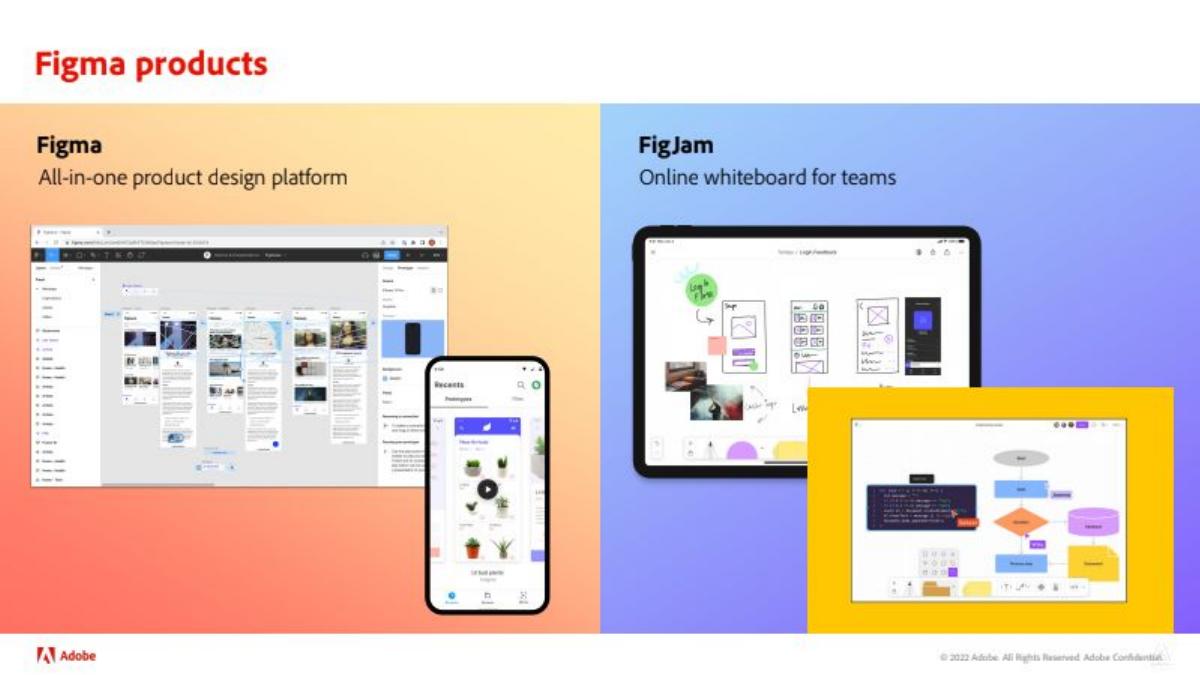
Slide 6 introduces the two core products: Figma (the all-in-one product design platform) and FigJam (the online whiteboard). Slide 7 uses a pie chart to illustrate a critical strategic point: Figma is not just for designers. The chart shows that developers, project managers, and marketers make up a majority of the user base. This 'multi-player' aspect is what Adobe lacked. Slide 8 reinforces this with a collage of 'millions of product designers, developers, students, and knowledge workers,' emphasizing the 'devoted community' that Adobe was effectively buying.
Slides 9-10: Adobe’s Creative Cloud Strategy
Slide 9 pivots to Adobe’s existing strategy, highlighting five pillars: content-first creativity, desktop/web/mobile advancement, 3D/immersive democratization, seamless collaboration, and community inspiration. Slide 10 then bridges the two companies, stating that Adobe and Figma share a passion for helping teams be more creative. It specifically mentions bringing together Adobe Express, Acrobat, and FigJam to offer value to hundreds of millions of customers.
Slides 11-13: The Synergy Deep Dive
Slide 11, 'Accelerating creativity on the web,' addresses Adobe’s historical weakness. Figma was built for the browser from day one. Adobe admits here that Figma’s web-based platform will 'accelerate the delivery of Adobe’s Creative Cloud technologies on the web.' Slide 12 discusses 'Advancing product design' by bringing Adobe’s imaging, photography, and video tech into the Figma platform. Slide 13 focuses on the community, suggesting that combining Adobe’s Behance/Creative Cloud community with Figma’s ecosystem will 'unlock the future of collaborative design.'
Slide 14: The Transaction Details
The final content slide (Slide 14) outlines the hard numbers of the deal:
Total Value: ~$20 billion. · Structure: Half cash, half stock. · Incentives: 6 million RSUs for Figma’s CEO and employees, vesting over four years. · Timeline: Expected to close in 2023. · Accretion: Expected to be accretive to Adobe Non-GAAP EPS at the end of year three.
This slide is a clinical breakdown of how a $20B exit is actually executed, including the 'golden handcuffs' (RSUs) used to ensure the talent doesn't leave immediately after the check clears.
What Works in This Deck
The emphasis on Net Dollar Retention (NDR). By highlighting the 150%+ NDR, Adobe showed investors that Figma was an 'efficient' grower. High NDR is the ultimate proof of product-market fit and platform stickiness.
The Persona Expansion. Slide 7 is the 'aha' moment. By showing that developers and marketers use Figma as much as designers, Adobe redefined Figma from a 'niche design tool' to a 'horizontal collaboration platform.' This significantly increases the perceived TAM.
Clear Strategic Gaps. The deck doesn't shy away from Adobe's need for better web-native tools. Slide 11 explicitly states that Figma will 'accelerate' Adobe's own web transition. Honesty about strategic gaps makes the acquisition logic more believable.
What Is Missing
The Competitive Landscape. Since this is an acquisition announcement, there is no mention of competitors like Sketch, Canva, or InVision. In a standard pitch deck, this would be a glaring omission, but here, the focus is purely on the Adobe-Figma union.
Integration Risks. The deck paints a rosy picture of 'bringing powerful capabilities... into the Figma platform.' It does not address the technical debt or cultural hurdles of merging a 40-year-old giant with a cloud-native startup.
Pricing and Packaging. There is no mention of how Figma’s pricing would change or how it would be bundled into the Creative Cloud. This was a major concern for the user community at the time, and the deck leaves it unaddressed.
What Founders Should Copy
The 'Snapshot' Slide. Slide 5 is a perfect example of how to present company health. It combines history, scale (headcount), market size (TAM), and financial performance (ARR/Margins/Retention) in a single, easy-to-digest view.
The User Persona Pie Chart. If your tool is used by people outside your primary target demographic, visualize it. Showing that 'non-core' users are adopting your product is the strongest evidence of a platform play versus a feature play.
Visualizing Synergies. Slides 11 and 12 use mockups to show what the combined future looks like. Founders pitching for a seed round or an exit should always show—not just tell—how their product fits into the larger ecosystem of their target market or acquirer.
Final Thoughts
The Adobe × Figma deck is a document of a specific moment in tech history—the peak of the 'collaboration' era. While the deal never closed, the deck remains the gold standard for how to articulate the value of a high-growth SaaS company. It proves that when your metrics are 'God Tier' (90% margins, 150% NDR), the narrative shifts from 'Can this work?' to 'How much of the future can we own together?'
Frequently asked questions
- What were Figma's key financial metrics at the time of the deal?
- According to slide 5, Figma was a high-growth, high-efficiency machine. It was expected to exit 2022 with over $400 million in ARR, representing a $200 million increase within that year alone. Its gross margins were approximately 90%, and it maintained a net dollar retention rate of over 150%. The company was also noted for having positive operating cash flows.
- How did Adobe justify the $20 billion price tag?
- The justification was built on three pillars: financial performance, market expansion, and technical synergy. Slide 5 highlights a $16.5B TAM by 2025. Slide 11 explains that Figma’s web-based platform would 'dramatically increase Adobe’s reach.' Essentially, Adobe was paying for Figma's superior web-native architecture and its ability to capture non-designer personas like developers and marketers.
- Who actually uses Figma according to the deck?
- Slide 7 provides a pie chart of the Figma user base. While 'Designer' is a primary segment, the chart shows that 'Developer' is nearly equal in size. Other segments include 'Project Manager,' 'Marketer,' and a significant 'Other' category. This was a key part of the 'collaboration' narrative used to justify the acquisition.
- What was the structure of the $20 billion acquisition?
- Slide 14 details the transaction: approximately $20 billion, comprised of half cash and half stock. Adobe planned to finance the cash portion through cash on hand or a term loan. Additionally, 6 million restricted stock units (RSUs) were earmarked for Figma's CEO and employees to vest over four years post-closing.
- What happened to the Adobe and Figma deal?
- While the deck (Slide 14) stated an expected close in 2023 subject to regulatory approvals, the deal ultimately fell through. As noted in the editorial context, regulatory pressure from authorities in the UK and EU led both companies to terminate the agreement in late 2023, with Adobe paying a $1 billion termination fee.