AcuMedical Inc. presents a compelling case for the AcuRanger, a digital electro-acupuncture device designed to disrupt the pain management sector. By framing acupuncture as a clinically superior alternative to morphine and a tool for opiate rehab, the company targets a massive $60.20 billion global therapeutics market. The deck is structured around a clear three-year milestone plan, emphasizing the need for multiple FDA 510(k) clearances. While the deck lacks a dedicated internal management team slide, it leans heavily on a high-pedigree advisory board with experience from Medtronic, Abbott,…
Key takeaways
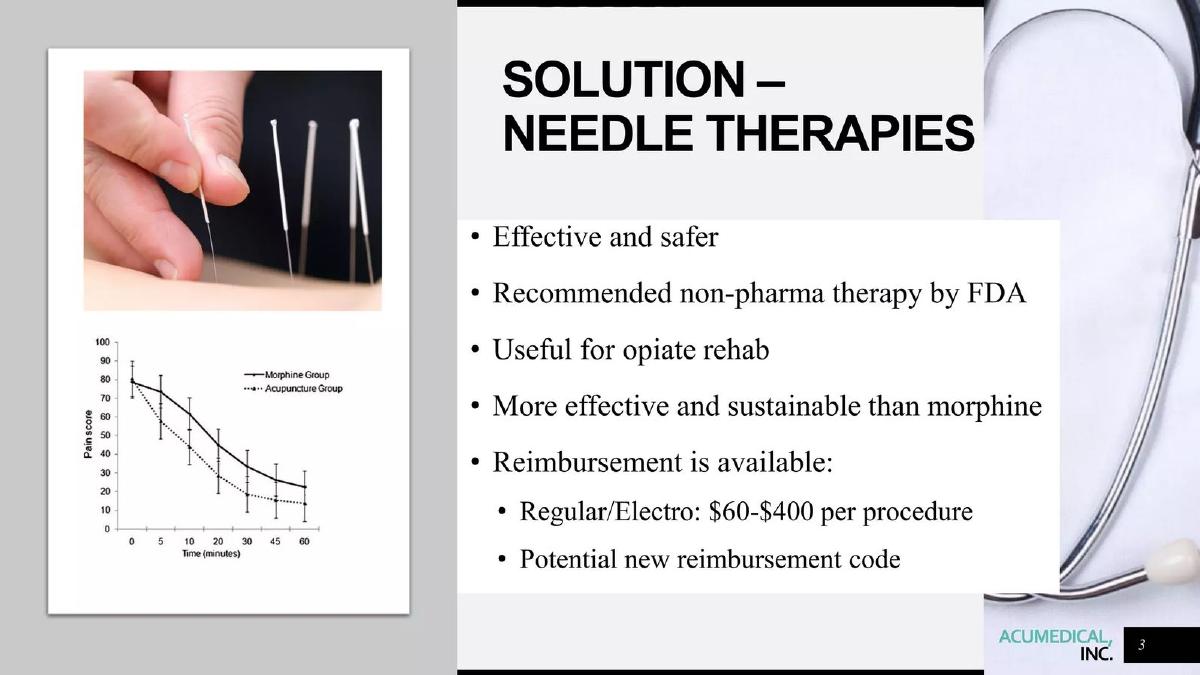
- The company positions acupuncture as more effective and sustainable than morphine, citing a pain score graph on slide 3.
- AcuMedical identifies a massive TAM, including a $60.20B global pain management therapeutics market and a $3.2B device market on slide 7.
- The product strategy involves a tiered launch of Model A, B, and C devices, each requiring separate 510(k) clearances as detailed on slide 11.
- Revenue targets are explicitly stated: $2.5M in Year 2 and $10M in Year 3 on slide 11.
- The $2M fundraising ask is clearly broken down, with 56% dedicated to manufacturing and 19% to clinical work on slide 13.
- The deck highlights a strong advisory board with veterans from Medtronic, Boston Scientific, and the China Association of Acupuncture-Moxibustion on slide 15.
- The target market is segmented into 45k US acupuncture practitioners and 179k in China, alongside 240k physical therapists on slide 9.
- There is a significant omission of the core founding team's operational roles, focusing instead on external advisors on slide 15.
Slide 1: Title and Vision
The deck opens with a clear value proposition: "Manage Pain with AcuRanger®." The imagery uses medical icons (stethoscopes, pills, patient silhouettes) and a global map, signaling both a clinical focus and international ambitions. The branding for AcuMedical, Inc. is prominent, establishing the company identity immediately.
Slide 3: The Problem and Solution Framework
Slide 3, titled "SOLUTION – NEEDLE THERAPIES," attempts to validate acupuncture through a Western medical lens. It includes a pain score graph comparing acupuncture to morphine, showing a steeper decline in pain for the acupuncture group over 60 minutes. Key claims include that it is "effective and safer" and a "recommended non-pharma therapy by FDA." Crucially, this slide addresses the business model by listing reimbursement rates: $60-$400 per procedure for regular/electro-acupuncture, and mentions the potential for a new reimbursement code.
Slide 5: The AcuRanger Platform
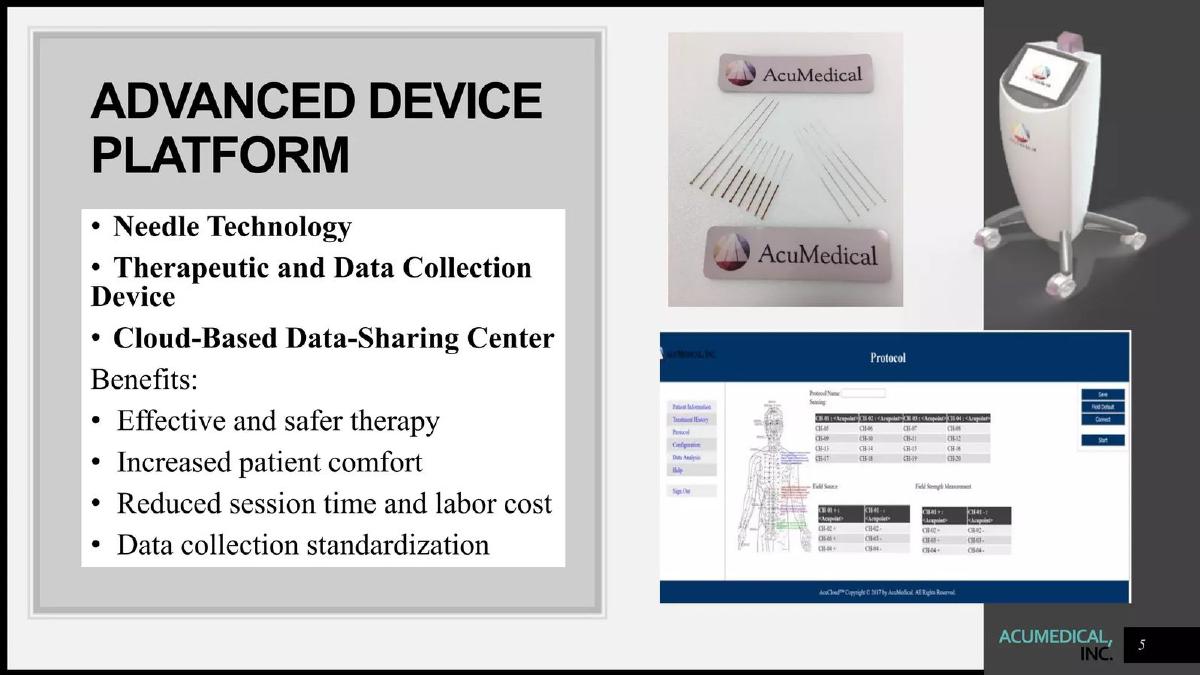
This slide introduces the hardware and software components. The "Advanced Device Platform" includes needle technology, a data collection device (shown as a sleek, white medical cart with a touchscreen), and a cloud-based sharing center. The benefits listed are operational: reduced session time, lower labor costs, and data collection standardization. The inclusion of a software interface screenshot (labeled "AcuCloud") suggests the product is beyond the conceptual stage and has a functional UI for tracking patient protocols.
Slide 7: Market Opportunity
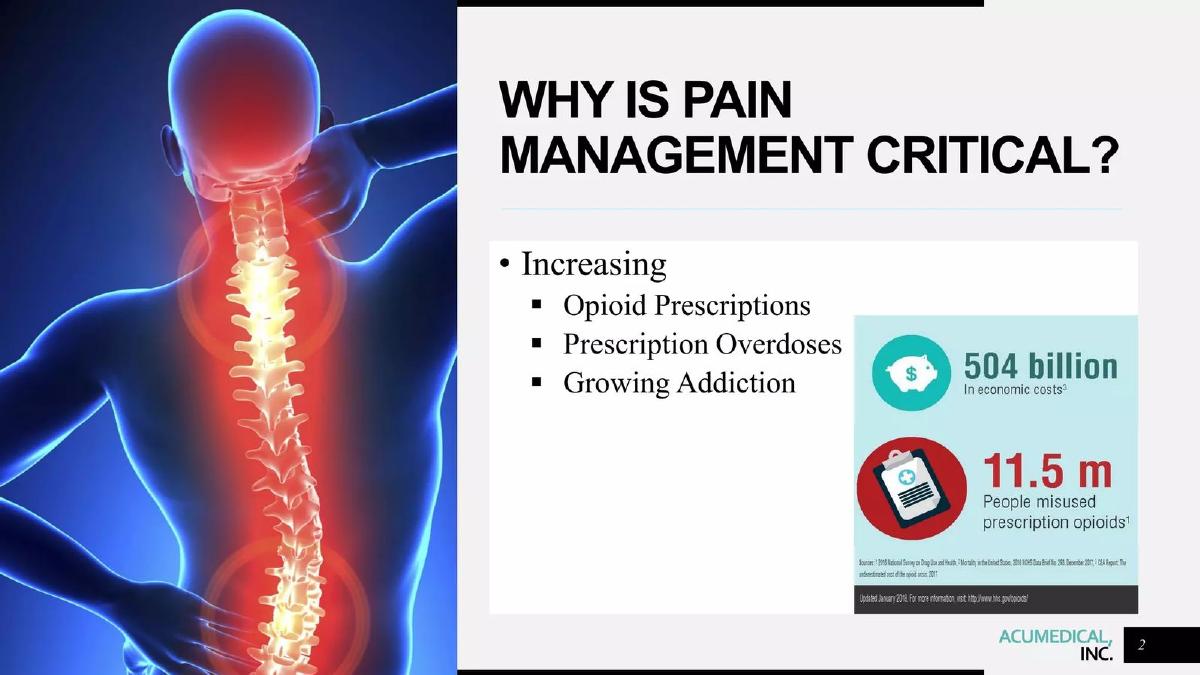
AcuMedical uses a classic TAM (Total Addressable Market) visualization on slide 7. They cite a $60.20 billion Global Pain Management Therapeutics market and a $3.2 billion Global Pain Management Devices market. To provide social context, the slide features a heat map of the United States titled "Overwhelming Retail Opioid Prescriptions," sourced from the CDC and DEA. This positions the AcuRanger not just as a medical tool, but as a solution to a public health crisis.
Slide 9: Customer Segmentation
Slide 9 provides specific numbers for the target market. It breaks down "Individual" customers into 45,000 chiropractors, 240,000 physical therapists, and 130,000 occupational therapists. It also highlights a massive international opportunity with 179,000 acupuncture practitioners in China compared to 45,000 in the US. The "Institutions" column lists cancer centers and rehab clinics, showing a broad B2B sales strategy.
Slide 11: The Three-Year Roadmap
The "Key Target Milestones" slide is one of the most detailed in the deck. It outlines a clear path to market:
Year 1: Production readiness for Model A and Type-I needles, pending 510(k) clearances (expected in 6-12 months), and a cloud service pilot. · Year 2: Target revenue of $2.5M, launch of Model B (data collection), and entry into Asian markets (Singapore, Hong Kong, China). · Year 3: Target revenue of $10M, launch of Model C (thermal therapy), and a subsequent fundraising round for AI and VR features.
Slide 13: The $2M Ask
The financing plan is straightforward. AcuMedical is seeking $2M to cover a 24-month runway. The pie chart shows a heavy lean toward execution: 56% for manufacturing, 19% for clinical, 13% for R&D, and 12% for marketing. This distribution suggests the company has finished initial prototyping and is focused on scaling production and clinical validation.
Slide 15: Advisory Board
Instead of a traditional team slide, slide 15 showcases an "Advisory Board." The pedigree is high, featuring Dr. Walter H. Olson (VP Emeritus at Medtronic), Mark Strong (former VP at HeartWare and Boston Scientific), and Dr. Li Gu (former Deputy Secretary-General of China Association of Acupuncture-Moxibustion). The logos of Harvard Medical School, MIT, and Abbott are used to bolster credibility. However, the lack of a slide detailing the full-time management team is a notable omission for a $2M raise.
Slide 17: Contact Information
The deck concludes with a "Thank You" slide providing contact details for Charlie Chen, including a phone number, email, and website URL. This serves as the call to action for interested investors.
What AcuMedical Does Well
AcuMedical excels at framing a traditional practice (acupuncture) as a modern, data-driven medical technology. By explicitly linking their product to the opioid crisis and FDA recommendations, they move the conversation away from "alternative medicine" and into "clinical therapeutics." The regulatory roadmap on slide 11 is exceptionally clear, providing investors with a measurable timeline for risk reduction through 510(k) clearances. Furthermore, the market segmentation on slide 9 shows a sophisticated understanding of who will actually buy the device, moving beyond vague "healthcare" labels to specific practitioner counts.
What Is Missing from the Deck
The most glaring omission is the core management team. While the advisors are impressive, investors fund founders, not just advisors. There is no information on who is running the day-to-day operations, their previous exits, or their technical expertise. Additionally, the deck lacks unit economics. While reimbursement rates are mentioned, the cost to manufacture the AcuRanger and the projected sales price are missing. There is also no mention of existing intellectual property or patent status, which is critical for a medical device company. Finally, while Year 2 and 3 revenue targets are provided, there is no evidence of current traction or pre-orders to justify those projections.
Founder Takeaways: What to Copy
Use a Phased Regulatory Roadmap: If your startup requires FDA or other regulatory approvals, copy the structure of slide 11. Breaking down specific models (A, B, C) and their corresponding clearance timelines shows that you understand the complexity of the medical market. Contextualize the Problem: AcuMedical doesn't just say "pain is bad." They use a heat map of opioid prescriptions (slide 7) to show the urgency of the problem. Using third-party data to illustrate a macro trend makes your solution feel inevitable. Segment Your TAM: Instead of claiming a trillion-dollar market, slide 9 breaks the market down by specific job titles and geographies. This makes the sales strategy feel grounded and achievable.
Frequently asked questions
- What is the primary product AcuMedical is developing?
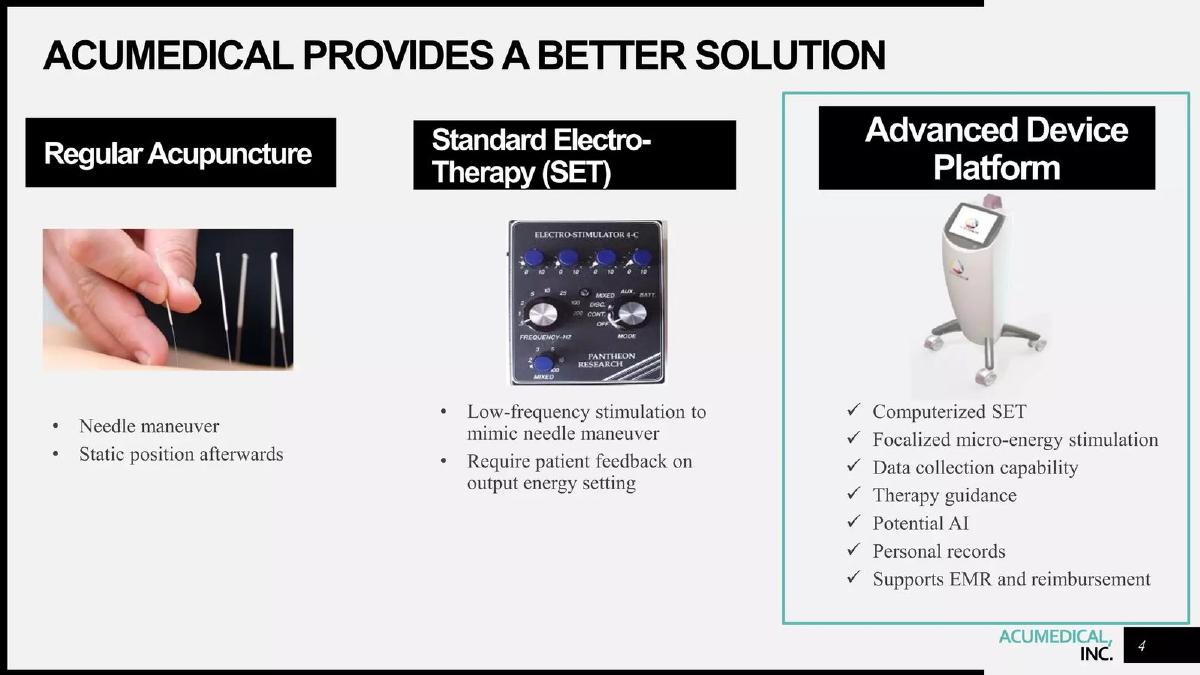
- The primary product is the AcuRanger, described on slide 5 as an 'Advanced Device Platform.' It consists of specialized needle technology, a therapeutic and data collection device, and a cloud-based data-sharing center. The platform aims to standardize acupuncture data while reducing labor costs and session time for practitioners.
- How does the company plan to navigate FDA regulations?
- AcuMedical has a phased regulatory strategy outlined on slide 11. Year 1 focuses on obtaining the first 510(k) clearance for 'Model A' (Digital Electro-acupuncture) and a second for 'Type-I' needles. Year 2 targets a third 510(k) for 'Model B' with data collection, and Year 3 involves clearance for 'Model C' and thermal therapy needles.
- What is the specific financial ask and its intended use?
- According to slide 13, AcuMedical is raising $2M for a 24-month financing plan. The largest portion, 56%, is earmarked for manufacturing. The remainder is split between clinical trials (19%), research and development (13%), and marketing (12%).
- Who are the intended customers for the AcuRanger platform?
- Slide 9 divides the target market into individuals and institutions. Individuals include 45,000 chiropractors, 240,000 physical therapists, 130,000 occupational therapists, and acupuncture practitioners in the US and China. Institutions include cancer centers, rehab clinics, and traditional Chinese medicine facilities.
- What evidence is provided for the efficacy of their solution?
- Slide 3 presents a line graph comparing a 'Morphine Group' to an 'Acupuncture Group.' The data suggests that the acupuncture group achieved lower pain scores over a 60-minute period. The slide also notes that needle therapies are a 'recommended non-pharma therapy by FDA' and useful for opiate rehabilitation.