HealthCaters, a Berlin-based health-tech startup, successfully raised a $1.2M Seed round in 2024 using a 14-slide deck that emphasizes the financial burden of chronic disease on B2B stakeholders. The narrative moves quickly from the problem of inaccessible diagnostics to a solution centered on a proprietary AI health risk assessment module. By targeting both employers and corporate health insurers, HealthCaters positions itself as a cost-saving tool rather than just a wellness perk. The deck showcases early commercial validation, including a €300k pipeline and partnerships with three health i…
Key takeaways
- The company frames the problem as a lack of access to early screening and diagnostics (Slide 2).
- The solution is defined as an AI-powered platform using 'hard data' to predict long-term health (Slide 3).
- HealthCaters analyzes over 50 parameters per user to generate personal risk profiles (Slide 4).
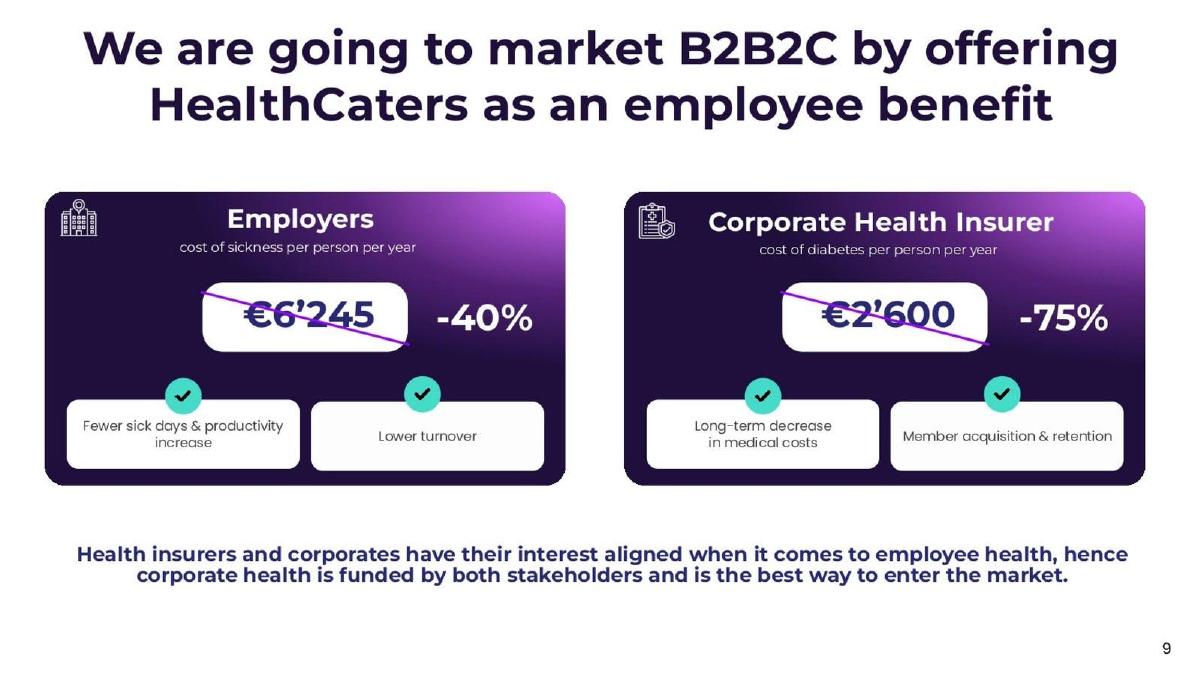
- The go-to-market strategy is strictly B2B2C, positioning the service as an employee benefit (Slide 9).
- The deck claims a potential 40% reduction in the €6,245 annual cost of sickness per person for employers (Slide 9).
- For insurers, the deck suggests a 75% reduction in the €2,600 annual cost of diabetes per person (Slide 9).
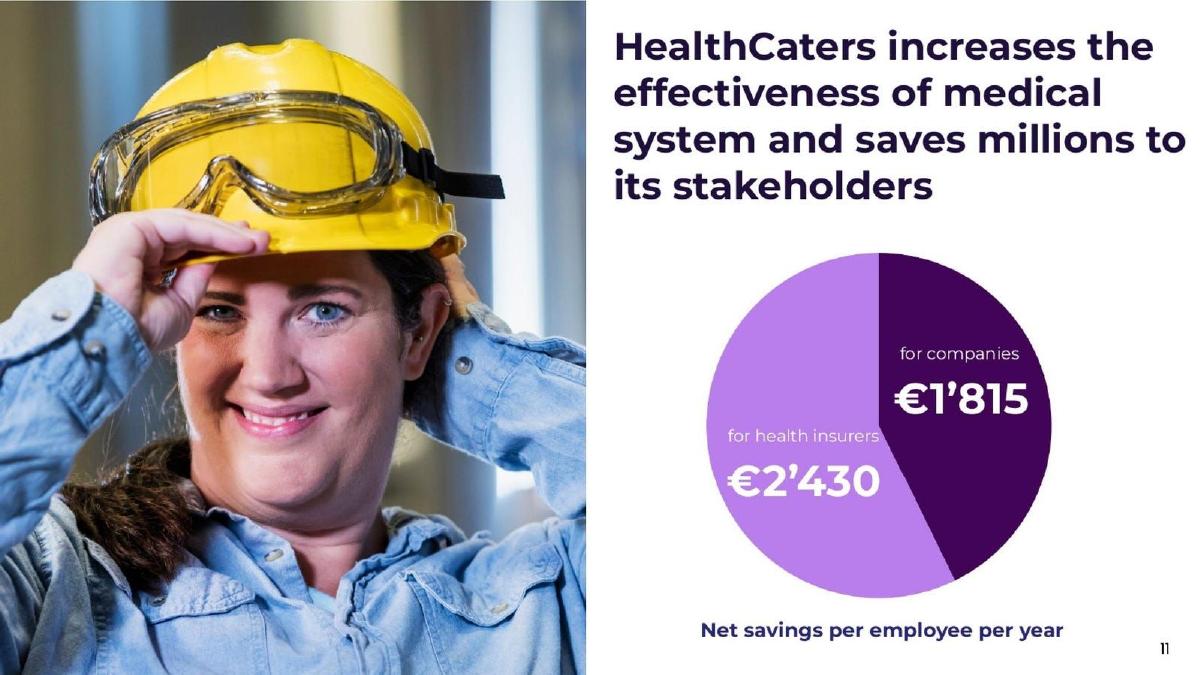
- Net savings are quantified at €1,815 for companies and €2,430 for health insurers per employee per year (Slide 11).
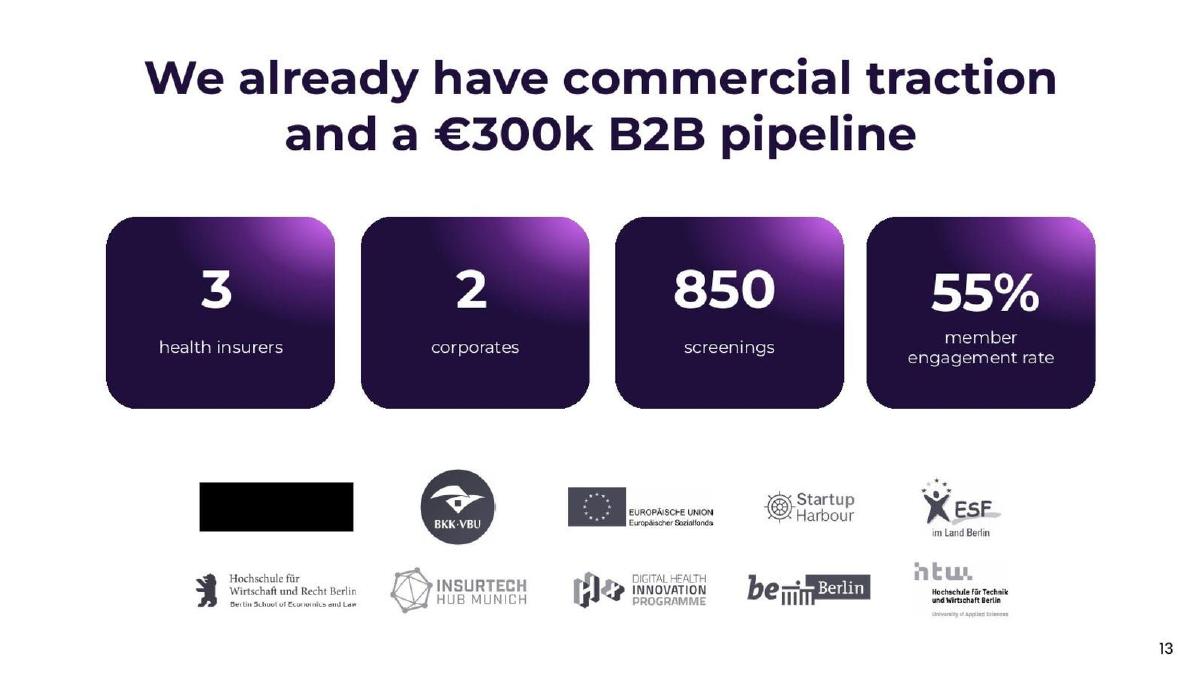
- Early traction is evidenced by 850 screenings and a 55% member engagement rate (Slide 13).
The Hook: Unblackboxing Personal Health
Slide 1: Title and Vision
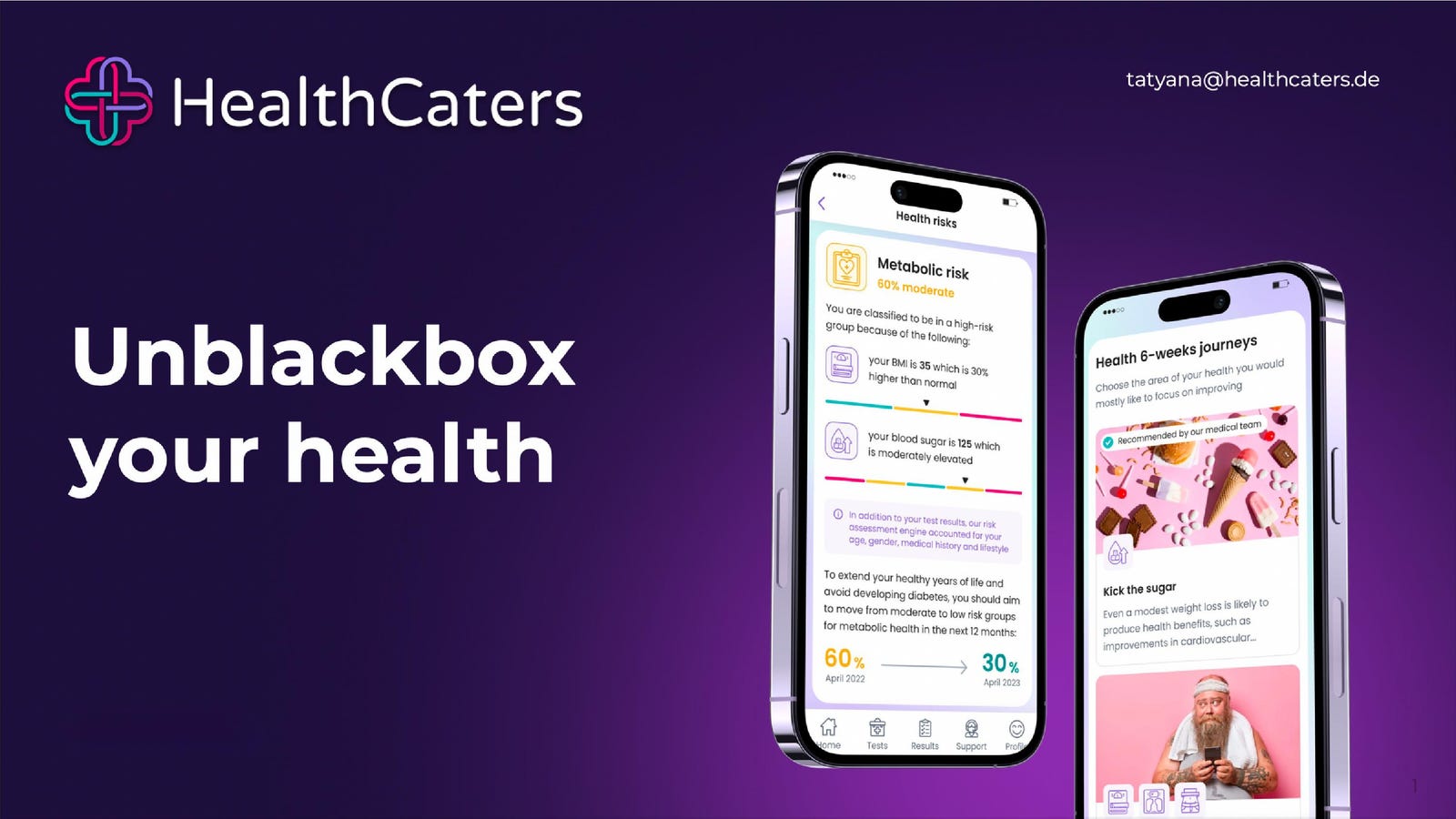
The deck opens with a clear, minimalist title slide featuring the HealthCaters logo and the tagline: "Unblackbox your health." The visual focus is on two high-fidelity smartphone mockups. One shows a 'Metabolic risk' assessment of 60% (moderate) with specific data points: a BMI of 35 and blood sugar of 125. The second screen shows a 'Health 6-weeks journey' titled 'Kick the sugar.' This immediately establishes the product as a data-driven, mobile-first health intervention tool. The inclusion of a founder email address (tatyana@healthcaters.de) in the top right corner is a standard but professional touch for direct investor outreach.
Slide 2: The Accessibility Gap
HealthCaters identifies its primary problem as the inaccessibility of early screening and diagnostics. The slide uses a black-and-white photograph of a cluttered, dated medical reception area with patients waiting. The text is sparse: "Problem 1: Early screening and diagnostics are inaccessible to most people." By using imagery of a traditional, paper-heavy clinic, the deck creates a visual contrast with the modern app interface shown on the previous slide, suggesting that the current medical system is inefficient and out of reach for proactive health management.
Slide 3: The AI-Powered Solution
Slide 3 defines the company's category. It describes HealthCaters as an "AI-powered personal health platform that uses hard data to predict and manage your long-term health." The background features a dark, monolithic 'black box' being illuminated or revealed, playing off the 'Unblackbox' tagline from the cover. This slide serves as the transition from the problem to the technical solution, emphasizing 'hard data' as the differentiator against more qualitative wellness apps.
Slide 4: The Proprietary Engine
This slide dives into the 'how.' It introduces the "Proprietary AI health risk assessment module," which it claims is "Built based on best clinical guidelines and hard science." The right side of the slide repeats the app interface from Slide 1 but adds a crucial metric: "We collect and analyze over 50 parameters for each user to create personal health risk profiles and data-based insights." This specific number (50 parameters) is vital for building investor confidence in the depth of the diagnostic tool. It also shows a target outcome: moving a user from a 60% risk in April 2022 to a 30% risk by April 2023.
The Business Case: B2B2C and Economic Alignment
Slide 9: The Go-To-Market Strategy
HealthCaters pivots from the user experience to the business model on Slide 9. They explicitly state a "B2B2C" approach, offering the platform as an employee benefit. The slide is divided into two value propositions: Employers and Corporate Health Insurers . For employers, they target a 40% reduction in the €6,245 annual cost of sickness per person. For insurers, they target a 75% reduction in the €2,600 annual cost of diabetes per person. The slide concludes that because both stakeholders have aligned interests in employee health, this dual-funding model is the "best way to enter the market."
Slide 11: Quantifying the ROI
Slide 11 reinforces the economic argument with a simple pie chart showing "Net savings per employee per year." It breaks this down into €1,815 for companies and €2,430 for health insurers. The visual of a worker in a hard hat and safety goggles suggests that the platform is applicable to industrial or blue-collar workforces where physical health is directly tied to operational uptime. This slide is the 'closer' for the financial side of the pitch, providing the specific figures an investor needs to model the potential market impact.
Slide 13: Commercial Traction
The final substantive slide provides proof of life. HealthCaters claims a "€300k B2B pipeline" and lists four key KPIs: 3 health insurers , 2 corporates , 850 screenings , and a 55% member engagement rate . The bottom of the slide is crowded with logos, including BKK VBU, Insurtech Hub Munich, and various Berlin-based government and academic institutions (e.g., Startup Harbour, be Berlin). This demonstrates that the company has successfully navigated the European regulatory and institutional landscape to secure early pilots and funding.
What HealthCaters Does Well
The HealthCaters deck excels at economic quantification . Many health-tech startups focus exclusively on patient outcomes, but HealthCaters leads with the financial burden on the payer. By citing specific figures like the €6,245 cost of sickness (Slide 9) and the €1,815 net saving for companies (Slide 11), they speak the language of the B2B buyer and the venture capitalist simultaneously. The deck also does a good job of visualizing the product early and often. Investors aren't left wondering what the 'AI module' looks like; they see the metabolic risk screens on Slide 1 and Slide 4, which makes the technology feel tangible.
What is Missing from the Deck
The most notable omission in the provided slides is a Team Slide . While the publisher reports a $1.2M raise, the deck does not showcase the founders' backgrounds, medical expertise, or technical credentials. In a health-tech play relying on 'proprietary AI' and 'clinical guidelines,' the pedigree of the medical and engineering team is a critical factor for Seed-stage investors. Additionally, there is no Competition Slide . The preventive health and at-home testing space is crowded with players like Thorne, Levels, and various corporate wellness platforms; HealthCaters fails to explicitly state how their 50-parameter analysis beats existing solutions. Finally, the Investment Ask is missing from these slides. While we know from external reports they raised $1.2M, the deck itself should ideally outline how that capital will be deployed (e.g., R&D, sales team expansion, or regulatory clearances).
Founder's Guide: What to Copy
Founders should emulate the stakeholder alignment strategy shown on Slide 9. Instead of picking one customer, HealthCaters identifies two parties who both benefit from the same outcome (a healthier employee) and explains how they share the funding burden. This makes the market entry seem more robust. Another takeaway is the use of specific KPIs on the traction slide. Rather than saying "we have many users," the deck specifies "850 screenings" and a "55% engagement rate." These hard numbers are much more persuasive than vague growth charts. Lastly, the clear problem-solution-ROI flow is a textbook example of how to structure a B2B pitch: identify a cost, show the tool that reduces it, and then prove the math works.
Frequently asked questions
- What is the core product of HealthCaters?
- Based on the deck and publisher reports, HealthCaters provides a proprietary AI health risk assessment module that analyzes over 50 data parameters. This is delivered via a personal health platform that helps users manage long-term health through data-based insights and personalized journeys, such as 'Kick the sugar' programs shown on Slide 1.
- How does HealthCaters make money?
- The deck outlines a B2B2C model where the platform is offered as an employee benefit. Revenue is generated through stakeholders who bear the cost of illness: employers (who face costs from sick days and turnover) and corporate health insurers (who face long-term medical costs). Slide 9 explicitly states that corporate health is funded by both stakeholders.
- What specific health risks does the platform monitor?
- Slide 4 and Slide 1 show the interface monitoring 'Metabolic risk,' specifically citing metrics like BMI (e.g., 'BMI is 35') and blood sugar levels (e.g., 'blood sugar is 125'). The platform aims to move users from high-risk to low-risk groups over a 12-month period, targeting a reduction in metabolic risk from 60% to 30%.
- What traction had the company achieved at the time of the deck?
- As of Slide 13, the company had conducted 850 screenings and achieved a 55% member engagement rate. They reported a €300k B2B pipeline and active commercial relationships with three health insurers and two corporate clients, supported by logos from organizations like Insurtech Hub Munich and the European Social Fund.
- What is the primary value proposition for employers?
- The primary value prop is cost reduction. Slide 11 calculates a net saving of €1,815 per employee per year for companies. This is achieved by reducing the 'cost of sickness,' which the deck estimates at €6,245 per person per year, through fewer sick days, increased productivity, and lower employee turnover.