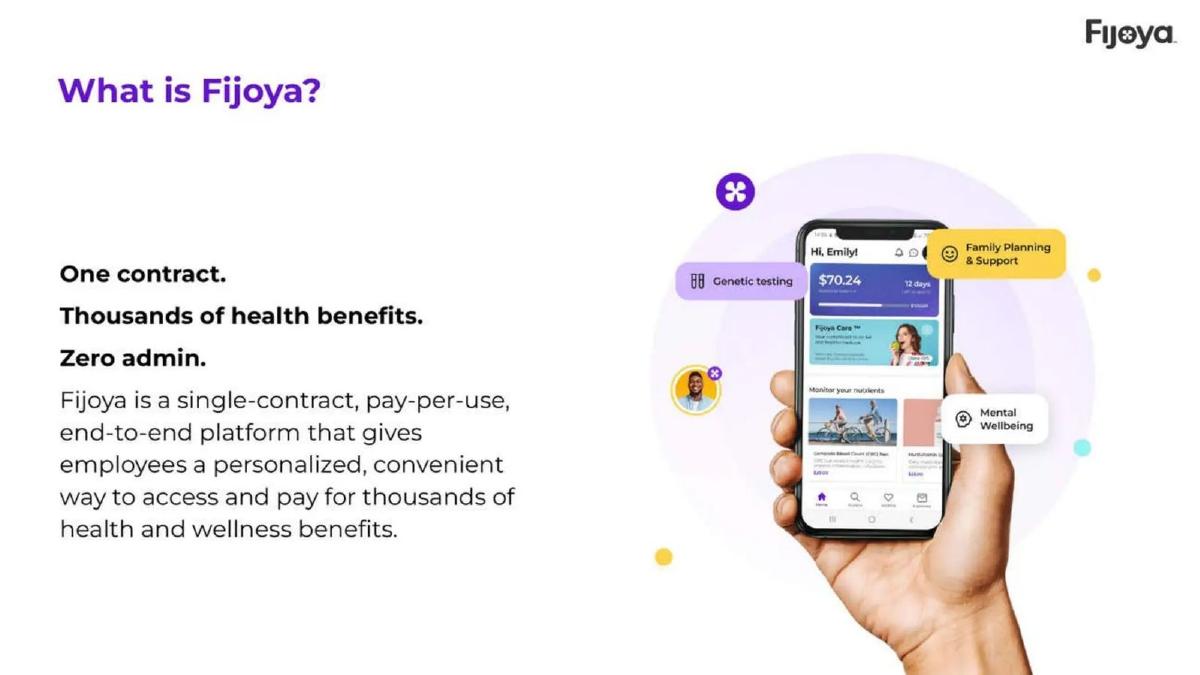
Fijoya's pitch deck addresses the 'point solution fatigue' plaguing HR departments and employees alike. By positioning themselves as a single-contract layer for diverse health services, they move away from the industry-standard Per Employee Per Month (PEPM) model toward a pay-per-use structure. The deck emphasizes financial efficiency, illustrating how a typical $1.2M benefits budget often results in over $1M in losses due to low utilization. Fijoya claims their platform can flip this ratio, ensuring over $720K is spent on actual benefits while returning $480K to the employer. With a leadersh…
Key takeaways
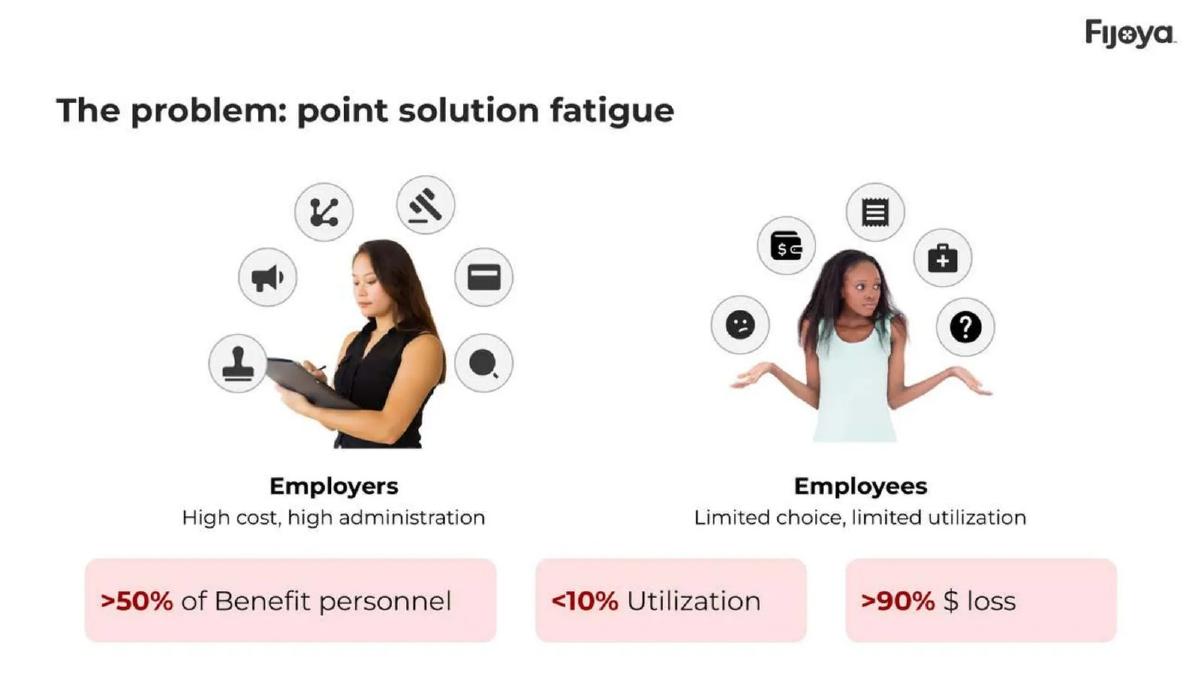
- The problem is defined as 'point solution fatigue,' leading to less than 10% utilization of benefits (Slide 3).
- Fijoya claims that employers lose over 90% of their benefits budget under current models (Slide 3).
- The platform utilizes a 'Single contract' approach to streamline high-cost benefits like IVF, egg freezing, and surrogacy (Slide 5).
- A core differentiator is the 'Pay-per-use' model, explicitly contrasting it against the traditional PEPM (Per Employee Per Month) billing (Slide 6).
- The Fijoya Care module focuses on clinical healthcare—preventive care and occupational health—rather than just lifestyle perks (Slide 4).
- A financial case study suggests that for a $1.2M budget, Fijoya can return $480K to the employer (Slide 7).
- The management team features a mix of healthcare veterans and fintech experts from companies like Wix, Deloitte, and Baxter (Slide 2).
- The deck omits specific current revenue figures, growth rates, or a detailed breakdown of the $8.3M use of funds.
Fijoya Pitch Deck Analysis: The Shift from PEPM to Pay-Per-Use
Fijoya’s pitch deck for their $8.3M funding round represents a growing trend in the 'Health-FinTech' space: the move away from administrative bloat and toward financial transparency in employee benefits. The deck is structured to highlight a massive inefficiency in how corporations buy healthcare services and presents a platform that acts as both a clinical guide and a financial clearinghouse.
Slide 1: Title and Visual Identity
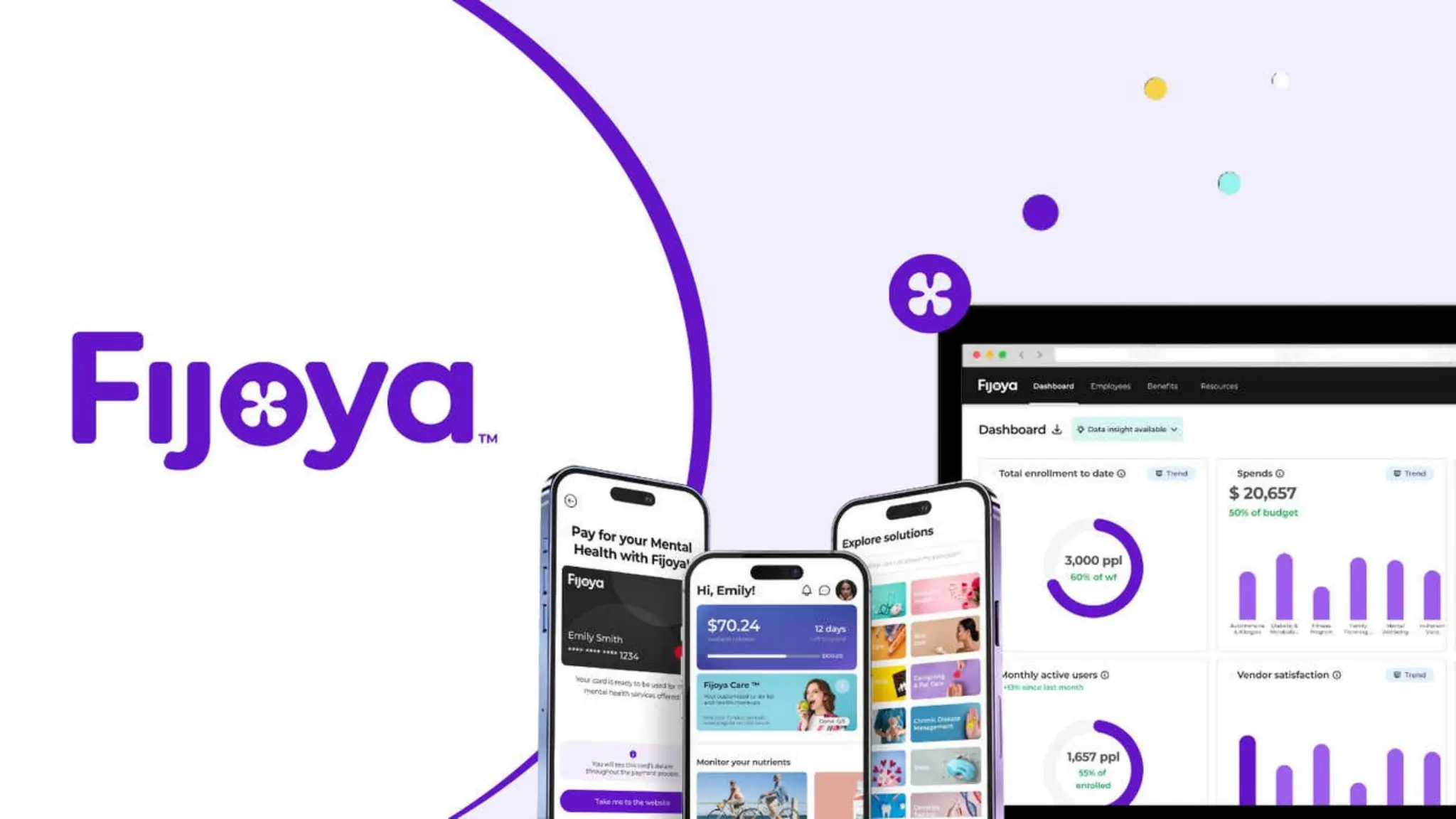
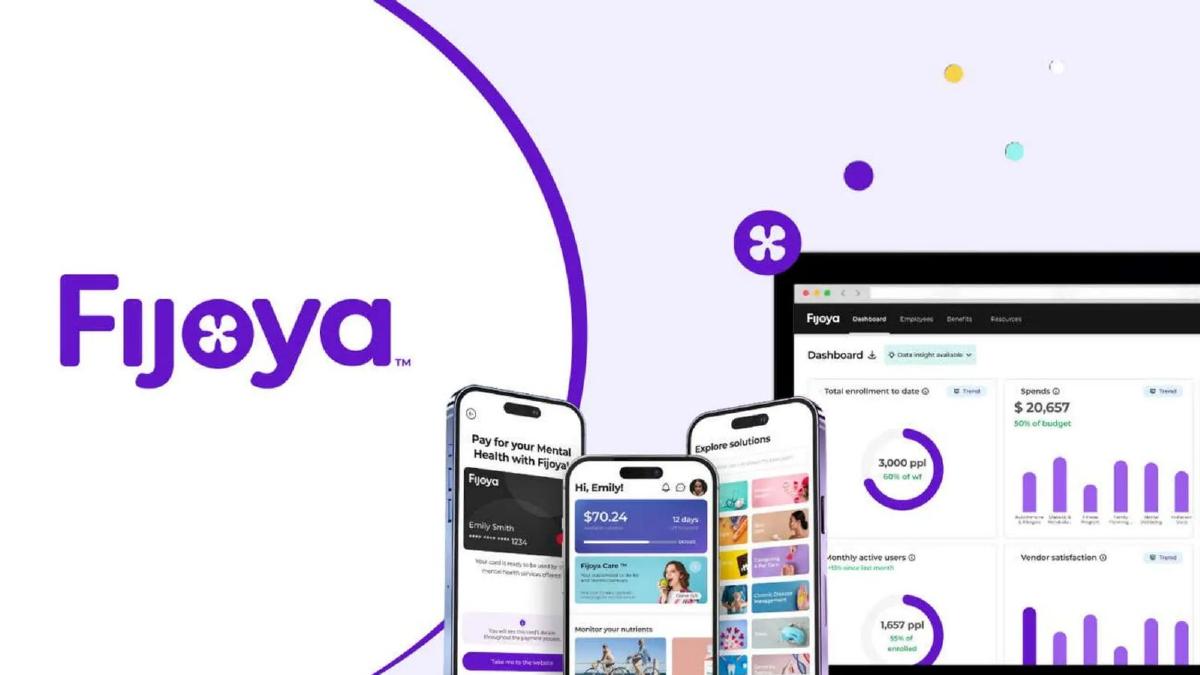
The opening slide introduces the Fijoya branding alongside a collage of mobile and desktop interfaces. The UI shown on the mobile devices highlights mental health payments and nutrient monitoring, while the desktop dashboard displays metrics like 'Total enrollment to date' (3,000 people) and 'Spends' ($20,657). This immediately establishes the company as a dual-interface platform serving both the individual employee and the HR administrator.
Slide 2: Management Team
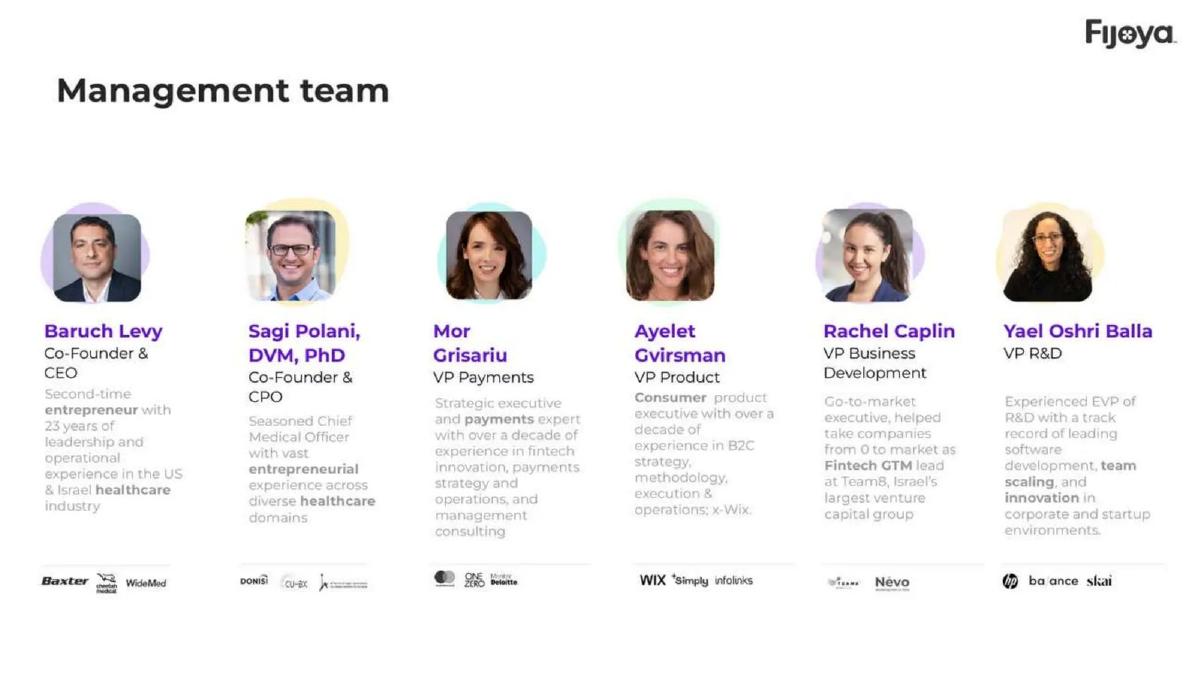
The team slide is heavy on institutional credibility. Baruch Levy (CEO) is noted as having 23 years of experience in the US and Israel healthcare industries. Sagi Polani (CPO) brings a clinical background as a DVM and PhD. The inclusion of VPs from fintech and consumer backgrounds (Wix, Deloitte, Team8) signals that this is not just a healthcare company, but a sophisticated payments and product organization. The logos at the bottom (Baxter, HP, Wix) associate the leadership with successful scale-ups and established giants.
Slide 3: The Problem - Point Solution Fatigue
This is the 'hook' of the deck. Fijoya defines the problem as 'point solution fatigue.' They provide three striking statistics: over 50% of benefit personnel time is spent on administration, utilization is less than 10%, and there is a greater than 90% dollar loss on these investments. By framing the problem as a financial loss rather than just a 'bad user experience,' they appeal directly to the CFO and the bottom line of potential enterprise clients.
Slide 4: Fijoya Care Module
Slide 4 pivots to the clinical side of the platform. It categorizes its offerings into Preventive Care, Occupational Health, and Self-Reported Outcomes. The mobile mockups show a 'suggested checklist' for users, including cardiovascular assessments and cancer screenings. This slide is crucial because it demonstrates that Fijoya isn't just a wallet; it’s an active participant in directing employees toward high-value healthcare actions.
Slide 5: Expense Management System
Here, the deck focuses on 'high-cost benefits.' The slide shows a dashboard where an admin can set tier-specific parameters (e.g., Executive vs. Non-executive). It lists specific high-dollar services: IVF ($25,000), Egg freezing ($8,000), and Surrogacy ($20,000). The value proposition stated is that they 'support and enhance the utilization of existing contracts, without administrative burden.' This suggests Fijoya can sit on top of a company's current vendors to streamline the payment and approval process.
Slide 6: What Sets Us Apart?
This slide serves as the competitive matrix. The most significant claim here is 'Pay-per-use (not PEPM).' In the benefits world, Per Employee Per Month (PEPM) is the standard, often leading to companies paying for thousands of seats that are never used. Other differentiators include 'AI-based technology,' 'Frictionless payments,' and a 'Non-preferred, unbiased network.' The 'Single contract' header emphasizes the reduction of legal and procurement friction for HR departments.
Slide 7: Case Study - Financial Perspective
Slide 7 quantifies the value proposition using a hypothetical $1.2M budget. It contrasts the 'Without Fijoya' scenario (only $120K realized, $1.08M loss) with the 'With Fijoya' scenario ($720K spent on benefits, $480K returned). This is a powerful visual for investors because it shows a clear path to ROI for the customer. It transforms the benefits department from a cost center into a source of potential savings.
Slide 8: Closing Slide
The deck concludes with the logo and contact information for Baruch Levy. It mirrors the title slide, maintaining brand consistency. While this version of the deck ends here, the source listing indicates a total of 15 slides, suggesting that the full deck likely contains more detailed financial projections, a roadmap, and a specific 'Ask' slide that were not included in this 8-slide preview.
What Works in This Deck
Clear Financial Incentives: By focusing on the '90% dollar loss' in the current system, Fijoya makes a compelling case for why a change is necessary now. · Business Model Innovation: Explicitly calling out the move away from PEPM to pay-per-use is a strong differentiator in a crowded HR tech market. · Dual-Sided Value: The deck successfully shows how the product helps both the employee (better care access) and the employer (lower costs and less admin). · Strong Team Pedigree: The mix of healthcare and fintech experience is perfectly aligned with the product's core functions.
What is Missing
Traction Metrics: While the dashboard in Slide 1 shows '3,000 ppl' enrolled, the deck lacks a dedicated slide showing actual growth, current revenue, or a list of signed enterprise customers. · Competitive Landscape: Aside from the 'What sets us apart' slide, there is no direct comparison to other aggregators or navigation platforms like Accolade or Quantum Health. · The 'Ask': The 8 slides provided do not state how much capital is being raised (though the source listing mentions $8.3M) or how that capital will be deployed. · Unit Economics: There is no mention of how Fijoya makes money—whether they take a percentage of the spend, a transaction fee, or a platform fee.
Founder Takeaways
Focus on the 'Waste': If you are building in a sector with high fixed costs and low utilization, use Fijoya’s approach of quantifying the 'sunk cost' for the customer. It is often easier to sell a solution that 'returns' money than one that requires 'new' budget.
Product-Led Problem Solving: Notice how Fijoya doesn't just say they have a dashboard; they show specific high-cost use cases like IVF and surrogacy. This makes the abstract concept of 'expense management' feel concrete and necessary.
The Power of the 'Single Contract': For B2B startups, the 'administrative burden' is a real sales blocker. Positioning your product as a way to consolidate multiple vendors into one contract is a powerful value proposition for procurement teams.
Visualizing the 'Before and After': The case study on Slide 7 is a masterclass in simple data visualization. Using red and green boxes to show the 'loss' vs. 'return' makes the decision feel like a mathematical certainty for a potential buyer.
Frequently asked questions
- What is the primary problem Fijoya is solving?
- Fijoya identifies 'point solution fatigue' as the core issue. Employers are overwhelmed by managing dozens of individual health contracts, leading to high administrative costs. Simultaneously, employees suffer from limited choice and low utilization. Slide 3 notes that over 50% of benefit personnel time is consumed by these tasks, yet utilization remains under 10%, resulting in massive financial waste for the corporation.
- How does Fijoya's business model differ from traditional health tech?
- Most health benefit platforms charge a Per Employee Per Month (PEPM) fee, regardless of whether the employee uses the service. Fijoya differentiates itself on Slide 6 by highlighting a 'Pay-per-use' model. This aligns the cost directly with actual healthcare consumption, which they argue is more transparent and cost-effective for the employer compared to fixed monthly subscriptions.
- What specific health services does the platform manage?
- The deck highlights two main areas. Slide 4 details the 'Fijoya Care' module, which covers preventive care, occupational health, and self-reported outcomes. Slide 5 focuses on 'high-cost benefits' such as IVF ($25,000 limit), egg freezing ($8,000 limit), and surrogacy ($20,000 limit), showing how the platform handles large-scale expense management and budgeting for these specialized services.
- Who is behind Fijoya?
- The leadership team, shown on Slide 2, includes Co-Founder & CEO Baruch Levy, a second-time entrepreneur with 23 years of experience in US and Israel healthcare. He is joined by Co-Founder & CPO Sagi Polani, a DVM/PhD with medical officer experience. The team is rounded out by VPs of Payments, Product, Business Development, and R&D with backgrounds at Wix, HP, and Team8.
- What is the financial impact for an employer using Fijoya?
- According to the case study on Slide 7, an employer with a $1.2M point solutions budget typically only realizes $120K in value, losing $1.08M. By switching to Fijoya, the deck claims the employer would spend over $720K on actual benefits (increasing utilization) while returning $480K to their bottom line, effectively eliminating the 'sunk cost' of unused subscriptions.