The Health Cuisine pitch deck presents a business centered initially on a luxury coffee table book titled 'Health Cuisine - 12 Chefs, 12 Destinations'. The deck details the book's specifications, pricing, and a revenue model for 3,000 pre-sales, projecting a 29% profit. It highlights the company's online presence, media coverage, and a perceived market problem of consumer confusion in the healthy food sector. The long-term vision includes expanding into hotel bookings, wellness travel, memberships, and awards, leveraging a network of luxury hotels. While it provides a revenue model and develo…
Key takeaways
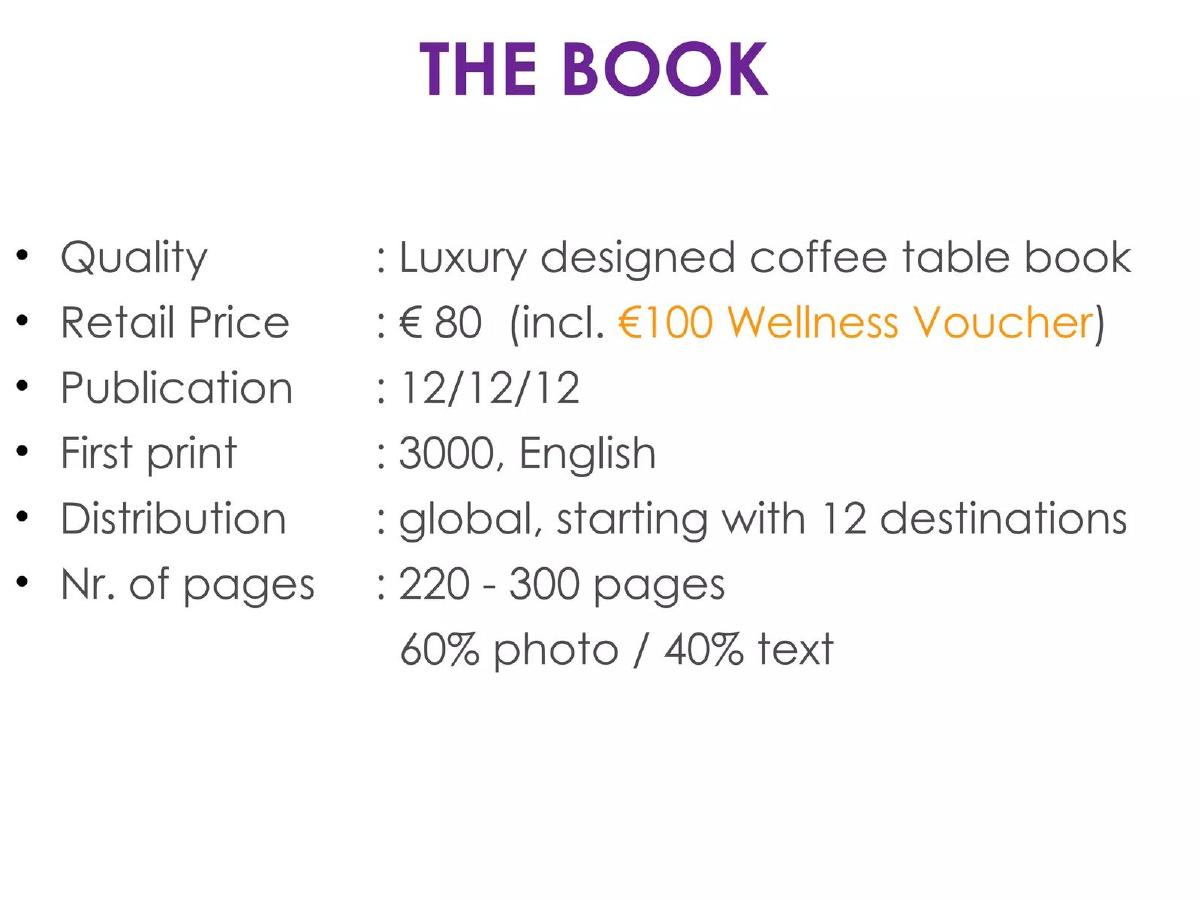
- The core product is a 'Luxury designed coffee table book' with a retail price of €80, including a €100 Wellness Voucher (Slide 2).
- The initial print run is 3,000 English copies, with global distribution starting in 12 destinations (Slide 2).
- The company has an online presence via health-cuisine.com and a Facebook page, indicating early digital engagement (Slide 3).
- Media coverage and partnerships with entities like Hotello TOP and Total Wellness are presented to demonstrate market visibility (Slide 4).
- The identified problem is consumer confusion regarding healthy food due to 'hype / marktet turbidity / haziness' and unreliable health claims (Slide 5).
- The proposed solution is to build a 'multi-media platform' that makes information accessible to a 'happy few' (Slide 6).
- The revenue model for 2012 targets 3,000 book pre-sales, projecting €179,000 in revenue and a 29% profit of €52,000 (Slide 7).
- Scalability plans include 'HC Bookings' (partner hotels, booking engine), 'Travel & Tours' (holidays, 12-destinations-tour), 'Membership', and 'HC Awards' (Slide 8).
Health Cuisine Pitch Deck Teardown
This teardown analyzes the Health Cuisine pitch deck, focusing on the initial 10 slides provided from a larger 39-slide presentation. The deck outlines a strategy centered around a luxury culinary book, with ambitions to expand into a broader wellness and hospitality platform. The analysis will proceed slide-by-slide, followed by sections on what works, what is missing, and what founders can learn from this example.
Slide 1: Cover Slide
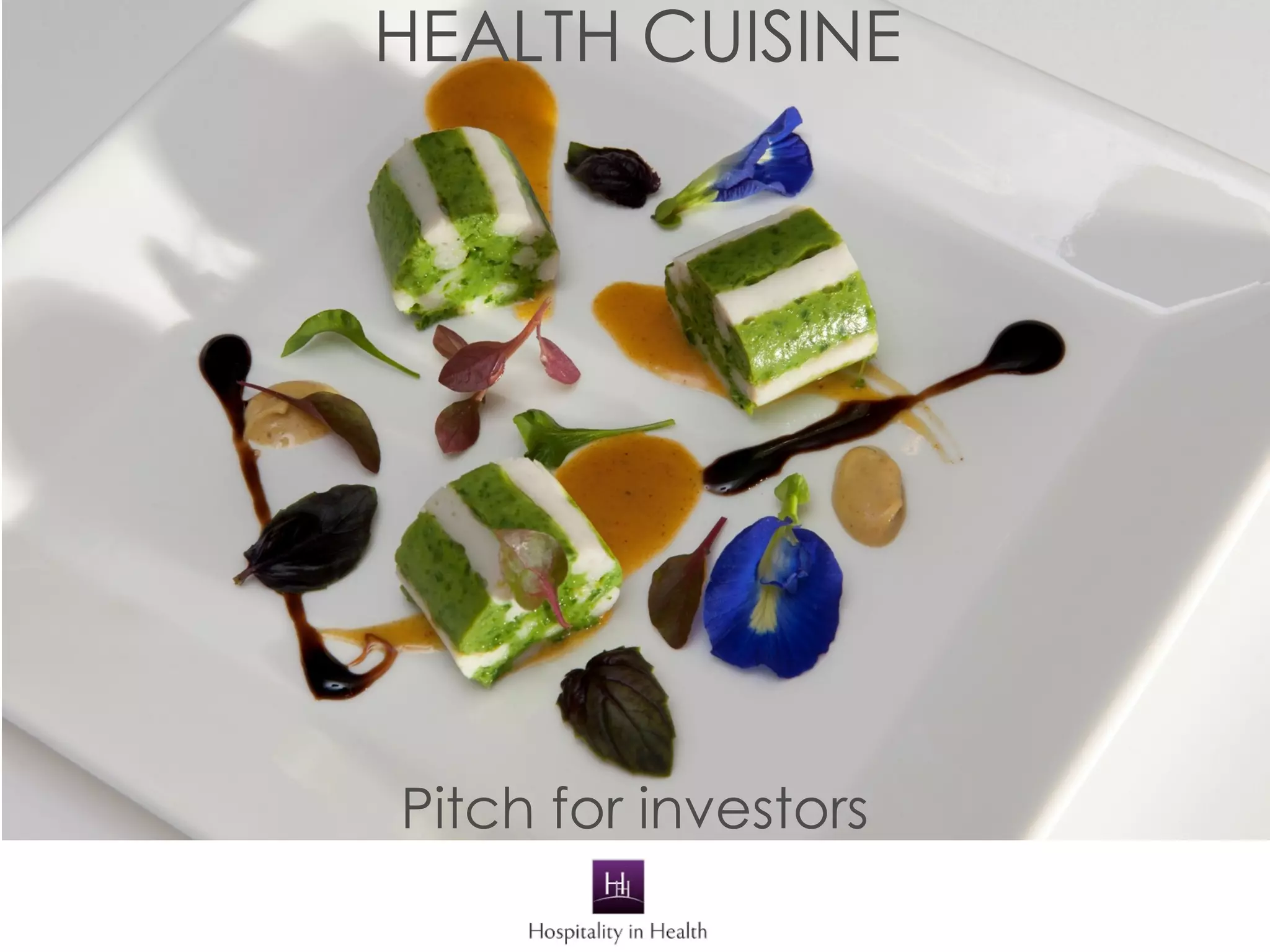
The cover slide features a high-quality, artfully plated dish, suggesting a focus on gourmet or aesthetically pleasing food. The title 'HEALTH CUISINE' is prominently displayed at the top, with 'Pitch for investors' at the bottom. A small logo, 'Hl Hospitality in Health', is positioned at the very bottom. The visual immediately conveys a premium, food-related offering, possibly within the hospitality or wellness sector, aligning with the tagline 'Hospitality in Health'.
Slide 2: THE BOOK
This slide details the core product: a book. It is described as a 'Luxury designed coffee table book'. Key specifications are listed:
Retail Price: € 80 (incl. €100 Wellness Voucher) · Publication: 12/12/12 · First print: 3000, English · Distribution: global, starting with 12 destinations · Nr. of pages: 220 - 300 pages, with a composition of 60% photo / 40% text
The inclusion of a €100 Wellness Voucher with an €80 book suggests a value proposition that extends beyond the book itself, potentially linking to future services or partners. The specific publication date '12/12/12' indicates a past event, implying this deck might be historical or pre-publication.
Slide 3: WE'RE ONLINE & SOCIAL
This slide demonstrates the company's digital presence. It features screenshots of a website, 'www.health-cuisine.com', and a Facebook page, 'www.facebook.com/healthcuisinebook'. The website screenshot shows a clean layout with images of food and book pages, indicating content related to '12 Chefs, 12 Destinations, 2012 Release'. The Facebook page screenshot shows 234 likes and content related to 'Health Cuisine - 12 Chefs, 12 Destinations'. A prominent 'Like' button icon is displayed at the top right, reinforcing the social media aspect. This slide aims to show early traction and engagement in the digital space.
Slide 4: MEDIA
This slide highlights media coverage and partnerships. It presents several snippets of articles and logos of partner organizations. Visible elements include:
An article from 'Hotello TOP' mentioning 'Health Cuisine - 12 Chefs, 12 Bestemmingen'. · A piece from 'Total Wellness' with a large image and text. · A blog post from 'Martin Kubler' titled 'Guest Post: Crowdfunding "Health Cuisine"'. · Logos of 'International culinary tourism association', 'ASIA & Middle East FOOD TRADE', 'HORECA', 'SPAFINDER', and 'HOTELIER INDONESIA'.
This slide serves to build credibility by showcasing external validation and strategic alliances within the hospitality and wellness industries.
Slide 5: What is the problem/demand?
This slide addresses the market problem Health Cuisine aims to solve. It starts with the question 'Wat is healthy food?' (which appears to be a typo for 'What'). The problem is broken down into three points:
FACT: Rising demand in higher quality levels of wellness, healthy nutrition & prevention → pleasure & health · BUT...: like 'green', CSR and organic these principles are over-marketed, an abundance of quality labels · RESULT: → hype / marktet turbidity / haziness → health claims turn unreliable
The conclusion drawn is that 'The consumer is confused (or misled)'. This frames the problem as a lack of clarity and trustworthiness in the healthy food market, which Health Cuisine presumably aims to rectify or navigate.
Slide 6: SUPPLY
Following the problem statement, this slide outlines Health Cuisine's approach to meeting the demand. It answers 'How do we meet demand?' and 'What makes it unique?' and 'What is our advantage?'.
How do we meet demand?: We make info for the 'happy few' more accessible; We build up a multi-media platform. · What makes it unique?: Never been done before, market is opening. · What is our advantage?: Access to niche market via HIH' Luxury Hotels and Spa & Wellness global network; Knowledge + Top Team + Creative freedom.
The slide positions Health Cuisine as an innovator creating a multi-media platform to serve a niche market, leveraging an existing network and internal expertise.
Slide 7: REVENUE MODEL 2012
This slide presents a specific revenue projection for the year 2012, focused on book pre-sales. It targets '3000 book pre-sales' for a total of '€ 179.000'. The revenue mix is detailed:
1200 books (12 Hotels x 100 x € 40) = € 48.000 · 650 books (investors x €60) = € 39.000 · 1150 books (at €80 retail price) = € 92.000
The slide also provides 'Margins & Profitability @ 3000 books': '€ 127K (costs) / € 179K → 29% profit € 52.000'. This offers a clear, albeit limited, financial snapshot of the initial book venture.
Slide 8: SCALABILITY 3
This slide outlines the long-term vision for diversification and expansion beyond the initial book. Titled 'If we think bigger, how can we diversify & expand?', it lists several potential avenues:
HC Bookings: Health Cuisine partner hotels, Hotel Bookings engine, Quality Seals of Excellence · Travel & Tours: Health Cuisine holidays, 12-destinations-tour · Membership: Health Cuisine community · HC Awards: Best Health Chef competitions
This demonstrates a strategic plan to leverage the brand and network established by the book into a broader ecosystem of wellness and hospitality services.
Slide 9: DEVELOPMENT COST
This slide details the costs associated with developing the book. It states 'For print-ready book' the cost is '€ 39.000', with an arrow pointing to 'SYMBID', possibly a partner or a cost category. It further breaks down 'Development costs for 9 chapters':
Cost per chapter +/- € 4.000 · Travel, studio luggage, etc. · Photography, editing, website · Graphic design, text, etc. · Unforeseen + extra's
This provides transparency on the initial investment required to produce the core product.
Slide 10: PARTICIPANT PROFILE
This slide describes the profile and terms for participating hotels. It states 'Participating Hotel:' with an arrow pointing to the 'Hl Hospitality in Health' logo. Key details include:
'Qualified Hotel or Resort participant to fill a chapter in Health Cuisine' · 'direct via HIH B.V. (shares optional)' · '€4000 = 100 books value €8000 (50% off + customized cover)' · 'Participation agreement in place'
This slide clarifies the business model for engaging with hotels, indicating a fee for participation which includes a bulk purchase of books at a discount, and the potential for equity involvement.
What Works Well
The Health Cuisine pitch deck effectively communicates a clear initial product and a vision for expansion. The cover slide (Slide 1) is visually appealing and sets a premium tone. Slide 2, 'THE BOOK', clearly defines the core offering with specific details on price, publication date, print run, and distribution, which is helpful for investors to understand the immediate business. The inclusion of a €100 Wellness Voucher with the book (Slide 2) is an interesting value-add that hints at future partnerships or services. The 'WE'RE ONLINE & SOCIAL' (Slide 3) and 'MEDIA' (Slide 4) slides provide early evidence of market engagement and credibility through existing digital presence and media mentions. This shows that the company is not starting from scratch in terms of brand building. The problem statement on Slide 5 is well-articulated, identifying a genuine market need for clarity in the healthy food space. The 'REVENUE MODEL 2012' (Slide 7) is specific, detailing the target pre-sales, revenue mix, and projected profit, giving a concrete financial outlook for the initial phase. The 'SCALABILITY 3' slide (Slide 8) demonstrates foresight and ambition, outlining multiple potential growth avenues beyond the initial book, which can excite investors about the long-term potential. Finally, the 'DEVELOPMENT COST' (Slide 9) and 'PARTICIPANT PROFILE' (Slide 10) slides provide practical details on the cost structure and how partners are brought into the ecosystem, showing a thought-out operational plan.
What Is Missing
Despite its strengths, the Health Cuisine pitch deck has several notable omissions. Crucially, there is no explicit 'ask' for funding presented in these 10 slides. Investors typically look for a clear statement of how much capital is being sought and what it will be used for. There is also no dedicated 'Team' slide, which is a significant oversight as investors often back the founders as much as the idea. While Slide 6 mentions 'Top Team' as an advantage, no details about the team members, their experience, or their roles are provided. The deck lacks a comprehensive financial forecast beyond the initial 3,000 book pre-sales in 2012; there are no projections for future revenue, profitability, or cash flow as the company scales into bookings, travel, or memberships. A competitive analysis is also absent, leaving investors to wonder how Health Cuisine differentiates itself from existing players in the wellness, culinary, or hospitality media space. Furthermore, while 'SCALABILITY 3' (Slide 8) outlines future plans, there's no clear roadmap or timeline for implementing these ambitious expansions. The deck also does not include a 'Market Size' slide, which would quantify the opportunity beyond the initial book sales. Finally, the legal structure or intellectual property protection for the 'multi-media platform' or 'Quality Seals of Excellence' is not discussed.
What a Founder Should Copy
Founders can learn several valuable lessons from the Health Cuisine pitch deck. Firstly, the clear and detailed presentation of the initial product (the book) on Slide 2 is excellent. Defining specifications, pricing, and distribution upfront helps investors quickly grasp the core offering. Secondly, the demonstration of early traction through online presence (Slide 3) and media coverage/partnerships (Slide 4) is a strong signal of market validation and brand building. Showing that the company is already engaging with its audience and industry partners builds confidence. Thirdly, the structured problem statement on Slide 5, moving from 'FACT' to 'BUT...' to 'RESULT', is an effective way to articulate a market need and position the company as a solution. Fourthly, providing a specific, albeit limited, revenue model with projected profitability for the initial phase (Slide 7) is crucial. This shows a clear path to generating income and understanding unit economics for the first product. Lastly, outlining a compelling vision for scalability (Slide 8) beyond the initial offering demonstrates long-term thinking and the potential for a much larger business. This can capture investor imagination and show that the initial product is a stepping stone to a broader platform. The transparency on development costs (Slide 9) and partner engagement terms (Slide 10) also adds a layer of professionalism and clarity to the operational aspects of the business.
Frequently asked questions
- What is the primary product or service offered by Health Cuisine?
- The primary product is a luxury designed coffee table book titled 'Health Cuisine - 12 Chefs, 12 Destinations'. This book is intended to feature content from participating hotels and chefs, serving as a foundational element for a broader multi-media platform.
- What is the proposed revenue model for Health Cuisine?
- The revenue model for 2012 is based on 3,000 book pre-sales, generating €179,000. This includes sales to hotels, investors, and retail customers. The projected profit from these sales is €52,000, representing a 29% profit margin.
- How does Health Cuisine plan to scale its business?
- Health Cuisine plans to scale by diversifying into 'HC Bookings' (partner hotels, booking engine, quality seals), 'Travel & Tours' (Health Cuisine holidays, 12-destinations-tour), 'Membership' for a community, and 'HC Awards' for chef competitions.
- What problem does Health Cuisine aim to solve?
- Health Cuisine aims to address consumer confusion in the healthy food market. The deck states that rising demand for wellness and healthy nutrition is met with 'hype / marktet turbidity / haziness' and unreliable health claims, leading to a confused or misled consumer.
- What are the stated development costs for the book?
- The development cost for a print-ready book is €39,000. This includes costs for 9 chapters, with an approximate cost per chapter of €4,000, covering travel, photography, editing, website, graphic design, and unforeseen expenses.