Heal's 2020 deck is a sophisticated presentation designed for a later-stage $100M round. It moves beyond the simple 'Uber for doctors' premise of its early days to focus on 'Value-Based Care' (VBC). The deck relies heavily on clinical validation, citing an $88MM healthcare cost saving for partners and a 71% reduction in avoidable ER visits. By positioning the home as the primary site for healthcare delivery, Heal addresses social determinants of health that traditional clinics miss. The presentation is dense with evidence, featuring logos from major payers like Anthem and Humana, and clinical…
Key takeaways
- The company reports delivering 200,000 house calls and telehealth visits with a +76 Net Promoter Score (Slide 3).
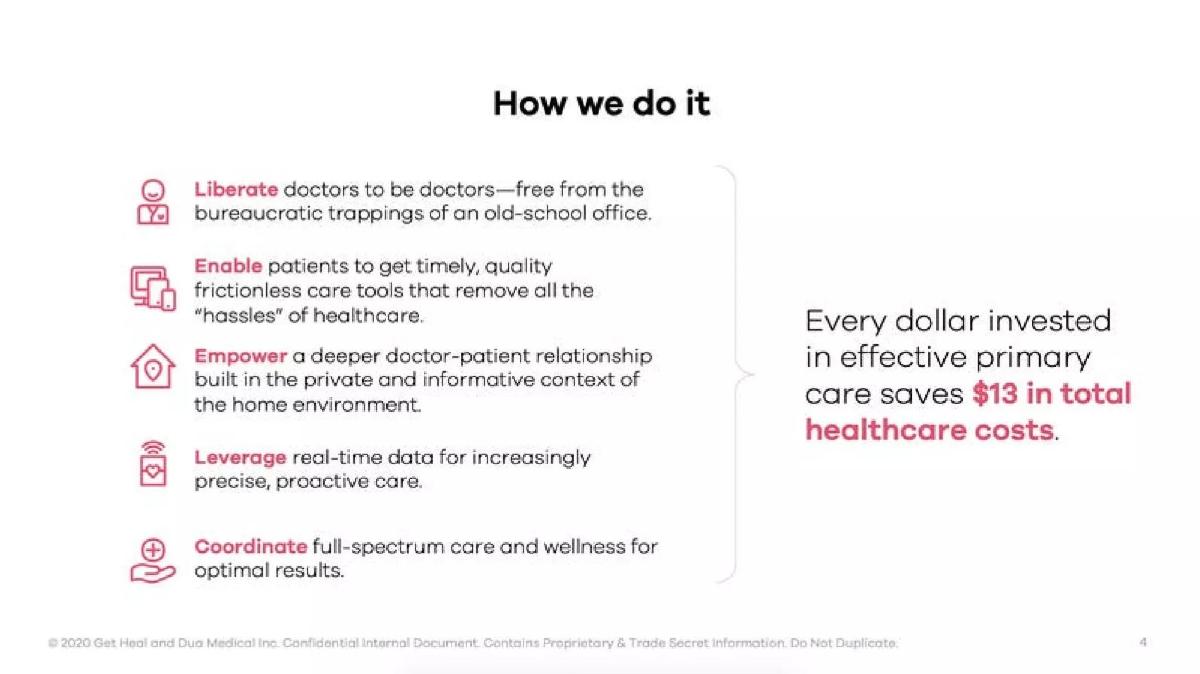
- Heal claims that every dollar invested in effective primary care saves $13 in total healthcare costs (Slide 4).
- The platform integrates with major health data providers including Epic, Apple HealthKit, and drchrono (Slide 14).
- Clinical outcomes include a 27% reduction in ER visits and a 27% reduction in hospital admissions (Slide 20).
- The revenue model is diversified across Full Risk, Value-based PCP Cap, and Fee-for-service (Slide 21).
- Heal providers see 70% fewer patients than traditional office-based providers, allowing for 550% more time per patient (Slide 13).
- The company targets high-cost chronic patients, noting an average medical cost of $41,000 per patient per year before Heal intervention (Slide 20).
- The team includes high-profile figures such as Paul Jacobs (Former CEO of Qualcomm) and Jeb Bush (Former Governor of Florida) on the board (Slide 23).
Executive Summary and Traction
Slides 1-3: The Value Proposition and Proof of Concept
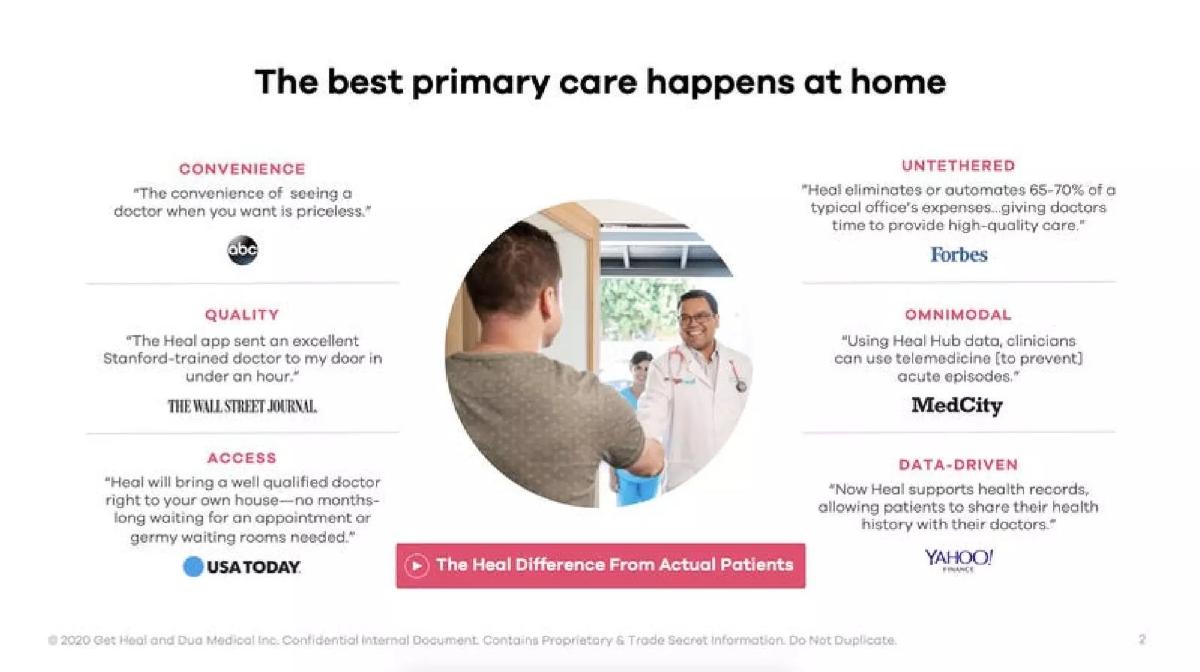
The deck opens with a clear, patient-centric mission: "Open your door to better care." Slide 1 immediately establishes credibility by highlighting Heal's ranking as #13 on the 2020 CNBC Disruptor 50 list. This is a high-signal start for a later-stage deck, signaling that the company is already recognized by major financial media. Slide 2 reinforces this with a wall of third-party validation from ABC, Forbes, The Wall Street Journal, USA Today, MedCity, and Yahoo Finance. Each quote targets a specific pillar: convenience, quality, access, cost-efficiency, and data. Forbes specifically notes that Heal "eliminates or automates 65-70% of a typical office's expenses," which is a critical point for investors interested in the unit economics of healthcare delivery.
Slide 3, titled "Who is Heal," provides the hard metrics that back up the hype. The company reports 200,000 house calls and telehealth visits delivered. The Net Promoter Score (NPS) of +76 is exceptionally high for the healthcare sector, which typically suffers from low consumer satisfaction. Most importantly for payers, Heal claims a 71% reduction in avoidable ER visits and a 28% reduction in admissions. The slide concludes with a massive figure: $88MM in healthcare cost savings for leading employers and insurance partners. This slide serves as the 'hook' for the entire deck, proving that the model works at scale.
The Economic and Clinical Logic
Slides 4-7: Why Home-Centric Care Wins
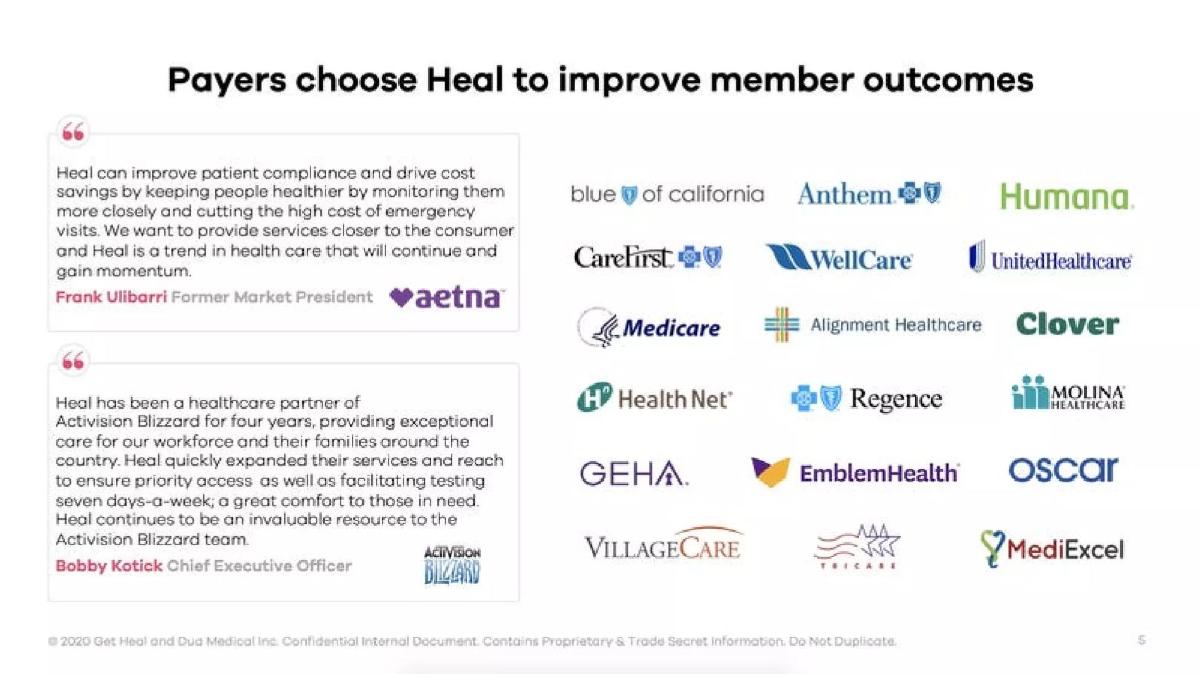
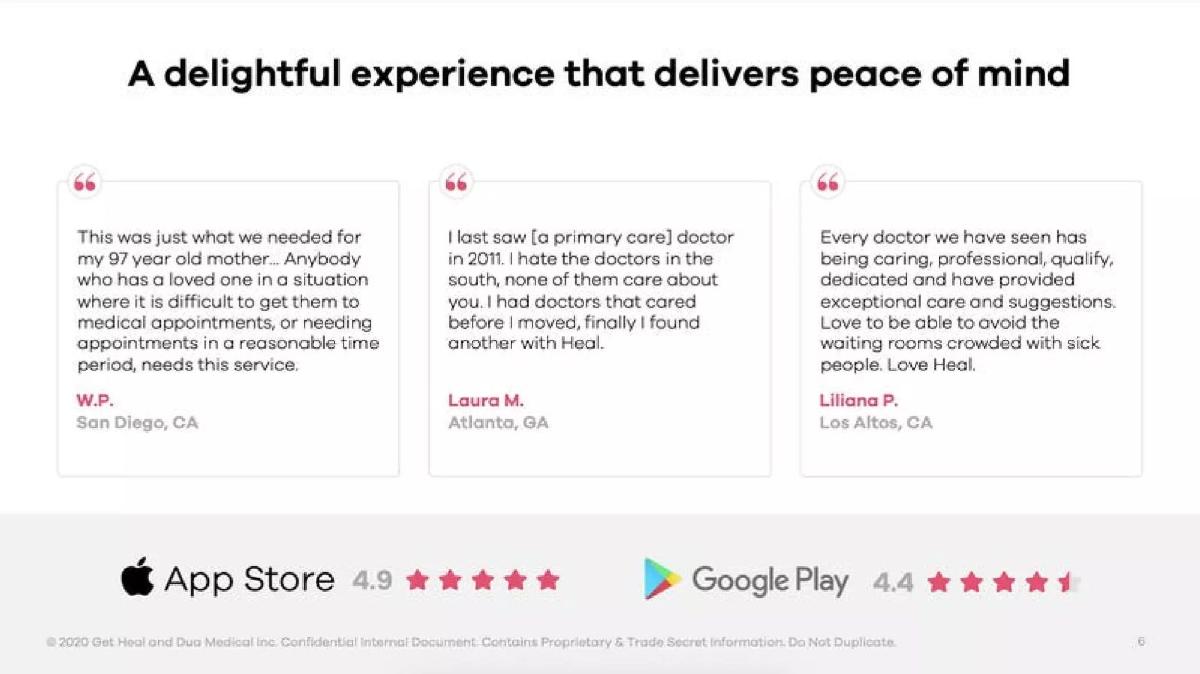
Slide 4 introduces a powerful economic multiplier: "Every dollar invested in effective primary care saves $13 in total healthcare costs." This sets the stage for Heal's role as a cost-containment engine. Slide 5 displays a robust roster of payer partners, including Blue of California, Anthem, Humana, UnitedHealthcare, and Medicare. Testimonials from Frank Ulibarri (Former Market President, Aetna) and Bobby Kotick (CEO, Activision Blizzard) demonstrate that Heal is serving both the insurance market and the self-insured employer market. Slide 6 adds the consumer voice with a 4.9-star App Store rating and a 4.4-star Google Play rating, proving that the tech interface is as reliable as the medical service.
Slide 7 pivots to the clinical rationale, citing Harvard Business School research that "80% of health outcomes are impacted by social determinants." By moving care into the home, Heal claims it can assess these determinants—such as fall risks, food insecurities, and substance abuse—that are invisible in a clinic setting. This slide is crucial for justifying the higher cost of a house call versus a clinic visit; the argument is that the home visit provides superior data that leads to better long-term outcomes.
Product and Service Integration
Slides 8-12: The Omnimodal Care Model
Heal describes its service as "managed care" that combines house calls, telemedicine, remote monitoring, and care coordination (Slide 8). Slide 9 emphasizes that this is a full-family solution, covering infants, children, adults, and seniors. The service range is broad, including chronic disease management, point-of-care tests, and on-demand care available 365 days a year. Slide 10 showcases the mobile interface, highlighting "100% up-front price transparency," a direct jab at the opaque billing practices of traditional hospitals.
Slide 11 details the "Comprehensive, data-driven doctor house calls." It mentions that every visit includes a highly-vetted, licensed physician and a certified medical assistant. They carry an "on-the-go medical kit" capable of IV administration, ultrasound, EKG, and various screenings. A quote from Dr. Eric Topol (Editor-in-Chief, Medscape) adds significant clinical weight to the presentation. Slide 12 focuses on the "One-touch telehealth" aspect, emphasizing that no downloads or registrations are required, which lowers the barrier to entry for elderly patients.
Provider and Data Strategy
Slides 13-15: The Engine Under the Hood
Slide 13 addresses the provider side of the marketplace. Heal claims to hire only 14% of applicants. The comparison between "Traditional office-based providers" and "Liberated Heal providers" is stark: Heal doctors see 70% fewer patients but have 550% more time per patient. This is a key retention strategy in an industry plagued by physician burnout. Slide 14 explains how Heal aggregates data from Epic, Apple HealthKit, and drchrono to create a "precision, personal medicine" profile. Slide 15 introduces the "Heal Hub," a proprietary remote monitoring device. The slide includes a chart showing an 11% decrease in systolic blood pressure within 100 days for a cohort of 237 patients, providing the clinical proof that investors in a $100M round require.
Ecosystem and Outcomes
Slides 16-20: Value-Based Care in Action
Slide 16 illustrates the "Integrated multi-disciplinary care team," which surrounds the member with doctors, care coordinators, behavioral health experts, and social workers. Slide 17 shows how Heal integrates with a patient's preferred network of specialists and hospitals, positioning itself as a hub rather than a silo. Slide 18 summarizes the "Heal experience" from the first house call through to long-term monitoring. Slide 19 provides a flowchart of how Heal prevents ER visits through digital tracking and diligent member engagement.
Slide 20 is perhaps the most important slide for the financial case. It focuses on chronic disease patients who cost an average of $41,000 per year. Heal claims to save $3,412 per patient per year, resulting in an 11% lower overall cost for payers. The metrics are specific: 90% of care gaps closed and a 37% reduction in specialist costs. This slide transforms Heal from a convenience app into a sophisticated financial instrument for risk management.
Revenue Model and Leadership
Slides 21-23: Business Model and The Team
Slide 21 outlines three revenue models: Full Risk (where Heal delivers care at a fixed Medical Expense Ratio), Value-based PCP Cap (gain-sharing based on quality and savings), and Fee-for-service. This diversity shows that Heal can adapt to different payer requirements. Slide 22 lists the expansion markets, covering major hubs from NYC to Houston. Finally, Slide 23 introduces the team. The board includes Paul Jacobs (Former CEO of Qualcomm) and Jeb Bush (Former Governor of Florida), providing the company with massive political and technological capital. The executive team features veterans from McKinsey, Microsoft, and UCLA, rounding out a group that appears capable of handling the regulatory and technical hurdles of national healthcare.
What Works in This Deck
Clinical and Financial Validation: The deck does not rely on vague promises. It uses specific percentages (27% reduction in ER visits, 11% reduction in costs) and cites reputable sources like Harvard Business School and Dr. Eric Topol. For a $100M round, this level of evidence is mandatory.
Payer Logos: The inclusion of nearly every major US health insurer on Slide 5 is a massive signal of market fit. It shows that the largest incumbents in the industry have already vetted and contracted with Heal.
The Provider Angle: By showing how they solve the "doctor burnout" problem (Slide 13), Heal addresses a major supply-side constraint in healthcare. Investors can see that the company has a sustainable way to recruit and retain the talent necessary for house calls.
What is Missing from This Deck
The Ask: There is no slide detailing how much capital is being raised in this specific deck or what the valuation expectations are. While the catalogue facts state $100M, the deck itself is silent on the terms.
Unit Economics: While the deck mentions that Heal saves payers money, it does not explicitly break down the cost of a house call versus the revenue generated per visit. The margin profile of the house call model is a common point of skepticism for investors, and this deck addresses it only indirectly through the "Value-Based Care" argument.
Competitive Landscape: There is no mention of other home-health players or telehealth giants like Teladoc or Amwell. A slide addressing how Heal defends its territory against these competitors would have been useful.
What a Founder Should Copy
The 'Proof' Slide: Slide 3 is a masterclass in summarizing traction. It combines volume (200k visits), quality (76 NPS), clinical impact (71% ER reduction), and financial impact ($88MM savings) on a single, easy-to-read page.
Focusing on High-Cost Users: Slide 20 is a great example of how to frame a solution around the most expensive part of a problem. By focusing on chronic patients costing $41k/year, Heal makes its $3.4k saving look like an essential necessity rather than a luxury.
Third-Party Validation: Using quotes from industry titans and major media outlets (Slides 2 and 11) builds a "wall of credibility" that makes it difficult for an investor to dismiss the company as just another startup.
Conclusion Heal's 2020 deck is a dense, evidence-heavy document that successfully transitions the company from a consumer-tech play to a serious healthcare infrastructure player. It uses the home-centric model not just as a convenience, but as a superior clinical environment for managing high-cost chronic patients. The combination of high-profile leadership, major payer partnerships, and validated clinical outcomes makes it clear why the company was able to secure $100M in funding.
Frequently asked questions
- What is Heal's primary value proposition to insurance payers?
- Heal focuses on reducing total cost of care through proactive, home-based intervention. According to slide 20, they achieve an 11% lower overall cost for payers in the first year. By closing 90% of care gaps and reducing ER visits by 27%, they move patients from high-cost emergency settings to lower-cost primary care, which is particularly effective for chronic disease management.
- How does Heal differentiate its provider experience from traditional clinics?
- Slide 13 highlights that Heal 'liberates' doctors by reducing bureaucracy by 90%. While traditional office-based providers see 40 patients a day in a rushed environment, Heal providers see 70% fewer patients. This results in 550% more time per patient, focusing on quality of care rather than volume, while using 21 minutes of commute time for revenue-generating telemedicine.
- What role does technology play in the Heal ecosystem?
- Technology is the connective tissue between the home and the clinical team. Slide 15 introduces the 'Heal Hub,' a device that accurately reports vitals like SpO2, HbA1C, and BMI to doctors in real-time. Slide 14 shows how this data is combined with historic records from Epic and wearables data from Apple Watch to create a 'precision, personal medicine' profile.
- Which markets was Heal operating in or planning for in 2020?
- Slide 22 lists several major US metropolitan areas as current or planned markets. These include Washington D.C. (including VA Metro), New York City, New Jersey, Chicago, Southern California (Los Angeles and Orange County), Seattle/Spokane, Atlanta, Houston, and Charlotte. This indicates a strategy focused on high-density urban and suburban areas where provider logistics are most efficient.
- Does the deck disclose the specific terms of the $100M raise?
- No, the deck does not include a 'The Ask' slide or specific valuation details. As a later-stage deck used for a $100M round (as noted in the catalogue facts), it focuses on demonstrating a proven, scalable model and clinical outcomes rather than the mechanics of the fundraise itself. It omits specific use-of-funds breakdowns.