Body of Knowledge (B-OK) pitches a comprehensive health and wellness ecosystem centered on a mobile application that facilitates behavior modification. The venture, led by Dr. Robert Moore, moves away from traditional journaling and calorie counting, instead focusing on a three-stage progression: meal frequency, nutrition, and finally, exercise. The business model is notably diverse, proposing four distinct revenue streams including meal delivery ($150-250 per month), packaged goods ($30-50 per month), and coaching subscriptions ($5-39 per month). While the deck provides a clear scientific fr…
Key takeaways
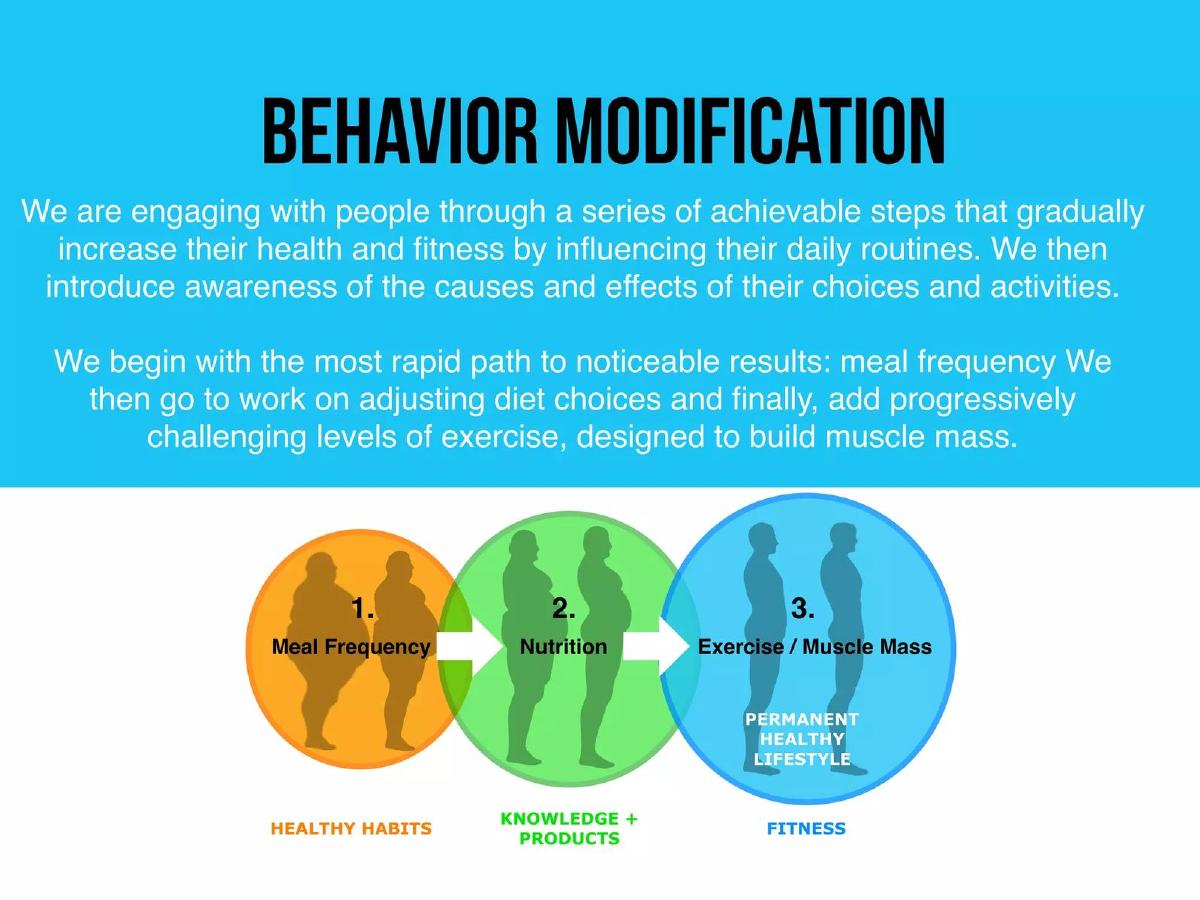
- The platform utilizes a three-step behavioral progression: Meal Frequency, Nutrition, and Exercise/Muscle Mass (Slide 3).
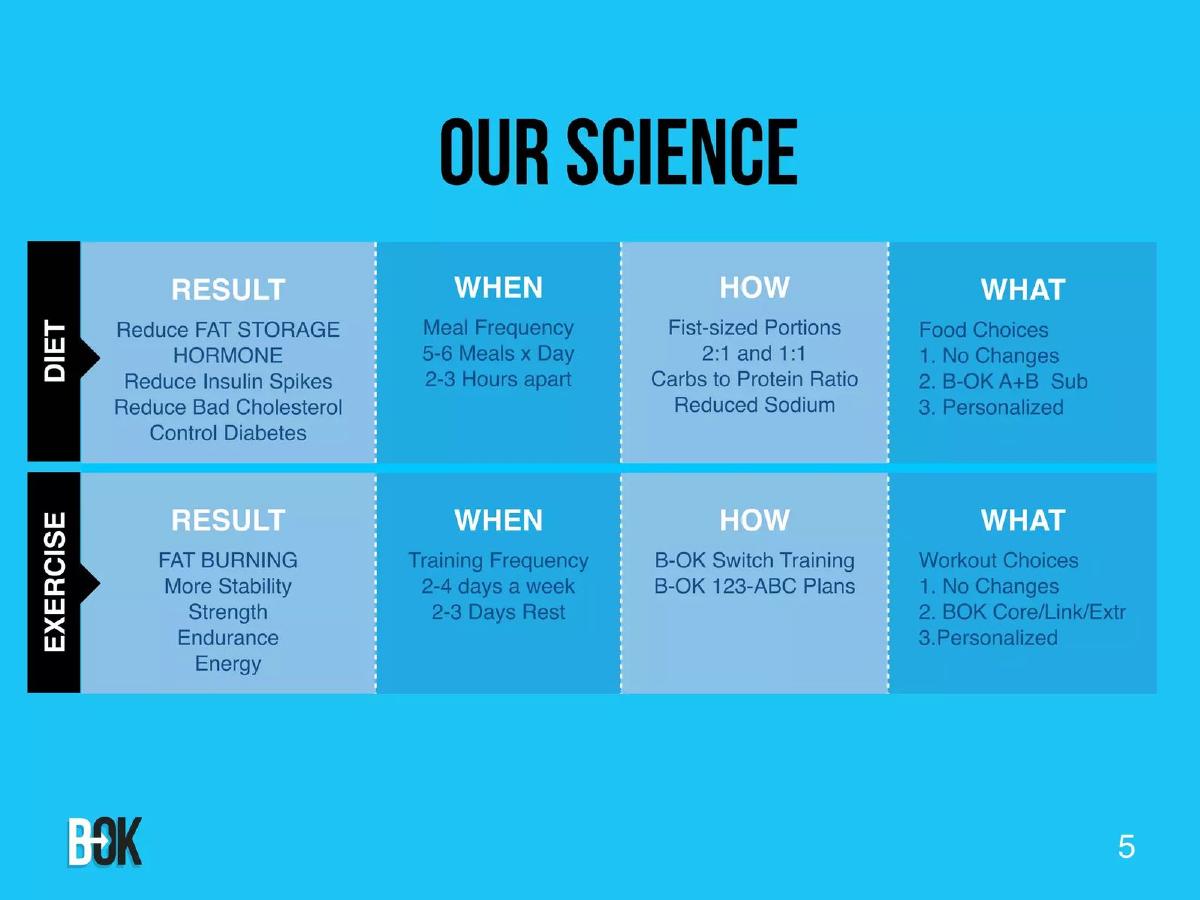
- The dietary 'science' focuses on 5-6 meals per day at 2-3 hour intervals using fist-sized portions (Slide 5).
- B-OK employs an 'Uber-style' coaching model, utilizing motivated individuals rather than just experienced professionals to drive accountability (Slide 9).
- Revenue is diversified across four streams, with meal delivery being the highest ticket item at $150-$250 per month (Slide 13).
- The venture has a long history, citing a book publication in 2006 and a wellness program with Halliburton in 2007 (Slide 17).
- The leadership team includes a medical doctor, a Harvard MBA, and a CMO with experience in 25 venture-backed startups (Slide 15).
- The deck omits a specific investment ask, valuation, or use of proceeds section.
- The product strategy relies on the app as a central hub for cross-selling food, coaching, and gym memberships (Slide 11).
Slide-by-Slide Teardown
Slide 1: Title and Vision
The cover slide introduces the brand 'B-OK' (Body of Knowledge). It positions the company as a leader in 'preventative care' with a focus on adopting and sustaining healthy habits. The slide makes a specific product claim: the system works 'without journaling or calorie counting.' The visual elements include a woman holding a pill or small object, accompanied by the tagline 'LOOK BETTER, FEEL BETTER, LIVE LONGER.' This slide sets a broad, consumer-facing tone rather than a clinical one.
Slide 3: Behavior Modification Framework
This slide outlines the three-stage process for user engagement. Stage 1 is 'Meal Frequency' (labeled Healthy Habits), Stage 2 is 'Nutrition' (labeled Knowledge + Products), and Stage 3 is 'Exercise / Muscle Mass' (labeled Fitness). The text explains that the program starts with the 'most rapid path to noticeable results,' which they identify as meal frequency. The goal is to reach a 'PERMANENT HEALTHY LIFESTYLE.' The use of silhouettes showing weight loss progression provides a visual representation of the intended outcome.
Slide 5: Our Science
Slide 5 provides the technical specifics of the program. For diet, the 'Result' is reducing fat storage hormones and insulin spikes. The 'When' is defined as 5-6 meals per day, 2-3 hours apart. The 'How' specifies 'fist-sized portions' and a '2:1 and 1:1 Carbs to Protein Ratio.' For exercise, the focus is on 'FAT BURNING' and strength, with a frequency of 2-4 days a week. This slide is critical as it defines the proprietary 'B-OK Switch Training' and 'B-OK 123-ABC Plans,' though these terms are not explained in detail.
Slide 7: The B-OK App
This slide introduces the digital product. It lists four functional phases: First (meal frequency reminders), Second (exercise reminders), Third (actionable wisdom), and Ongoing (education and prompts). The visual shows an iPhone interface where users can 'Choose Your Coach,' featuring profile photos of individuals named Chris, Steve, and Margaret. This confirms the app is the primary delivery vehicle for the service and the marketplace for coaching.
Slide 9: Coaching Platform
Slide 9 details the 'accelerated progress and subscription services.' The most notable part of this slide is the comparison to Uber. The text states the model 'does not require experienced taxi drivers, so much as enthusiastic, trustworthy people.' This indicates a gig-economy approach to health coaching. A screenshot shows coach profiles for 'Leslie Snare' and 'Julie Harris,' including their specialties (e.g., 'Accountability coach') and testimonials. This slide clarifies that coaching is an 'optional paid subscription.'
Slide 11: App as a Hub for Subscriptions
This slide illustrates the ecosystem. The B-OK app sits at the center of a wheel, with arrows pointing inward from five sources: Coaching Platform, Gyms/Health Clubs, Partner Integrations (health and wellness programs), Nutrition (snacks, meals, supplements), and Metrics & Monitoring. The text claims these channels provide 'inbound source of high-conversion customers.' This slide effectively communicates the company's intent to be a platform that aggregates various wellness services and products.
Slide 13: Revenues and Costs
Slide 13 provides the unit economics and revenue streams. The company identifies four sources of income: 1. Delivered Full Meals ($150 - 250 PM), 2. Curated Packaged Goods ($30-50 PM), 3. Coaching Subscriptions ($5 - 39 PM per seat), and 4. Licensing of content. The 'Costs' section is high-level, listing customer acquisition, revenue share with coaches, and sales/management staff. No specific margins or historical revenue figures are provided on this slide.
Slide 15: Team
The team slide features three named executives and one placeholder. Dr. Robert Moore is the Founder and 'Health and fitness expert.' Steve Latham is the COO and Co-Founder, noted as a 'Harvard MBA' and founder of Encore Metrics. David Shantz is the CMO, credited with roles in over 25 venture-backed startups. The 'Tech Lead' is listed as CTO but lacks a name or photo, suggesting a potential hiring gap in the technical leadership at the time this deck was produced.
Slide 17: Milestones
This timeline slide provides historical context. It shows the brand's evolution over a decade: 2006 (Book publication), 2007 (Halliburton program), 2008 (TV production), 2009 (Incorporation and partnership), and 2016 (Application Launch). This suggests the 'science' and brand have been tested in various formats long before the mobile app was developed. The gap between 2009 and 2016 is not explained.
Slide 19: Conclusion
The final slide summarizes the value proposition. It reiterates that patterns of behavior are 'entrenched and difficult to break' and that B-OK provides the 'tools and structure' to guide people through 'gradual adoption.' It emphasizes 'contextually relevant soundbites' and 'rewards for actions.' The slide serves as a summary of the behavioral psychology approach mentioned throughout the deck.
What Works Well
The deck excels at defining a clear, step-by-step methodology. By breaking down the 'Science' into specific ratios, meal frequencies, and workout schedules (Slide 5), the founders demonstrate they have a concrete plan rather than just a vague idea for a wellness app. The 'Uber-style' coaching model (Slide 9) is a compelling way to address the scalability issues typically associated with human-led health coaching, providing a clear path to high-margin growth if the accountability framework holds up.
The revenue slide (Slide 13) is also a strength. Instead of relying solely on a single subscription fee, the company has identified multiple ways to monetize the user base, including high-ticket physical goods like meal delivery. This diversification suggests a higher potential Lifetime Value (LTV) per user. Finally, the Milestones slide (Slide 17) gives the venture a sense of longevity and 'proven' expertise, showing that the founder has been working in this specific niche for over a decade.
What Is Missing
The most glaring omission is a clear Investment Ask . There is no mention of how much capital the company is seeking, the valuation, or how the funds will be allocated. Without this, the deck functions more as a sales presentation or a company overview than a fundraising tool. Additionally, there is a complete lack of Financial Projections . While revenue streams are listed, there are no forecasts for user growth, burn rate, or break-even points.
The Competitive Landscape is also absent. The health and wellness space is incredibly crowded with incumbents like Noom, MyFitnessPal, and Weight Watchers. The deck fails to explain why B-OK’s 'no journaling' approach is a defensible moat against these giants. Furthermore, the CTO role is a placeholder (Slide 15), which is a significant red flag for a company pitching an 'App as a Hub' strategy. Investors typically want to see a committed technical co-founder in place before committing capital to a mobile-first platform.
Founder's Playbook: What to Copy
Founders should emulate the Behavioral Framework shown on Slide 3. Investors love to see that a product is built on a specific psychological or scientific journey. By showing a progression from 'Meal Frequency' to 'Fitness,' B-OK makes a complex lifestyle change feel manageable and structured. This 'on-ramping' strategy is a great way to explain user retention and product stickiness.
The Ecosystem Map on Slide 11 is another excellent template. It clearly shows how the product interacts with the broader market (gyms, partners, nutrition) and how those interactions drive value back to the core app. This helps investors visualize the 'flywheel' effect of the business. Finally, the Unit Economics breakdown on Slide 13—specifically listing the dollar ranges for different services—is a transparent way to show how the business actually makes money, which is often missing from early-stage decks that only focus on 'growth.'
Frequently asked questions
- What is the core methodology of the B-OK system?
- The B-OK system is built on 'Behavior Modification' through gradual steps. According to Slide 3, it follows a linear path starting with meal frequency to achieve rapid results, followed by nutrition adjustments, and concluding with progressive exercise to build muscle mass. Slide 1 emphasizes that this is achieved without the need for traditional journaling or calorie counting, relying instead on automated reminders and 'actionable wisdom' delivered via their mobile app.
- How does the company plan to generate revenue?
- B-OK proposes a multi-pronged revenue model detailed on Slide 13. This includes full meal delivery ($150-$250 PM), curated packaged goods like snacks and beverages ($30-$50 PM), coaching subscriptions ($5-$39 PM per seat), and the licensing of content and the application to third-party health and wellness programs. This suggests the company views itself as both a logistics/product company and a software-as-a-service (SaaS) provider.
- What is the 'Uber-style' coaching model mentioned in the deck?
- Slide 9 describes a coaching platform where the model is 'similar to Uber drivers.' The company explicitly states that it does not require 'experienced taxi drivers' (highly credentialed professionals) as much as 'enthusiastic, trustworthy people with interest and motivation.' These coaches act as accountability partners, using checklists and actions to keep users on track, which theoretically allows the platform to scale its human-element coaching more rapidly and at a lower cost.
- Who are the key members of the leadership team?
- As shown on Slide 15, the team is led by Founder Dr. Robert Moore, a surgeon and author. He is joined by COO Steve Latham, a Harvard MBA and serial entrepreneur who founded Encore Metrics. David Shantz serves as CMO, bringing experience from over 25 venture-backed startups. The deck also notes a 'Tech Lead' as CTO, though a specific name and photo are omitted for that role.
- What historical traction does the venture claim?
- Slide 17 outlines a decade-long timeline of milestones. It began with the publication of the 'Body of Knowledge' book in 2006, followed by a health and wellness program for Halliburton in 2007. The venture expanded into multimedia and TV production in 2008 and formed a partnership with Metrics Lab in 2009. The most recent milestone listed is the B-OK application launch in 2016.