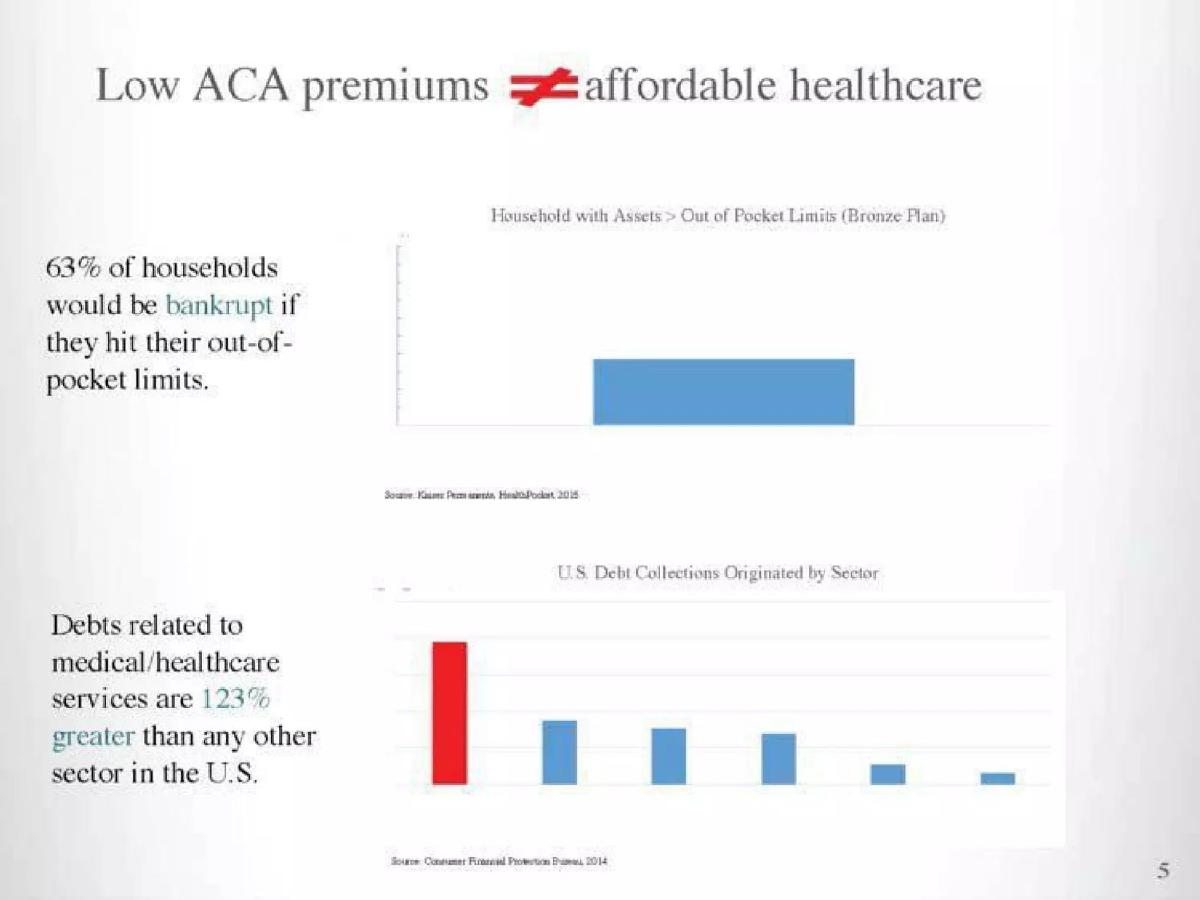
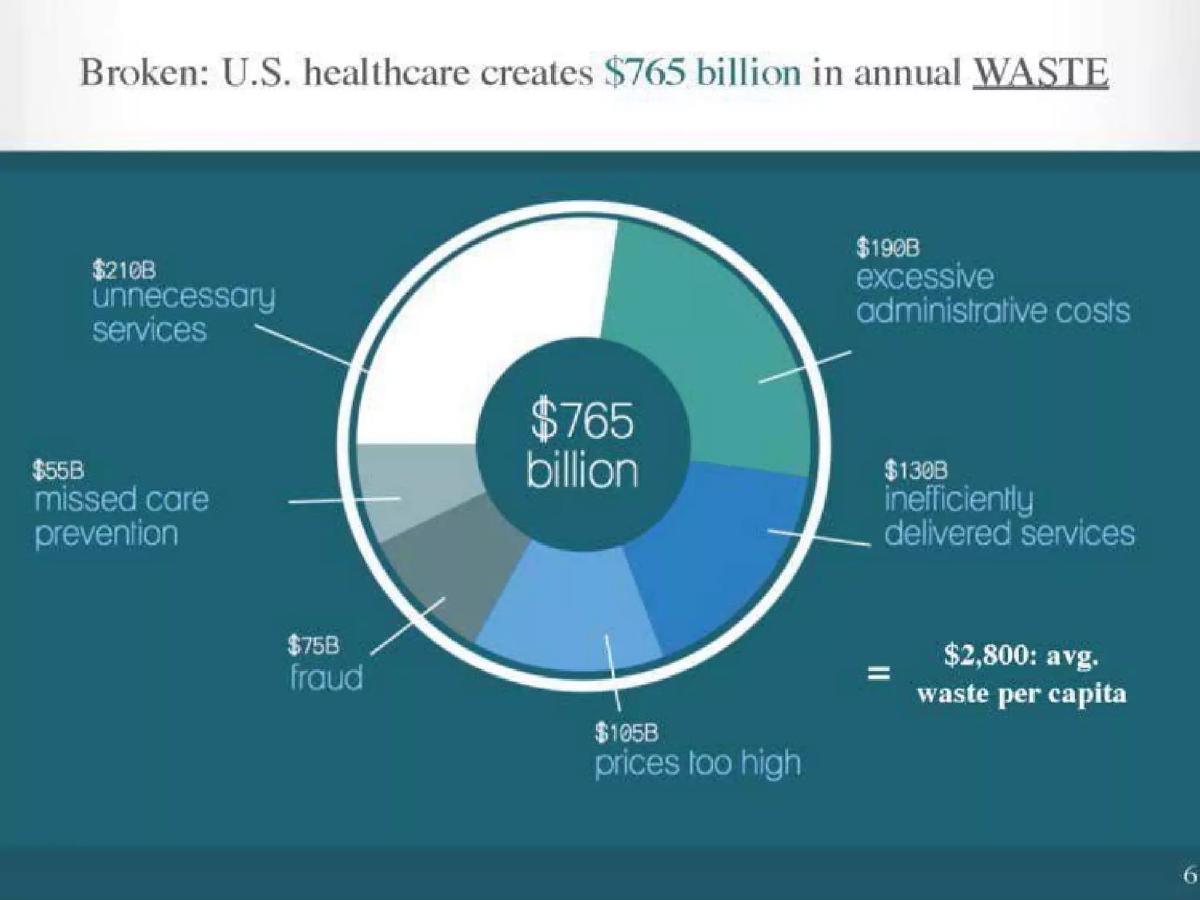
HealthJoy’s 16-slide deck is a masterclass in identifying a massive regulatory shift—the Affordable Care Act—and positioning a product as the necessary 'hub' for the resulting complexity. The deck focuses heavily on the 'pain' of the U.S. healthcare system, citing $765 billion in annual waste (Slide 6) and the fact that 63% of households would face bankruptcy if they hit out-of-pocket limits (Slide 5). While the deck is technically labeled for a Series A (Slide 14), it laid the groundwork for their $12.5M Series B by demonstrating clear unit economics, such as a jump from $12.50 to $25.00 ARP…
Key takeaways
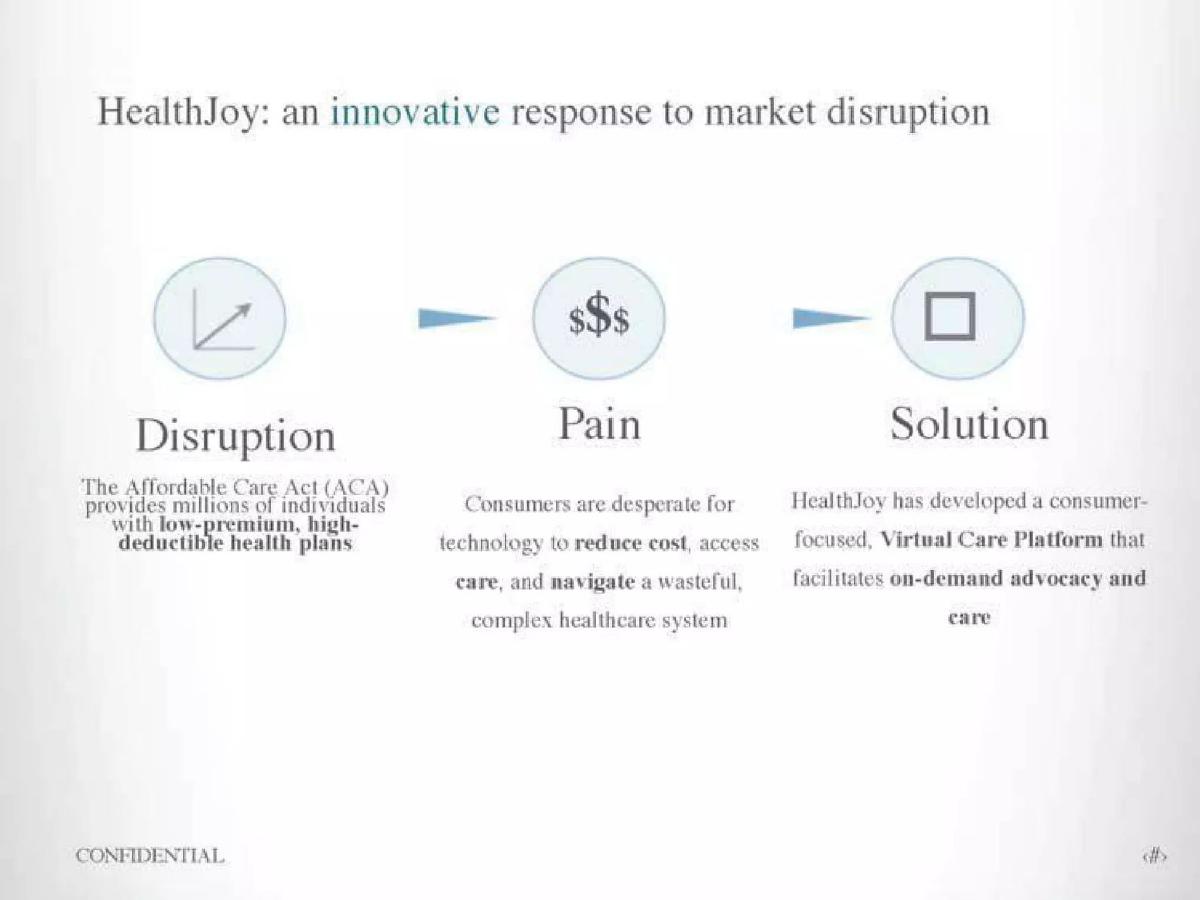
- The deck identifies a specific regulatory catalyst, noting that the ACA created millions of individuals with high-deductible plans (Slide 2).
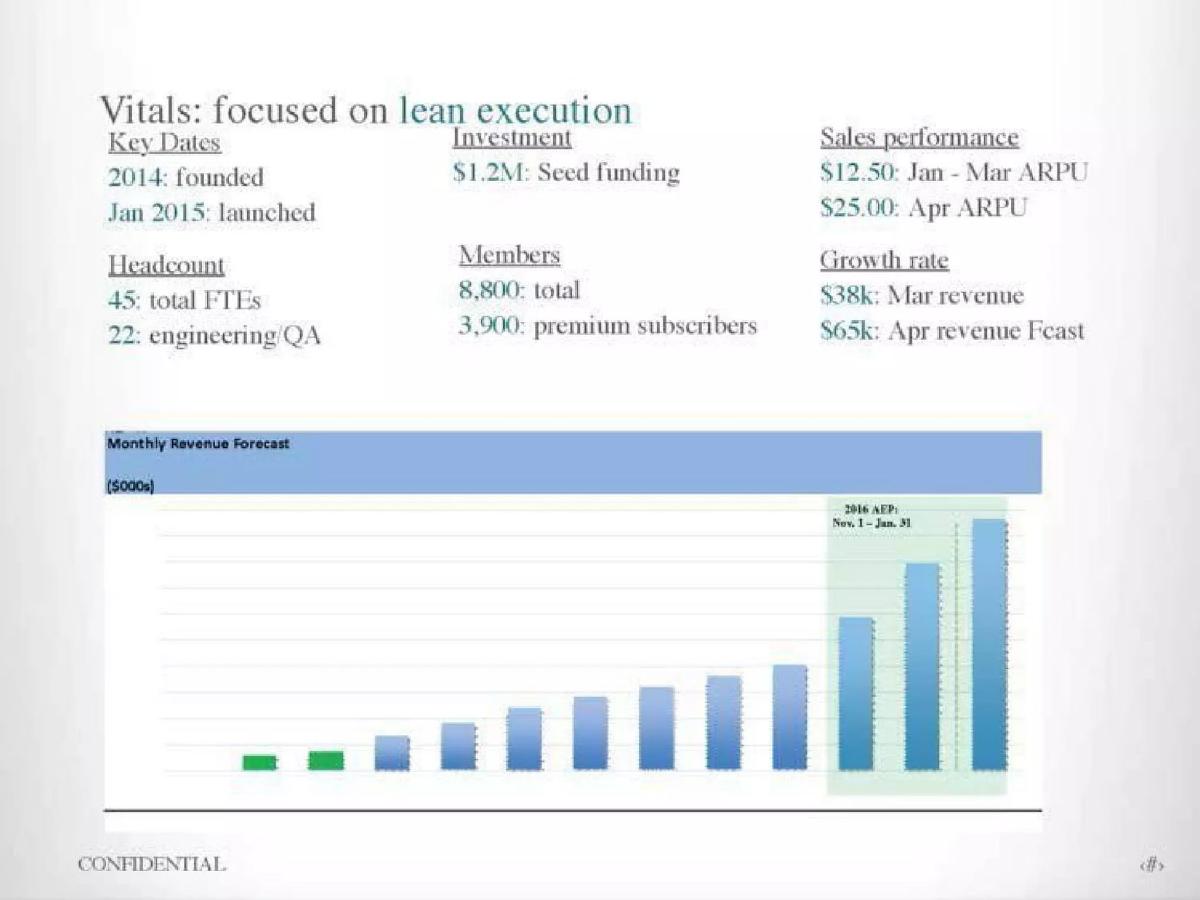
- Revenue growth is shown through a monthly forecast chart and a doubling of ARPU from $12.50 to $25.00 in early 2015 (Slide 3).
- Market sizing is framed by a 35% CAGR in the U.S. individual health plan market (Slide 4).
- The 'Problem' is quantified as $765 billion in annual waste, with $210B attributed to unnecessary services (Slide 6).
- Product value is demonstrated via a 'Medication Optimization' feature that identifies over $100 in average monthly savings for members (Slide 9).
- The business model uses a 'hub and spoke' strategy, utilizing brokers and benefits managers as primary distribution partners (Slide 11).
- The competitive landscape is visualized through a four-way Venn diagram covering Medicine, Transparency, Advocacy, and Navigation (Slide 12).
- The 'Ask' slide (Slide 14) provides a detailed 'Inputs vs. Deliverables' table, specifically targeting 2,500 independent brokers by AEP 2017.
The Narrative: Turning Regulatory Chaos into Opportunity
The HealthJoy pitch deck is a textbook example of how to frame a startup as a necessary solution to a systemic crisis. By anchoring the entire presentation in the wake of the Affordable Care Act (ACA), the founders position their platform not just as a 'nice-to-have' app, but as an essential navigation layer for a broken system. The deck uses a 16-slide structure that moves from macro-economic pain to micro-level product success.
Slides 1-3: The Hook and the Vitals
Slide 1 is a standard title page featuring the tagline 'We make healthcare simple.' It establishes the brand identity immediately. Slide 2 introduces the 'Disruption-Pain-Solution' framework. It explicitly cites the ACA as the disruptor that provided millions with 'low-premium, high-deductible health plans,' leading to a desperate need for technology to reduce costs. Slide 3 , titled 'Vitals: focused on lean execution,' provides a snapshot of the company's health as of early 2015. It lists a headcount of 45 FTEs, $1.2M in seed funding, and 8,800 total members. Most importantly, it shows a doubling of ARPU to $25.00 and a revenue forecast showing aggressive month-over-month growth.
Slides 4-7: Quantifying the Healthcare Crisis
This section of the deck is dedicated to market validation. Slide 4 shows the 'boom time' for individual health plans with a 35% CAGR. Slide 5 pivots to the human cost, stating that 63% of households would be bankrupt if they hit out-of-pocket limits and that medical debt is 123% greater than any other sector in the U.S. Slide 6 is the 'money slide' for the problem statement. It breaks down $765 billion in annual waste into categories like 'unnecessary services' ($210B) and 'excessive administrative costs' ($190B). Slide 7 personifies the confusion with a character 'rolling the dice' on cost traps and coverage confusion, setting the stage for the HealthJoy solution.
Slides 8-10: The Solution and Product Innovation
Slide 8 introduces the 'concierge healthcare in your pocket' concept, showing how HealthJoy moves a user from 'confused' to 'informed and empowered.' Slide 9 focuses on a specific high-value feature: Medication Optimization. By showing a side-by-side app comparison, the deck claims to identify over $100 in average monthly savings for members. Slide 10 uses a 'Real Customer Success Story' featuring Robert, a truck driver. This slide is crucial because it humanizes the data, showing how the concierge team and telemedicine work in a real-world scenario to save a user $200/month.
Slides 11-13: Business Model and Competition
Slide 11 outlines the 'hub and spoke' business model. The 'Hub' is the ACA plan navigation, while the 'Spokes' are various products (dental, vision, Rx) and services (urgent care, labs). It clearly separates distribution into 'Partners' (brokers/benefits managers) and 'Direct to Consumer.' Slide 12 uses a Venn diagram to show HealthJoy at the intersection of Medicine, Transparency, Advocacy, and Navigation, listing competitors like Teladoc and Castlight in their respective silos. Slide 13 provides the hard numbers for revenue: $10-$40 monthly subscriptions and $40 telemedicine consults, plus lead-gen fees ranging from $2 to $100.
Slides 14-16: The Ask, the Team, and Engagement
Slide 14 is the Series A investment slide. It is highly detailed, using an 'Inputs' and 'Deliverables' table. For example, it states that the investment will be used to 'Triple engineering force' to 'Increase speed of feature development' and aims to have 2,500 independent brokers by AEP 2017. Slide 15 introduces the executive team, highlighting that CEO Justin Holland is a 'Serial entrepreneur with three successful exits.' Slide 16 concludes with a dense list of 'Product engagement' metrics, including 4:20 average session duration and a massive medical database containing 700,000,000 formulary connections.
What Works in This Deck
Regulatory Tailwinds: The deck does a fantastic job of explaining why now is the time for this business, specifically linking their growth to the ACA. · Granular Unit Economics: Slide 3 and Slide 13 provide specific dollar amounts for ARPU, subscriptions, and lead-gen fees, which gives investors confidence in the math of the business. · The 'Hub and Spoke' Visual: This clearly explains how the company intends to expand its LTV (Lifetime Value) by adding ancillary services once the user is in the ecosystem. · Detailed Use of Funds: Slide 14 doesn't just ask for money; it lists specific milestones (like the number of brokers) that the money will buy.
What Is Missing From This Deck
Churn and Retention Data: While the deck shows 'Product Engagement' (Slide 16), it doesn't explicitly state the churn rate for their 3,900 premium subscribers. · Customer Acquisition Cost (CAC): Slide 13 mentions 'User acquisition cost' as a bullet point but doesn't provide the actual dollar figure for what it costs to acquire a user through brokers vs. direct media. · Board/Advisors: The team slide (Slide 15) only features the two co-founders. At a Series A/B stage, investors usually want to see the broader leadership team or influential board members.
What a Founder Should Copy
The 'Inputs vs. Deliverables' Table: Slide 14 is a perfect template for an 'Ask' slide. It shows exactly what the investor's capital will be used for and what the expected outcome is. · Feature-Specific ROI: Slide 9 (Medication Optimization) doesn't just show a feature; it shows the value of that feature ($100 savings). Always lead with the benefit to the user. · Market Waste Analysis: If you are in a complex industry, use a slide like Slide 6 to show the 'Total Addressable Waste.' It is often more compelling than a standard TAM/SAM/SOM slide because it highlights the inefficiency your product captures.
Frequently asked questions
- What is the primary problem HealthJoy aims to solve?
- HealthJoy targets the complexity and high cost of the U.S. healthcare system following the Affordable Care Act. According to Slide 6, the system generates $765 billion in annual waste. The deck argues that individuals are 'forced to roll the dice' due to cost traps like provider networks and coverage confusion (Slide 7), necessitating a concierge-style navigation and advocacy platform.
- How does HealthJoy generate revenue?
- The company uses a multi-stream model detailed on Slide 13. The 'Hub' generates revenue through monthly subscriptions ($10-$40) and telemedicine consults ($40). 'Spokes' include referral-based revenue from insurance products ($2-$100 per lead) and prescription medications ($3 per fill). They also plan for revenue from medical bill reviews and clinical diagnostics.
- What are the key growth metrics mentioned in the deck?
- On Slide 3, HealthJoy highlights 8,800 total members with 3,900 premium subscribers. They report a significant increase in ARPU (Average Revenue Per User) from $12.50 in the first quarter of 2015 to $25.00 in April 2015. Monthly revenue grew from $38k in March to a forecasted $65k in April.
- Who is the target customer for HealthJoy?
- While the product is used by individuals (like 'Robert' the truck driver on Slide 10), the distribution strategy focuses on B2B partners. Slide 11 identifies brokers, exchanges, and benefits managers as the primary 'Distribution Partners' who funnel users into the HealthJoy hub.
- What is the 'Medication Optimization' feature?
- This is a core product innovation shown on Slide 9. The app analyzes a user's current prescriptions against their specific insurance formulary to find cheaper alternatives. The deck claims this feature identifies an average of over $100 in potential monthly savings per member.