Healx’s Series B deck is a masterclass in presenting a complex biotech value proposition through the lens of efficiency. By focusing on 'drug repurposing' rather than 'de novo discovery,' the company argues for a 10-fold lower attrition rate and a massive reduction in both time (3-5 years vs. 12-14 years) and cost ($50M vs. $2-3Bn). The deck leans heavily on the strength of its 'Healnet' knowledge graph and a leadership team with deep institutional pedigree from Roche, AstraZeneca, and Cambridge University. While it lacks explicit financial projections or a specific 'ask' slide, the therapeut…
Key takeaways
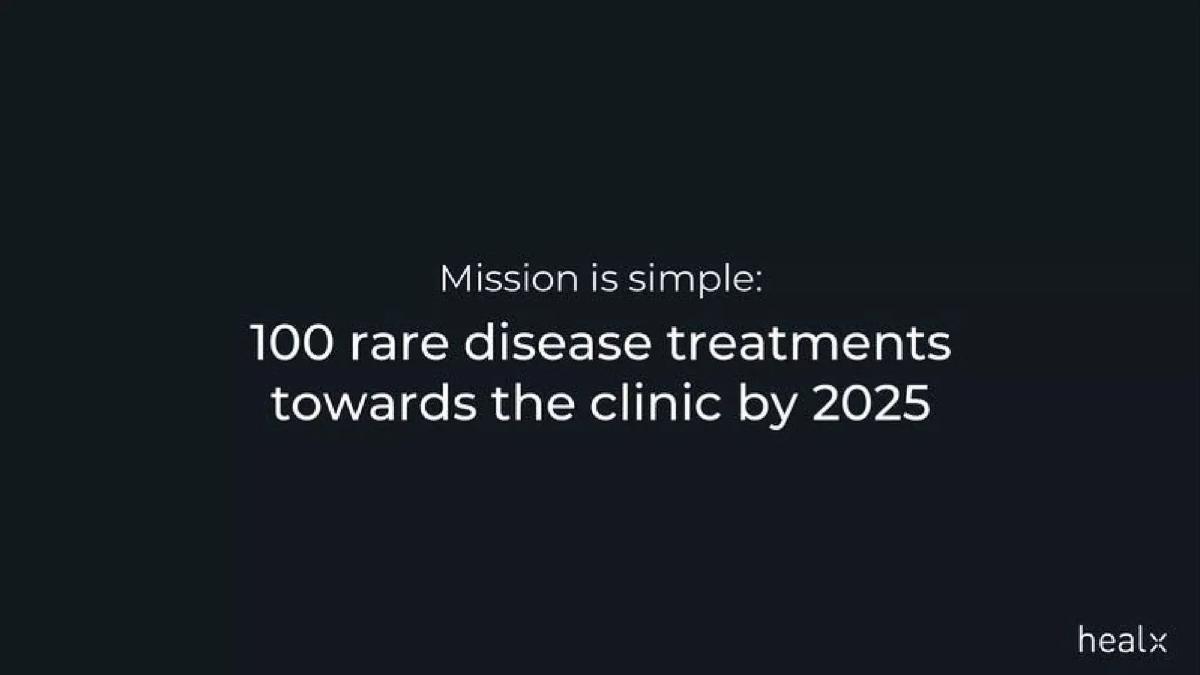
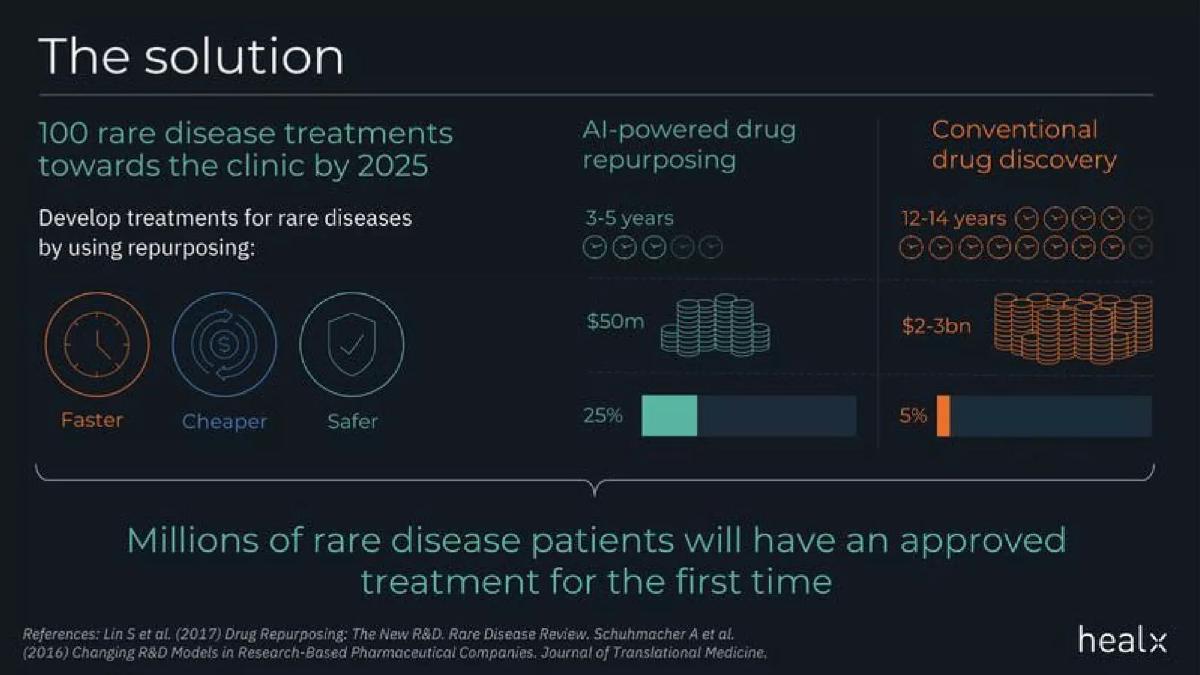
- The company sets a concrete, time-bound mission: 100 rare disease treatments towards the clinic by 2025 (Slide 3).
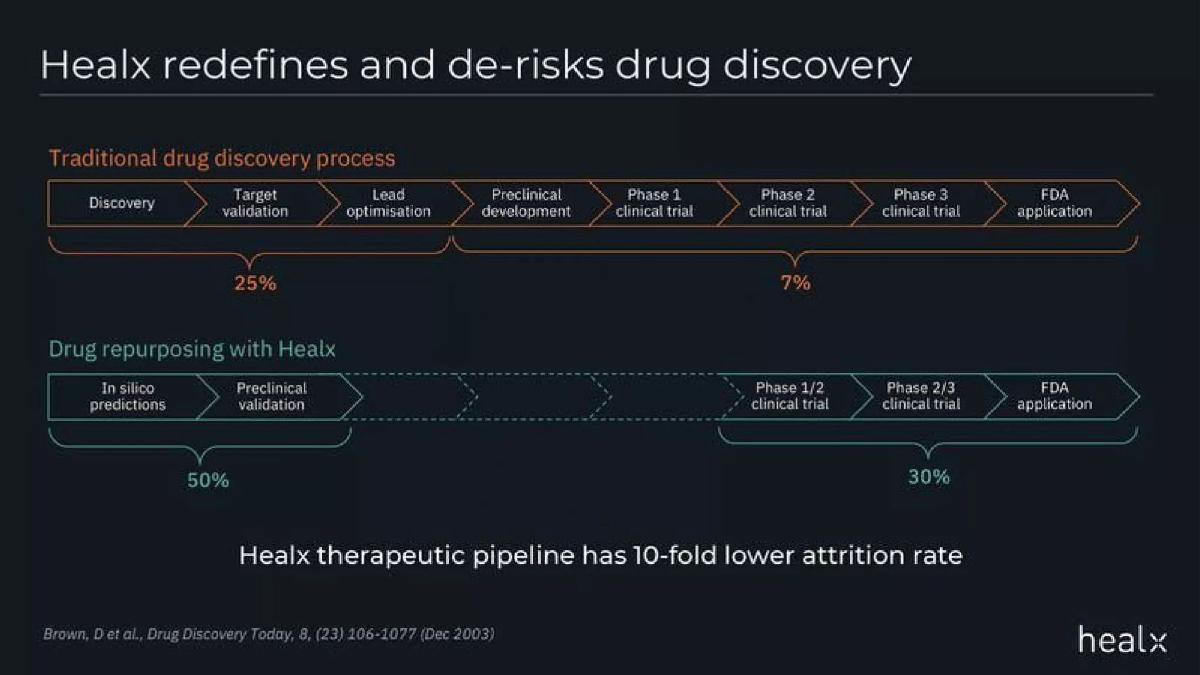
- Healx claims a 10-fold lower attrition rate compared to traditional drug discovery by using in silico predictions (Slide 5).
- The economic argument is centered on reducing R&D costs from $2-3Bn to just $50M per treatment (Slide 6).
- The 'Healnet' platform is backed by a knowledge graph containing over a billion relationships (Slide 8).
- The therapeutic pipeline is diversified across three main categories: Rare neurology, Rare oncology, and Rare metabolic (Slide 11).
- The leadership team boasts significant industry experience, including a Chairman who was the co-inventor of Viagra (Slide 14).
- The deck omits a formal 'Ask' slide, financial use of funds, or detailed exit strategy (Omitted).
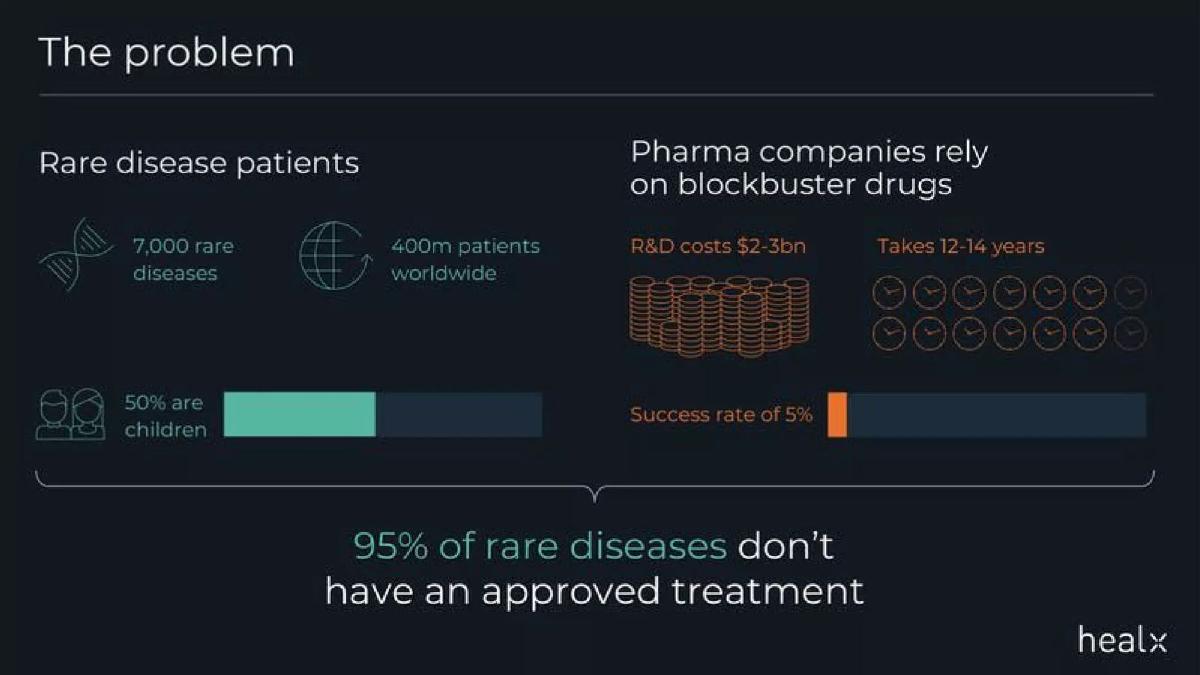
- Market size is framed by the 400 million patients worldwide suffering from 7,000 rare diseases (Slide 2).
The Healx Series B Teardown
Healx is a Cambridge-based biotech company that sits at the intersection of artificial intelligence and pharmacology. In 2019, they secured $56M in Series B funding to advance their mission of treating rare diseases. This deck is a clinical, data-driven presentation that prioritizes technical credibility and pipeline progress over flashy marketing.
Slides 1-3: The Mission and the Macro Problem
Slide 1 establishes the brand identity immediately: "Accelerating treatments for rare diseases" with the subtitle "AI-powered, patient-inspired." It is a clean, professional opening that defines the sector (Healthcare/AI) without jargon.
Slide 2 , titled "The problem," provides the quantitative justification for the company's existence. It highlights that there are 7,000 rare diseases affecting 400m patients worldwide, 50% of whom are children. The slide then pivots to the inefficiency of the current pharmaceutical model: $2-3bn in R&D costs, 12-14 years to market, and a 5% success rate. The punchline is at the bottom: "95% of rare diseases don't have an approved treatment." This creates a massive, underserved market opportunity.
Slide 3 is a simple, high-impact mission statement: "100 rare disease treatments towards the clinic by 2025." By setting a specific number and a specific date, Healx moves from a vague tech platform to a goal-oriented pharmaceutical contender.
Slides 4-6: The Solution and Economic De-risking
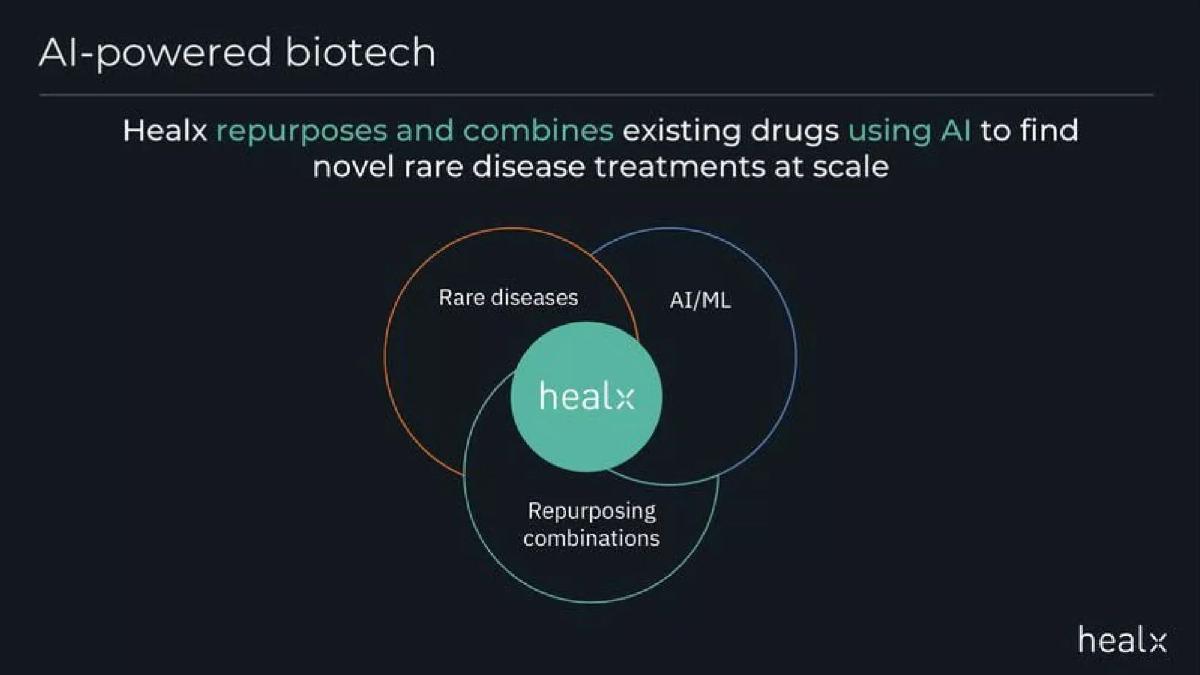
Slide 4 introduces the "AI-powered biotech" concept. It uses a Venn diagram to show Healx at the center of Rare Diseases, AI/ML, and Repurposing combinations. The core value prop is stated clearly: Healx repurposes and combines existing drugs to find novel treatments at scale.
Slide 5 is one of the most important slides for a Series B investor. It compares the "Traditional drug discovery process" with "Drug repurposing with Healx." It claims that Healx has a "10-fold lower attrition rate." It visualizes how Healx skips the early discovery, target validation, and lead optimization phases, moving straight to in silico predictions. It claims a 50% success rate in the early phase (vs 25% traditional) and a 30% success rate in clinical trials (vs 7% traditional).
Slide 6 summarizes the "The solution" in economic terms. It contrasts the 3-5 year timeline of Healx against the 12-14 years of conventional discovery, and the $50m cost against the $2-3bn industry standard. This slide effectively argues that Healx is not just a better way to find drugs, but a fundamentally different asset class for investors due to the reduced capital intensity.
Slides 7-9: The Technology (Healnet)
Slide 7 is a transition slide for "Healnet," their AI platform.
Slide 8 explains the "Healx knowledge graph." It claims to be the "Most comprehensive rare disease knowledge graph" and mentions "A billion relationships" informing treatment discovery. The visual is a complex node-map, which serves to illustrate the depth of their data moat. They emphasize that the data is "highly-curated" and integrates public, private, and proprietary sources.
Slide 9 provides the workflow: "From data to drugs." It shows how structured data, curated proprietary data, and public unstructured data (processed via NLP) feed into the Healx Knowledge Graph. This then leads to AI reasoning, expert analysis, and finally three outputs: Combination therapies, Biomarker discovery, and Drug repurposing. This slide is crucial because it shows that while the AI does the heavy lifting, "Drug discovery experts analysis" is still part of the loop, which adds a layer of human validation to the tech.
Slides 10-11: The Therapeutic Pipeline
Slide 10 is a transition slide for the "Therapeutic pipeline."
Slide 11 is the "Current projects" slide. For a Series B company, this is the proof of work. It lists 10 indications. Fragile X is the lead candidate, shown as having completed in silico discovery and preclinical work, and currently in "Clinical planning." Other named diseases like Pitt Hopkins and CDKL5 syndrome are also in clinical planning. The presence of five "Undisclosed (oncology)" projects suggests a strategy of building a broad portfolio to mitigate the risk of any single trial failure. The color-coding (Rare neurology, Rare oncology, Rare metabolic) shows a deliberate diversification strategy.
Slides 12-15: Team and Credibility
Slide 13 introduces the "Leadership team." It is heavy on PhDs and institutional experience. Kate Hilyard (COO) has 25 years of experience at Roche and Pfizer. Tim Guilliams (CEO) is a Cambridge PhD. Neil Thompson (CSO) was a former SVP at Astex with 30 years of experience. This slide tells investors that the company is run by industry veterans, not just software engineers.
Slide 14 covers the "Board of directors." This is where the heavy hitters appear. David Brown, the Chairman, is listed as the "Co-inventor of Viagra" and former Global Head of Drug Discovery at Roche. Having the inventor of one of the most successful drugs in history on the board provides immense credibility to their repurposing claims. Other board members represent top-tier VCs like Balderton Capital and Atomico.
Slide 15 is a full-team photo in their office. While it contains no data, it humanizes the company and shows the scale of the operation (approximately 30-35 people at the time).
What Works in This Deck
The Economic Contrast: Slide 6 is a perfect example of how to present a disruptive business model. By putting the $50M cost next to the $2-3Bn cost, the investor immediately understands the potential ROI. · Quantified Mission: The goal of "100 treatments by 2025" (Slide 3) gives the company a clear North Star and allows investors to measure progress in future rounds. · Pedigree: The leadership and board slides (13 and 14) are exceptionally strong. In biotech, the "who" is often as important as the "what," and Healx has top-tier validation. · Clarity of Process: Slide 9 demystifies the "black box" of AI by showing exactly how data flows from raw input to clinical output.
What Is Missing
The Ask: There is no slide stating how much money they are looking for or what the specific milestones for this round will be. While this information is often in the cover email, its absence in the deck is a missed opportunity to frame the deal. · Competition: The deck assumes a vacuum. It does not mention other AI drug discovery players (like Recursion or Insitro) or how Healx's knowledge graph specifically outperforms them. · Intellectual Property: Repurposing drugs can be tricky from a patent perspective. The deck does not explain how they protect their discoveries when the underlying compounds might already be off-patent or owned by others. · Financials: There are no burn rate projections, revenue models (e.g., licensing vs. internal development), or exit strategy discussions.
What a Founder Should Copy
The "10-fold" Comparison: Use Slide 5 as a template for showing how your technology de-risks a traditional, high-failure-rate industry. Visualizing the "skipped steps" is very effective. · The Knowledge Graph Visual: If you are a data-moat company, show the complexity of your data (Slide 8) but then immediately follow it with a simple flow chart (Slide 9) so the investor doesn't feel lost. · The Pipeline Chart: Slide 11 is the standard for biotech. Even if you are in SaaS, a "Product Roadmap" slide that shows features in "Discovery," "Beta," and "Live" using this horizontal bar format is highly readable.
Frequently asked questions
- What is the core technology behind Healx?
- Healx utilizes 'Healnet,' an AI-powered drug discovery platform. According to slide 8, this platform is built on a 'knowledge graph' that integrates public and private databases with proprietary data to map over a billion relationships between clinical, biological, and pharmacological information. This allows the company to predict which existing drugs can be repurposed or combined to treat rare diseases.
- How does Healx improve the economics of drug discovery?
- On slide 6, Healx compares its AI-powered repurposing model to conventional discovery. It claims to reduce the timeline from 12-14 years down to 3-5 years, and the cost from $2-3 billion down to $50 million. Furthermore, it claims a 25% success rate compared to the industry standard of 5%, significantly de-risking the capital investment.
- What does the current therapeutic pipeline look like?
- Slide 11 shows 10 active projects. The most advanced is for Fragile X, which is in the clinical planning stage. Other named indications include Pitt Hopkins, CDKL5 syndrome, Neuroblastoma, and Barth syndrome. The pipeline also includes five undisclosed oncology projects at various stages of in silico discovery and preclinical validation.
- Who are the key people involved in Healx?
- The team is highly credentialed. CEO Tim Guilliams holds a PhD in Biophysics from Cambridge. The board includes David Brown, the former Global Head of Drug Discovery at Roche and co-inventor of Viagra, and Shaun Grady, a Global VP at AstraZeneca. This level of 'big pharma' validation is critical for a Series B biotech raise.
- What is missing from this pitch deck?
- The deck is notably missing a financial 'Ask' slide detailing how much they are raising and how the funds will be allocated. It also lacks a competition slide, a detailed regulatory roadmap for the FDA/EMA, and specific unit economics regarding intellectual property ownership of repurposed drugs.