Healthcare Solution Slide: Real Pitch Deck Examples
How health startups present the solution in a pitch deck: where it fits in the clinical workflow, who uses it and who pays.
Healthcare Solution Slide: Real Pitch Deck Examples
Eight solution slides from health startups, shown in full, compare how each shows where the product fits into care, who uses it, who pays for it, and what improves compared with today.
TL;DR
A healthcare solution slide should show where the product sits in the care process, who uses it (patient, clinician, hospital), and who pays, with one measured improvement over today's care. Aevus (pRx) draws the doctor's workflow step by step, from "Doctor Performs Diagnosis" to a "Prescription Guidance Report". Healx compares its approach with conventional drug discovery on time, cost and success rate. Rekovo names the payment route: therapists "can add additional billing codes for reimbursement". A product screenshot with no explanation, like QoC Health's, shows the software but not who uses it or why it's better.
Healthcare solution slides from real pitch decks
Each example shows the exact stored slide above its analysis and links to the full teardown. Figures are as shown on the slides; we have not verified them.
Aevus (pRx) solution slide — slide 4
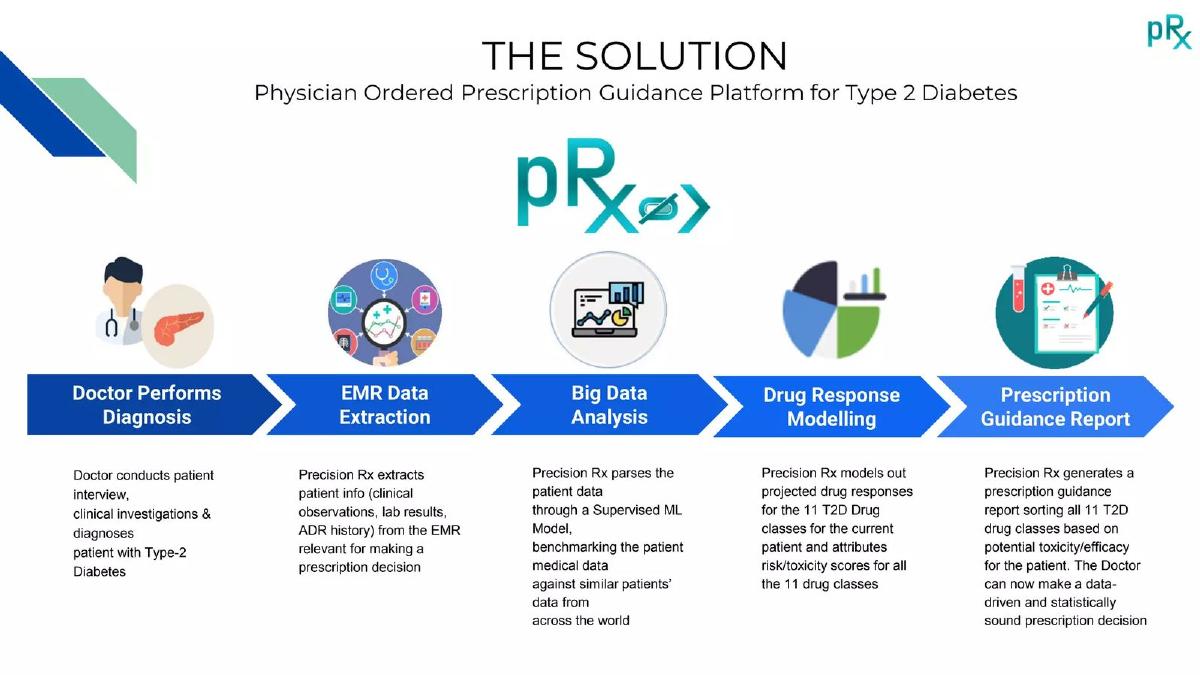
Prescription guidance for type 2 diabetes. A five-step clinical workflow.
Aevus (pRx) deck, slide 4. Exact stored slide matched to this analysis.
Our analysis: It shows the product starting and ending with the doctor, so it adds to their work rather than replacing it.
Evidence and limitation: No figures.
What a founder can adapt: Draw the care steps and mark which ones your product handles.
Supporting analysis
What the deck claims: "THE SOLUTION: Physician Ordered Prescription Guidance Platform for Type 2 Diabetes." Steps: "Doctor Performs Diagnosis" → "EMR Data Extraction" → "Big Data Analysis" → "Drug Response Modelling" → "Prescription Guidance Report", ending with "The Doctor can now make a data-driven and statistically sound prescription decision."
Presentation choice: Clinicians and investors can see exactly where it plugs in, including the health record.
When it does not fit: Add one result, such as better blood sugar control or fewer switches between drugs.
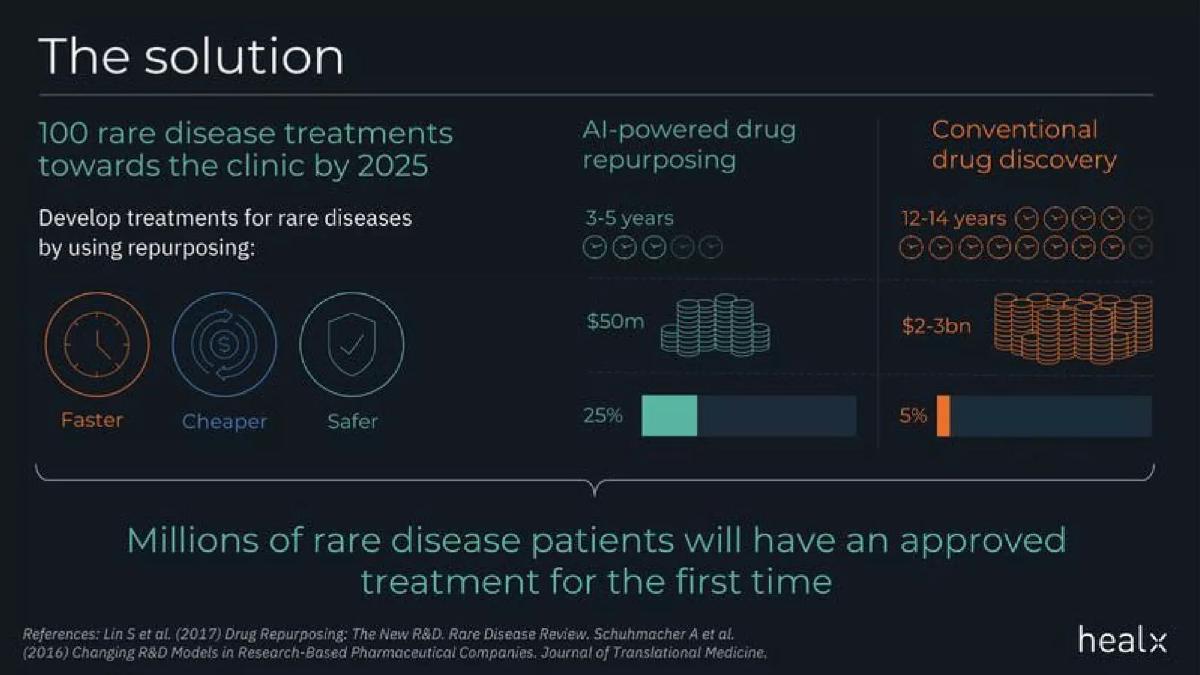
AI drug repurposing for rare diseases. A side-by-side with conventional discovery.
Healx deck, slide 6. Exact stored slide matched to this analysis.
Our analysis: Three numbers compare the approach with the standard one: time, cost and chance of success.
Evidence and limitation: Two cited references (Lin 2017; Schuhmacher 2016).
What a founder can adapt: Compare your approach with today's standard on two or three measures, with sources.
Supporting analysis
What the deck claims: "100 rare disease treatments towards the clinic by 2025." "AI-powered drug repurposing": "3-5 years", "$50m", "25%". "Conventional drug discovery": "12-14 years", "$2-3bn", "5%". "Faster, Cheaper, Safer."
Presentation choice: A cited side-by-side makes the improvement concrete.
When it does not fit: Separate industry averages from your own results; these are averages for the method.
Surgery updates for patients' families. Separate value for families and hospitals.
Medifies deck, slide 4. Exact stored slide matched to this analysis.
Our analysis: Families use it, but the hospital pays, so the slide gives the hospital its own return.
Evidence and limitation: Unsourced 5% and 75% figures.
What a founder can adapt: List the user's benefit and the payer's return as two blocks.
Supporting analysis
What the deck claims: "Solution: Medifies Surgery." "Mobile, timely updates for family anywhere", "HIPAA-compliant". "Patient Acquisition ROI: 5 family members' data/procedure, 5% of Family Users become hospital patients." "ROI for Hospitals": "Saves clinician time", "Inbound calls reduced 75%". A screenshot shows the update timeline.
Presentation choice: Separating user value from payer value answers who will buy.
When it does not fit: Say where the 75% and 5% come from: a pilot, a site, a period.
Rekovo (Agile Art) deck, slide 5. Exact stored slide matched to this analysis.
Our analysis: It covers the patient (engagement), the therapist (outcome tracking) and payment (billing codes).
Evidence and limitation: No figures; a photo of a session in use.
What a founder can adapt: If an existing billing code covers your product, say so on the solution slide.
Supporting analysis
What the deck claims: "Agile Art generates engagement in patients by allowing them to create impressionistic artwork while performing their prescribed therapy." "Results of the session are tracked with several outcome metrics." "Because it qualifies as neurorehabilitation and biofeedback, by using Agile Art the physical therapist can add additional billing codes for reimbursement."
Presentation choice: Naming how the clinic gets paid removes the biggest adoption question.
When it does not fit: Name the codes and add an adherence figure.
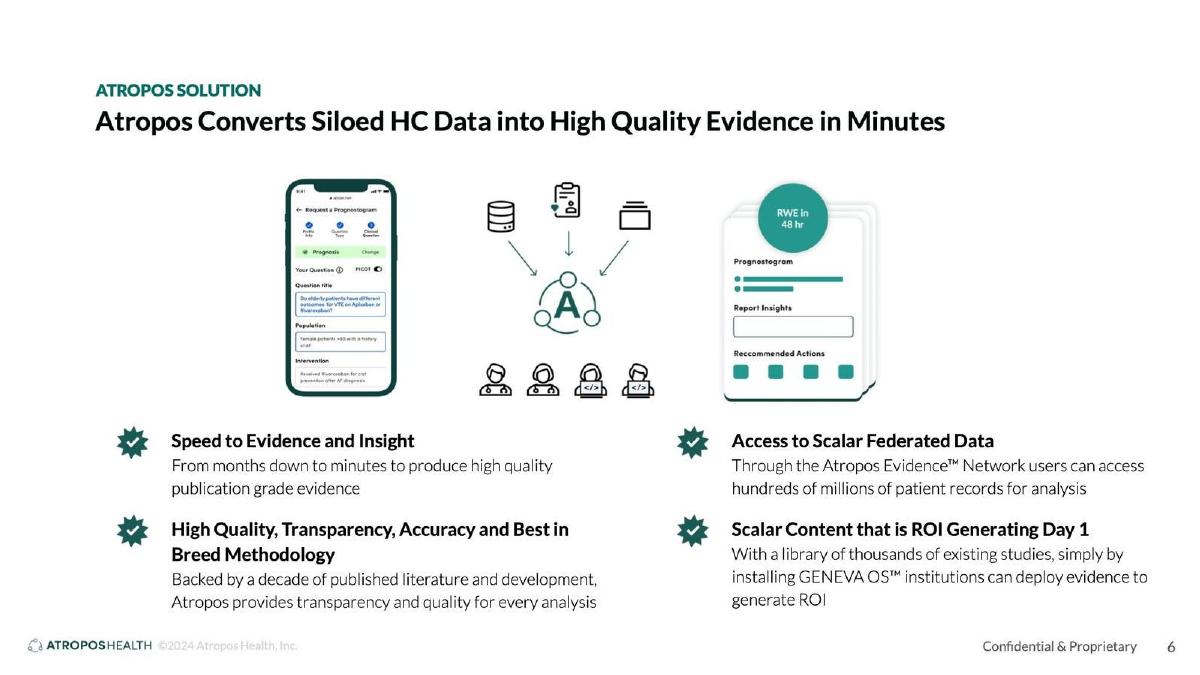
Real-world evidence from health data. Speed as the headline.
Atropos Health deck, slide 6. Exact stored slide matched to this analysis.
Our analysis: The headline states one before-and-after: months to minutes.
Evidence and limitation: "Months to minutes" and record counts, unsourced.
What a founder can adapt: Put your main before-and-after in the headline.
Supporting analysis
What the deck claims: "Atropos Converts Siloed HC Data into High Quality Evidence in Minutes." "Speed to Evidence and Insight: From months down to minutes." "Access to Scalar Federated Data": "hundreds of millions of patient records". "Scalar Content that is ROI Generating Day 1."
Presentation choice: One clear time comparison is easy to remember.
When it does not fit: Name the user (researchers? clinicians?) and what "ROI Generating Day 1" means in money.
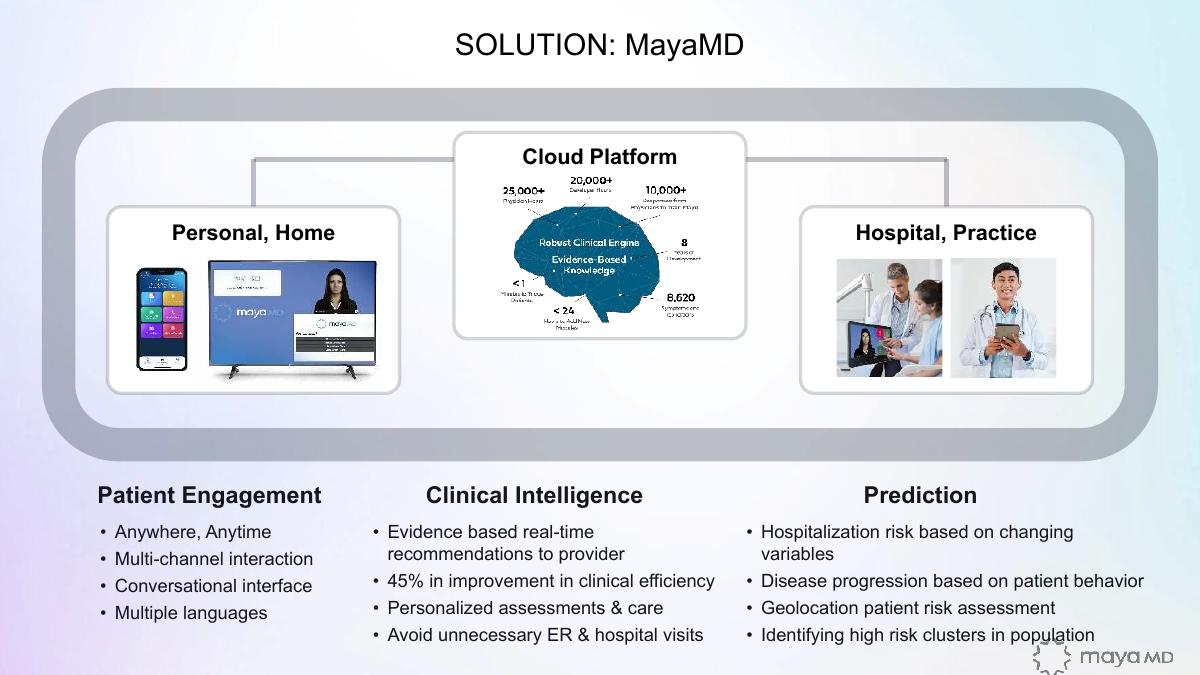
Clinical AI platform. Home and hospital users on one diagram.
MayaMD deck, slide 5. Exact stored slide matched to this analysis.
Our analysis: Both user groups appear, but twelve features compete for attention.
Evidence and limitation: One unsourced 45% figure.
What a founder can adapt: Show each user group once, with one benefit each.
Supporting analysis
What the deck claims: "SOLUTION: MayaMD." "Personal, Home" and "Hospital, Practice" connected to a "Cloud Platform". "Patient Engagement: Anywhere, Anytime." "Clinical Intelligence": "45% in improvement in clinical efficiency", "Avoid unnecessary ER & hospital visits". "Prediction: Hospitalization risk based on changing variables."
Presentation choice: Showing patient and clinician on one diagram explains a two-user product.
When it does not fit: Say who pays, and source the 45%.
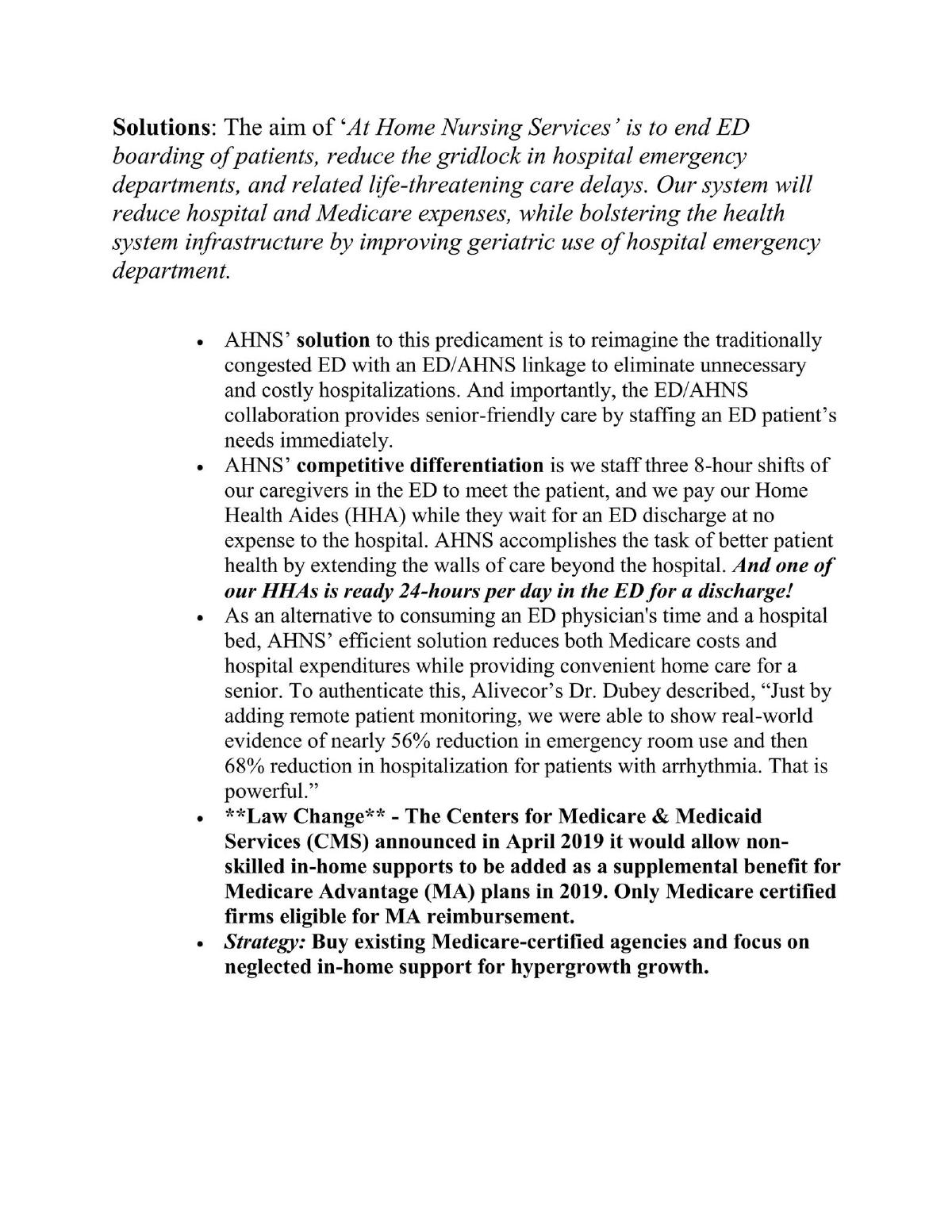
Home care for seniors leaving emergency departments. A text page with a payment change.
At Home Nursing Services deck, slide 3. Exact stored slide matched to this analysis.
Our analysis: It places the service at the hospital discharge step and names the payment change that makes it viable.
Evidence and limitation: Outcome figures from a third party's remote-monitoring work, not this company's service; a named policy change.
What a founder can adapt: If a policy change enables your model, name it with its date.
Supporting analysis
What the deck claims: "The aim... is to end ED boarding of patients." "We staff three 8-hour shifts of our caregivers in the ED to meet the patient." Cites a doctor: remote monitoring showed "nearly 56% reduction in emergency room use and then 68% reduction in hospitalization for patients with arrhythmia." "CMS announced in April 2019 it would allow non-skilled in-home supports to be added as a supplemental benefit for Medicare Advantage (MA) plans."
Presentation choice: Linking the solution to a specific payer rule explains why it can work now.
When it does not fit: The outcome figures are borrowed from a different intervention; label them clearly.
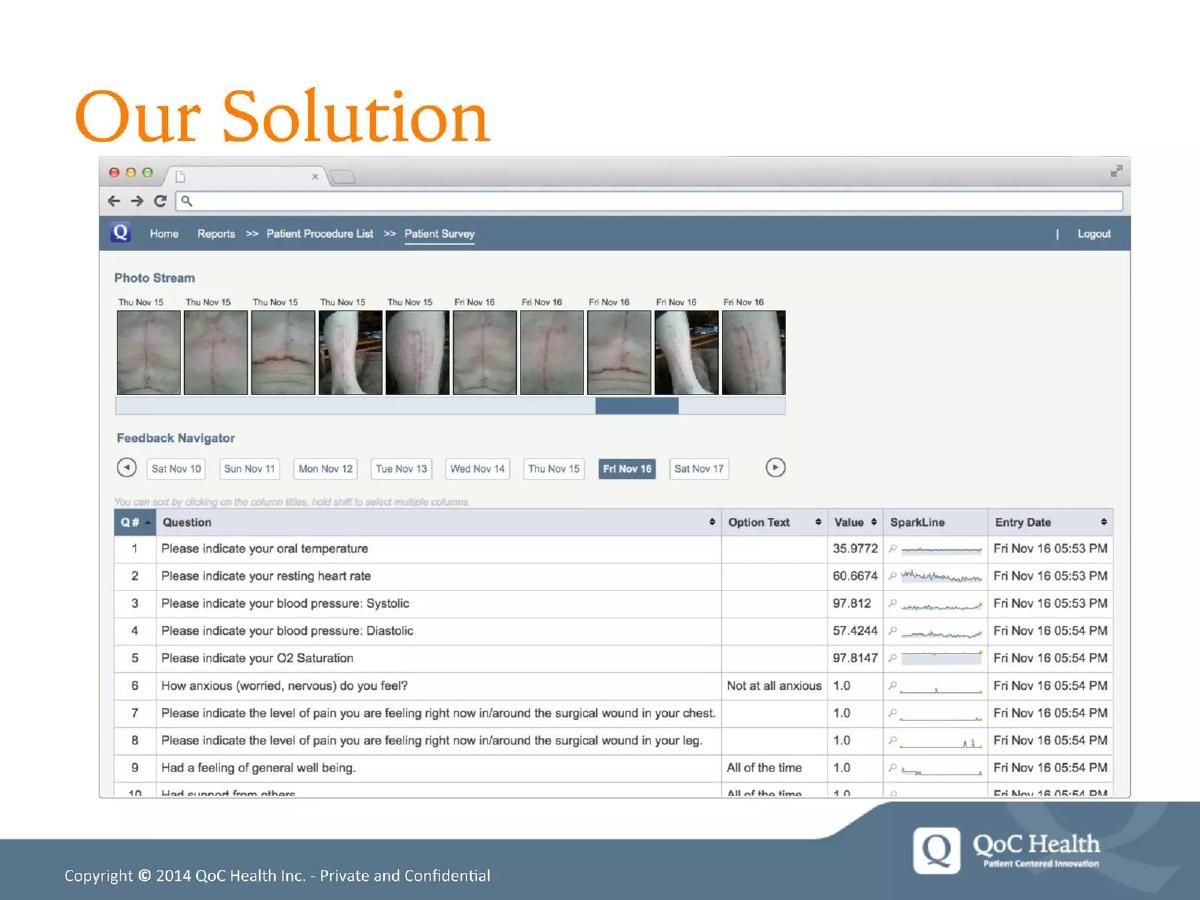
Post-surgery patient monitoring. Included as a weaker pattern.
QoC Health deck, slide 6. Exact stored slide matched to this analysis.
Our analysis: The software looks real, but the slide doesn't say who reviews the data, when, or what it replaces.
Evidence and limitation: No figures; a product screenshot only.
What a founder can adapt: Caption the screenshot with the user, the step in care, and the outcome.
Supporting analysis
What the deck claims: "Our Solution" above a screenshot: a "Photo Stream" of wound photos and a table of patient-reported temperature, heart rate, blood pressure and pain scores by date.
Presentation choice: Included as a contrast: a screenshot standing in for the solution.
When it does not fit: A screenshot with no explanation.
Whether each slide shows the place in care, the user and payer, and an improvement over today.
Example
Place in care
User / payer named
Improvement shown
Aevus (pRx)
Yes (5-step workflow)
Doctor / —
No
Healx
Drug development
— / —
Yes (time, cost, success, cited)
Medifies
During surgery
Families / hospital
Yes (75% fewer calls)
Rekovo
Physical therapy
Patient, therapist / billing codes
No
Atropos Health
Evidence generation
— / —
Yes (months to minutes)
MayaMD
Home and hospital
Patients, clinicians / —
Yes (45% efficiency)
At Home Nursing
ED discharge
Seniors / Medicare Advantage
Borrowed figures
QoC Health
No
No
No
Key Takeaways
Show where the product fits into care: which step, before or after what.
Name the user and the payer separately. In healthcare they are often different people.
Compare with today's care on one or two numbers: time, cost, readmissions, success rate.
If reimbursement exists, say how: a billing code, a benefit, a contract.
A screenshot needs a caption saying who uses it and what it replaces.
Build your healthcare solution slide
One line per part, each with a number if you have one.
Place in care. Which step of diagnosis, treatment or follow-up does the product change?
User. Who uses it day to day: patient, nurse, doctor, administrator?
Payer. Who pays: hospital, insurer, employer, patient? Is there a billing code?
Improvement. One measured difference from today's care, with its source.
Copyable framework: At [step in care], [user] uses [product] to [action]. [Payer] pays through [route]. Compared with today, [measure] improves from [X] to [Y].
Illustrative example 1 — written by us
Before: Our platform empowers patients with AI-driven insights.
After: After discharge, nurses review patients' daily symptom check-ins in our app and call only those flagged. Hospitals pay per patient per month. In a 3-month pilot, 30-day readmissions fell from 18% to 12%.
What improved: Our illustrative rewrite; figures are invented for the example. It names the step, the user, the payer and one result.
What this guide adds
The general solution slide guide covers presenting a product in any business. In healthcare, the user, the buyer and the payer are often different, and a product only spreads if it fits how clinicians already work. This guide compares how health startups show that.
The healthcare problem guide covers the problem that comes first; the healthcare reimbursement guide covers the business model in detail.
Three parts of a healthcare solution
Place in care: the step of diagnosis, treatment or follow-up the product changes (Aevus, Medifies, At Home Nursing Services).
Users and payers: who touches the product and who pays for it (MayaMD, Medifies, Rekovo).
Improvement over today: a measured difference from current care (Healx, Medifies, At Home Nursing Services).
Strong slides cover all three. Most real slides cover two.
Common mistakes
No place in care. Say which step of treatment the product changes.
User and payer mixed up. Name who uses it and who pays separately.
Feature list. Twelve features hide the one improvement that matters.
Borrowed results. Label figures from other studies or methods as such.
Uncaptioned screenshot. Say who uses the screen and what it replaces.
Diagnostic checklist
The slide shows where the product fits in care.
The user and the payer are both named.
There is one measured improvement over today, with a source.
Any reimbursement route is stated.
Screenshots are captioned.
Frequently asked questions
How we chose these examples
Corpus: published pitch deck teardowns on StartupFundraising.com. Founder-uploaded private decks are excluded.
Selection (2026-09-24): we searched extracted text of slides 2–6 for solution slides in decks mentioning patients, clinics, hospitals or physicians, and inspected about twenty-five candidates. We excluded non-health matches, slides that were feature lists without a clinical context (Being Health), and slides that weren't solution slides (Heart Metrics Solutions).
Overlap check: the general solution slide guide covers presenting a product in any business; the healthcare problem, team and reimbursement guides cover other slides. None of these eight slides appears in another guide; Healx appears in the healthcare problem guide with a different slide.
QoC Health is included to show a weaker pattern. At Home Nursing Services is a written text page rather than a designed slide.
Review: all eight stored slide images were inspected on 2026-09-24 and matched to company, deck and slide number (editorial model review). No person has yet completed an editorial review of this page.
Figures are as shown on the slides; we have not verified them. We make no claim that any slide caused a fundraising outcome, and nothing here is medical advice.