Atropos Health's 22-slide Series B deck is a sophisticated example of how to transition deep academic research into a commercial powerhouse. By highlighting a decade of innovation at Stanford University (Slide 4) and a federated network covering over 200 million patients (Slide 10), the company establishes immediate authority in the high-stakes healthcare sector. The deck effectively categorizes its product suite under the 'Geneva OS' umbrella, showcasing a clear path from raw data to actionable clinical insights in under three minutes via their ChatRWD interface (Slide 7). While the deck is…
Key takeaways
- The company leverages a 'decade of medical innovation' starting from the Shah Lab in 2011 to establish deep technical defensibility (Slide 4).
- Atropos claims a federated network of over 200 million patients across dozens of datasets, providing significant data gravity (Slide 10).
- The product architecture, Geneva OS, supports multiple 'live' modules including ChatRWD, Alexandria, and Workbench (Slide 7).
- The business model is a user-based SaaS structure with four distinct upsell levers: user growth, data set deployment, evidence network usage, and new product access (Slide 13).
- A Net Promoter Score (NPS) of >40 is cited as a key indicator of user satisfaction and speed to value (Slide 10).
- The deck includes a specific ROI case study claiming over $3M in institutional savings for a hospital partner (Slide 21).
- Competitive positioning focuses on the 'evidence gap,' contrasting Atropos's personalized content against static reference materials like PubMed (Slide 16).
- The deck omits a dedicated team slide, though it references founder Dr. Nigam Shah's work at Stanford (Slide 4).
Executive Summary: The Bridge Between Research and Revenue
Atropos Health's Series B deck is a masterclass in establishing 'Data Gravity.' In the healthcare sector, where AI is often met with skepticism, Atropos uses its 22 slides to build a narrative of inevitability. As reported by Business Insider, the company raised $33M in 2024, and this deck illustrates why: they have successfully productized a decade of academic research into a scalable SaaS platform. The deck focuses heavily on the 'Evidence Gap'—the space between what is known in medical literature and what is needed for a specific patient—and positions their Geneva OS as the only viable bridge.
Slide 1-2: The Mission and Identity
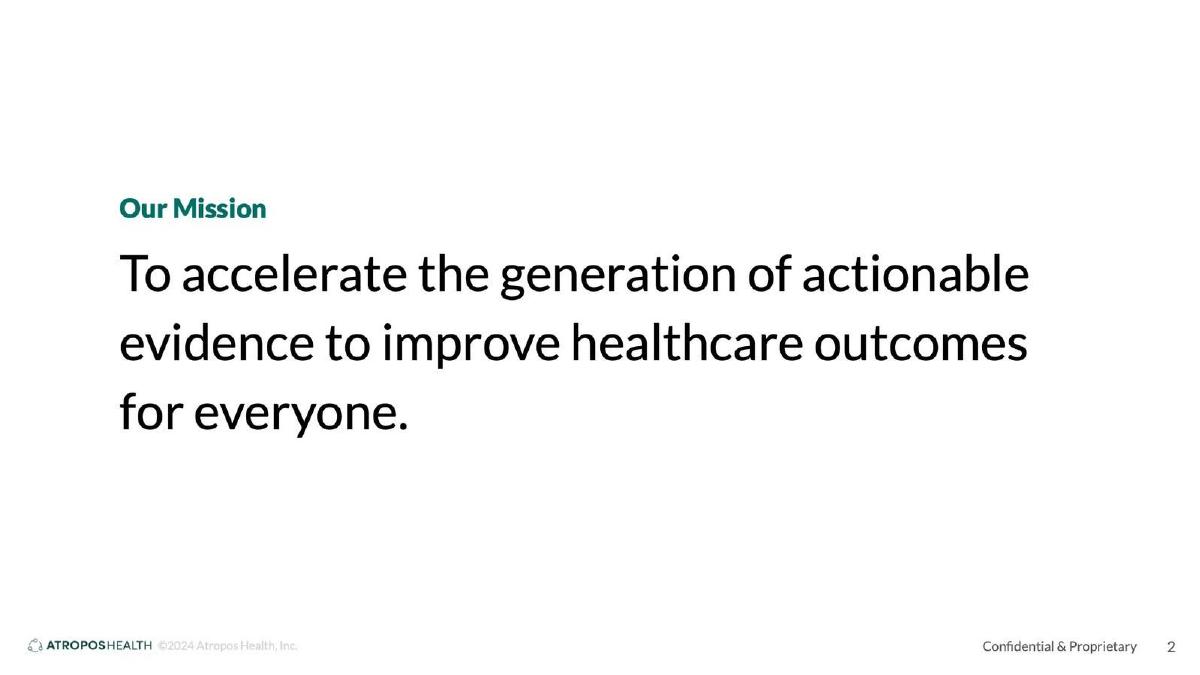
The deck opens with a clean, professional aesthetic. Slide 1 is a standard title slide, while Slide 2 introduces the mission. The mission focuses on closing the 'evidence gap' to ensure every clinical decision is informed by data. This sets the stage for a problem-solution narrative that is deeply rooted in clinical utility rather than just technological novelty.
Slide 3-4: The Problem and the Pedigree
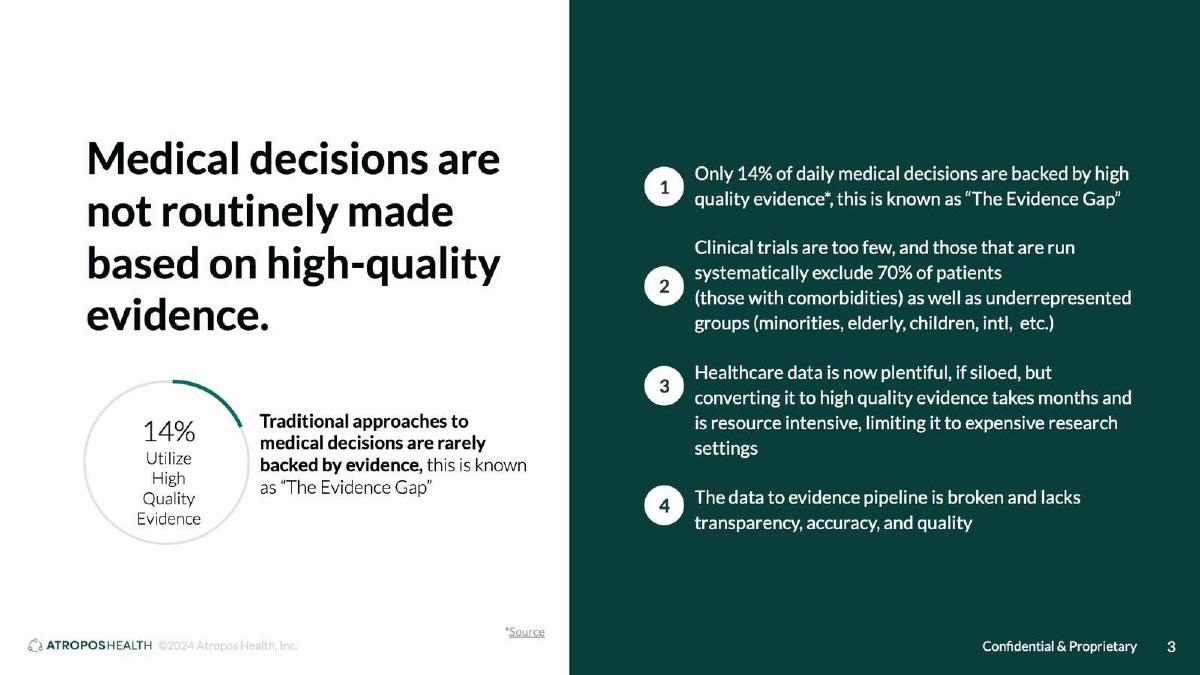
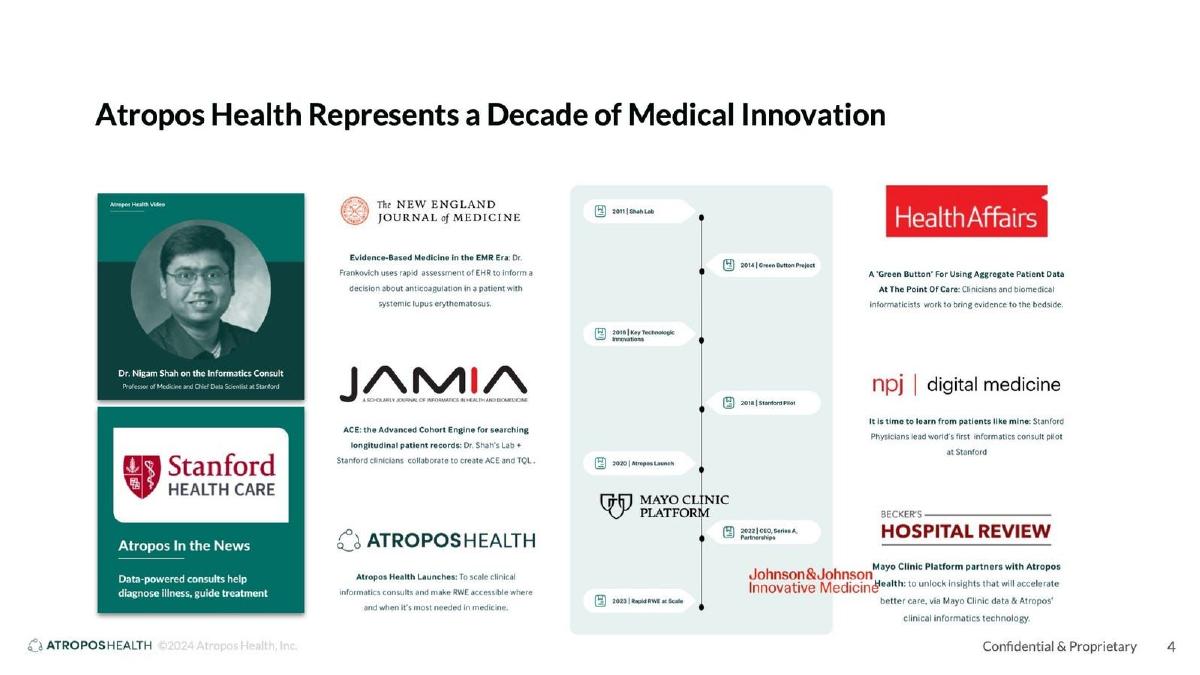
Slide 3 identifies the core problem: medical decisions are not routinely made based on high-quality evidence because that evidence often doesn't exist for specific patient profiles. Slide 4 is arguably the most important slide for establishing trust. Titled 'Atropos Health Represents a Decade of Medical Innovation,' it features a timeline starting in 2011 with the Shah Lab at Stanford. It highlights the 'Green Button Project' (2014) and various publications in The New England Journal of Medicine and JAMA. By the time an investor reaches Slide 5, the technical risk has been largely mitigated by the company's academic pedigree.
Slide 5-6: The Business of Evidence
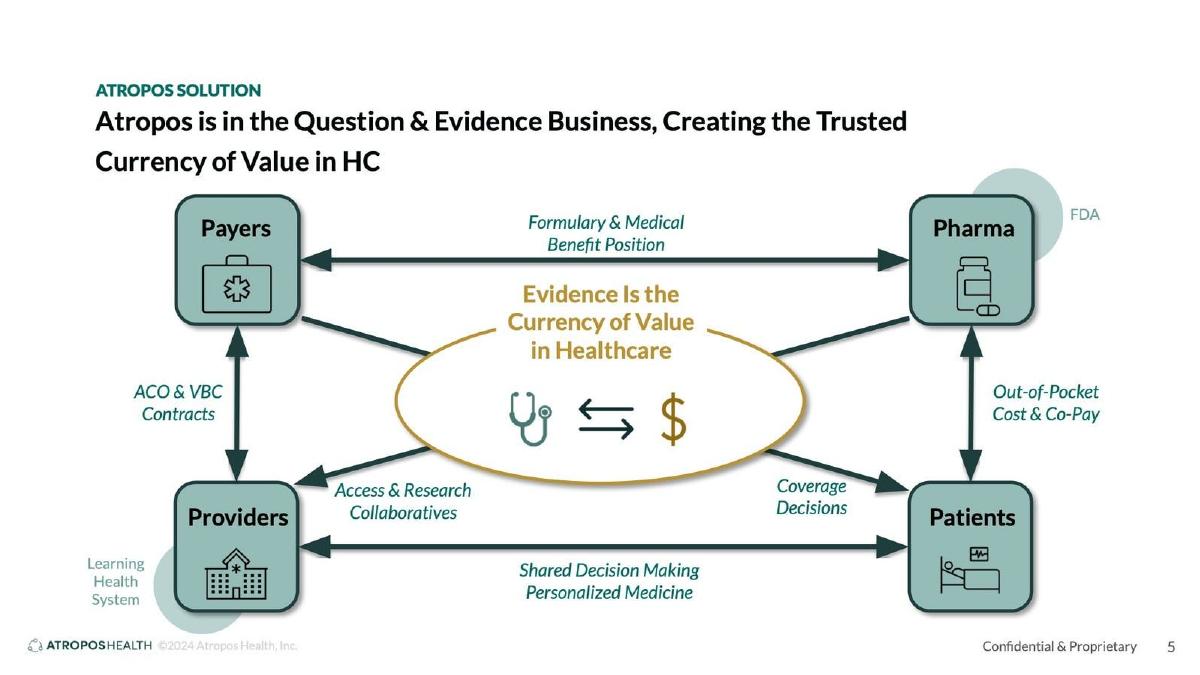
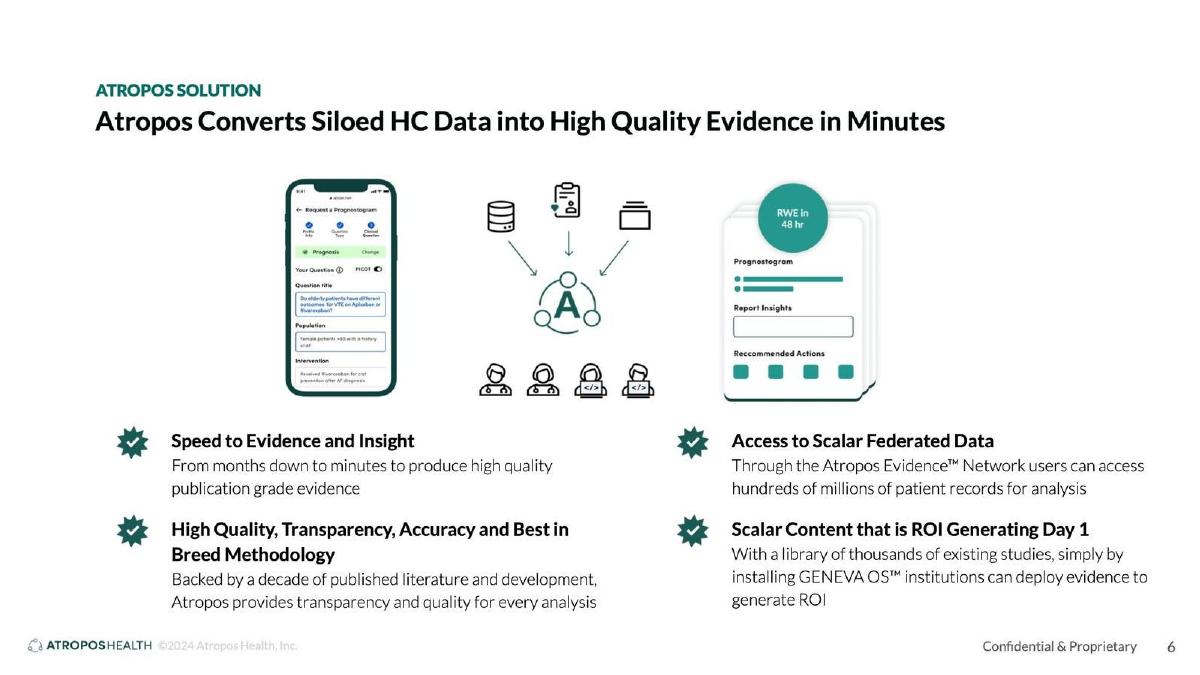
Slide 5 explicitly states that Atropos is in the 'question and evidence business.' This is a clever framing that moves the conversation away from 'AI' (a commodity) to 'Evidence' (a high-value clinical asset). Slide 6 explains the mechanics: converting siloed healthcare data into high-quality evidence in minutes. This slide emphasizes speed and quality, the two primary pain points for clinical researchers who usually wait months for similar studies.
Slide 7-9: The Geneva OS Ecosystem
Slide 7 introduces Geneva OS, the core platform. It lists several 'Live' modules: ChatRWD (LLM-driven RWE in 10,000 novel studies), and Workbench (low-code research platform). Slide 8 and 9 go deeper into these components, specifically highlighting the Alexandria evidence library. The use of 'Live' and '2024' labels on these modules gives investors a clear sense of product maturity and the upcoming roadmap.
Slide 10: The Unique Value Proposition
Slide 10 summarizes what makes Atropos unique. It cites three pillars: User Experience and Speed (NPS >40, proprietary tech from Stanford), Data Scale (200M+ patients in a federated network), and Quality (100% peer-review success rate). The mention of a 'federated network' is crucial; it implies that Atropos can access data without the security risks of moving it, a major selling point for hospital systems.
Slide 11-12: Traction and Market Opportunity
Slide 11 covers traction and growth, though the specific revenue figures are not detailed in the provided text. Slide 12 outlines the 'Global Market Opportunity,' positioning the company to capture value across both the provider and life sciences sectors. The deck frames the market not just as 'Healthcare AI,' but as the infrastructure for real-world evidence.
Slide 13: The SaaS Business Model
Slide 13 is a vital 'how we make money' slide. It describes a 'User-Based SaaS Model' with four growth levers:
SaaS Based Per User Bundle Pricing: The entry point. · Upcharge Per Data Set: Scaling with the client's data footprint. · Evidence Network Fees: Monetizing the federated network. · SKU Growth: Upselling new modules like Alexandria or CRAFT.
This multi-pronged approach suggests a high Net Revenue Retention (NRR) potential.
Slide 14-16: The AI Edge and Competition
Slide 14 introduces ChatRWD, specifically addressing how it fills the gap left by literature-trained LLMs (like ChatGPT) which often hallucinate or lack specific clinical data. Slide 15 claims Atropos is the 'only resource' to generate new personalized content. Slide 16 is a competitive matrix. It plots competitors across 'Care Personalization' and 'Workflow Integration.' It categorizes incumbents like PubMed and UpToDate as 'Static Content' and peer-to-peer consults like RubiconMD as 'Advice Lacking Validation,' leaving Atropos alone in the high-personalization, high-integration quadrant.
Slide 17-21: Social Proof and ROI
Slides 17 through 20 are dedicated to customer stories and case studies. Slide 19, 'In Their Words,' features quotes from Life Sciences clients emphasizing speed and independence. Slide 21 provides the 'hard' ROI: a case study claiming Atropos saved a hospital over $3M. In a Series B deck, these specific dollar amounts are essential for proving that the product is a 'must-have' rather than a 'nice-to-have.'
Slide 22: The Final Validation
The deck concludes on Slide 22 with 'Research Grade Quality, Accuracy, and Transparency.' It lists partnerships with Datavant and AWS, and features a screenshot of the 'Green Button' being discussed in Congress. This final slide reinforces the theme of the entire deck: Atropos is not just a startup; it is a clinically validated institution.
What Works in the Atropos Health Deck
The Pedigree Play: By anchoring the company in a decade of Stanford research (Slide 4), Atropos bypasses the 'why should we trust your AI?' question. They aren't building a new model from scratch; they are scaling a proven academic methodology.
Clear Product Segmentation: The Geneva OS framework (Slide 7) makes a complex technical offering easy to understand. By breaking the platform into specific modules (ChatRWD, Alexandria, CRAFT), they show a clear path for land-and-expand sales strategies.
Focus on 'Evidence' over 'AI': While they use generative AI, the deck focuses on the output (high-quality evidence) rather than the process . This is a much more effective way to sell to healthcare executives who care about clinical outcomes and ROI (Slide 21) more than neural network architectures.
What is Missing from the Atropos Health Deck
Specific Financials: While the business model is clear (Slide 13), the deck omits specific ARR, growth rates, or churn metrics. For a Series B, investors typically expect to see a 'Numbers' slide that shows the historical revenue trajectory.
Detailed Team Slide: Although Dr. Nigam Shah is mentioned in the context of Stanford research (Slide 4), there is no dedicated slide introducing the full executive team or board. Investors at this stage want to see the balance of clinical, technical, and commercial leadership.
The 'Ask': The provided slide content does not include a final 'Ask' slide detailing how much they are raising (though we know it was $33M) or how those funds will be allocated (e.g., R&D vs. Sales expansion).
Founder Takeaways: How to Copy the Atropos Strategy
1. Use 'Evidence' to Sell AI: If your startup uses AI in a regulated or high-stakes industry, don't lead with the tech. Lead with the validation. Atropos mentions '100% peer-review success rate' (Slide 10), which is a far more powerful metric for a clinician than '99% accuracy rate.'
2. Build a 'Modular' Roadmap: Even if you have one core engine, present it as a suite of products (Slide 7). This makes your business look larger and provides a clear narrative for how you will increase your Average Contract Value (ACV) over time.
3. Quantify the 'Gap': Atropos doesn't just say they are better; they define a specific 'Evidence Gap' (Slide 3) that their competitors cannot fill. By naming the problem, you own the solution.
4. Leverage Institutional Validation: If your tech has been featured in a journal, a government hearing, or a major partnership (Slide 22), give it its own slide. In healthcare, social proof is often as valuable as the code itself.
Frequently asked questions
- What is the core technology behind Atropos Health?
- The core technology is Geneva OS, which acts as a data-to-evidence conversion pipeline. It includes ChatRWD, a generative AI interface that allows users to query real-world evidence (RWE) and receive answers in under three minutes. This system is built on a decade of research from Stanford University, specifically the 'Green Button' project, which aims to provide clinicians with instant, data-driven insights at the point of care.
- How does Atropos Health make money?
- Atropos utilizes a user-based SaaS model. Revenue is generated through base license fees per user bundle. Growth is driven by four primary upsell mechanisms: increasing the number of users within an account, charging for each new dataset deployed at a client site, fees for accessing the Atropos Evidence Network, and SKU growth through new product launches like their Alexandria library or CRAFT tool.
- Who are the primary customers for Atropos Health?
- The deck identifies two main customer segments: Healthcare Providers/Academic Medical Centers (AMCs) and Life Sciences companies. For providers, the value proposition is clinical decision support and hospital cost savings. For life sciences, the platform accelerates research initiatives, clinical trial emulation, and drug development by providing rapid access to high-quality real-world evidence.
- How does Atropos differentiate itself from competitors like PubMed or UpToDate?
- Atropos argues that existing solutions like PubMed or UpToDate rely on 'static content' that lacks personalization for specific patient cohorts. In contrast, Atropos generates 'new high-quality personalized content' by analyzing real-time patient data. They position themselves as the only resource that answers clinical questions by creating evidence rather than just searching for existing literature.
- What evidence of market traction does the deck provide?
- Traction is demonstrated through a mix of data scale (200M+ patients), user satisfaction (NPS >40), and institutional validation. The deck cites partnerships with Mayo Clinic and AWS, publications in journals like JAMA and The New England Journal of Medicine, and a specific case study where a hospital saved over $3M using their platform.