micro1 is an AI-powered HR tech platform designed to source and vet global engineering talent. Their pitch deck, used for a 2023 Pre-seed round, emphasizes high-velocity growth and a streamlined user experience. The deck highlights a significant revenue jump from $27,532.31 in Q2 2022 to $718,187.65 in Q2 2023, representing a 199.85% average quarter-over-quarter growth rate. By utilizing unconventional 'growth hacks' like Twitter memes and VC partnerships offering 240 hours of free development, micro1 positioned itself as a high-momentum alternative to incumbents like Upwork and Toptal. The d…
Key takeaways
- The company achieved a 199.85% average quarter-over-quarter growth rate leading up to Q2 2023 (Slide 8).
- Revenue scaled from $27,532.31 in Q2 2022 to $718,187.65 in just one year (Slide 8).
- The platform uses AI to pre-vet the 'top 1%' of engineers, handling global compliance and benefits for clients (Slide 12).
- Growth strategies included offering 240 hours of free software development to startups within specific VC portfolios like Browder Capital (Slide 12).
- Social media momentum is a core metric, with the company claiming 35,462 new followers, second only to Upwork in their competitive set (Slide 13).
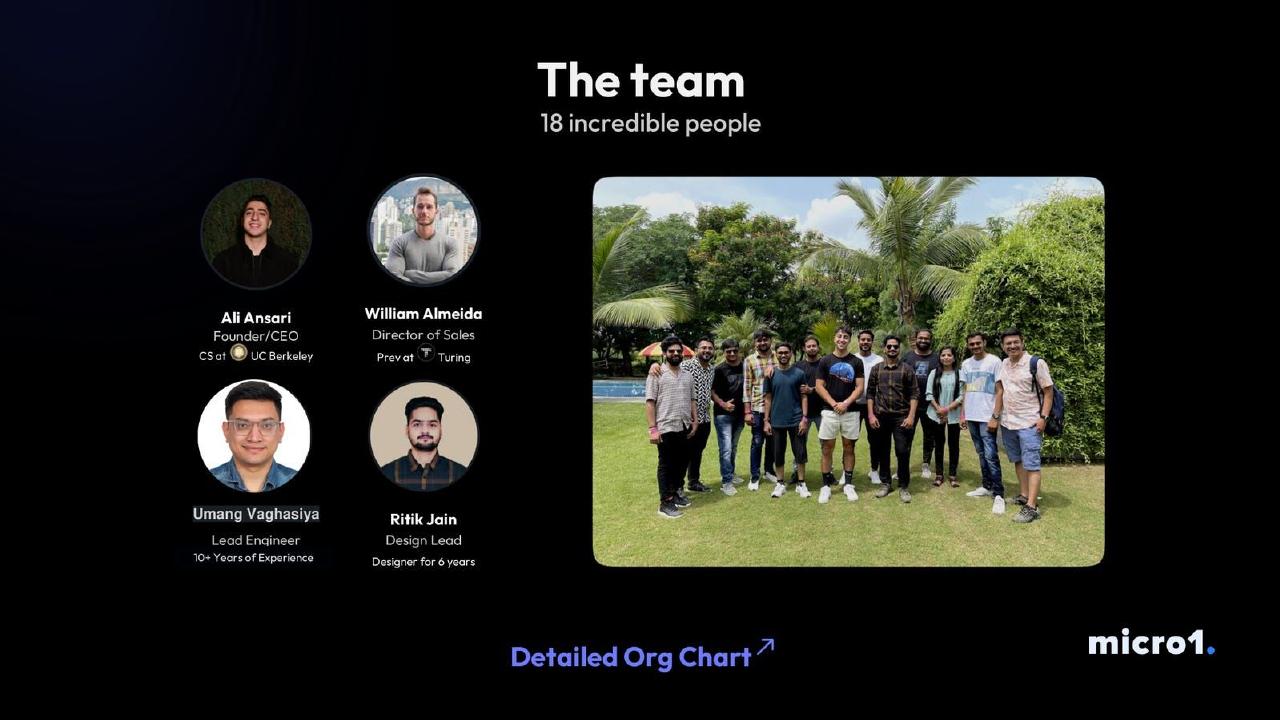
- The team consists of 18 people, led by a CEO from UC Berkeley and a Director of Sales previously at Turing (Slide 17).
- The initial funding ask was $2M at a $14M post-money valuation to triple product development speed (Slide 20).
- The deck lacks a traditional detailed 'Problem' slide, opting instead to lead with product and traction (Slides 4-8).
Executive Summary: The Momentum-First Pitch
micro1’s pitch deck is a masterclass in leading with traction. In a crowded HR tech market, the company avoids the standard 'hiring is hard' problem slides and instead focuses on the sheer velocity of their business. As reported by Business Insider, the company raised $3.3M in 2023, surpassing the $2M target stated in this deck. The narrative is driven by a 199.85% average quarter-over-quarter growth rate and a lean, aggressive approach to customer acquisition.
Slide 1-3: The Vision and Branding
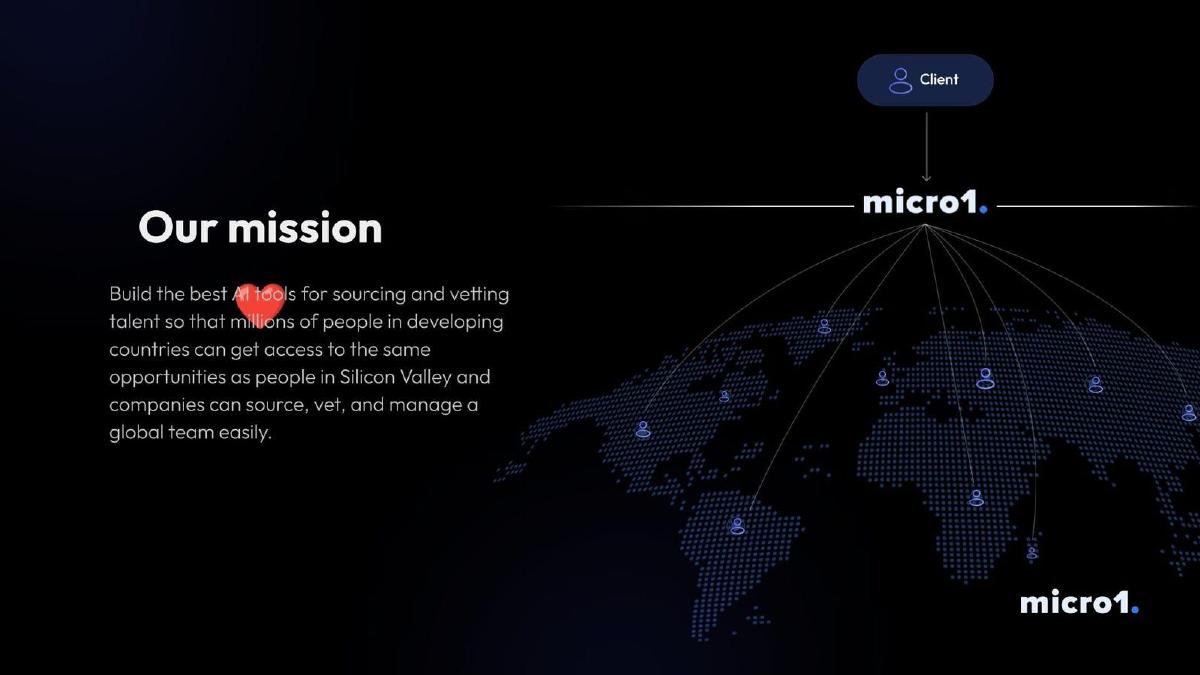
The deck opens with a minimalist aesthetic. Slide 1 introduces the tagline: "World-class software engineers, powered by AI." It explicitly states their mission is building AI tools for sourcing and vetting global teams. Slides 2 and 3 continue this branding exercise, maintaining a dark, high-contrast theme that suggests a modern, tech-forward company rather than a traditional recruitment agency.
Slide 4: The Product Interface
Slide 4 features a '2 min product demo' placeholder over a screenshot of the micro1 dashboard. The dashboard shows a list of 'Hand picked recommendations' for UI/UX Designers, each listed at a flat rate of $5,000/month. The interface is clean, showing candidate names, locations (e.g., Afghanistan), and simple 'Decline' or 'Request interview' buttons. This slide communicates that the platform is ready and functional, emphasizing ease of use for the hiring manager.
Slide 8: The Traction Hook
This is the 'money slide' of the deck. Titled "Zoomed out revenue," it shows a vertical bar chart of quarterly revenue. The figures are precise: $27,532.31 in Q2 2022, rising to $718,187.65 in Q2 2023. Below the chart, the text highlights a "QoQ average growth" of 199.85%. By including exact cents in the revenue figures, the company projects a sense of transparency and data integrity. This slide serves to prove product-market fit before the deck even explains how the product works in detail.
Slide 12: Growth Hacks and Customer Acquisition
Slide 12, titled "growth hacks," explains how the company achieved the numbers on Slide 8. It highlights two channels: VC partnerships and Twitter ads. The VC partnership example shows a promotion for "240 hours of free software development for Browder Capital Startups." This is a clever 'Trojan Horse' strategy—giving away services to high-growth startups to lock them into the platform. The Twitter ads section shows a meme-based advertisement, signaling that the company understands how to capture the attention of the modern tech community on social media.
Slide 13: Competitive Momentum
Rather than a standard feature-comparison matrix, Slide 13 compares "our momentum vs. competitors" using social media follower metrics. It lists Upwork, Nagarro, Turing, and Toptal. While Upwork leads in total followers (2.1M), micro1 claims the second-highest number of "New followers" at 35,462. This is a strategic choice: by picking a metric where they are winning (growth rate) rather than size (total scale), they frame themselves as the rising star in the category.
Slide 17: The Team
The team slide features four key leaders and a group photo of "18 incredible people." Ali Ansari (Founder/CEO) is noted for his background at UC Berkeley. William Almeida (Director of Sales) is highlighted for his previous experience at Turing, a direct competitor, which adds significant credibility to their sales strategy. The inclusion of a Lead Engineer with 10+ years of experience and a Design Lead suggests a balanced leadership team. A link to a "Detailed Org Chart" is provided, indicating organizational maturity beyond a typical pre-seed startup.
Slide 20: The Ask
The deck concludes with a clear financial request: "Raising $2M at $14M Post-money." The justification for the round is "To manage the crazy demand & speed up product development." The slide breaks down the use of funds into three specific goals: tripling product development speed, hiring 2-3 sales people, and hiring 1-2 recruiters. This level of specificity gives investors confidence that the founders know exactly where the next dollar goes to generate further growth.
What micro1 Does Well
Traction-First Narrative: By placing the revenue growth slide early, micro1 answers the most important question for any investor: "Does anyone want this?" The 199.85% QoQ growth makes the rest of the deck a formality of explaining how they will keep the streak going.
Specific Growth Tactics: Many decks vaguely mention 'marketing' or 'sales.' micro1 shows the actual ads and the specific VC partnership offers they used. This transparency makes their growth seem repeatable rather than accidental.
Competitive Framing: The use of 'New Followers' as a competitive metric is a clever way for a smaller company to look like a market leader. It shifts the conversation from 'who is biggest' to 'who is trending.'
What is Missing from the micro1 Deck
Unit Economics: While the revenue growth is impressive, the deck does not detail the margins on the $5,000/month developer placements. Investors would want to know the take-rate and the cost of acquiring those developers versus the cost of acquiring the hiring companies.
AI Technical Depth: The tagline promises "powered by AI," but the slides provided do not explain the proprietary nature of the AI. Is it a wrapper on an LLM for vetting, or a custom-built sourcing engine? Without this, the 'AI' claim feels more like a marketing buzzword than a technical moat.
Retention Metrics: The deck shows new revenue, but not churn or net revenue retention. In a talent marketplace, knowing if companies come back to hire their second, third, and tenth engineer is crucial for long-term viability.
Founder Takeaways: Copy These Moves
Lead with the 'Wow' metric: If you have a growth chart that looks like a hockey stick, don't bury it on slide 15. Put it in the first third of the deck to buy the investor's attention for the more technical slides. · Show, Don't Just Tell: Instead of saying "we have a great UI," show the dashboard with real pricing and candidate profiles. It makes the business feel tangible. · Be Specific with the Ask: Don't just ask for money "for growth." List the specific headcount you plan to add. It shows you have a plan for the Monday after the wire hits. · Use 'Momentum' Metrics: If you are the underdog, find a metric where your rate of change is higher than the incumbent's. Whether it's GitHub stars, social followers, or weekly active user growth, use the derivative to tell a story of inevitable success.
Frequently asked questions
- What is micro1's core value proposition?
- micro1 positions itself as an AI-powered sourcing and vetting tool for global engineering teams. Unlike traditional job boards, it focuses on providing 'top 1%' pre-vetted talent while managing the complexities of global compliance and benefits, as shown on Slide 12.
- How fast is micro1 growing according to the deck?
- The company reported exceptional growth on Slide 8, showing revenue increasing from approximately $27.5k to over $718k in five quarters. This represents a nearly 200% average QoQ growth rate, which is the primary hook of the investment case.
- What 'growth hacks' did the company use to acquire customers?
- As detailed on Slide 12, micro1 utilized two main strategies: VC partnerships where they offered 240 hours of free development to portfolio companies (e.g., Browder Capital) and aggressive Twitter advertising using viral meme formats to contrast themselves with traditional agencies.
- Who are micro1's primary competitors?
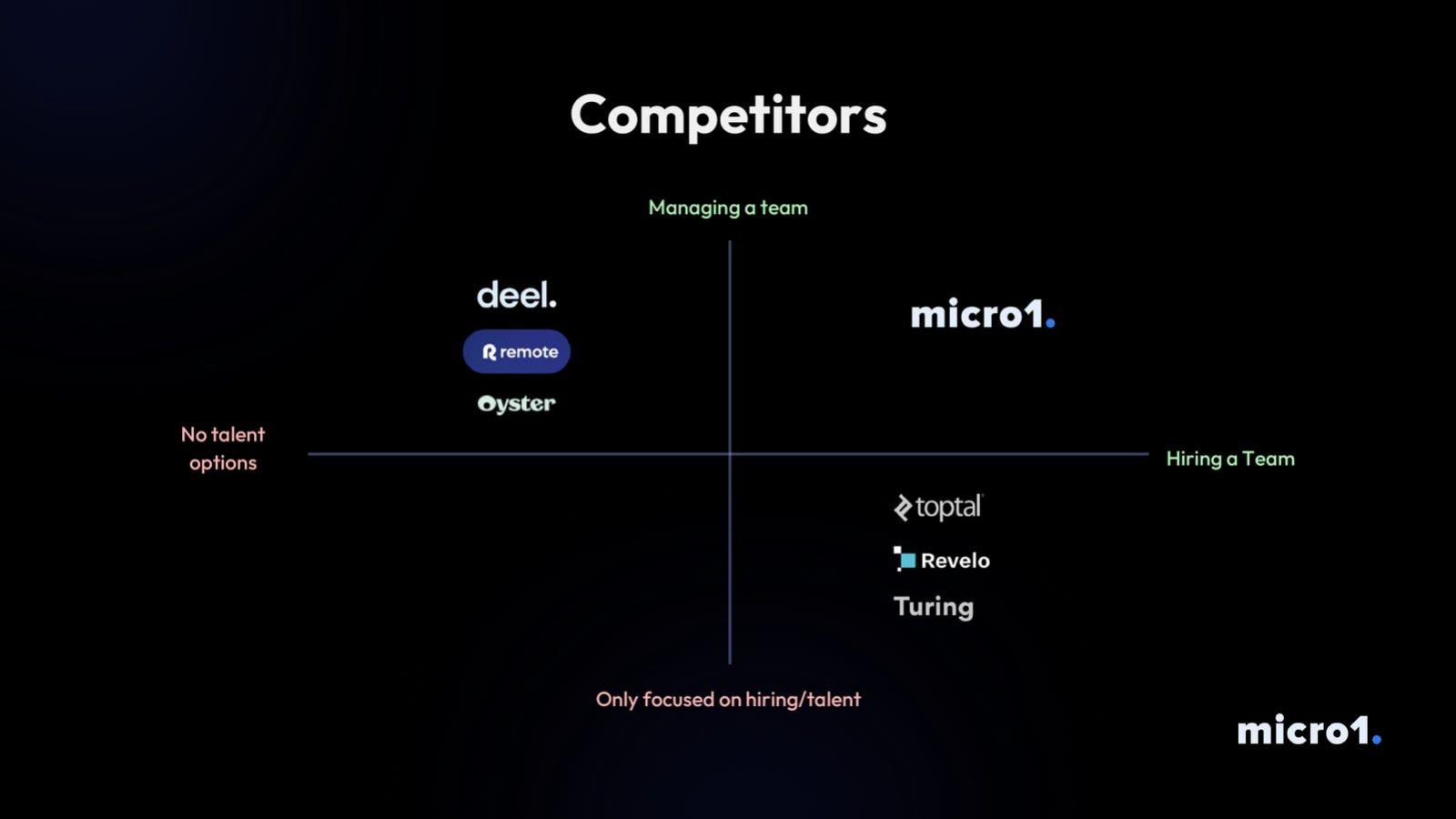
- Slide 13 lists Upwork, Nagarro, Turing, and Toptal as competitors. micro1 uses 'new follower' growth metrics to argue that they have higher momentum than these established players, despite having a smaller total follower base.
- What was the specific use of funds for the Pre-seed round?
- According to Slide 20, the company sought $2M to manage 'crazy demand.' Specifically, they planned to triple product development speed, hire 2-3 more sales professionals, and add 1-2 recruiters to their internal team.