Miga Health’s 13-slide seed deck is a masterclass in narrative-driven fundraising, focusing almost entirely on the scale of the cardiovascular health crisis rather than technical product specifications. By highlighting that 80% of premature heart attacks are preventable (Slide 5) and that 115 million Americans suffer from hypertension (Slide 7), the company establishes a massive Total Addressable Market. The deck successfully raised $12M in 2024 despite omitting traditional slides like a detailed team breakdown, competitive landscape, or specific financial projections. It relies on the streng…
Key takeaways
- The deck uses a minimalist aesthetic with high-contrast text to emphasize the urgency of cardiovascular disease in the U.S. (Slide 3).
- Miga Health identifies hypertension as the primary modifiable risk factor, citing that 75% of the 115M+ affected Americans have uncontrolled hypertension (Slide 7).
- The presentation positions telemedicine as the ideal delivery vehicle for hypertension treatment due to established algorithmic guidelines (Slide 7).
- A core strategic pillar is the 'consumer first' approach, intended to disrupt the status quo of traditional healthcare delivery (Slide 9).
- The deck defines its value proposition across three stakeholders: consumers (delight), physicians (outcomes), and employers (cost reduction) (Slide 11).
- There is a total absence of a competitive analysis slide, suggesting the founders believe the market size is large enough to accommodate multiple players or their approach is unique.
- No specific 'Ask' slide is included in the 13-slide sequence, though Business Insider reports a $12M seed round was successfully closed.
- The deck lacks a roadmap or milestone slide, focusing instead on the long-term vision of becoming a 'household consumer brand' (Slide 11).
The Narrative-First Approach to Digital Health
Miga Health’s seed deck is an exercise in restraint. In an industry often bogged down by clinical data and regulatory hurdles, Miga chooses to lead with a bold, simple mission: preventing heart attacks and strokes. The deck, consisting of 13 slides, functions more as a manifesto than a technical manual. By the time an investor reaches the end, they aren't necessarily experts on Miga’s code, but they are convinced of the catastrophic scale of the problem and the logic of Miga’s entry point.
Slide 1: The Mission Statement
The title slide sets a high-stakes tone immediately. The tagline, "Preventing the next million heart attacks and strokes," moves the conversation away from 'app features' and toward 'public health impact.' The branding is clean, using a red pulse-like graphic that reinforces the cardiovascular focus without being overly clinical.
Slide 3: Defining the Barrier
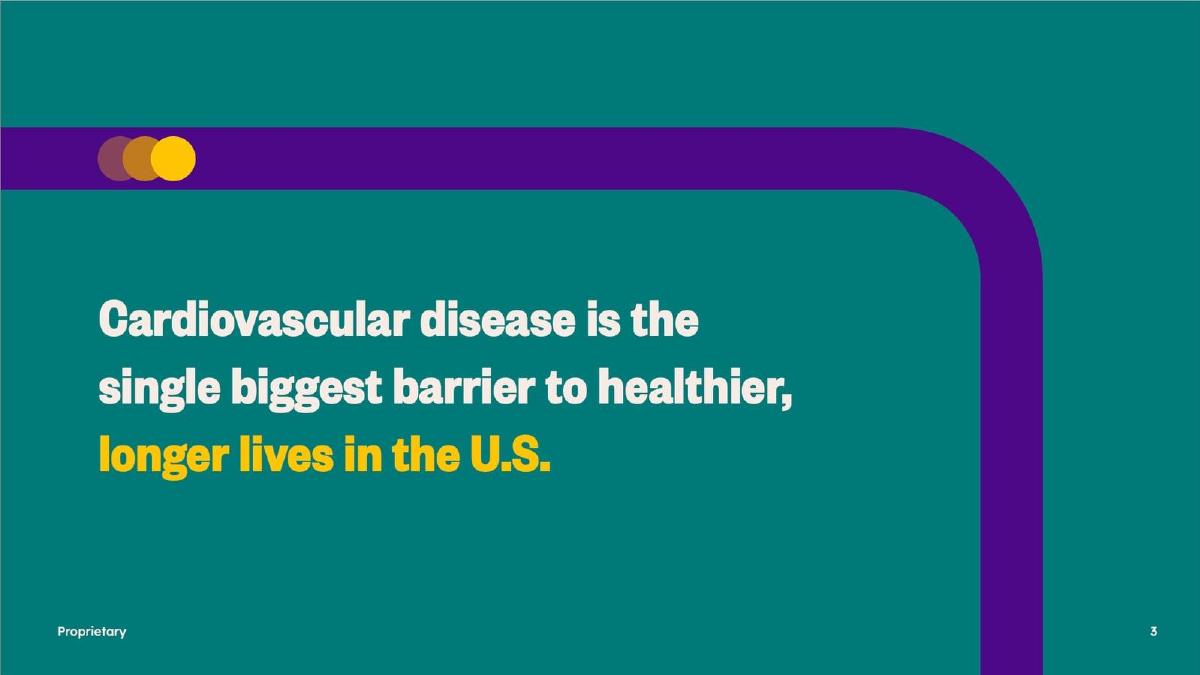
Slide 3 identifies the enemy: "Cardiovascular disease is the single biggest barrier to healthier, longer lives in the U.S." This is a classic 'Problem' slide, but it uses a macro-economic and societal lens. It frames the company not just as a healthcare tool, but as a solution to the primary obstacle of human longevity.
Slide 5: The Opportunity of Prevention
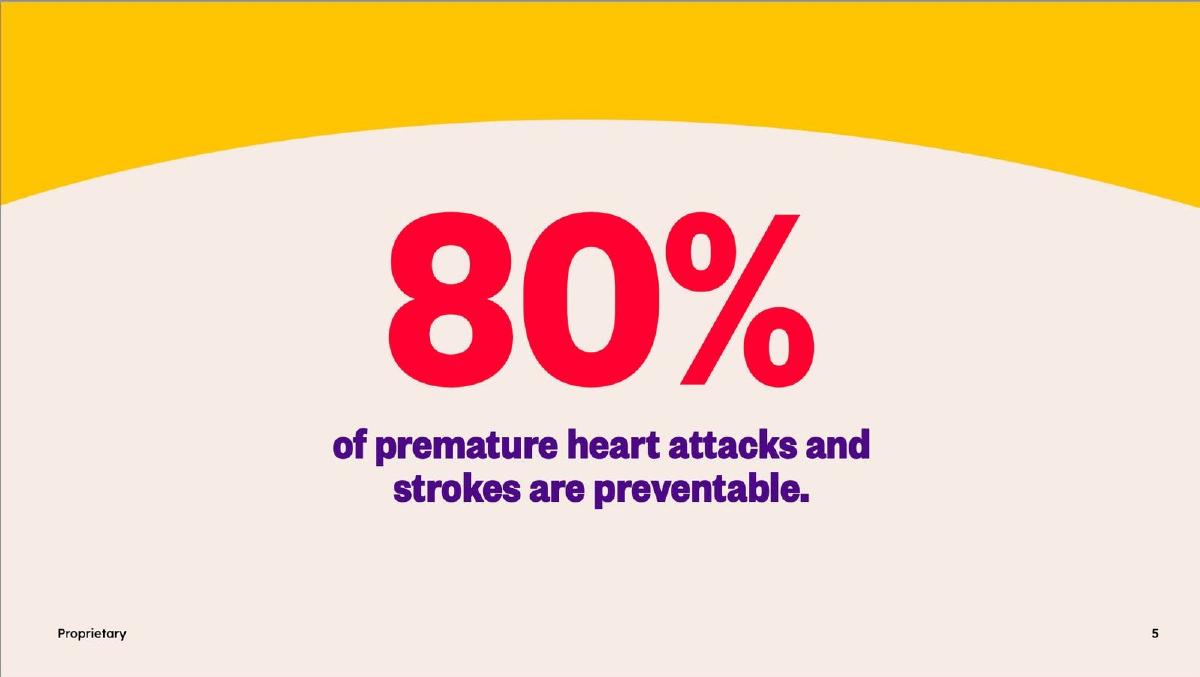
This slide provides the 'Why Now' and the 'Why This.' By stating that "80% of premature heart attacks and strokes are preventable," Miga Health highlights a massive inefficiency in the current healthcare system. For an investor, this percentage represents the 'addressable' portion of a multi-billion dollar problem. It suggests that the solution doesn't require a scientific breakthrough, but rather a better delivery mechanism for existing preventative measures.
Slide 7: The Strategic Wedge - Hypertension
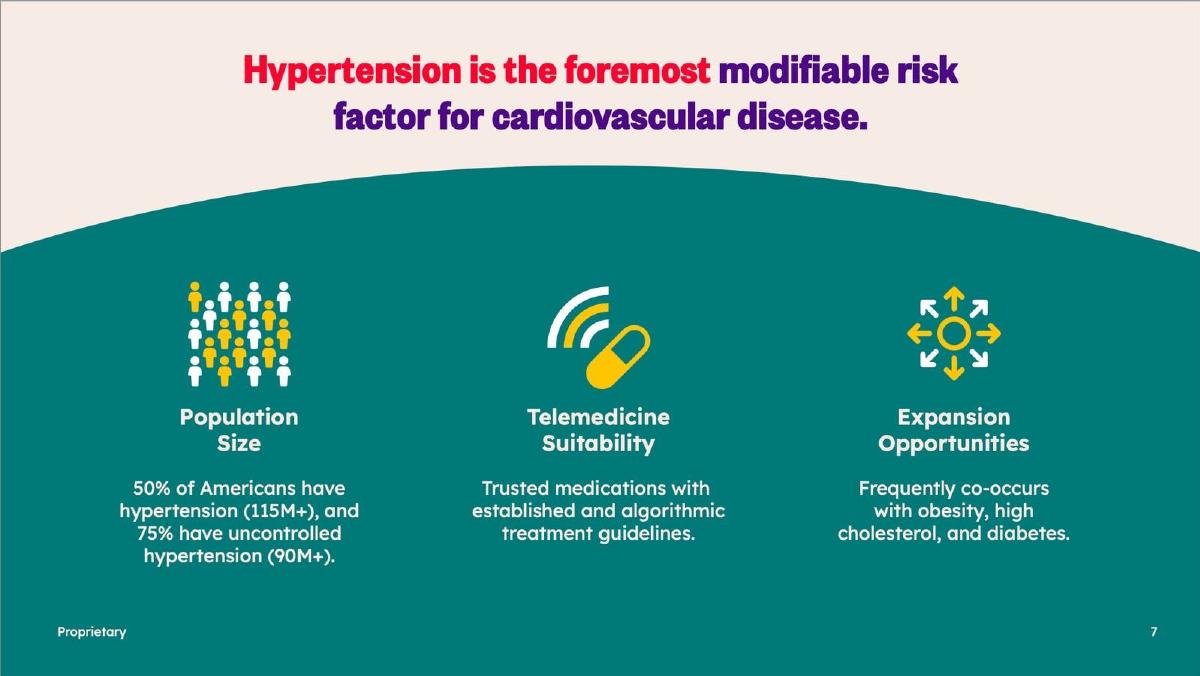
Slide 7 is the most data-dense slide in the deck, providing the rationale for starting with blood pressure. It breaks down the opportunity into three pillars:
Population Size: 50% of Americans have hypertension (115M+), and 75% are uncontrolled (90M+). · Telemedicine Suitability: The slide notes that treatment follows "established and algorithmic treatment guidelines," making it perfect for a digital-first model. · Expansion Opportunities: It positions hypertension as the gateway to treating obesity, high cholesterol, and diabetes.
This slide effectively argues that hypertension is the highest-leverage entry point into the broader chronic disease management market.
Slide 9: The Philosophy of Change
Miga Health explicitly states their theory of change on Slide 9: "We believe the only way to change the status quo is to build from the consumer first." This is a subtle critique of traditional healthcare (which is often built for payers or providers first). It signals to investors that Miga intends to win on user experience and engagement, much like a consumer tech company rather than a legacy health system.
Slide 11: The Vision and Stakeholders
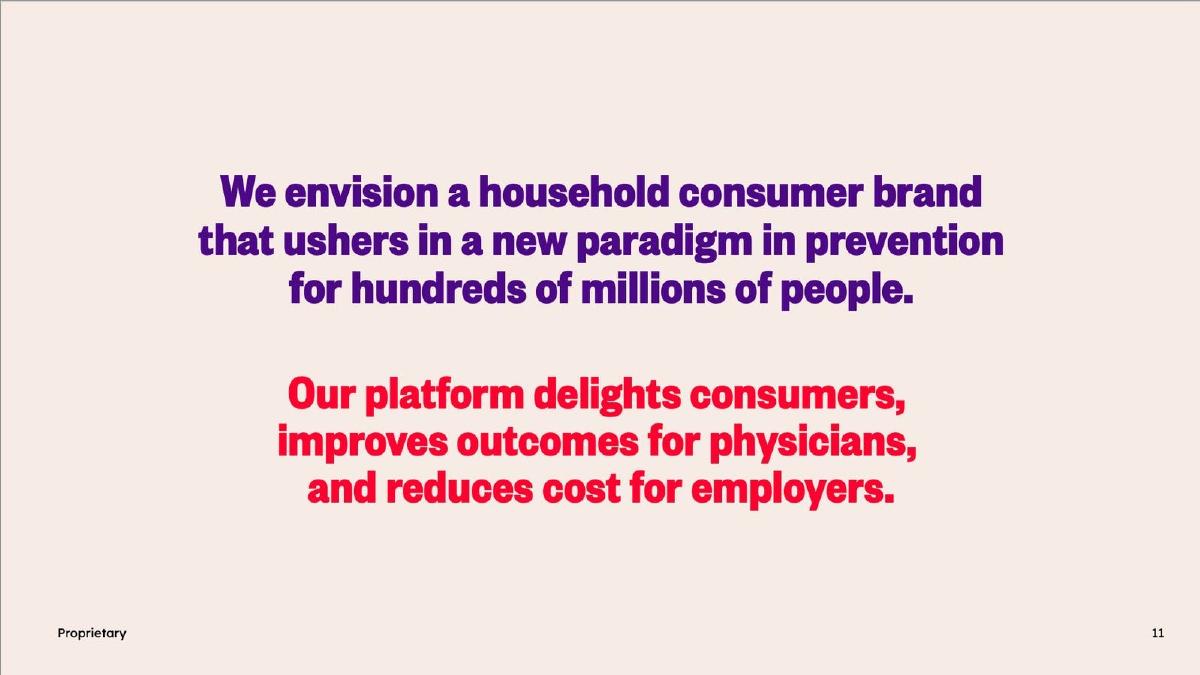
The deck concludes its narrative on Slide 11 by defining success. They envision a "household consumer brand." Crucially, they list three value propositions: delighting consumers, improving outcomes for physicians, and reducing costs for employers. This confirms that while the brand is consumer-facing, the revenue model likely involves employer-sponsored health plans or provider partnerships.
Slide 13: The Call to Action
The final slide is a simple invitation: "Join us and help people lead the long, healthy lives they deserve." It maintains the emotional resonance established in the first slide, closing the loop on the mission-driven narrative.
What Miga Health Does Well
The strength of this deck lies in its clarity of purpose . Many healthcare startups get lost in the 'how'—explaining complex API integrations or clinical trial phases. Miga stays focused on the 'what' and the 'so what.' By citing that 90 million Americans have uncontrolled hypertension (Slide 7), they make the market size undeniable. The use of bold typography and a limited color palette ensures that the key statistics (like the 80% preventability rate on Slide 5) are impossible to miss. They also do an excellent job of justifying their specific focus on hypertension, framing it as an 'algorithmic' problem that is uniquely suited for a software-driven solution.
What is Missing from the Deck
While the deck was successful in raising $12M, it leaves several critical questions unanswered for a standard due diligence process:
The Team: There is no slide introducing the founders or their clinical/technical background. In a seed round, the 'who' is usually as important as the 'what.' · Product Visuals: The deck contains no screenshots or mockups of the mobile app. Investors are left to imagine how the 'consumer-first' philosophy actually manifests in the product interface. · Business Model: While Slide 11 mentions employers and physicians, there is no detail on how Miga makes money. Is it a per-member-per-month (PMPM) fee? A subscription? A fee-for-service telehealth model? · Competition: The digital health space for hypertension is crowded (e.g., Omada, Livongo, Hello Heart). The deck does not address how Miga differentiates itself from these established players. · Unit Economics: There is no mention of Customer Acquisition Cost (CAC) or Lifetime Value (LTV), which are vital for a 'consumer-first' brand.
Lessons for Founders
Founders can learn two major lessons from Miga Health. First, don't be afraid of a narrative-heavy deck if your market is massive and your mission is clear. You don't always need 20 slides of charts to prove a point if your 'Problem' slide is sufficiently staggering. Second, identify your 'Strategic Wedge.' Miga doesn't try to solve all of cardiovascular disease at once; they identify hypertension as the 'foremost modifiable risk factor' (Slide 7) and build their entire case around that single point of entry. This focus gives investors confidence that the company has a clear, actionable starting line.
Frequently asked questions
- How much did Miga Health raise with this deck?
- According to publisher reports from Business Insider, Miga Health raised $12 million in a Seed round in 2024. The deck itself does not state the amount being raised or the valuation, which is common for decks shared publicly after a round closes.
- What is the primary problem Miga Health is solving?
- The company focuses on cardiovascular disease prevention. Specifically, they target hypertension, noting on Slide 7 that 50% of Americans have hypertension and 90 million of those cases are currently uncontrolled. They aim to prevent the 'next million heart attacks and strokes' as stated on Slide 1.
- Does the deck show the actual mobile app or product?
- No. The 13-slide deck is entirely conceptual and narrative-driven. It does not include screenshots of the mobile app, hardware integrations for blood pressure tracking, or the telehealth interface. It focuses on the 'Expansion Opportunities' like obesity and diabetes (Slide 7) rather than current UI/UX.
- Who are the target customers for Miga Health?
- Slide 11 indicates a multi-sided business model. While they aim to be a 'household consumer brand,' they explicitly mention reducing costs for 'employers' and improving outcomes for 'physicians.' This suggests a B2B2C or enterprise healthcare sales strategy.
- What slides are missing from the Miga Health deck?
- The deck is missing several standard components: a Team slide (biographies of founders), a Competitor slide, a Business Model/Pricing slide, a Go-to-Market strategy, and a Financial Projections slide. Its brevity suggests it was used as a teaser or a high-level vision deck.