MindsDB's pitch deck is a masterclass in using community traction to validate a technical product. By highlighting a GitHub star history that significantly outpaces established competitors like Keras and H2O, the company establishes immediate credibility. The deck identifies a specific bottleneck—the disconnect between ML researchers and systems developers—and proposes a solution that integrates ML directly into the database layer via SQL-like commands. With a reported $25M raised in 2024, the deck successfully transitioned from a developer-centric open-source project to a commercial enterpri…
Key takeaways
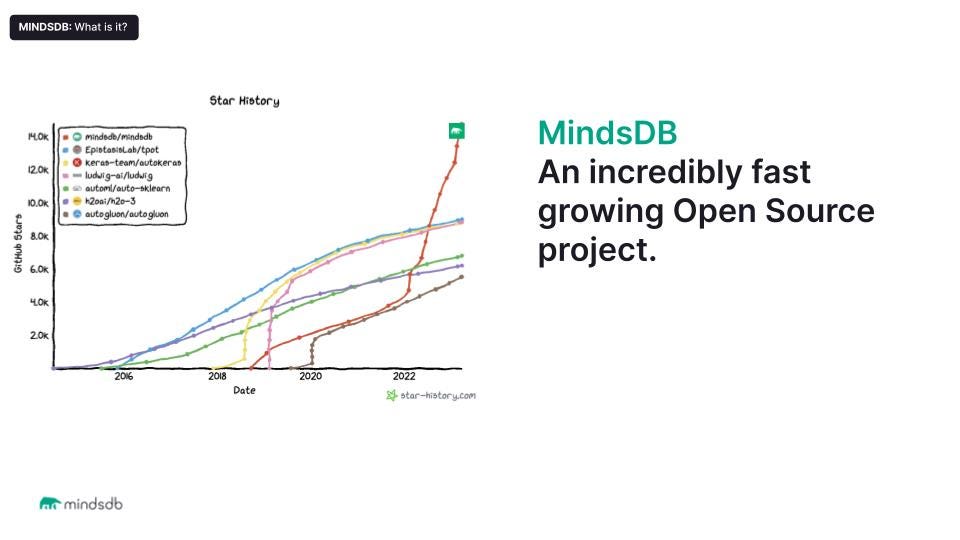
- MindsDB reports a GitHub star history exceeding 14k, showing a growth trajectory steeper than Keras, Ludwig, and H2O (Slide 1).
- The core problem identified is that getting ML to production takes months because ML researchers are not systems developers (Slide 2).
- The product is positioned as an 'AI Logic Cloud' for dev-teams building AI-first enterprise applications (Slide 3).
- Community engagement is quantified through Slack membership, which grew from near zero to approximately 3,000 members between Q1 2021 and Q1 2023 (Slide 4).
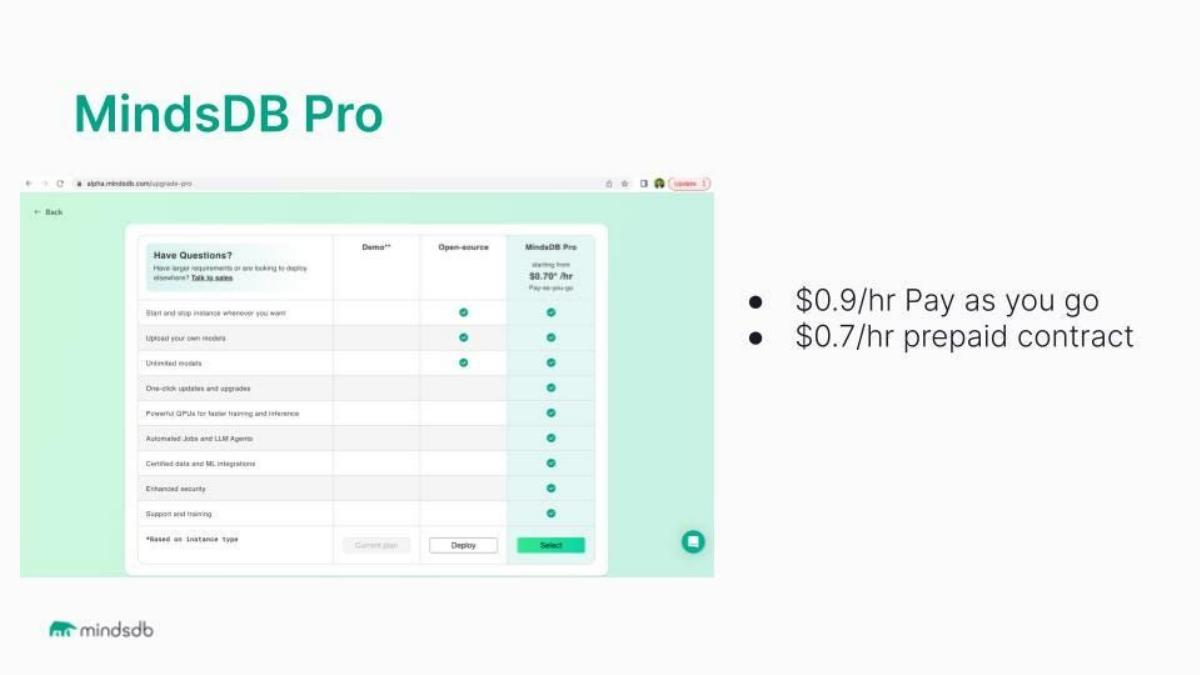
- The commercial model, MindsDB Pro, is introduced with a $0.7/hr prepaid contract or $0.9/hr pay-as-you-go pricing (Slide 5).
- The platform leverages a partner ecosystem, arguing that 'More ML more consumption' brings more business to partners like Snowflake (Slide 6).
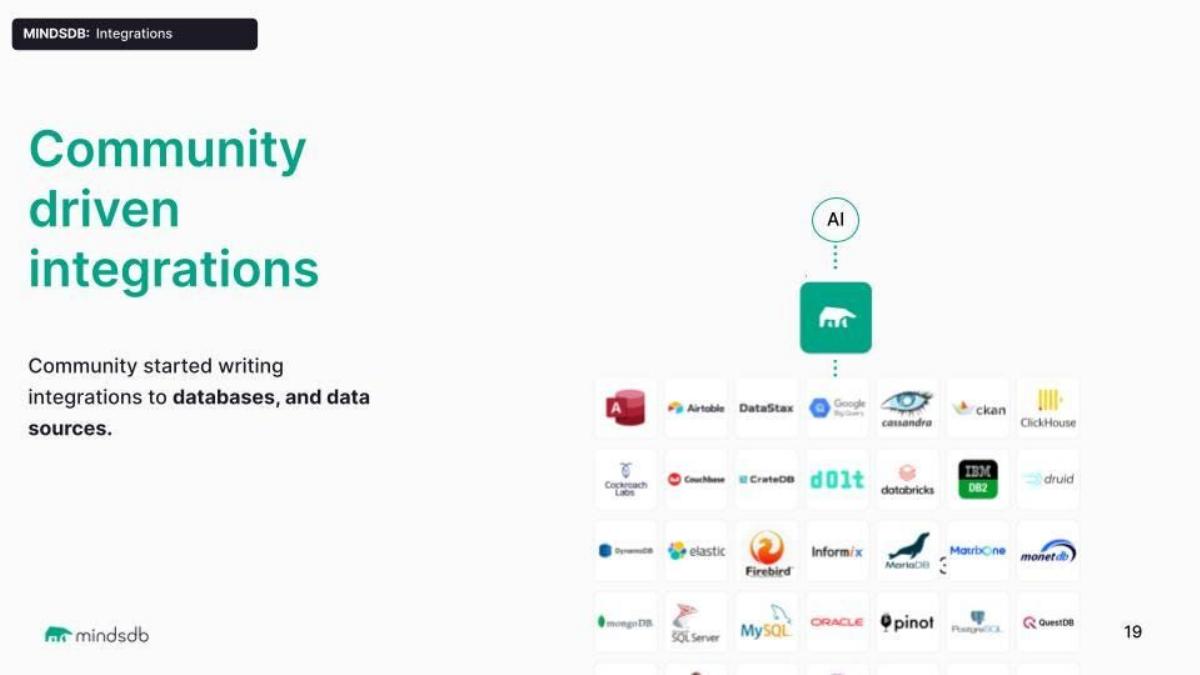
- Community-driven integrations are a key growth lever, with over 30 database and data source logos displayed, including MongoDB, MySQL, and Oracle (Slide 19).
- The technical innovation simplifies ML by allowing users to 'CREATE PREDICTOR' and 'TRAIN FROM' existing database tables using SQL syntax (Slide 23).
The Power of Open Source Traction
MindsDB’s pitch deck, which supported a $25M Seed round in 2024 as reported by Business Insider, is a prime example of how to leverage developer adoption as a proxy for enterprise value. In the highly competitive AI infrastructure sector, technical superiority is often claimed but rarely proven in a slide deck. MindsDB bypasses this by leading with community metrics that are difficult to fake and easy for investors to verify.
Slide 1: The Traction Hook
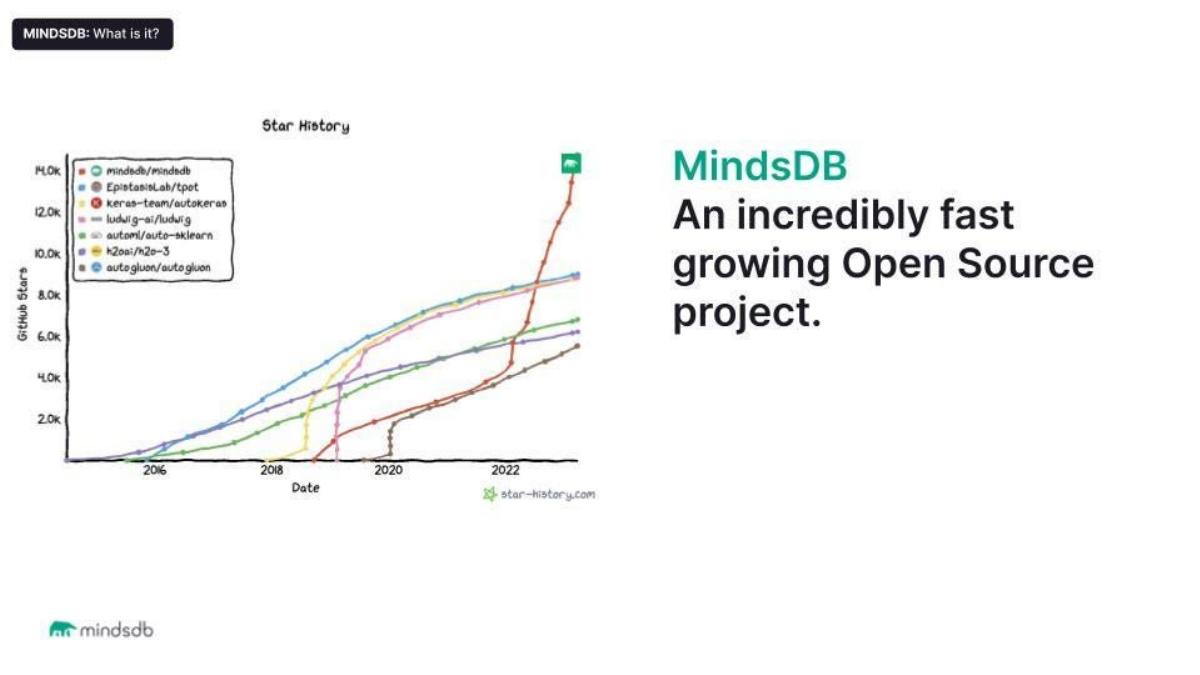
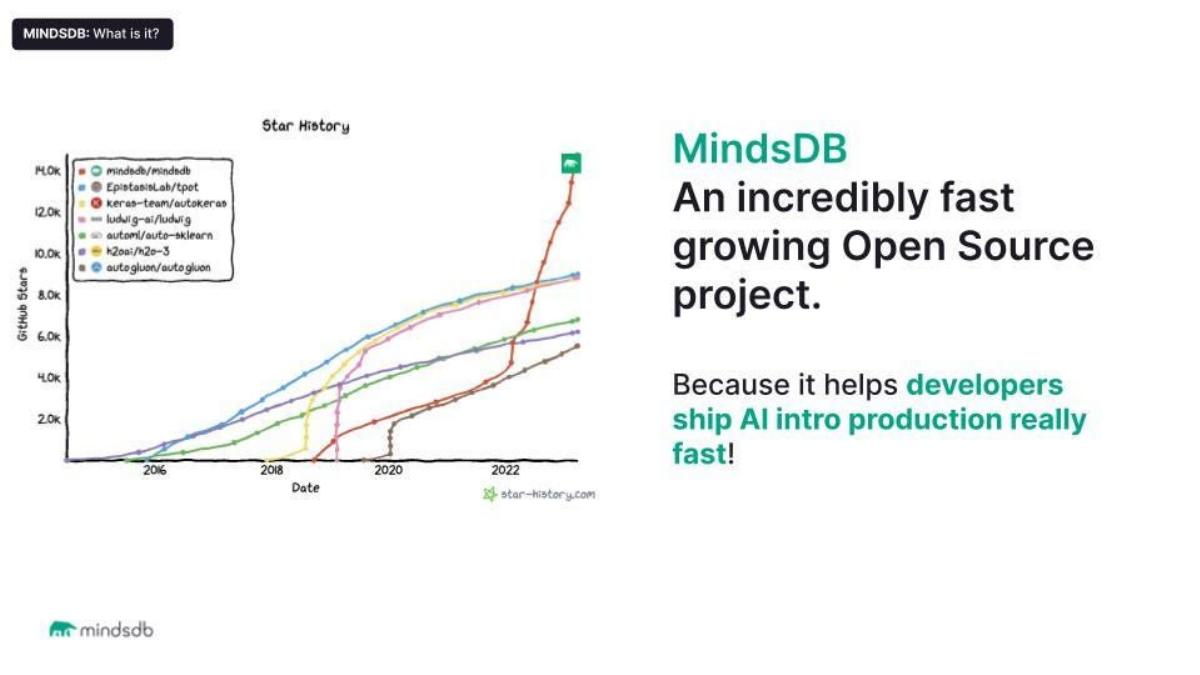
The presentation opens with a 'Star History' chart. This is a common tactic for open-source startups, but MindsDB executes it with specific competitive benchmarking. The chart shows MindsDB (the red line) starting slowly in 2018 and then experiencing an 'incredibly fast' vertical inflection point in 2022, surpassing 14,000 stars. By plotting their growth against industry standards like Keras, H2O, and Auto-Sklearn, they provide immediate context for their momentum. This slide serves as the 'Why Now' and 'Validation' slides combined into one.
Slide 2: Defining the Production Gap
Slide 2 identifies the core friction point: 'Getting ML to production is painful.' The slide explains that ML researchers are not systems developers, leading to a lack of foresight regarding data pipelines (ETL). The visual shows a fragmented process where 'Time to Production' is measured in months. This sets up the need for a unified platform that bridges the gap between the model and the application data.
Slide 3: The AI Logic Cloud
This slide functions as the high-level vision statement. It introduces the term 'AI Logic Cloud' and explicitly defines the target audience: 'dev-teams.' The annotations on the slide—'Our Users,' 'Our User Needs,' and 'Where They Need It'—emphasize that MindsDB is focused on the 'Enterprise Application' layer. This is a strategic shift from being just a tool for hobbyists to being a critical piece of the enterprise software stack.
Slide 4: Community as a Moat
Traction is further reinforced on Slide 4, which moves from GitHub stars to active engagement. The 'Slack member overtime' chart shows a steady climb to 3,000 members. More importantly, the bottom chart tracks 'Weekly active members,' showing that the community isn't just joining—they are participating. For a Seed-stage company, this level of organic engagement suggests a strong product-market fit among developers, which reduces the cost of customer acquisition (CAC) later on.
Slide 5: Monetization Strategy
Slide 5 introduces 'MindsDB Pro,' the commercial version of the open-source project. This is a critical slide for investors as it outlines the path to revenue. The pricing is transparent: $0.9/hr for pay-as-you-go and $0.7/hr for prepaid contracts. The feature comparison table shows that the Pro version includes 'Powerful GPUs,' 'Automated Jobs,' and 'Enhanced security.' This demonstrates a clear 'Open Core' business model where the community version drives adoption and the Pro version captures enterprise value through infrastructure and support.
Slide 6: The Ecosystem Play
MindsDB positions itself not as a silo, but as a multiplier for other platforms. Slide 6 shows the MindsDB logo at the center of a web of partners, including Snowflake, Hugging Face, and OpenAI. The text 'More ML more consumption, we can bring more business for them' is a direct appeal to the ecosystem. By making it easier to use ML, MindsDB increases the data processed in Snowflake or the models pulled from Hugging Face, making them a valuable partner rather than a competitor.
Slide 19: Integration Breadth
The 'Community driven integrations' slide is a visual testament to the platform's versatility. It features dozens of logos across the database and data source spectrum. The claim that the 'Community started writing integrations' is powerful because it implies that the product is so useful that users are willing to do the engineering work to expand its reach. This effectively crowdsources the R&D required to maintain a massive integration library.
Slides 22-23: The Technical 'Aha' Moment
These slides explain the 'how.' Slide 22 compares standard DB tables and queries to the MindsDB approach. Slide 23 introduces the 'ML as DB Tables' concept. The code snippet 'CREATE PREDICTOR debtmodel TRAIN FROM incometable PREDICT debt' is the core innovation. It shows how MindsDB abstracts away the complexity of machine learning into a syntax that every backend developer already knows: SQL. This is the 'secret sauce' that allows them to claim they can reduce production time from months to days.
What MindsDB Does Well
The deck excels at quantifying developer love . By using GitHub and Slack metrics, they move beyond anecdotal evidence of interest. The competitive benchmarking on Slide 1 is particularly effective because it uses well-known, successful projects as the baseline, making MindsDB's growth look even more impressive. Furthermore, the technical simplification shown in the SQL examples makes a complex AI product feel accessible and implementable.
What is Missing from the Deck
Despite the strong traction and technical narrative, the provided slides have notable omissions. There is no team slide in the sequence, which is unusual for a Seed round where the founders' backgrounds are often a primary investment criteria. There is also a lack of case studies or specific customer logos ; while they show partner logos like Snowflake, they don't show which enterprises are currently paying for MindsDB Pro or what the results were. Finally, there are no financial projections or 'The Ask' slide in the provided set, leaving the specific use of the $25M and the expected milestones undefined.
Founder Takeaways
Founders building in the developer tools or AI space should take note of how MindsDB uses community as a primary metric . If you have an open-source component, your star history and community activity are your most important slides. Additionally, the 'Problem/Solution' framing on Slide 2 and Slide 23 is excellent—it identifies a human bottleneck (researchers vs. developers) and provides a technical bridge (SQL for ML). Finally, the transparent pricing on Slide 5 shows that the company is 'open for business,' which is a vital signal for Seed investors looking for a path to $100M+ in ARR.
Frequently asked questions
- What is the primary value proposition of MindsDB?
- MindsDB enables developers to ship AI-first enterprise applications by integrating machine learning directly into the database. By treating ML models as virtual tables, it removes the need for complex ETL pipelines and allows developers to use standard SQL to train and query models, significantly reducing the time to production from months to days.
- How does MindsDB demonstrate market validation?
- The deck relies heavily on open-source metrics. It showcases a GitHub star growth chart where MindsDB surpasses several well-known ML frameworks. Additionally, it tracks Slack community growth, which reached 3,000 members by early 2023, and highlights a vast library of community-contributed integrations for various data sources.
- What is the pricing structure for the commercial product?
- MindsDB Pro uses a consumption-based pricing model. According to slide 5, the 'Pay as you go' rate is $0.9 per hour, while a 'prepaid contract' reduces the cost to $0.7 per hour. This aligns the company's revenue directly with the compute usage of their AI Logic Cloud.
- Who is the target user for MindsDB?
- The deck specifically targets 'dev-teams' rather than just data scientists. It addresses the 'pain' of systems and application developers who struggle to implement models created by ML researchers. By using SQL-like syntax, it makes machine learning accessible to the much larger population of backend and software engineers.
- How does MindsDB handle data integrations?
- MindsDB utilizes a community-driven approach to integrations. Slide 19 shows a wide array of supported data sources, including traditional SQL databases (PostgreSQL, MySQL, SQL Server), NoSQL options (MongoDB, Cassandra), and modern data warehouses (Snowflake, Databricks), allowing it to act as a central hub for AI logic.