Mimir’s 16-slide pitch deck outlines a vision for an AI-powered business development tool aimed at the UK’s 5.5 million SMEs. The company seeks £300,000 to fund its first 12 months of operations, including hiring software developers and securing desk space. The deck is notable for its heavy emphasis on technical architecture, detailing a Node.js backend and AWS deployment, which is rare for early-stage decks. However, it lacks current traction data, noting that the working model is still under construction as of the deck's creation. The financial projections are ambitious, targeting 10,000 pa…
Key takeaways
- The company identifies a target market of 5.5 million UK businesses, specifically focusing on the 660,000 startups launched in 2017 (Slide 2).
- Mimir proposes a low-cost entry point for SMEs with individual licenses priced at £9.99 per month (Slide 8).
- The technical stack is explicitly detailed, featuring a Node.js server, AWS hosting with load balancing, and data persistence via Oracle or PostgreSQL (Slide 7).
- The funding ask is £300,000 for the first 12 months, earmarked for a full-time developer, desk space, and PhD students or a software house (Slide 11).
- The competitive landscape positions Mimir as a 'Free' and 'Business Lead Generation' tool, contrasting it against paid incumbents like HubSpot and DiscoverOrg (Slide 12).
- A specific exit strategy is stated for May 2023, following a projected revenue milestone of £1.39m in April 2021 (Slide 14).
- The advisory board includes a Chairman of CyberOwl and a lecturer from UCL, providing significant institutional credibility (Slide 16).
- At the time of the deck, the product was not yet live, with the 'working model under construction' and testing 'about to commence' (Slide 13).
Executive Summary and Value Proposition
Slide 1: Title and Introduction
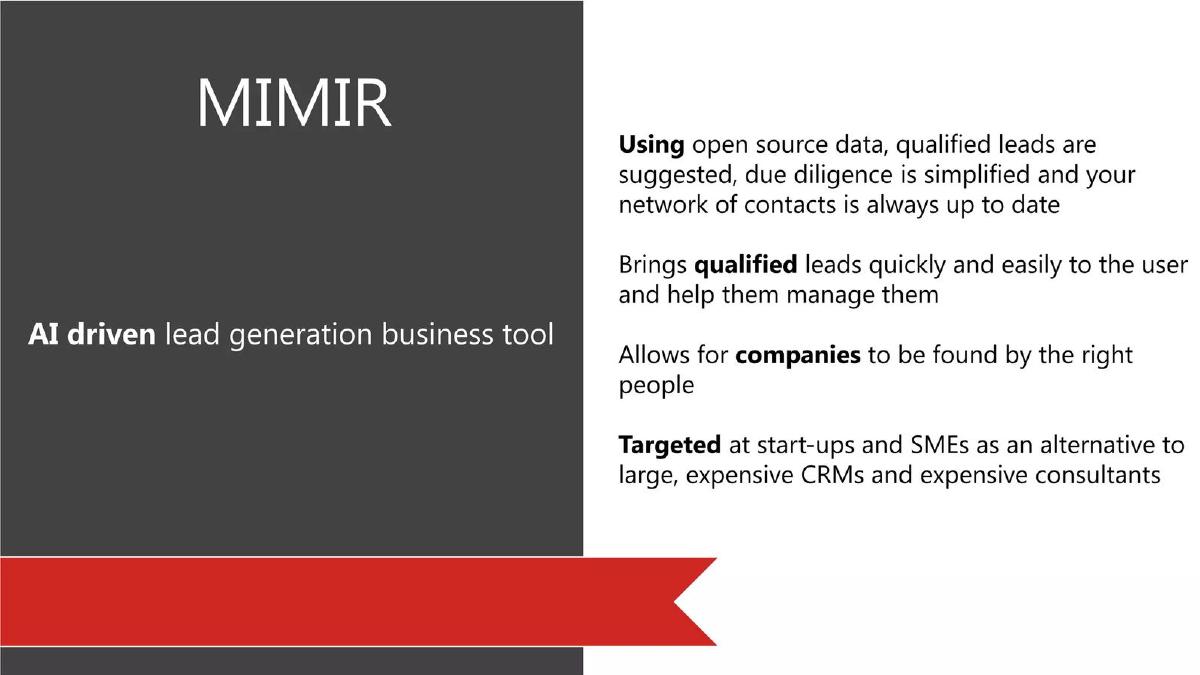
The deck opens with a clear, albeit minimalist, title slide. Mimir is defined as an AI driven lead generation business tool . The slide lists four core pillars: using open source data for lead suggestion, simplifying due diligence, maintaining up-to-date contact networks, and providing a cost-effective alternative to large CRMs for startups and SMEs. The branding is functional, utilizing a dark grey and white split with a red accent ribbon that persists throughout the deck.
Slide 2: Market and Solution
Mimir identifies its initial target market as the 5.5m Businesses in the UK , specifically highlighting the 660,000 start-ups launched in the UK in 2017 alone . The solution side of the slide emphasizes cost-effectiveness for "resource-lite" companies and efficiency for business development teams in larger organizations. This slide establishes the scale of the opportunity but lacks a traditional TAM/SAM/SOM breakdown, focusing instead on raw business counts.
Product Functionality and User Experience
Slide 3: Search Smarter
This slide explains the mechanics of the "smart search" function. It claims the tool scans the internet for the latest facts and figures to generate company profiles. These profiles are categorized into four sections: 'financials' , 'people' , 'media' , and 'additional' . This suggests a data aggregation play rather than just a contact database.
Slide 4: Why use MIMIR
The value proposition is distilled into three bullet points: Save Time , Save Money , and Be Found . Notable features mentioned include an AI feedback loop that learns from the user and a "living CRM system" where qualified leads are stored. It also notes that users can make their own profiles "data rich," implying a two-sided network effect where companies manage their own visibility.
Slide 5: User Journey
A flow chart illustrates the user experience. It starts with a "Home Ada Style Chat Interface" (referencing the Ada chatbot style), leading to company profiles, criteria searches, and a "Tinder Style Swipe/Search" mechanism. The journey ends in a feedback loop, reinforcing the AI learning aspect mentioned previously. The inclusion of a swipe mechanic suggests a mobile-first or high-velocity interaction model.
Technical Infrastructure
Slide 6: Technology Stack and Architecture (Diagram)
This is a highly technical slide for a general pitch deck. It shows a NodeJS server at the center, interacting with web APIs like CompaniesHouse , LinkedIn, and the BBC. It also displays a database/CRM component and mobile registration paths for Android and iOS. This level of detail is usually reserved for a technical due diligence annex but here serves to prove the product's feasibility.
Slide 7: Technology Stack and Architecture (Details)
Continuing the technical theme, this slide lists specific infrastructure choices: AWS deployment with load balancing, auto-scaling, and disaster recovery. Data is stored in Oracle or PostgreSQL . Notifications are handled via Google’s Firebase Cloud Messaging , and authentication uses OAuth . A key operational detail is provided: "Backend refreshes its data once every 24 hours."
Business Model and Market Strategy
Slide 8: Pricing Model
Mimir proposes two tiers. Individual licenses are £9.99 pcm (per calendar month) for the app and a basic dashboard. Enterprise licenses are listed as "tbc" for larger teams. The slide sets specific targets: £139,880 in Year 1 (from 1,000 UK startups and 2 corporate clients) and £1,398,800 in Year 2 (from 10,000 global startups and 20 corporate clients). The math implies a roughly £10/month average revenue per user (ARPU).
Slide 9: Market Adoption
This slide is a logo cloud representing potential partners or target ecosystems. It includes Notion Capital , Santander , Lloyds Bank , Octopus Ventures , and various UK universities like Cardiff . It is important to note these are listed under "Market Adoption" in a way that suggests these are the types of organizations Mimir intends to target or partner with, rather than current customers.
Slide 10: Map of UK Incubators & Accelerators
This slide visualizes the density of the target market across the UK. It shows two maps: one for Incubators and one for Accelerators . This supports the strategy of recruiting users through established tech hubs, as mentioned later in the timeline.
Investment and Competition
Slide 11: Investment Required
The ask is clearly stated: £300,000~ For first 12 months . The use of funds is specific: a full-time software developer , desk space , and two PhD students or a software house . This confirms the company is in a pre-seed or seed stage where the primary goal is building the core product team.
Slide 12: Competition
A standard 2x2 matrix plots Mimir against competitors. The axes are Paid vs. Free and Social vs. Business Lead Generation . Mimir places itself in the top-right (Free/Business). Competitors identified include HubSpot , DiscoverOrg , RainKing , Ventrica , and Qualifa on the paid side, and LinkedIn , Facebook , and Twitter on the social/free side.
Roadmap and Team
Slide 13: Progress / Next Steps
This slide provides a reality check on the current state of the company. It admits the "Working model [is] under construction" and "Testing [is] about to commence." The next steps include raising funding, linking with a university, three months of development, and one month of pre-launch marketing.
Slide 14: Route to Market (Timeline)
The timeline spans from Feb 19 (Beta Launch) to May 23 (Looking to exit) . Key milestones include 500 users by May 19, a revenue-earning launch in July 19, and reaching £1.39m revenue by April 21 . The strategy relies on "Organic growth via tech start up community" and recruitment through incubator networks.
Slide 15: Team
The core team consists of two members. Andrew Cockburn is credited with international business development experience and building the UK Government’s Technology and Smart Cities export team. Chris Welch is described as an international event producer and pre-sales expert. Notably, neither founder is described as a technical lead or developer, which explains the funding ask for engineering talent.
Slide 16: Advisory Board
The deck concludes with a strong advisory board to offset the small core team. It includes Peter Jaco (Chairman of CyberOwl), Dr. Tristan Fletcher (AI consultancy MD and UCL Lecturer), and John Griffiths (CEO of Care Systems Integrated). LinkedIn profiles are provided for all three, offering a high level of transparency and credibility.
What Mimir Does Well
The deck is exceptionally clear about its technical requirements and infrastructure . By detailing the specific stack (Node.js, AWS, PostgreSQL), the founders demonstrate they have thought through the build process, even if they aren't the ones writing the code. The pricing model is also refreshingly simple; a sub-£10 price point is a clear differentiator against enterprise-grade CRMs that often cost hundreds per month. Finally, the advisory board is top-tier for a pre-seed company, providing the necessary "adult in the room" gravitas to a two-person startup.
What is Missing from the Deck
The most glaring omission is current traction . The deck explicitly states the product is under construction, which makes the revenue projections in Slide 14 purely speculative. There is also a lack of unit economics ; while the pricing is set at £9.99, there is no mention of Customer Acquisition Cost (CAC) or Lifetime Value (LTV) projections. Furthermore, the core team lacks a CTO . For a company branding itself as "AI driven," having to hire a software house or PhD students with the investment capital is a significant execution risk that investors would scrutinize.
Lessons for Founders
Be honest about your stage: Mimir doesn't hide the fact that the product isn't finished. This builds trust, provided the ask is aligned with building that product. · Leverage advisors to fill gaps: If your core team is business-heavy, having a technical advisor from a reputable institution (like UCL) is essential. · Define your niche: Mimir doesn't try to beat HubSpot on features; it tries to beat them on price and accessibility for the "resource-lite" segment. · Include a clear exit strategy: While not always required, stating a target exit date (Slide 14) shows investors you are thinking about their liquidity from day one.
Frequently asked questions
- What is Mimir's primary value proposition?
- Mimir aims to provide an AI-driven alternative to expensive CRMs and consultants for resource-lite companies. According to Slide 1, it uses open-source data to suggest qualified leads and simplify due diligence. The tool is designed to help small businesses be found by the right people while keeping contact networks up to date automatically through an AI feedback loop.
- How does Mimir plan to generate revenue?
- The business model relies on a tiered subscription strategy. Slide 8 outlines an individual license at £9.99 per month for an app and basic dashboard. It also mentions enterprise licenses for large business development teams, though the pricing for this tier was 'tbc' (to be confirmed) at the time of the deck's publication.
- What is the specific funding request and use of proceeds?
- Mimir is seeking approximately £300,000 to cover its first 12 months of operations. As detailed on Slide 11, the funds are intended for hiring one full-time software developer, securing two PhD students or a software house, and paying for desk space. This indicates the company was in a pre-product or early development phase.
- Who are the competitors identified by Mimir?
- Slide 12 uses a 2x2 matrix to map the competition. Mimir positions itself in the 'Free / Business Lead Generation' quadrant. It identifies 'Paid' competitors such as HubSpot, DiscoverOrg, RainKing, and Ventrica. It also lists social platforms like LinkedIn, Facebook, and Twitter as 'Free' but 'Social' alternatives, whereas Mimir focuses on lead generation.
- What is the projected timeline for growth and exit?
- The route to market on Slide 14 shows a Beta launch in February 2019, reaching 1,000 paid users and £139k revenue by December 2019. The company projected scaling to 10,000 paid users and £1.39m revenue by April 2021, with a final goal of seeking an exit in May 2023.