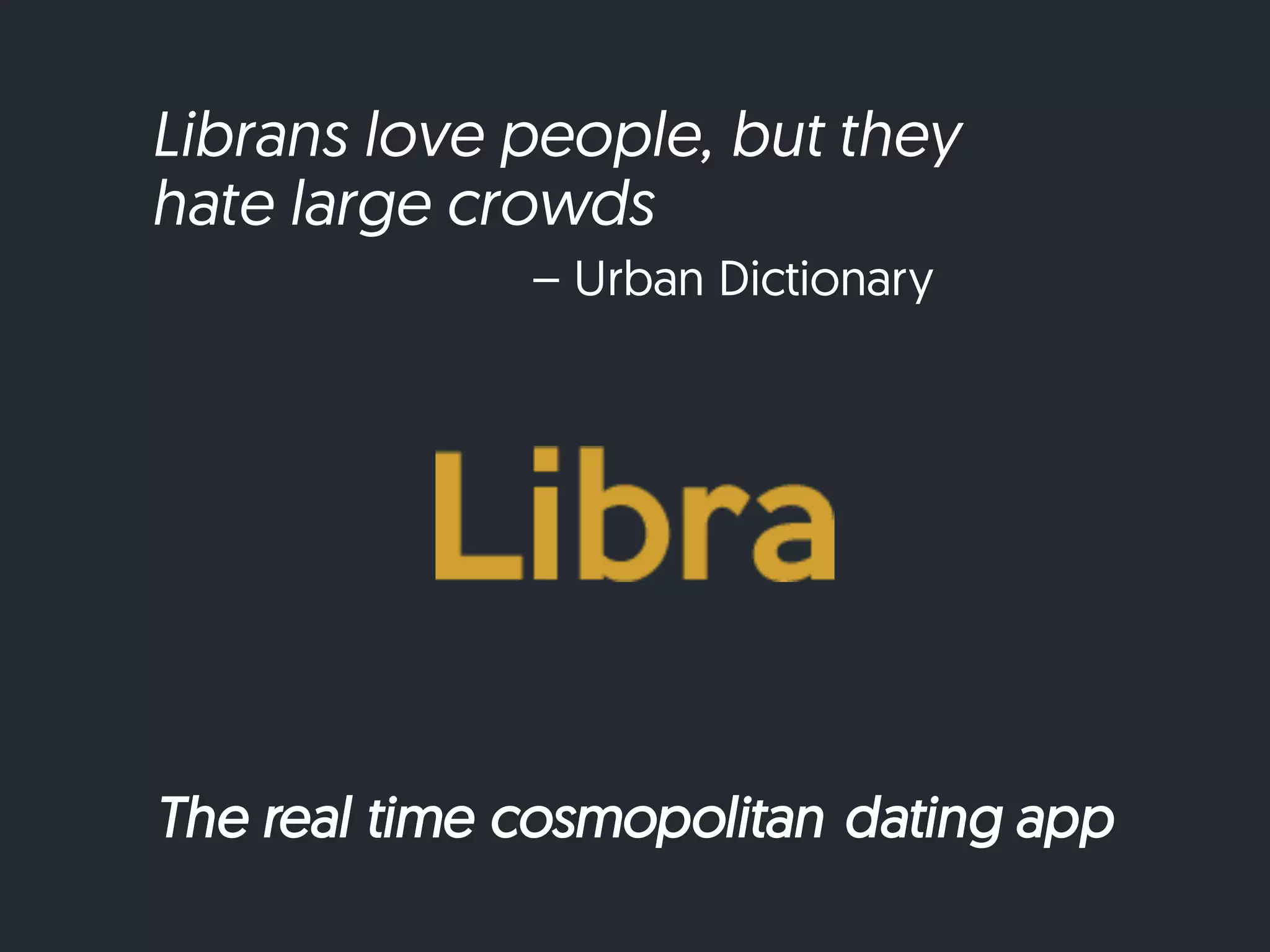
Libra is a conceptual dating application that positions itself as a 'real-time cosmopolitan dating app.' The deck argues against the friction of traditional dating platforms, citing a burden of '400 questions to fill' on slide 2. Instead, Libra focuses on hyper-local, real-time interactions specifically within coffee shops, which the founder describes as safe, familiar, and personal environments (slide 3). The business model appears to rely on physical presence, as evidenced by the marketing collateral shown for coffee shop tables on slide 4. However, the deck is significantly incomplete; it…
Key takeaways
- The product is defined as a 'real time cosmopolitan dating app' on slide 1.
- Libra identifies the '400 questions' required by competitors as a primary user friction point on slide 2.
- The app targets coffee shops as the primary venue, labeling them as 'safe' and 'familiar' on slide 3.
- Marketing strategy involves physical table tents in coffee shops with 'He is waiting for you' and 'Talk to her now' messaging on slide 4.
- The founder is a 25-year-old with a background in import/marketing tech and B2B sales, according to slide 5.
- The team is currently incomplete, with an open request for a 'strong lady to run the business' on slide 5.
- Core features include 'limited chat' and 'location real time' to encourage physical meetings, as shown on slide 6.
- The deck contains a placeholder 'Vision' slide (slide 7) that is entirely blank, indicating an unfinished presentation.
Libra Pitch Deck Analysis
The Libra pitch deck, dated 2016 per the source listing, presents a concept for a dating application that attempts to bridge the gap between digital discovery and physical interaction. The deck is brief, consisting of only 21 slides in the full version, with 7 key slides provided for this teardown. It relies heavily on emotional resonance and the specific atmosphere of coffee shops to differentiate itself in a crowded dating market.
Slide 1: Title and Positioning
The deck opens with a quote attributed to Urban Dictionary: "Librans love people, but they hate large crowds." Below this, the company name Libra is displayed in a gold font, followed by the tagline "The real time cosmopolitan dating app." This slide establishes the brand identity as something focused on intimate, one-on-one connections rather than the 'crowd' feel of massive social networks or high-volume swiping apps. The use of 'real time' suggests a focus on immediacy.
Slide 2: The Numbers (Problem Statement)
Slide 2, titled "The numbers," uses iconography to highlight two data points. First, it notes "400 # of questions to fill," accompanied by an icon of overflowing file trays. This is a direct critique of legacy dating sites (like eHarmony or OkCupid) that require extensive profiling. Second, it claims "9.1 in 10 singles" are part of the target demographic or perhaps dissatisfied with current options, though the specific source or context for this metric is not provided on the slide. The slide effectively communicates that the current 'virtual' dating world is a struggle due to administrative burden.
Slide 3: The Venue Strategy
Slide 3 is titled "Coffee shops" and features a background image of the 'Central Perk' set from the television show Friends . Overlaid on this image are five keywords: Daylight, Personal, Soothing, Familiar, Safe. This slide serves as the 'Why Now' or 'Environment' slide. It argues that coffee shops are the ideal setting for Libra's real-time dating model because they mitigate the safety concerns and high-pressure environments of bars or late-night venues.
Slide 4: Physical Marketing and UX
Slide 4, "The coffee shops," shows a mockup of physical table tents placed on a wooden surface. The text "Coffee shops are part of the game too" reinforces the hybrid nature of the app. The marketing collateral shown includes phrases like "He is waiting for you" and "Talk to her now!" This implies that the app functions by showing you who is currently present in the same physical location, encouraging an immediate transition from app-usage to face-to-face conversation.
Slide 5: The Team
The "Team" slide presents a significant red flag for institutional investors. It features one founder, described as a "young 25 years old entrepreneur" with experience in "import and marketing tech in online stores and B2B sales." He identifies as an "IT guy" who has personally struggled with dating in the "virtual world." Crucially, the bottom half of the slide features a silhouette with the text: "Still looking for... an amazing strong lady to run the business." This confirms that the startup is in a pre-team phase and lacks a balanced leadership structure.
Slide 6: Product Features
The "Add-ons | Features" slide uses a hexagonal graphic to list four core pillars of the Libra app:
Minimal opportunities: Likely a mechanism to prevent choice paralysis. · Limited chat: A feature designed to move users off the phone and into a real conversation. · Location real time: The core technical driver of the coffee-shop-based matching. · Login when you want: Suggesting a non-persistent, session-based user experience.
Slide 7: The Vision (Omission)
Slide 7 is titled "Vision" but is entirely blank. In the context of a pitch deck teardown, this is a literal omission. It suggests the deck was either a work-in-progress or that the founder failed to articulate the long-term impact of the company beyond the immediate coffee-shop use case.
What Libra Does Well
The deck is successful in identifying a specific niche. By focusing on "Daylight" and "Safe" environments (Slide 3), Libra differentiates itself from the 'hookup culture' often associated with 2016-era dating apps. The focus on reducing friction—specifically the "400 questions" mentioned on Slide 2—is a strong value proposition for users who are exhausted by traditional profile building. The physical marketing strategy shown on Slide 4 is also a clever way to solve the 'cold start' problem in social apps by targeting users who are already in a specific location.
Critical Omissions
The Libra deck is missing almost all of the 'hard' data required for a successful fundraise. There is no Business Model slide; it is unclear if the app plans to charge users, take a commission from coffee shops, or sell advertising. There is no Market Size analysis to show how many coffee-shop-goers exist or what the potential revenue could be. Most importantly, the Team slide (Slide 5) reveals a lack of operational leadership, and the Vision slide (Slide 7) is empty, leaving the investor with no sense of where the company is headed.
Founder Takeaways
Founders should look at Libra's attempt to define a "Third Place" for their app. Using coffee shops as a safety-first environment is a strong positioning tactic. However, the lesson here is primarily one of completeness. A pitch deck cannot rely solely on a 'vibe' or a quote from Urban Dictionary. It must include a clear path to monetization and a complete team. If you are a solo founder, do not use a silhouette to indicate you are looking for a co-founder; instead, highlight your current advisors or your plan to hire, as the silhouette approach emphasizes the vacuum in leadership rather than the potential of the idea.
Frequently asked questions
- What is the core problem Libra is trying to solve?
- Based on slide 2, Libra is targeting the exhaustion and complexity of traditional dating apps, specifically citing the '400 questions' users often have to fill out. The deck suggests that 9.1 in 10 singles are dissatisfied with current methods. By focusing on 'real-time' location-based interactions in coffee shops, Libra aims to move dating from a virtual struggle back into a physical, safe environment.
- How does Libra plan to acquire users?
- Slide 4 shows a physical marketing strategy. The company intends to place table-top displays (tent cards) inside coffee shops. These cards feature the Libra branding and call-to-action phrases like 'He is waiting for you' or 'Talk to her now,' alongside app store badges. This suggests a hyper-local growth strategy that relies on partnerships with physical venues to capture users while they are already out in public.
- What are the specific features of the Libra app?
- Slide 6 lists four primary 'Add-ons | Features': Minimal opportunities, Limited chat, Location real time, and Login when you want. The inclusion of 'limited chat' and 'minimal opportunities' is a counter-intuitive design choice likely intended to force users to meet in person rather than spending weeks messaging within the app, aligning with their 'real-time' cosmopolitan branding.
- Is the Libra team fully formed?
- No. Slide 5 identifies a single 25-year-old male founder who describes himself as an 'IT guy' with experience in B2B sales and marketing tech. The same slide explicitly states he is 'Still looking for... an amazing strong lady to run the business.' This indicates the startup lacks a complete C-suite and is currently a solo-founder project seeking a co-founder.
- What information is missing from this pitch deck?
- The deck is missing several critical components required for a professional fundraise. There is no slide covering the business model or how the company makes money. There are no financial projections, no market size (TAM/SAM/SOM) analysis, no competitive landscape, and no 'Ask' detailing how much capital is being raised. Furthermore, the 'Vision' slide (slide 7) is completely empty.