Gazelle Futures, in partnership with The Center for Advancing Innovation, presents a massive 55-slide deck that functions more as an ecosystem overview than a traditional startup pitch. The model focuses on 'High-Impact Gazelles'—startups built around proven, capital-efficient inventions from institutions like the NIH and NASA. The deck highlights successful portfolio companies like Oncolinx ($20MM valuation) and Circumvent Pharmaceuticals ($5MM valuation), both of which licensed NIH inventions. While the deck is heavy on institutional credibility and partnership logos (AstraZeneca, Johns Hop…
Key takeaways
- The company highlights a portfolio company, Oncolinx, which has an exclusive license to an NIH invention and a $20MM valuation (Slide 7).
- Angio360 Diagnostics LLC is cited as having a $20MM valuation with its first sale projected for 2017 (Slide 7).
- The deck leverages the massive scale of MedImmune (AstraZeneca's R&D arm) to demonstrate the potential for biologics, citing a pipeline of 120+ biologics (Slide 2).
- Academic credibility is established through a list of collaborations with institutions like University of Cambridge, UCSF, and Johns Hopkins (Slide 19).
- The strategy involves mining 40 years of NASA 'Spinoff' data and the 2015-16 NASA software catalog to find commercializable IP (Slides 36, 46).
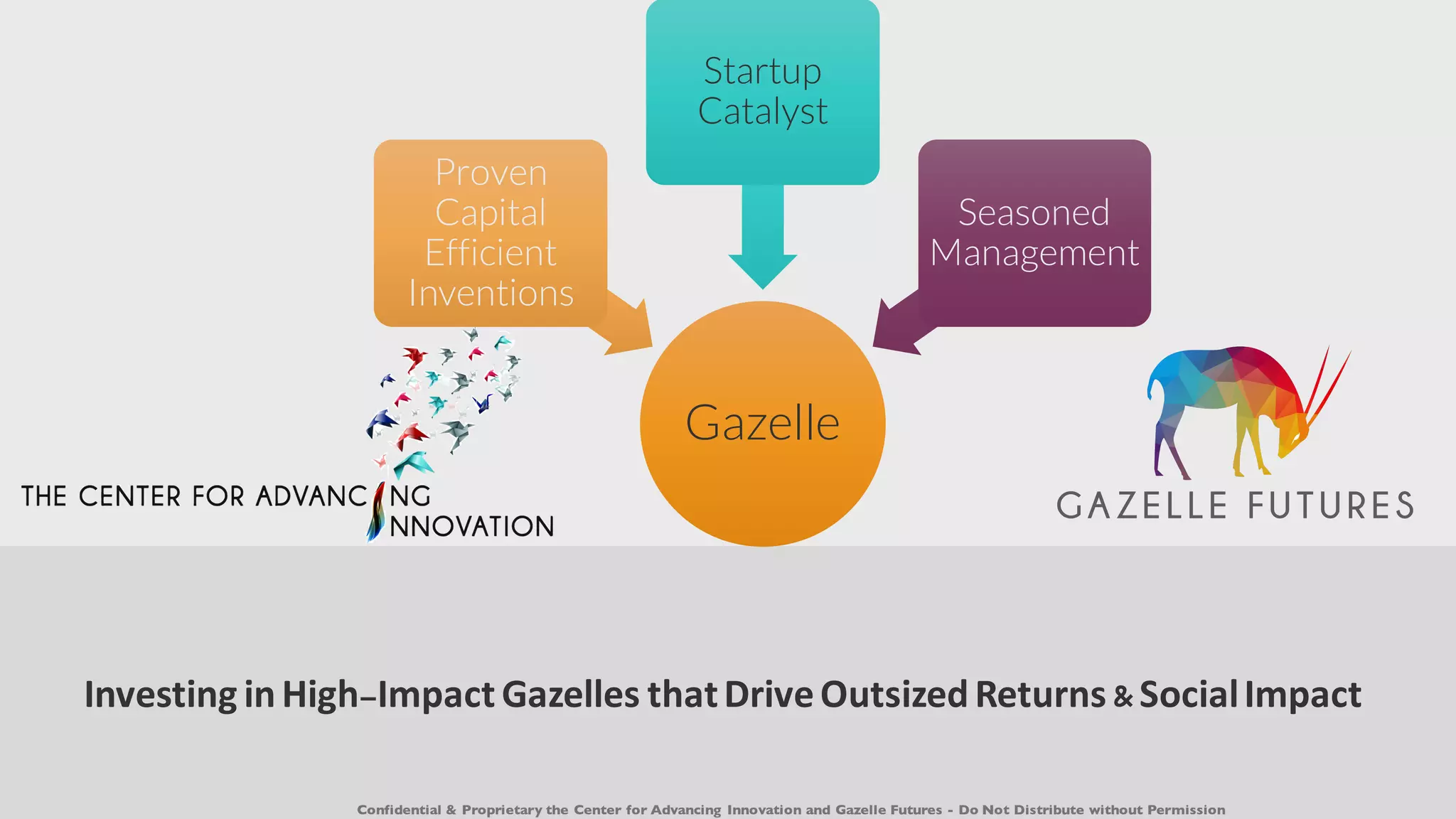
- The 'Gazelle' model is defined by three pillars: Proven Capital Efficient Inventions, Startup Catalyst, and Seasoned Management (Slide 1).
- Circumvent Pharmaceuticals is presented as a success story with an orphan drug indication from the FDA and a $5MM valuation (Slide 7).
- The deck concludes without a specific dollar amount 'ask,' instead seeking strategic partnerships and advisors (Slide 55).
Executive Summary: The Institutional IP Arbitrage
The Gazelle Futures deck, produced in collaboration with The Center for Advancing Innovation (CAI), is a sprawling 55-slide document that outlines a strategy for commercializing federal and academic research. The core thesis is that billions of dollars in R&D are sitting idle in labs like NASA and the NIH, and Gazelle Futures provides the 'Startup Catalyst' (Slide 1) to turn these inventions into high-growth companies. The deck relies heavily on institutional logos and third-party validation to build a case for a model that is part accelerator, part venture studio, and part tech-transfer office.
Slide 1: The Gazelle Framework
The opening slide introduces the three pillars of the company's strategy: Proven Capital Efficient Inventions, Startup Catalyst, and Seasoned Management. These three inputs feed into 'Gazelle,' a term used here to describe high-impact companies. The slide also features the logos of The Center for Advancing Innovation and Gazelle Futures, framing the venture as a dual-entity operation focused on 'Outsized Returns & Social Impact.'
Slide 2: The MedImmune Benchmark
Slide 2 provides a 'Brief Overview' of MedImmune, the global biologics R&D arm of AstraZeneca. It highlights 2,500 employees and a pipeline of 120+ biologics. This slide functions as a 'market size' or 'opportunity' indicator, showing the scale of the industry Gazelle Futures intends to disrupt or participate in. By citing 40+ projects in clinical stage development, the deck sets a high bar for what 'success' looks like in the biotech sector.
Slide 7: Success Stories and Valuations
This is the most critical slide for investors. It lists three 'Breast Cancer & Neuro Successes' that have emerged from their process. Oncolinx is credited with a $20MM valuation and 20 agreements with pharma. Circumvent Pharmaceuticals , focused on Batten’s disease, is listed with a $5MM valuation and an exclusive license to an NIH invention. Angio360 Diagnostics LLC is shown with a $20MM valuation and a note that its first sale was expected in 2017. This slide provides the only concrete financial metrics in the teardown, validating the 'Gazelle' model with real-world valuations.
Slide 19: Academic Credibility
To reinforce their 'Startup Catalyst' claim, Slide 19 lists 'Examples of Academic Collaboration.' The list includes heavyweights like the University of Cambridge, UCSF, and Johns Hopkins. The descriptions focus on joint PhD programs, entrepreneur-in-residence programs, and joint steering committees. This slide is designed to show that Gazelle Futures is not an outsider, but a deeply integrated partner within the global research community.
Slides 36, 40, 41, and 46: The NASA Connection
A significant portion of the deck is dedicated to NASA. Slide 36 shows a collage of 40 years of 'NASA Spinoff' publications, suggesting a deep well of untapped potential. Slides 40 and 41 are purely visual, showing a truck and a bridge, likely representing the physical-world applications of space-age technology. Slide 46 introduces the 'NASA Technology Transfer Program' and the 2015-16 software catalog, which includes categories like propulsion, autonomous systems, and aeronautics. The implication is that Gazelle Futures has the 'keys' to this massive library of intellectual property.
Slide 49: The Evolution of the Challenge
This slide marks a transition in the deck, titled 'Startup Challenge Evolution.' It features the Gazelle Futures logo prominently. This suggests that the company is moving from a pure non-profit or grant-based model (via CAI) into a more formalized commercial entity (Gazelle Futures) that can scale the 'challenge' model globally.
Slide 55: The Conclusion and Call to Action
The final slide, 'Key Takeaways,' is surprisingly soft for a pitch deck. Instead of asking for a specific investment amount, it invites the reader to 'Join the RACE,' 'be a judge,' or 'mentor a team.' It states that 'GAZELLE is seeking strategic partnerships & advisors.' The slide provides contact information for Rosemarie Truman, Founder and CEO. This suggests the deck is used more for networking and partnership development than for a hard-nosed capital raise.
What Works in This Deck
Institutional Validation: The use of logos from NASA, NIH, AstraZeneca, and top-tier universities creates an immediate sense of credibility. It is difficult for an investor to dismiss a company that appears to have the backing of the world's leading research institutions. · Proof of Concept: Slide 7 is a powerhouse. By showing that they have already created companies with $20MM valuations, they move the conversation from 'this might work' to 'this is already working.' · Technology Depth: The mention of specific catalogs (like the NASA software catalog) shows that the founders have done the legwork to identify exactly where the value lies within these massive bureaucracies.
What Is Missing from This Deck
The Revenue Model: There is no explanation of how Gazelle Futures makes money. Do they take a percentage of the licensing fees? Do they own 10% of every 'Gazelle' they create? Without this, it is a project, not a business. · The 'Ask': A pitch deck should clearly state how much money is being raised and what it will be used for. This deck ends with a request for 'advisors,' which is confusing if the goal is to raise a venture fund or operating capital. · Unit Economics: While we see the valuations of the startups, we don't see the cost to produce them. How much does it cost to run a 'Startup Challenge'? How long does it take to go from a NASA software file to a $5MM company? · Team Slide: In the 10 slides provided, there is no dedicated team slide highlighting the backgrounds of the leadership beyond the CEO. In a 'Seasoned Management' play, the management's resumes are the most important asset.
Founder's Guide: What to Copy and What to Avoid
Copy the 'Success Table' format: Slide 7 is excellent. It combines the company name, a brief description, a list of 'Progress' (awards, grants, licenses), and a 'Valuation.' This is a highly efficient way to show portfolio health without needing a separate slide for every company.
Avoid the 'Logo Soup': While the academic and institutional logos add credibility, the deck relies on them too heavily. A founder should ensure that their own brand and their own value proposition aren't buried under the weight of their partners' reputations.
Avoid the 'Infinite Deck': 55 slides is far too many for a standard pitch. This deck likely functions as a 'leave-behind' or a reference document. For a live pitch, founders should aim for 12-15 slides that focus strictly on the Problem, Solution, Market, Traction, and Ask. The NASA and MedImmune history lessons could be moved to an appendix.
Be clear about the 'Ask': Never end a presentation without telling the audience exactly what you want from them. If you want $2 million to run five more challenges, say so. If you want strategic partners, define what a 'partner' actually does and what they get in return. Rosemarie Truman is clearly a capable ecosystem builder, but the deck leaves the investor wondering where the 'buy' button is.
Frequently asked questions
- What is the primary business model of Gazelle Futures?
- Gazelle Futures operates as a 'startup catalyst' that identifies underutilized intellectual property from federal labs (like NIH and NASA) and academic institutions. They then run 'startup challenges' to recruit management teams and form new companies around this IP. The goal is to create 'Gazelles'—high-growth companies that drive both outsized financial returns and social impact through medical or technological breakthroughs.
- How does the deck demonstrate traction?
- Traction is shown through the success of specific companies formed under their model. Slide 7 lists three examples: Oncolinx ($20MM valuation, 20 agreements with pharma), Circumvent Pharmaceuticals ($5MM valuation, FDA orphan drug status), and Angio360 Diagnostics ($20MM valuation). These examples serve as proof-of-concept for their ability to license government inventions and turn them into valued private entities.
- What role do NASA and the NIH play in this deck?
- They are the primary sources of 'Proven Capital Efficient Inventions.' The deck highlights 40 years of NASA spinoffs and a software catalog containing thousands of programs across 15 categories (Slide 46). By positioning themselves as the bridge to this institutional IP, Gazelle Futures argues they are starting with technology that has already been de-risked by millions in federal funding.
- Who is the target audience for this 55-slide presentation?
- Given the lack of a specific funding 'ask' and the focus on 'Key Takeaways' like joining a race or mentoring a team (Slide 55), the deck appears targeted at institutional partners, government agencies, and high-net-worth individuals interested in impact investing or ecosystem building rather than traditional seed or Series A venture capitalists.
- What are the most significant omissions in the deck?
- The deck lacks a clear revenue model for Gazelle Futures itself. While it shows the valuations of the startups it helps create, it does not explain how the parent organization makes money (e.g., equity stakes, management fees, or licensing royalties). Additionally, there is no slide detailing the specific use of funds or a roadmap for the platform's expansion.