Liefergrün’s Series A deck is a masterclass in narrative-driven logistics, focusing heavily on the consumer experience rather than just the operational backend. By framing the problem as a combination of poor service and environmental impact, the company positions its zero-emission delivery service as a premium alternative to legacy carriers like DHL. The deck outlines a clear path to a 22.1 billion Euro market opportunity, driven by an asset-light model that utilizes third-party fleet partners. While the deck lacks a specific team slide or detailed historical traction data in this 9-slide ve…
Key takeaways
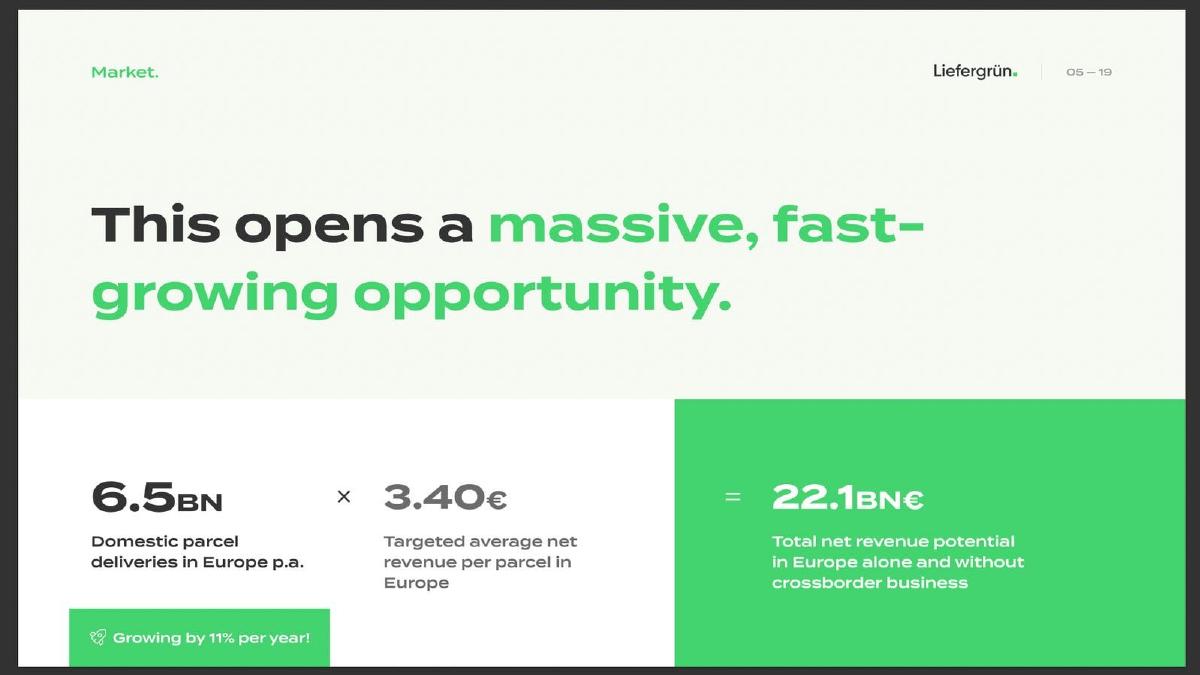
- The company identifies a 22.1 billion Euro total net revenue potential in Europe, excluding cross-border business, on slide 5.
- Liefergrün targets an average net revenue of 3.40 Euro per parcel, as shown in the market calculation on slide 5.
- The platform is currently 100% reliant on 3PL fleet partners, maintaining an asset-light model for hyper-scaling, according to slide 7.
- The 'Product Vision' on slide 6 explicitly compares the company to Klarna, aiming to create new touchpoints along the customer journey.
- The market for domestic parcel deliveries in Europe is cited as 6.5 billion parcels per year, growing at 11% annually on slide 5.
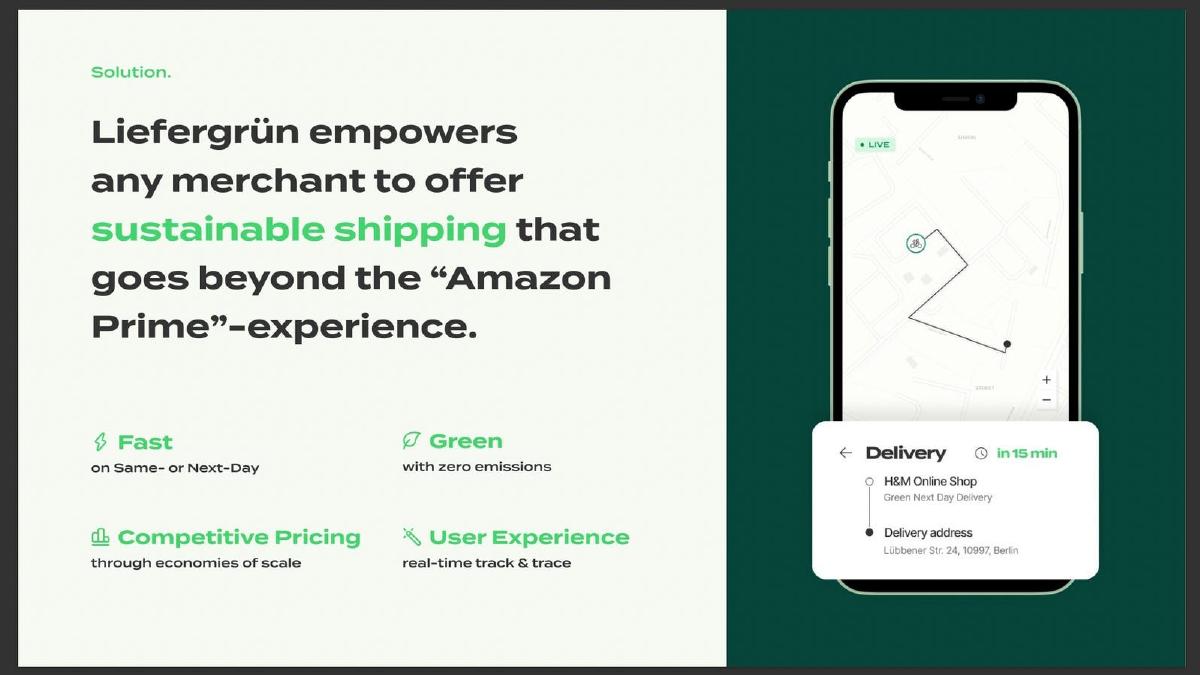
- The solution emphasizes four pillars: Fast (Same- or Next-Day), Green (Zero emissions), Competitive Pricing, and User Experience, detailed on slide 6.
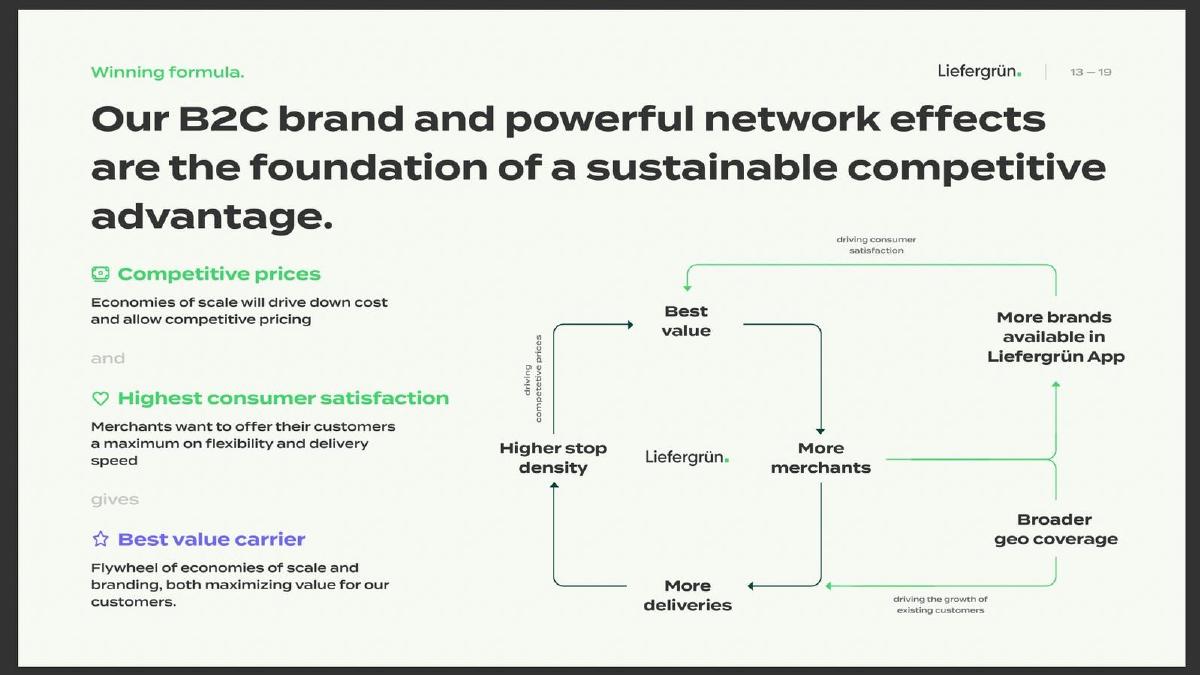
- A competitive advantage flywheel is presented on slide 9, linking higher stop density to lower costs and increased merchant adoption.
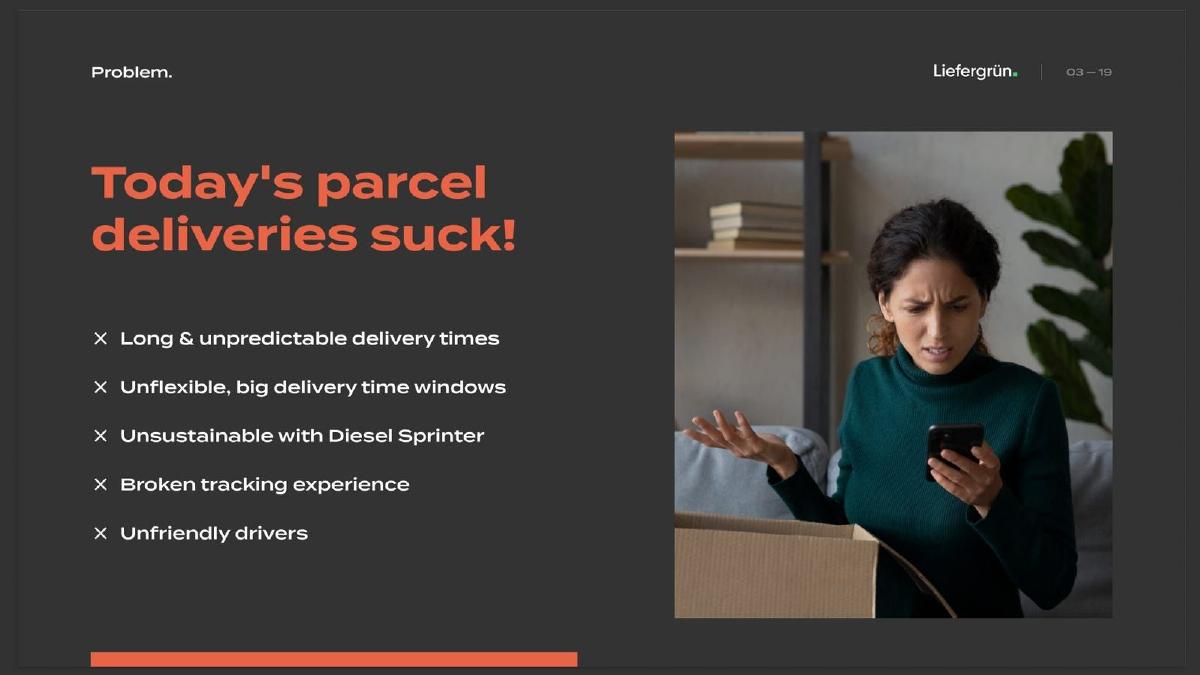
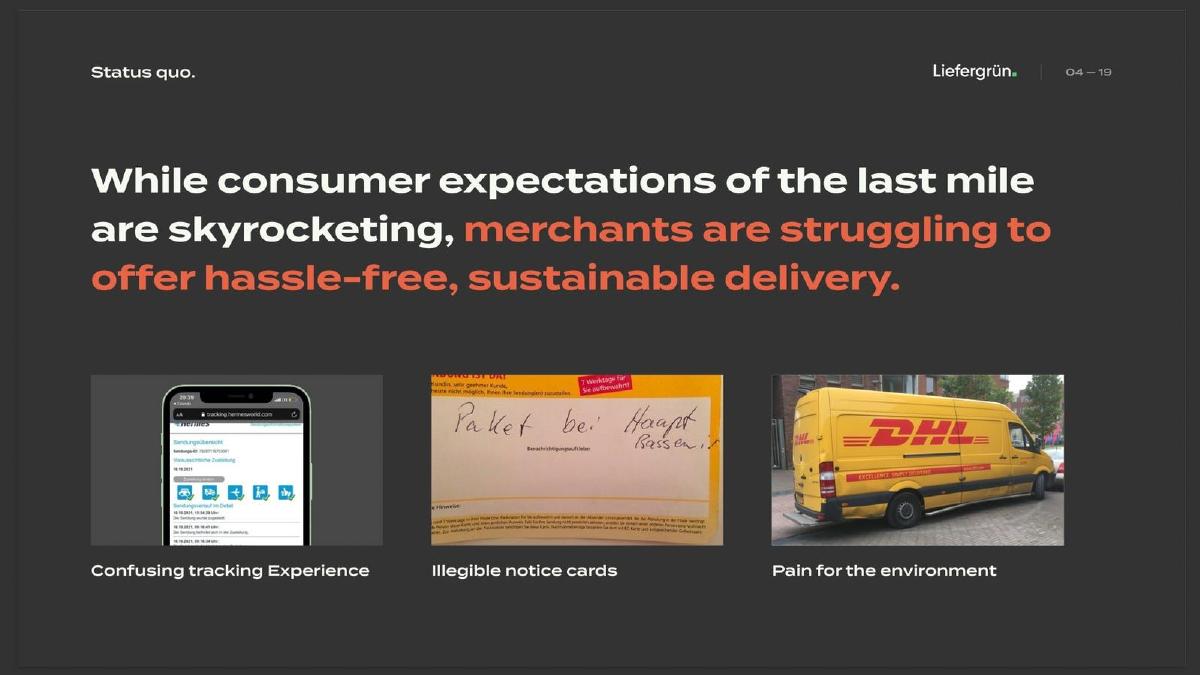
- The deck highlights specific consumer pain points including 'unfriendly drivers' and 'illegible notice cards' on slides 3 and 4.
Liefergrün Series A Teardown: Redefining the Last Mile
Liefergrün’s 2022 Series A deck, which secured $12M in funding, is a concise 9-slide presentation that focuses on the intersection of e-commerce growth and environmental sustainability. As a German green logistics platform, the company uses this deck to argue that the current state of delivery is fundamentally broken—not just for the planet, but for the end consumer. By positioning themselves as a tech-first platform rather than a traditional trucking company, they successfully framed a logistics play as a high-margin, scalable software opportunity.
Slide 1-2: The Mission Statement
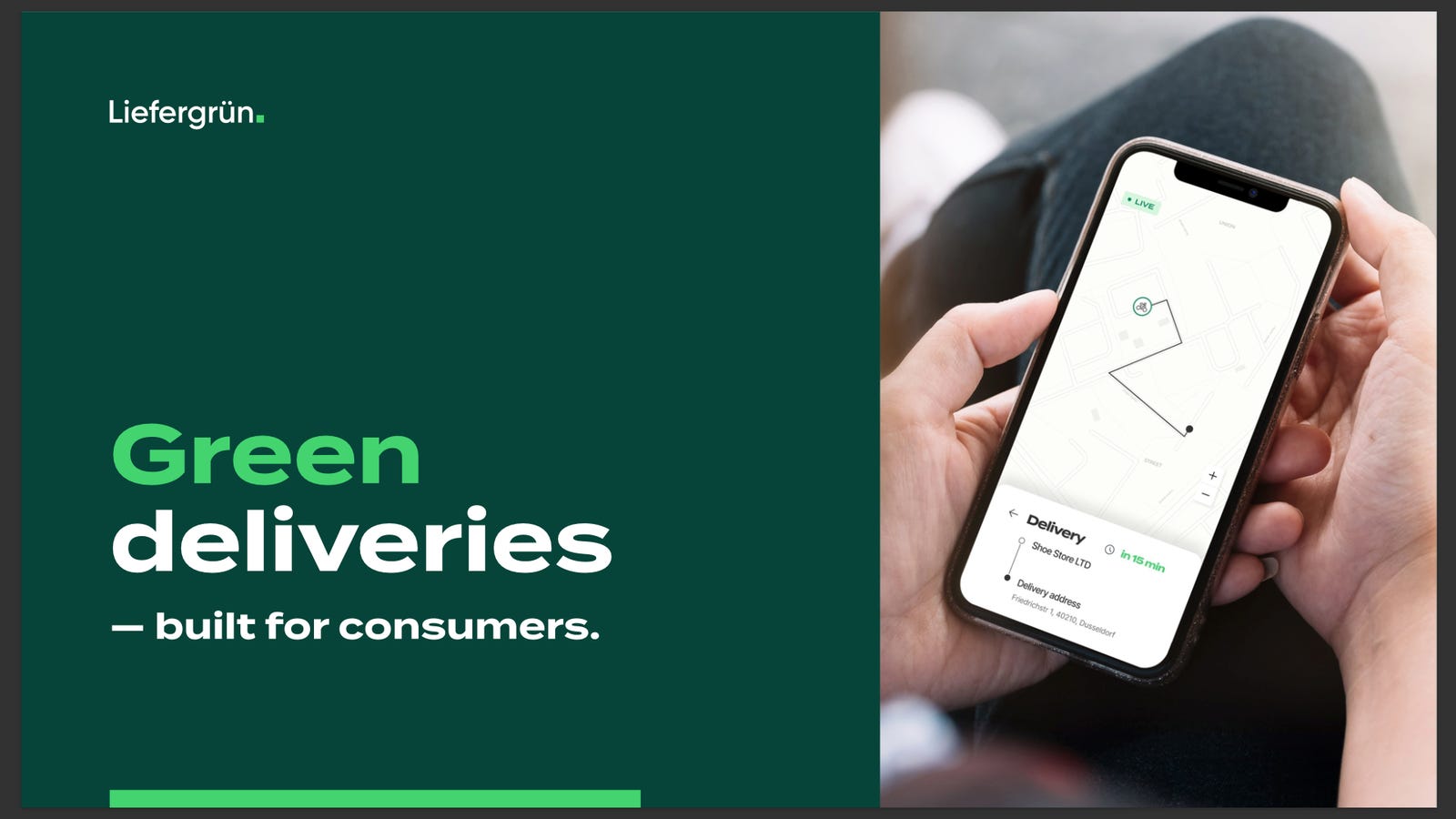
The deck opens with a strong visual identity. Slide 1 introduces the brand with the tagline "Green deliveries — built for consumers." This is a critical distinction; they are not just building for merchants or for the environment, but for the person receiving the package. Slide 2 reinforces this with a purpose statement: "We are driven by the purpose to turn every parcel delivery into a green experience." The use of high-quality photography showing a friendly delivery person in branded gear sets a professional, reliable tone immediately.
Slide 3: The Problem – "Today's parcel deliveries suck!"
Slide 3 takes a blunt approach to the problem statement. It lists five specific pain points: long and unpredictable delivery times, inflexible windows, the unsustainability of Diesel Sprinter vans, broken tracking, and unfriendly drivers. By labeling these as things that "suck," the company aligns itself with the frustrated consumer. This slide is effective because it addresses both operational inefficiencies and emotional frustrations, making the case for change multi-dimensional.
Slide 4: Status Quo and Visual Proof
Slide 4 deepens the problem by contrasting skyrocketing consumer expectations with merchant struggles. It uses three real-world images to illustrate the "Status Quo": a confusing mobile tracking screen from a competitor, a handwritten "illegible notice card" left at a door, and a traditional yellow DHL van labeled as "Pain for the environment." This visual evidence makes the abstract problem of "bad logistics" feel tangible and urgent to the investor.
Slide 5: The 22.1 Billion Euro Opportunity
This is the core financial slide of the deck. Liefergrün breaks down the market opportunity into a simple equation: 6.5 billion domestic parcel deliveries in Europe per year multiplied by a 3.40 Euro targeted average net revenue per parcel. This results in a 22.1 billion Euro total net revenue potential. They also note the market is growing by 11% per year. By providing a specific per-parcel revenue target, they give investors a clear unit of value to track against their growth.
Slide 6: The Solution – Beyond Amazon Prime
Slide 6 introduces the Liefergrün solution. The headline claim is that they empower merchants to offer shipping that "goes beyond the Amazon Prime-experience." They break the solution into four quadrants: Fast (Same/Next-Day), Green (Zero emissions), Competitive Pricing (via economies of scale), and User Experience (real-time track & trace). A mockup of their tracking interface on a smartphone is shown, emphasizing the "15 min" delivery window, which directly addresses the "unpredictable times" problem mentioned on slide 3.
Slide 7: The Asset-Light Business Model
Slide 7 explains how the company scales without the massive capital expenditure usually associated with logistics. They describe their platform as "asset-light" and "designed for hyper-scaling." A flow chart shows the relationship between Merchants, the Liefergrün Platform, and Consumers. Crucially, it reveals that they currently use 100% 3PL (third-party logistics) fleet partners. Liefergrün provides the Dashboard, API, Driver App, and Tracking App, while the partners provide the physical labor and vehicles. This slide also mentions a future "own fleet scenario" to be implemented only when utilization provides cost advantages.
Slide 8: Product Vision – The "Klarna of Green Deliveries"
Slide 8 is the most ambitious in the deck. It moves the company from a delivery service to a "consumer brand." By calling themselves the "Klarna of green deliveries," they are signaling an intent to own the checkout and post-purchase experience. The slide lists future features like scheduled returns, a consumer app for brand consolidation, and a "one-stop shop" for consumer monetization. This suggests that delivery is just the entry point into a much larger consumer ecosystem.
Slide 9: The Winning Formula and Flywheel
The final slide (numbered 13-19 in the internal sequence, but 9th in this set) illustrates the company's competitive advantage through a flywheel diagram. The logic is: Higher stop density leads to better value, which attracts more merchants, which leads to more deliveries, which further increases stop density. They argue that this cycle, combined with their B2C brand, creates a sustainable moat. It’s a classic network effects argument applied to physical geography.
What Liefergrün Does Well
The deck is exceptionally strong at framing logistics as a consumer experience . Most logistics decks focus on warehouse efficiency or fuel costs; Liefergrün focuses on the "unfriendly driver" and the "illegible notice card." This makes the solution feel like a modern tech product rather than a commodity service. The asset-light strategy is also clearly articulated, which is vital for a Series A company to prove they won't burn through $12M just buying vans. Finally, the market sizing on slide 5 is transparent and easy to verify, using a bottom-up approach that feels more realistic than a generic multi-billion dollar TAM figure.
What is Missing from the Deck
Despite its visual polish, this 9-slide version of the deck has significant omissions. There is no team slide , which is usually the most important slide in a Series A deck. Investors need to know if the founders have logistics experience or tech backgrounds. There is also a complete lack of historical traction data . While they mention a 3.40 Euro target revenue, they don't show their current parcel volume, revenue growth over the last 12 months, or existing merchant logos (though H&M appears in mockups). Additionally, there is no specific 'Ask' slide detailing how the $12M will be spent or what milestones it will help them reach. The competitive landscape is also ignored, aside from a brief swipe at DHL and Amazon.
Founder Takeaways: Copy the Narrative, Show the Math
Founders should emulate Liefergrün’s use of visual evidence . The photos of bad competitor experiences on slide 4 are much more persuasive than a bulleted list of problems. The flywheel diagram on slide 9 is another excellent addition; it shows that the founder understands how the business becomes more profitable as it scales, rather than just getting bigger. However, founders must ensure they include the "missing" elements—team, traction, and the ask—in their own presentations. Liefergrün likely had these in a longer version of the deck, but their absence here leaves the story incomplete. The "Klarna of X" comparison is a double-edged sword; it provides immediate clarity on the vision but sets a very high bar for execution and consumer adoption that the deck doesn't quite prove they can meet yet.
Frequently asked questions
- How does Liefergrün generate revenue?
- According to slide 7, the company operates an asset-light platform where merchants pay a 'revenue per delivery.' Liefergrün then pays its 3PL fleet partners per hour. Slide 5 indicates they target an average net revenue of 3.40 Euro per parcel. This spread between the merchant fee and the delivery cost constitutes their primary margin.
- What is the company's stance on owning its own delivery fleet?
- Slide 7 notes that the company currently uses 100% 3PL (Third-Party Logistics) fleet partners. However, it includes a 'future scenario' where they intend to introduce their own fleets only when utilization reaches a point that brings specific cost and quality advantages over the outsourced model.
- How does Liefergrün differentiate itself from Amazon Prime?
- Slide 6 claims the service 'goes beyond the Amazon Prime experience' by combining speed (Same- or Next-Day) with sustainability (zero emissions). While Amazon offers speed, Liefergrün emphasizes the 'Green' aspect and a superior 'real-time track & trace' user experience as their primary competitive edge.
- What specific market size is Liefergrün targeting?
- On slide 5, the company calculates a total net revenue potential of 22.1 billion Euro. This is based on 6.5 billion domestic parcel deliveries in Europe per year, multiplied by their targeted net revenue of 3.40 Euro per parcel. They note this market is growing at 11% per year.
- What is the 'Klarna of green deliveries' vision?
- Slide 8 details this vision, which involves moving beyond just delivery to becoming a consumer brand. This includes a consumer app for brand consolidation, scheduled returns, a 'parcel concierge service,' and eventually a 'one-stop shop' for monetization of consumers through cross-merchant shipping and additional product offers.