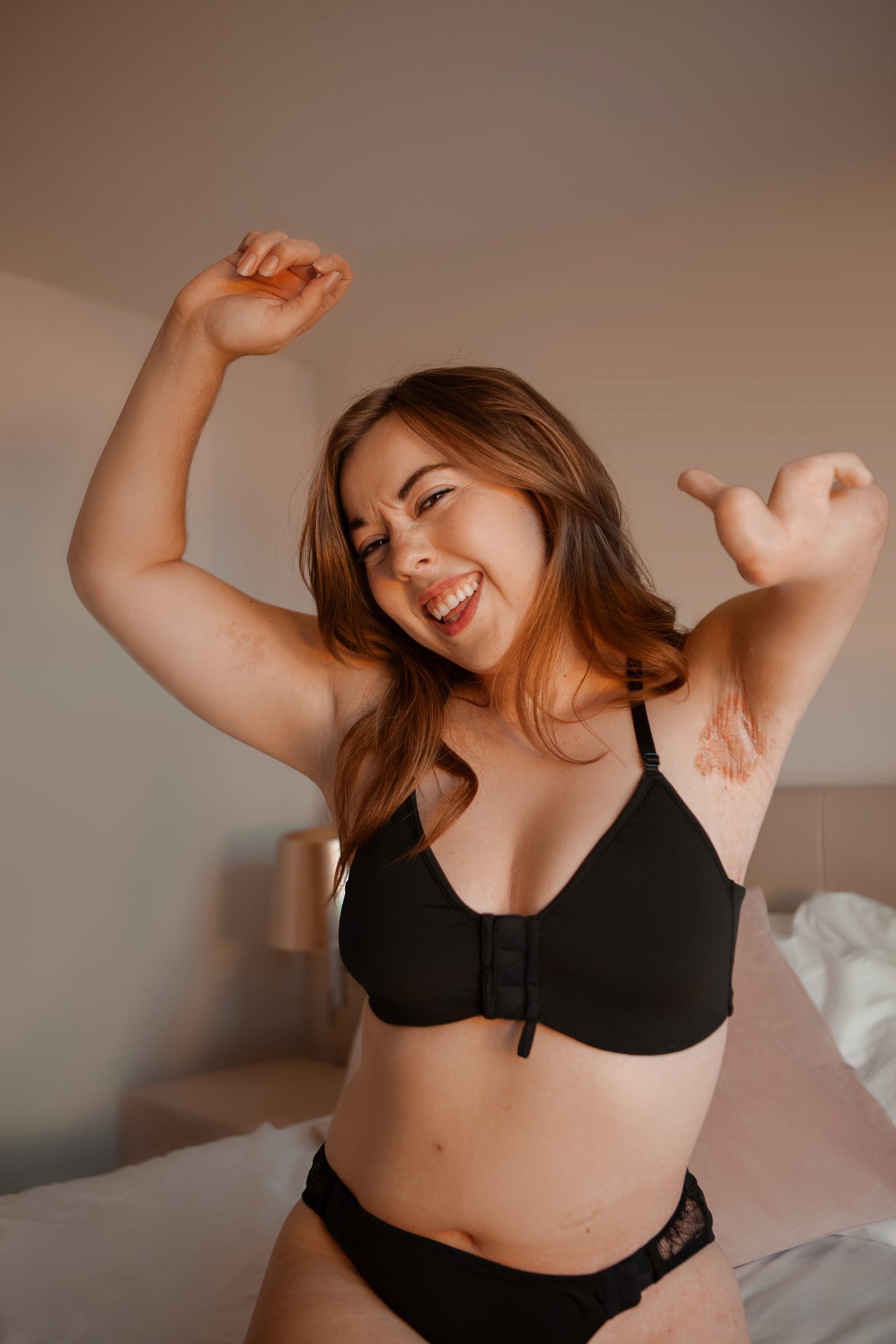
Liberare’s 19-slide deck, which secured a $1M pre-seed round in 2021, focuses on the underserved adaptive apparel market. The company identifies a significant gap between functional but 'ugly' medical garments and mainstream fashion brands that ignore accessibility. By positioning itself as both a Direct-to-Consumer (DTC) brand and a B2B licensing partner for major fashion labels, Liberare aims to capture a beachhead market of 18 million women with substantial disabilities. The deck emphasizes community-led product development and non-traditional acquisition channels, such as partnerships wit…
Key takeaways
- The deck identifies a total addressable market of over 1 billion women with disabilities, including 600 million who struggle with dressing daily (Slide 6).
- Liberare defines its beachhead market as 18 million women with substantial disabilities and discretionary income in target markets (Slide 6).
- The business model is bifurcated into DTC (own brand) and B2B (licensing technology to major fashion brands) (Slide 4).
- Product development is driven by a proprietary app that serves as a forum for the disabled community to discuss sex, beauty, and product needs (Slide 5).
- Customer acquisition strategy bypasses traditional Instagram-only methods in favor of medical partnerships with hospitals and OT/PT professionals (Slide 10).
- The competitive landscape slide positions Liberare as the only player bridging the gap between large-scale fashion and the disability market (Slide 9).
- The deck omits a formal 'Ask' slide detailing the specific use of the $1M raised in 2021.
- Founder Emma Butler’s personal connection to the problem—her mother’s struggle with clothes after becoming disabled—serves as the primary origin story (Slide 3).
The Mission-Driven Approach to Adaptive Fashion
Liberare’s pitch deck is a masterclass in identifying a massive, overlooked market through the lens of empathy and functional design. Raising $1M in a pre-seed round in 2021, the company set out to solve a problem affecting 600 million women globally: the lack of fashionable, easy-to-wear undergarments for those with disabilities. The deck relies heavily on high-quality photography and clear market segmentation to prove that 'adaptive' does not have to mean 'medical.'
Slides 1-3: The Emotional Hook and Problem Statement
The deck opens with three slides of high-quality lifestyle photography. These images are critical because they immediately challenge the 'medical' stereotype of adaptive clothing. We see women in stylish black lingerie, including a woman in a wheelchair and a woman with visible scarring, looking confident and empowered. This sets the tone for the brand's aesthetic before a single word of business strategy is mentioned.
Slide 3 introduces the core problem. It states that 600 million women worldwide struggle to get dressed every day . The slide features screenshots of existing 'special needs' undergarments—plain, white, bulky items that the deck describes as 'ugly' and 'dehumanizing.' This contrast between the beautiful imagery of the first two slides and the clinical look of the current market options creates a powerful 'before and after' narrative. The slide also introduces founder Emma Butler, noting she saw this struggle firsthand with her mother, providing the necessary founder-market fit story.
Slide 4: The Multi-Channel Solution
Liberare does not view itself as just a clothing brand. Slide 4 outlines a two-pronged business model. First, Our Own Brand: DTC , which focuses on creating their own innovative and functional clothing. Second, Licensing to Other Brands: B2B . This is a significant strategic choice. By licensing their technology to 'big brands,' Liberare positions itself as an infrastructure play for the $1.5 trillion mainstream fashion market. The slide also mentions a 'one-stop-shop marketplace' where they will sell their own brand alongside curated small brands, suggesting an ambition to become the 'Amazon' or 'Sephora' of adaptive fashion.
Slide 5: The Pillars of Success
This slide breaks down the four requirements for a successful adaptive line. It moves from the 'what' to the 'how.' The pillars are:
Key Partnerships: Establishing relationships with physical therapists and hospitals. · New Constructs and Design: Redesigning how garments are put on and taken off. · New Fasteners: Developing closures that work for those with limited dexterity. · Direct Access to the Disabled Community: Launching a proprietary app for shopping and community discussion.
The mention of an app for 'sex, beauty, and confidence' discussions is a clever way to show investors they are building a sticky community, not just a transactional e-commerce site.
Slide 6: TAM and Market Segmentation
Market sizing is often where pitch decks lose credibility, but Liberare uses a tiered approach that feels grounded. They cite 18M as their 'Beachhead Market,' specifically women with substantial disabilities and discretionary income in target markets. They then scale up to 103M women who 'absolutely need' adaptive apparel, 600M whose disability affects their dress, and finally 1B+ to include the aging population (350M women 65+) and those with temporary injuries. This slide successfully argues that the market is both immediate and expandable.
Slide 8: Defining Adaptive Apparel
Slide 8 serves as an educational tool for investors who may not be familiar with the category. It defines adaptive apparel as 'clothing that is easy to put on for people with mobility & dexterity issues.' The slide uses a collage of images, including a man using a prosthetic hand to button a shirt and a woman in a wheelchair, to illustrate the functional necessity of the product. This reinforces the 'functional' aspect of their 'fashionable and functional' promise.
Slide 9: The Competitive Landscape
The 'Magic Quadrant' slide (Slide 9) is a standard pitch deck staple, but here it is used to highlight a massive void. The Y-axis measures 'serves disability market' and the X-axis measures 'large scale fashion.' Liberare places competitors like Silverts and Buck and Buck in the top-left (serves disability, but small/not fashionable). Mainstream brands are in the bottom-right (large scale, but don't serve the disability market). Liberare places itself in the top-right, claiming to be the only entity bringing 'technology, functionality and disabled market to the big fashion labels.'
Slide 10: Customer Acquisition Strategy
Slide 10, titled 'Disabled Customer Acquisition,' is one of the most practical slides in the deck. It moves away from generic 'social media marketing' to specific, high-intent channels. The four quadrants are:
Disabled Influencers: Leveraging existing voices in the community. · Online Community on Liberare App: Owned audience. · Partnerships with Disability Organizations: Trust-based acquisition. · Partnerships with Hospitals, OT, PT and Medical Device Companies: Point-of-need acquisition.
This multi-faceted approach shows a deep understanding of the customer journey, recognizing that the first place a person looks for help after a disability diagnosis is often a medical professional, not a fashion blog.
Slide 19: Contact and Founder Info
The final slide provides contact information for Emma Butler, CEO and Founder, based in Paris, France. While the publisher reports the company raised $1M in 2021, the deck itself is surprisingly light on the 'Ask.' There is no slide detailing the round size, valuation, or use of funds in the provided materials. This suggests that this version of the deck may have been a 'teaser' or a 'storytelling' deck used to secure initial meetings rather than the final diligence deck.
What Liberare Does Well
The deck’s greatest strength is its visual storytelling . By using high-end fashion photography, they immediately elevate the category of adaptive apparel. They successfully frame the disability market not as a niche medical segment, but as a massive, underserved consumer group with discretionary income. The bifurcated business model (DTC + B2B Licensing) is also a strong move, as it suggests multiple paths to an exit and a way to scale without the massive overhead of a global retail footprint.
What is Missing from the Deck
Despite the successful raise, the deck has several glaring omissions that a founder should be aware of:
Unit Economics: There is no mention of the cost to manufacture, the retail price point, or the expected Customer Acquisition Cost (CAC). For a physical goods company, these numbers are vital. · The Ask: As noted, the deck does not state how much money is being raised or how it will be spent. · Team Slide: While the founder is mentioned, a robust team slide showing expertise in garment manufacturing, logistics, or medical technology would have strengthened the 'New Fasteners' and 'New Constructs' claims. · Traction: There are no sales figures, waitlist numbers, or app engagement metrics. Even at the pre-seed stage, showing early interest (e.g., '5,000 women on the waitlist') helps de-risk the investment.
Founder Takeaways
Use imagery to shift perception. If you are working in a 'boring' or 'clinical' industry, use your first few slides to show the aspirational version of your product. Liberare proved that adaptive clothing could be sexy, which likely helped investors see the brand's potential to go viral on social media.
Segment your TAM. Don't just throw out a multi-billion dollar number. Break it down into a 'Beachhead' (who you serve today) and 'Expansion' (who you serve tomorrow). This shows you have a realistic go-to-market strategy.
Think beyond Facebook ads. Liberare’s plan to partner with Occupational Therapists (OT) and Physical Therapists (PT) is a brilliant way to find customers at the exact moment they need the product. Founders should look for these 'high-intent' offline partnerships to supplement their digital marketing.
Frequently asked questions
- What is Liberare's primary value proposition?
- Liberare creates functional and fashionable adaptive apparel for women with disabilities. The deck argues that existing options are either 'ugly' medical garments or mainstream fashion that is impossible to put on for those with limited mobility. Their solution combines new fasteners and constructs with a high-fashion aesthetic, moving away from the 'dehumanizing' experience of shopping for medical-grade undergarments.
- How does Liberare plan to scale beyond its own brand?
- The company employs a B2B licensing strategy. According to slide 4, they intend to license their adaptive technology to 'big brands,' allowing those mainstream labels to capture the disability market efficiently. This turns Liberare into a technology provider and a curated marketplace for other small adaptive brands, rather than just a standalone apparel line.
- What unique acquisition channels does the deck highlight?
- Unlike typical DTC brands that rely heavily on social media ads, Liberare targets 'Key Partnerships' on slide 5. They focus on physical therapists, hospitals, and disability foundations. Slide 10 further details an acquisition mix of disabled influencers, an online community app, and medical device companies, recognizing that their target audience often interacts with these entities before searching for apparel.
- How does the deck define its market size?
- Slide 6 uses a concentric circle diagram to show market tiers: an 18M beachhead market of women with substantial disabilities and discretionary income, a 103M group who 'absolutely need' adaptive apparel, and a 1B+ total market that includes women 65+ and those with temporary post-surgery mobility issues.
- What is missing from the Liberare pitch deck?
- The deck is notably missing a slide on unit economics (CAC, LTV, margins) and a detailed financial forecast. It also lacks a specific 'Ask' slide that breaks down how the $1M pre-seed funding will be allocated across hiring, inventory, or R&D. While the team is mentioned, there is no detailed 'Team' slide highlighting the specific backgrounds of co-founders or advisors beyond the CEO.